Sponsored

Maximizing Battery Life

chrisakz

Well-Known Member
First Name
Chris
Joined
Mar 3, 2022
Threads
0
Messages
162
Reaction score
248
Location
North Jersey
Vehicle(s)
2019 Magnetic Supercab XLT FX4
- putting the electrical system into sleep mode and the Ford Pass alerts
I have never registered for Ford Pass and battery should stay optimally charged, so Not Needed
I don’t use it much but my FordPass app still works with BMS deactivated. Lock, unlock, remote start, vehicle alerts, GPS vehicle location, oil life and TPMS readings all work and stay up to date.

im not sure if it’s any different with the BMS unplugged vs deactivated. Perhaps the truck will see it as a”problem” with the BMS unplugged and shut certain things down?
Sponsored

 

got3fords

Well-Known Member
First Name
James
Joined
Apr 12, 2021
Threads
131
Messages
5,368
Reaction score
14,013
Location
22973
Vehicle(s)
2026 Marsh Gray Ranger Raptor, 1995 Harley XLH1200
Occupation
Mom Joke Professional
Good for you. It is a simple install. I used 2 zip ties to secure mine to the anti brake module by the firewall. I connected the Desulfator terminals directly to the battery posts by passing the BMS module. Don't disconnect your battery when you install it.

I ran my big BatteryMinder Desulfating charger on my Ranger battery and brought to almost as good at the one in my 4G Ranger that has never not had it doing its thing. Took it just over 2 weeks to get there, but I am now seeing 780 CCA from that battery with a 2.9 Ohm resistance. I am happily surprised that I got it back to that level.

I then watched both Rangers closely for a couple of days and found the 5G Ranger was not charging high enough to keep the desulfator active while the truck was running for 75%-80% of the time.

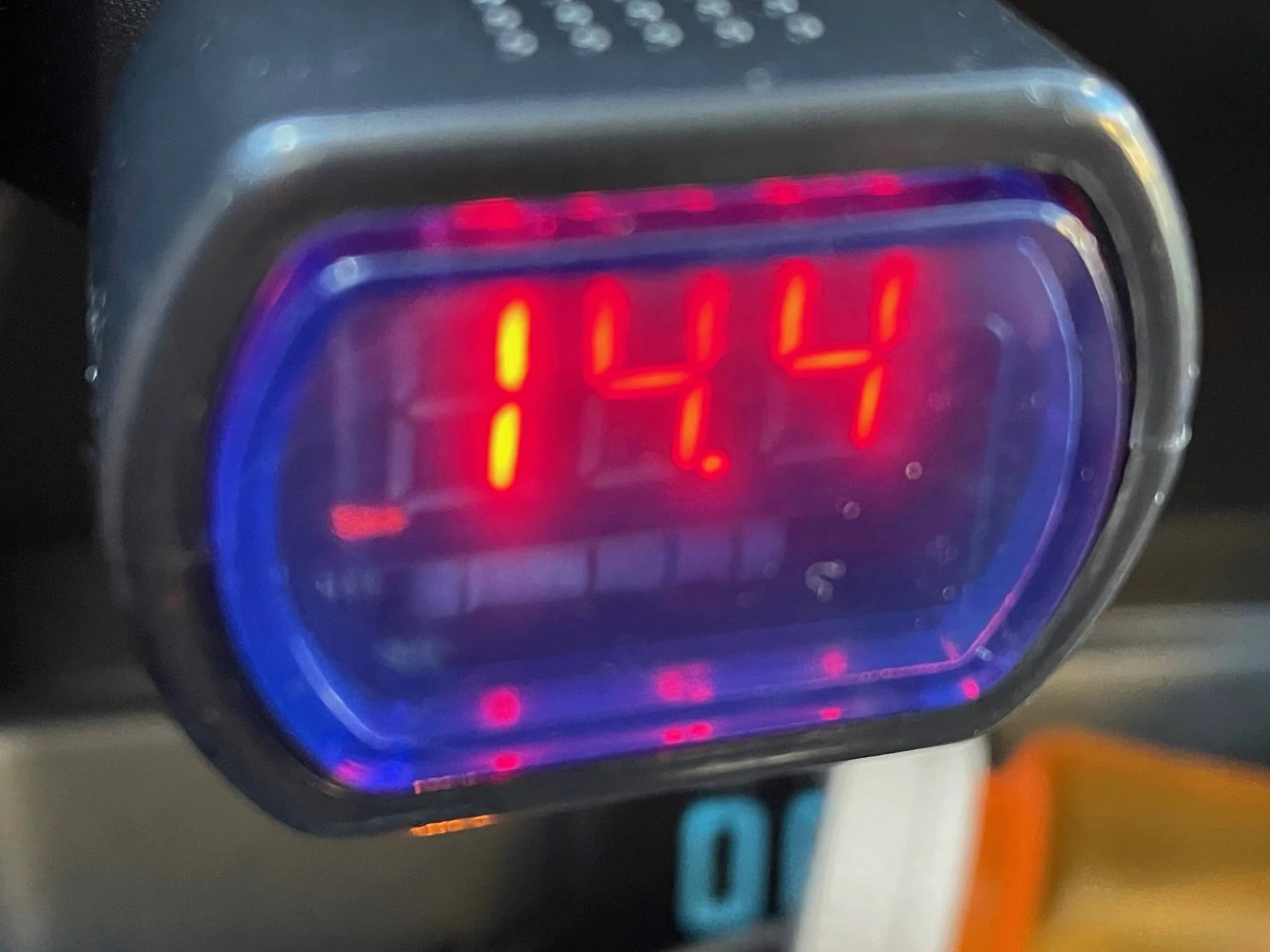
I pulled the BMS sensor cable and have been monitoring my charge voltage constantly since. It never breaks 14.1 volts (usually 14.0v to 14.1v) , which is exactly where my 4G Ranger settles down to once it recovers from the starter / startup of the engine (it is at 14.5V for about 15 miles, then drops to 14.1v - 14.2v).

So I am running without the BMS system. I would rather my battery last 7-9 years without BMS, then last on 20-30 months with BMS turned on.

The voltage in the cab is 0.2v lower than at the battery posts in the 5G Ranger. It is identical in the 4G Ranger. So I see 13.8v - 13.9v in the cab when driving.

I'd be interested to see what voltage you are seeing with BMS disconnected. I've read reports from others that see the same readings as my 4G in their 5G with BMS disconnected.

Best of Luck.
According to my plug-in meter in the 12v outlet in the cab I hardly even see less than 13V and is most often 14-14.8V. I'll check it at the battery when I install the desulfator, but I don't want to disconnect the BMS. Sounds like your truck is just plain running differently.
 

AzScorpion

Moderator
First Name
Dave
Joined
Jul 25, 2019
Threads
340
Messages
26,776
Reaction score
135,237
Location
Back Home In AZ!
Vehicle(s)
2023 Ford Ranger Tremor
Occupation
Retired...Full Time Slacker
According to my plug-in meter in the 12v outlet in the cab I hardly even see less than 13V and is most often 14-14.8V. I'll check it at the battery when I install the desulfator, but I don't want to disconnect the BMS. Sounds like your truck is just plain running differently.
That's right about where mine is all the time too. Since getting the new battery 2+ years ago I've always had it on the maintainer 3-4 days a week and so far it seems to have helped.

IMG_8207.webp
 

got3fords

Well-Known Member
First Name
James
Joined
Apr 12, 2021
Threads
131
Messages
5,368
Reaction score
14,013
Location
22973
Vehicle(s)
2026 Marsh Gray Ranger Raptor, 1995 Harley XLH1200
Occupation
Mom Joke Professional
That's right about where mine is all the time too. Since getting the new battery 2+ years ago I've always had it on the maintainer 3-4 days a week and so far it seems to have helped.

IMG_8207.jpg
I don't have the option of putting it on the maintainer. I would have to run an extension cord out to the yard or driveway. Or get a solar powered one. We'll see how the desulfator works.
 

AzScorpion

Moderator
First Name
Dave
Joined
Jul 25, 2019
Threads
340
Messages
26,776
Reaction score
135,237
Location
Back Home In AZ!
Vehicle(s)
2023 Ford Ranger Tremor
Occupation
Retired...Full Time Slacker
I don't have the option of putting it on the maintainer. I would have to run an extension cord out to the yard or driveway. Or get a solar powered one. We'll see how the desulfator works.
It seems to be working for you so hopefully you won't need to hook it up to a maintainer now. I know that David @subquark has his hooked up outside so if you have a spot. that doesn't interfere with anything (someone tripping over it lol) you could always do that too.


OP
OP

TJC

Well-Known Member
First Name
Tony
Joined
Aug 28, 2020
Threads
46
Messages
3,978
Reaction score
10,030
Location
North Carolina
Vehicle(s)
93 Miata, 05 Ranger 4x4, 20 Ranger 4x4, 23 CX-5
According to my plug-in meter in the 12v outlet in the cab I hardly even see less than 13V and is most often 14-14.8V. I'll check it at the battery when I install the desulfator, but I don't want to disconnect the BMS. Sounds like your truck is just plain running differently.
I have a feeling that if I had tested the battery before the desulfation process, my battery charge voltages would have been inline with what everyone else are reporting - much higher due to double/triple internal resistance in the battery. As battery resistance drops so does the necessary charge voltage. I think that is part of the aging battery algorithm used in the BMS.

With the BMS active, I saw high 14.5v readings when off throttle, but low to mid 12v when I added any throttle. This on an optimally charged and desulfated battery (a 2 week process with desulfator running 24/7). Desulfator only triggers at or above the 13.5V threshold, which in effect means only on off throttle conditions - probably about 20%-30% of the time if BMS is active. !00% of the time when BMS is turned off.

Make an informed decision. Test it for yourself. Unplugging the BMS sensor for a test or two will not affect anything. I am lucky in that I had my old 4G Ranger still around for comparison purposes. It still has conventional charging not affected by EPA/CAFE initiatives.

The battery in the 4G is very healthy. And I see higher initial voltages in the 4G than in the 5G with BMS sensor unplugged, but after 10-15 miles the charge levels of both trucks are within 0.1v of each other. So I have no fear of cooking the 5G battery. Steady state charge rates are identical in both the 4G and the (BMSless) 5G. Initial charging rates are .4v higher in the 4G.
 
Last edited:

airline tech

Well-Known Member
Joined
Aug 24, 2022
Threads
28
Messages
4,499
Reaction score
8,592
Location
Midwest - KS
Vehicle(s)
2022 Ranger Lariat-Super Crew, Cactus Gray
Occupation
Aircraft Tech
Good to hear you have a solution, only long-term monitoring will tell. (For Battery Temp), that would be my only concern. Once the warmer weather comes, I plan on revisiting my test and actually monitor Battery Temp while driving in the higher SOC ranges, just to satisfy my curiosity in raising the SOC, what effect does it have on the battery (Temp Wise) and compare Factory setting vs 80-90 percent. I feel that since the AGM battery specs state that a lower charging voltage is recommended above 80% SOC and other Ford platforms use 80%, this would be my focus setting over factory, and it appears Ford only lowered the Ranger settings to make Mahogony Row happy and to make the fuel numbers better by (A small percentage)

Keep in mind this is my first experience with smart charging and AGM batteries, so I am learning myself, I don't like it either, why change something that has worked flawless for years and over complicate it.

As far as the BMS shutting things down, only by description and other owners' issues has it been noted that if a BMS recalibration, has not been performed within 7 days, it will shut certain features down. I have yet to confirm what the trigger voltage is, but I believe it's 11.5 volts. If and when I get anything showing an issue, I will get a confirmed voltage reading.
So far, I have only seen the Deep Sleep notification (1) time, but it was before I invested in my voltmeter, so I have no idea what the battery voltage was.
 

got3fords

Well-Known Member
First Name
James
Joined
Apr 12, 2021
Threads
131
Messages
5,368
Reaction score
14,013
Location
22973
Vehicle(s)
2026 Marsh Gray Ranger Raptor, 1995 Harley XLH1200
Occupation
Mom Joke Professional
I have a feeling that if I had tested the battery before the desulfation process, my battery charge voltages would have been inline with what everyone else are reporting - much higher due to double/triple internal resistance in the battery. As battery resistance drops so does the necessary charge voltage. I think that is part of the aging battery algorithm used in the BMS.

With the BMS active, I saw high 14.5v readings when off throttle, but low to mid 12v when I added any throttle. This on an optimally charged and desulfated battery (a 2 week process with desulfator running 24/7). Desulfator only triggers at or above the 13.5V threshold, which in effect means only on off throttle conditions - probably about 20%-30% of the time if BMS is active. !00% of the time when BMS is turned off.

Make an informed decision. Test it for yourself. Unplugging the BMS sensor for a test or two will not affect anything. I am lucky in that I had my old 4G Ranger still around for comparison purposes. It still has conventional charging nat affected by EPA/CAFE initiatives.

The battery in the 4G is very healthy. And I see higher initial voltages in the 4G than in the 5G with BMS sensor unplugged, but after 10-15 miles the charge levels of both trucks are within 0.1v of each other. So I have no fear of cooking the 5G battery. Steady state charge rates are identical in both the 4G and the (BMSless) 5G. Initial charging rates are .4v higher in the 4G.
Once you are confident you have revived the battery, are you going to reconnect the BMS?
 

got3fords

Well-Known Member
First Name
James
Joined
Apr 12, 2021
Threads
131
Messages
5,368
Reaction score
14,013
Location
22973
Vehicle(s)
2026 Marsh Gray Ranger Raptor, 1995 Harley XLH1200
Occupation
Mom Joke Professional
As far as the BMS shutting things down, only by description and other owners' issues has it been noted that if a BMS recalibration, has not been performed within 7 days, it will shut certain features down. I have yet to confirm what the trigger voltage is, but I believe it's 11.5 volts. If and when I get anything showing an issue, I will get a confirmed voltage reading.
I assume people who have a night light plugged into the 120V outlet to keep the ASS off are preventing the BMS recal. Or does the 120V outlet time out after a while?
 
OP
OP

TJC

Well-Known Member
First Name
Tony
Joined
Aug 28, 2020
Threads
46
Messages
3,978
Reaction score
10,030
Location
North Carolina
Vehicle(s)
93 Miata, 05 Ranger 4x4, 20 Ranger 4x4, 23 CX-5
Airline Tech, I appreciate all your investigative work. You gave me insight into the system that I had no idea existed. Thank You!

I kinda took the path of least resistance. I know my 4G doesn't eat AGM batteries so I used it as my baseline target. It gets very hot here in central NC, 90F+ with 90+ humidity for 2 or 3 months during summer, and my 4G has performed well with the desulfator installed.

I am still mildly surprised at the voltage levels I saw after unplugging the BMS sensor, but I am also confident that my battery will not boil over if those charging voltages stay consistent.

My LED Voltage reader from Amazon reads accurate, and appears to be the same one that AZScorpion is using. I get 13.8v-13.9v readings from it in the 5G. But as I mentioned previously, that is 0.2v less than I measure at the battery posts. So I have added 0.2v to my notes here.

I honestly believe that the BMS is less than kind to our batteries, and it has resulted in shortened battery life. I know that the 4G and 5G are different beasts. But the batteries are the same AGM technology, and require the same charging parameters to optimize health.

The 4G with the BM desulfator installed has worked very well for me for years now. I have them installed 3 different vehicles and all of them the battery life is more than doubled... 7-9 years, usually 9. The one that died at 7 years was due to an alternator failure on a road trip on Christmas eve, where I had to drive 135 miles on the battery alone. I barely made my destination! That optima yellow top battery was severely drained! It recovered and lasted another 2 years, but it was never the same.
 
Last edited:
OP
OP

TJC

Well-Known Member
First Name
Tony
Joined
Aug 28, 2020
Threads
46
Messages
3,978
Reaction score
10,030
Location
North Carolina
Vehicle(s)
93 Miata, 05 Ranger 4x4, 20 Ranger 4x4, 23 CX-5
Once you are confident you have revived the battery, are you going to reconnect the BMS?
No. I am confident that the battery is much stronger than when I purchased the truck, and the desulfator will continue to do its work - optimizing it further as I drive. It was last at 766 CCA after resting 24 hours in the 5G. FWIW, I have never disconnected the battery from the truck, so this is with parasitic dark current drains over night.
 

dtech

Well-Known Member
Joined
May 10, 2020
Threads
39
Messages
3,152
Reaction score
7,660
Location
colorado
Vehicle(s)
Ranger Lariat FX4, chromed and forever damperless
Cut the cord, it's a growing trend 1.5 yrs here. The info from TJC regards the lower voltage suggests that the default (traditional) charging system does lower the voltage when the battery SOC is maintained at a high level, that's good news for cord cutters.
 
OP
OP

TJC

Well-Known Member
First Name
Tony
Joined
Aug 28, 2020
Threads
46
Messages
3,978
Reaction score
10,030
Location
North Carolina
Vehicle(s)
93 Miata, 05 Ranger 4x4, 20 Ranger 4x4, 23 CX-5
Cut the cord, it's a growing trend 1.5 yrs here. The info from TJC regards the lower voltage suggests that the default (traditional) charging system does lower the voltage when the battery SOC is maintained at a high level, that's good news for cord cutters.
I will continue to monitor the CCA, Resistance, and Voltage on a weekly basis throughout the summer and into the fall. I don't intend to use a charger on the truck unless absolutely necessary. I'll report back about once a month unless something unexpected happens.
 
OP
OP

TJC

Well-Known Member
First Name
Tony
Joined
Aug 28, 2020
Threads
46
Messages
3,978
Reaction score
10,030
Location
North Carolina
Vehicle(s)
93 Miata, 05 Ranger 4x4, 20 Ranger 4x4, 23 CX-5
I also want to stress that there comes a point where a battery can be damaged beyond what a desulfator can correct.

Most modern chargers that I have used have a desulfate cycle, but don't stay in that cycle nearly long enough to make a difference. It takes 2 weeks or so on a desulfator to see big results.

Measure and watch the internal resistance. It has been my experience that it will trend down slowly, with some spike aberrations both ways on the way down. The battery in my 2020 Ranger started out at 8+ mOhms (measured after the first pass charge and 8 hours of desulfation). It is now just below 3 mOhms (after 2 weeks of 24/7 desulaftion).

My 4G battery is below 2.5 mOhms, and measures almost 1100 CCA on a consistent basis on a battery rated by the manufacturer for 750 CCA.

My 720 CCA FoMoCo battery in my 2020 Ranger is now measuring 770 CCA.

I am satisfied enough to take if off the full time desulfation cycle, and let the onboard desulfator continue to optimize the battery's condition when the truck is running.

IMO, letting the battery stay consistently at a 75% SOC is harmful over time.

While driving my truck after successfully charging the battery, I found that the BMS was actively lowering the SOC in my battery! In fact, when charging using Ford's procedure (with BMS active) attaching the charger's negative clamp to the negative ground cable before the BMS sensor, the voltage measured on the battery posts with the battery charger running would not exceed 12.5V!

When I connected directly to the battery posts bypassing the BMS sensor, charging voltage went to 13.5V. This test check was done after the battery had been on the charger for a while and the battery had reached the 70%-75% threshold. This leads me to believe that the BMS is active even when the truck is turned off.

The short of it is - I am not convinced the BMS is designed to maximize battery life.
 
Last edited:

JesseS

Well-Known Member
First Name
Jesse
Joined
May 26, 2021
Threads
19
Messages
1,755
Reaction score
4,824
Location
NorCal (Roseville)
Vehicle(s)
2021 Ranger XLT FX4, Jayco 26' Class A
Occupation
Retired, work is a four letter word.
AGM batteries are a whole different battery than the old school Lead Acid.
I want wholeheartedly to push that this is a viable option without any effects but the mechanic side of me needs proof through actual test results, not just do it and see what happens.
AGM (Absorbed Glass Matt) and Flooded LA batteries are basically the same, the only difference being AGM are maintenance free due to the electrolyte being absorbed and held in the glass matts between the lead plates, preventing much of the out gassing and any spillage. Charging rate and duration is based more on how large and thick the plates are and is also a factor in heating. I have set my SOC at 90% and keep the battery on a smart maintainer while parked for long periods, After 2 years its fine and I expect at least 5. AGM's have been around since the 80's so are not new.
Sponsored


Top