
Sponsored

Fuel in oil

Samsquanch

Well-Known Member
Joined
Mar 14, 2021
Threads
13
Messages
376
Reaction score
833
Location
Maryland
Vehicle(s)
2017 Expedition XLT
Interesting take at https://polarislabs.com/how-gasoline-engine-technology-affects-fuel-dilution/. I highlighted the part that seems to go against the idea that using higher viscosity oil helps mitigate dilution damage. Seems counterintuitive, and likely to be poo poo'd by some.

How much is acceptable?

While OEMs do not publish acceptable numbers, the common range used by most is that 3 - 7% can be acceptable as long as there is not a noticeable increase in wear or drop in lubricant viscosity. Most OEMs are using low viscosity oils that tend to be more tolerant of higher amounts of fuel.

Our laboratory will report fuel dilution by two methods. The first method will be an estimate based on the viscosity result. If the viscosity has not dropped further than one centistoke from the midpoint of the SAE grade identified for the sample, an estimate of <1% fuel will be reported. However, if the viscosity has dropped further than one centistoke, the sample is then tested for fuel dilution using Gas Chromatography (GC) method ASTM D7593 for an exact percentage of fuel. The unleaded gasoline fuel dilution method by GC is calibrated up to 5%. If the GC registers a result higher than 5%, a result of >5% will be reported. Exact percentages above 5% cannot be reported due to the calibration limits.
That sounds like a much more comprehensive approach than blackstone...
Sponsored


Trigganometry

Well-Known Member
First Name
Rick
Joined
Dec 4, 2020
Threads
153
Messages
5,833
Reaction score
25,359
Location
Massachusetts
Vehicle(s)
20 XLT scab 301A/tow 4X4 magnetic w/sport blackout
Occupation
Engineering
That sounds like a much more comprehensive approach than blackstone...
Thing to keep in mind here is there is no “accepted” industry method because there is more than one ASTM testing method. So each has its own end result that is a repeatable testing process.
 

GregsFX2Ranger

Well-Known Member
First Name
Greg
Joined
Mar 19, 2021
Threads
8
Messages
557
Reaction score
773
Location
Tennessee
Vehicle(s)
2021 XLT 302A 4x2 Rapid Red Black Appear Package
Occupation
Management
I'll let you know how much poo poo it is using higher viscosity oil when I send my 5/40 sample off at 3000 miles to Blackstone!
Yes, I am curious. I had thought about 5w-40 full synthetic being the oil on my first change after reading all of the thread.
 

GregsFX2Ranger

Well-Known Member
First Name
Greg
Joined
Mar 19, 2021
Threads
8
Messages
557
Reaction score
773
Location
Tennessee
Vehicle(s)
2021 XLT 302A 4x2 Rapid Red Black Appear Package
Occupation
Management
Why is it that Ford dealers(service departments) refuse to look at Blackstone analyses?
 

Samsquanch

Well-Known Member
Joined
Mar 14, 2021
Threads
13
Messages
376
Reaction score
833
Location
Maryland
Vehicle(s)
2017 Expedition XLT
Why is it that Ford dealers(service departments) refuse to look at Blackstone analyses?
I have a feeling that the dealerships don’t know what to do to resolve the issue. Some have replaced the injectors but has it actually fixed the problem? My conspiracy theory is that the frequent priming of the engine is somehow involved. I have had 4 modern turbo charged engines and several have been GDI. I have a 3.5 EB in my driveway that never audibly primes the fuel pump. I have heard my ranger prime many times when it’s just sitting there. Also, does it truly need to prime every time you open the door or is that some engineers bright idea that isn’t really necessary? Makes you wonder since other Fords don’t have the reported priming behaviors that the ranger have. Additionally my understanding is that fuel dilution isn’t as prevalent on any of the other 2.3 applications so what is different. I am thinking it’s software and Ford is basically ignoring it or doing something quietly that we will hear about later.


jblc

Well-Known Member
First Name
JB
Joined
Nov 15, 2020
Threads
75
Messages
749
Reaction score
644
Location
USA
Vehicle(s)
2021 XLT FX2 supercab
Also, does it truly need to prime every time you open the door or is that some engineers bright idea that isn’t really necessary?
Firstly: i would also want to disable that priming, but am not sure if there's a problem turning it off.
Phil or others could probably advise; i'll start another thread on that.

Second: since there wasn't (that i could tell) a way to disable that feature, perhaps we could disconnect the door sensors. I have another similar issue Sync3 turning booting when the passenger door is opened, which is pointless (for me).

Disconnecting door sensors would admittedly cause problems with logic of the truck (weight on seat, then door opens, etc, means someone's leaving) and the open door indicator, but could be worth an experiment.
 

Langwilliams

Well-Known Member
First Name
Langley
Joined
Dec 31, 2019
Threads
26
Messages
3,204
Reaction score
7,503
Location
Lorain, Ohio
Vehicle(s)
2019 Ford Ranger XLT, 2014 Harley Street Glide
Occupation
Mail Carrier (retired) Navy Vet
Wouldn't there be a software update to reduce the fuel pump priming? Only when the drivers door is unlocked or opened would make sense.
 

Texasota

Well-Known Member
First Name
Al
Joined
Jan 27, 2019
Threads
1
Messages
1,035
Reaction score
3,495
Location
Rochester, MN
Vehicle(s)
2026 Ranger XLT, 2023 Escape PHEV
Interesting take at https://polarislabs.com/how-gasoline-engine-technology-affects-fuel-dilution/. I highlighted the part that seems to go against the idea that using higher viscosity oil helps mitigate dilution damage. Seems counterintuitive, and likely to be poo poo'd by some.

How much is acceptable?

While OEMs do not publish acceptable numbers, the common range used by most is that 3 - 7% can be acceptable as long as there is not a noticeable increase in wear or drop in lubricant viscosity. Most OEMs are using low viscosity oils that tend to be more tolerant of higher amounts of fuel.

Our laboratory will report fuel dilution by two methods. The first method will be an estimate based on the viscosity result. If the viscosity has not dropped further than one centistoke from the midpoint of the SAE grade identified for the sample, an estimate of <1% fuel will be reported. However, if the viscosity has dropped further than one centistoke, the sample is then tested for fuel dilution using Gas Chromatography (GC) method ASTM D7593 for an exact percentage of fuel. The unleaded gasoline fuel dilution method by GC is calibrated up to 5%. If the GC registers a result higher than 5%, a result of >5% will be reported. Exact percentages above 5% cannot be reported due to the calibration limits.
Thanks for posting, Bob. That was an interesting read. They also said this:

What do you need to watch?
Higher percentages of fuel dilution are not ideal as fuel does not have the same lubricating properties of oil and can lead to early wear. Monitoring wear metals becomes paramount to determining if the oil is maintaining the proper lubricant film. You will also want to monitor the lubricant viscosity as well as the other lubricant properties such as base number, oxidation and nitration. If the wear metals are increasing and the viscosity is decreasing, reducing the interval time or increasing the viscosity of the oil may be recommended.
I will be patiently waiting to hear Jim's next test results with the 5W40.
 

Trigganometry

Well-Known Member
First Name
Rick
Joined
Dec 4, 2020
Threads
153
Messages
5,833
Reaction score
25,359
Location
Massachusetts
Vehicle(s)
20 XLT scab 301A/tow 4X4 magnetic w/sport blackout
Occupation
Engineering
Has anyone confirmed that the sounds from the truck when off is actually the fuel pump priming?
When my XLT was stock you could definitely hear it priming randomly. After I put on the collector engine cover it’s barely noticeable now. Now my hearing isn’t all that great anymore so your mileage may vary
 

Samsquanch

Well-Known Member
Joined
Mar 14, 2021
Threads
13
Messages
376
Reaction score
833
Location
Maryland
Vehicle(s)
2017 Expedition XLT
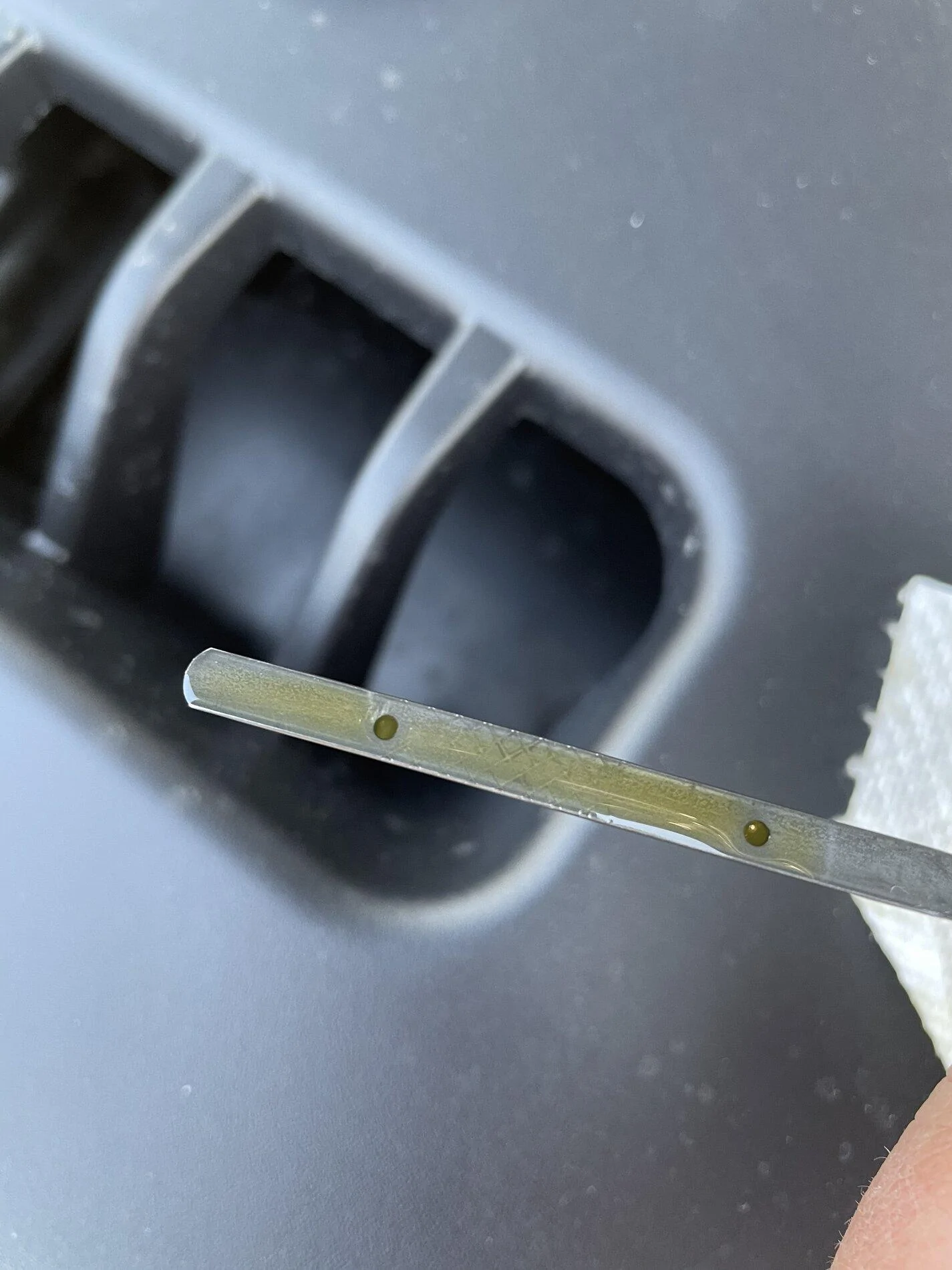
Well posting in this thread reminded me to go check my oil. It absolutely reeks like fuel. You can smell it as soon as I pull the dipstick it stinks up the garage. With only 568 miles on my truck this is my oil level. I’m calling the dealership tomorrow. Very frustrated that I’m dealing with this on a brand new vehicle.

C245EFA9-718F-4EA4-BB21-7C4A99EBC35F.webp
 

GregsFX2Ranger

Well-Known Member
First Name
Greg
Joined
Mar 19, 2021
Threads
8
Messages
557
Reaction score
773
Location
Tennessee
Vehicle(s)
2021 XLT 302A 4x2 Rapid Red Black Appear Package
Occupation
Management
Well posting in this thread reminded me to go check my oil. It absolutely reeks like fuel. You can smell it as soon as I pull the dipstick it stinks up the garage. With only 568 miles on my truck this is my oil level. I’m calling the dealership tomorrow. Very frustrated that I’m dealing with this on a brand new vehicle.

C245EFA9-718F-4EA4-BB21-7C4A99EBC35F.jpeg
That is what my level looks like, slightly over. Luckily, I haven't smelled gas in the oil.. I have about 350 miles so far.
 

the5Gmartian

Well-Known Member
First Name
Jesse
Joined
May 29, 2020
Threads
20
Messages
413
Reaction score
1,151
Location
Washington, D.C.
Vehicle(s)
2020 Ford Ranger Lariat FX4
Occupation
U.S. Navy
Mine definitely had a strong odor when I pulled the dipstick out, but the dipstick looked fine and the truck runs great. Running Mobil 1 full synthetic. Not too worried honestly, but I'll be keeping an eye on this thread
 

parkranger

Active Member
First Name
Robert
Joined
Apr 24, 2020
Threads
3
Messages
41
Reaction score
114
Location
maine
Vehicle(s)
2019 Ranger XL STX super crew
Occupation
Locksmith
Has anyone confirmed that the sounds from the truck when off is actually the fuel pump priming?
I have wondered this as well. I definitely hear an electronic whirring sound from what sounds like the passenger fender or firewall area. Definitely when I open the door, and other random times as well.

So there's the in-tank fuel pump (is this somehow making the priming sound WAY up in the front?), the mechanical HPFP, and then, so is there yet a third priming pump in the engine bay making these sounds?

Forscan shows my fuel rail pressure immediately start rising after turning off the engine and turning the key back on to keep the live data streaming. The pressure was 10 times what it was reading at idle after sitting for roughly 10 minutes.

I understand this is normal, (after freaking out and searching on Google) but can someone please explain why the fuel system needs priming at all if the pressure is not relived when the motor is turned off?
 

2ford

Banned
Banned
Joined
Jan 14, 2020
Threads
2
Messages
104
Reaction score
104
Location
Oregon
Vehicle(s)
19 ranger
Wouldn't there be a software update to reduce the fuel pump priming? Only when the drivers door is unlocked or opened would make sense.
How about after the driver door is closed and a foot on the brake pedal to initiate the prime.
Sponsored


Top