Sponsored

Maximizing Battery Life

IdahoRanger

Well-Known Member
First Name
Steve
Joined
Sep 26, 2019
Threads
12
Messages
4,349
Reaction score
21,612
Location
Idaho
Vehicle(s)
2019 Lariat SuperCrew FX4
Occupation
RETIRED
Thanks all for the quick responses. Yes, I tested fairly soon after the charge.
Sponsored

 

got3fords

Well-Known Member
First Name
James
Joined
Apr 12, 2021
Threads
131
Messages
5,344
Reaction score
13,905
Location
22973
Vehicle(s)
2026 Marsh Gray Ranger Raptor, 1995 Harley XLH1200
Occupation
Mom Joke Professional
I tested mine the other day. It had been quite a while since I tested it. It had sat at least 2 days. I had popped the hood and let it sit for at least another hour. I can never remember which type battery to select (there are more than on glass mat selections). I just happened to look on the back of the tester where it lists all the abbreviations and what they mean. There is a selection for SSA for start/stop dedicated AGM.
Anyhoo, I don't remember the other parameters but the IR was upper 3'sΩ. I always do it multiple times because every result is different, so I note the best.
 

IdahoRanger

Well-Known Member
First Name
Steve
Joined
Sep 26, 2019
Threads
12
Messages
4,349
Reaction score
21,612
Location
Idaho
Vehicle(s)
2019 Lariat SuperCrew FX4
Occupation
RETIRED
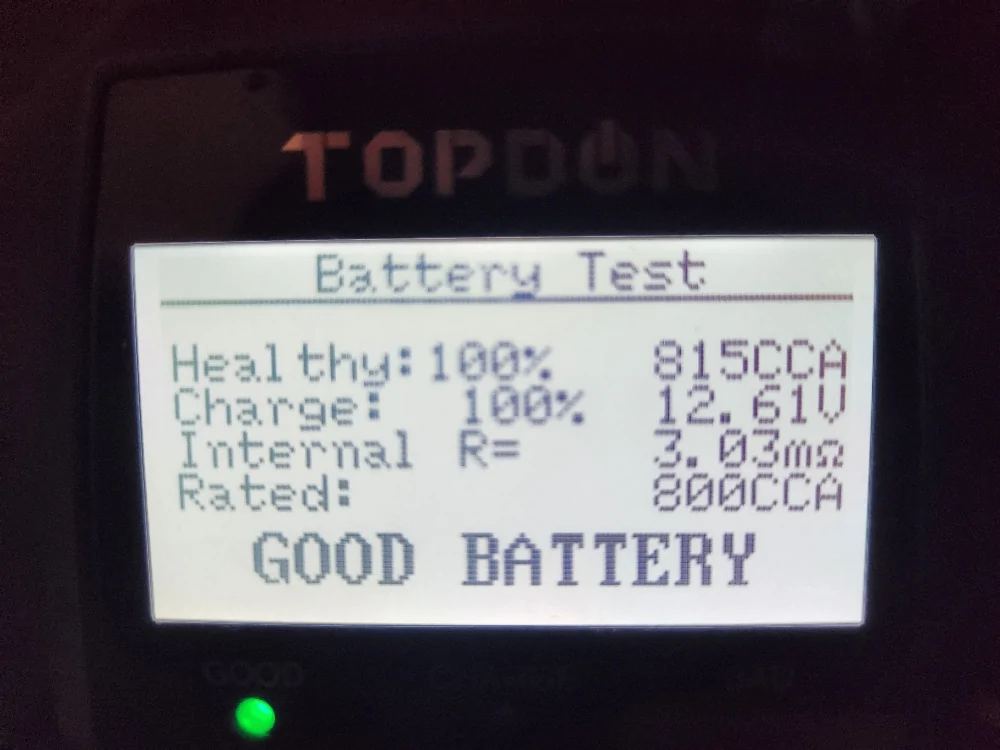
So I charged up the battery yesterday and ran a test (12 hours later) this morning. Pretty happy with the results.

battery 93025.webp
 
OP
OP

TJC

Well-Known Member
First Name
Tony
Joined
Aug 28, 2020
Threads
45
Messages
3,965
Reaction score
9,991
Location
North Carolina
Vehicle(s)
93 Miata, 05 Ranger 4x4, 20 Ranger 4x4, 23 CX-5
Yes - Flat Blade to push the hood latch (switch) down

Yes - Neg Cable, I even swapped it over to the Pos (Alt) Feed a few times to see if the reading matched.

For each test result - as the clamp timed out between tests- I pulled (zeroed) and reinstalled.

Normally I route my charging cable out a seam and close the hood. But the last few times I was lazy and simply left the hood up or unlatched.

Yesterday I used the charger to keep the battery charged while working with Forscan, and noticed that the power draw was significant.

I noticed that my 8 amp BatteryMinder charger was overheating trying to charge the battery! Too many systems were remaining active with the hood and doors open, with the ignition turned on but not running..

After making a few changes ( Raiding Battery SOC from 95% to 100%, and plugging the BMS sensor back in ) I buttoned up the truck, locked the hood latch, and reattached the charger.

This time around the charger went through it's 7 stage progression and I woke up this morning with a fully charged battery with my onboard Desulfator happily flashing as expected.

For optimal results when charging our Rangers, be sure to minimize the dark power draw. Turn off the headlights, (Off not Automatic) if the hood stays open flip the hood latch into the closed position, close the doors and wait a few minutes for systems to time out.... Then attach your charger and power it up.

It makes a big difference in how these smart chargers determine what to they need to do.
Hat tip to Airline Tech for the hood latch suggestion!

I also noticed a slight amount of corrosion under the negative battery terminal. Corrosion will increase resistance, which increases excessive heat and voltage drops. None of which are good and all will cause changes in the inputs to the BMS. The BMS will react incorrectly, thinking battery internal resistance is higher than it actually is and adjust its charging patterns accordingly. Keep the battery connections clean and tight!

I cleaned up the terminals with a water/baking soda mix, then used NOCO NCP2 Battery Corrosion Preventative to coat the connection. Brush on rather than spray. First time trying this product, but I expect solid results.
 
Last edited:


OP
OP

TJC

Well-Known Member
First Name
Tony
Joined
Aug 28, 2020
Threads
45
Messages
3,965
Reaction score
9,991
Location
North Carolina
Vehicle(s)
93 Miata, 05 Ranger 4x4, 20 Ranger 4x4, 23 CX-5
Purchased and installed a ScanGauge 3 to my Ranger. From an electrical perspective, I can now monitor in real time Battery SOC, Battery Voltage, and Battery Amps.

I also set the Battery SOC limit to 100% using Forscan. I also reconnected the BMS sensor and went for a nice long test drive several days ago. Battery charged to 100%, and I noticed that Ranger wasn't using engine braking nearly as much as before the changes.

Preliminary Observations
I then let the Ranger sit 2 days and checked battery status. SOC was at 96% So I seem to be losing 2% / day. zi did open the door a few times and I know that plays into battery drain significantly. After shutting the truck off I saw Battery Amps drop from +2 to -13.

I also was our before daylight this AM and drove 20 miles with the headlights on. SOC went up only 1%. Drove an additional 10 miles when lights off and SOC went up another 1%. Battery charging rates drop significantly when driving with the lights on.

The BMS charging system is at least smart enough to lower charge amperage as the battery nears 100% charge. I let the battery drop to 90% and noticed the AMP at 5-6. By the time SOC was at 97% the Amps had dropped to 2.

The ScanGauge 3 does report the voltage accurately. It reads 0.2v higher than the 12V plug voltage reader reports. MY VOM across the battery posts reads the same as the ScanGauge 3
 

dtech

Well-Known Member
Joined
May 10, 2020
Threads
39
Messages
3,143
Reaction score
7,614
Location
colorado
Vehicle(s)
Ranger Lariat FX4, chromed and forever damperless
The BMS charging system is at least smart enough to lower charge amperage as the battery nears 100% charge. I let the battery drop to 90% and noticed the AMP at 5-6. By the time SOC was at 97% the Amps had dropped to 2.
With the bms disconnected you should also see amperage drop relative to rising soc With the bms in play as the soc level ramps to 100%, the bms should be dropping the voltage as well, most modern smart chargers use 3 algorithm levels of charging , bulk , absorb and float. One of the supposed benefits of bms is to regulate the voltage charge levels to improve battery life by reducing sulfation, but as widely discussed allowing a lead acid battery to consistently charge to less than 100% promotes sulfation. I think periodic use of a desulfator is a more reliable way of maintaining battery health, as I think you may have stated yrs ago batteries would last much longer albeit with fixed voltage system, all one had to do was to check and maintain the cell water levels , parasitic draws were much less of an issue in days of yore.
 
OP
OP

TJC

Well-Known Member
First Name
Tony
Joined
Aug 28, 2020
Threads
45
Messages
3,965
Reaction score
9,991
Location
North Carolina
Vehicle(s)
93 Miata, 05 Ranger 4x4, 20 Ranger 4x4, 23 CX-5
With the bms disconnected you should also see amperage drop relative to rising soc With the bms in play as the soc level ramps to 100%, the bms should be dropping the voltage as well, most modern smart chargers use 3 algorithm levels of charging , bulk , absorb and float. One of the supposed benefits of bms is to regulate the voltage charge levels to improve battery life by reducing sulfation, but as widely discussed allowing a lead acid battery to consistently charge to less than 100% promotes sulfation. I think periodic use of a desulfator is a more reliable way of maintaining battery health, as I think you may have stated yrs ago batteries would last much longer albeit with fixed voltage system, all one had to do was to check and maintain the cell water levels , parasitic draws were much less of an issue in days of yore.
You are correct.

Voltage varied with both ( Sensor plugged and unplugged). Setting to 100% with ASS off in Forscan appears to be similar to unplugging the sensor. My measurement with the ScanGauge 3 is accurate at the battery posts. Charge rate is anywhere from 13.8v - 14.1v

I have not measured charge rate with a low battery yet... and don't want to discharge it to do the test. I like my battery in the 90%+ SOC range, as it keeps sulfation under control. It is currently at 98% SOC right now.

Quite pleased with the monitoring insight the ScanGauge offers. It was expensive though! I now have these monitoring functions set in my ScanGauge

Row 1
Coolant Temp.....Trans Fluid Temp.....Oil Pressure

Row 2
Battery SOC..........Battery Voltage.........Battery Amp

Row 3
Torque Conv Actual Slip.....Torque Conv Command Slip.....Gear

ScanGauge Support is excellent. I requested the PID code information to add the Torque Converter Slip Actual and Desired, and they had them to me within hours!
 

got3fords

Well-Known Member
First Name
James
Joined
Apr 12, 2021
Threads
131
Messages
5,344
Reaction score
13,905
Location
22973
Vehicle(s)
2026 Marsh Gray Ranger Raptor, 1995 Harley XLH1200
Occupation
Mom Joke Professional
Voltage varied with both ( Sensor plugged and unplugged). Setting to 100% with ASS off in Forscan appears to be similar to unplugging the sensor. My measurement with the ScanGauge 3 is accurate at the battery posts. Charge rate is anywhere from 13.8v - 14.1v
The only mod I have done, is add an onboard desulfator. My charge voltage ranges widely, day to day, morning to evening. And is quite frequently in the mid to upper 14's. Other times mid 13's, and anywhere in between. Still on original battery.
 

dtech

Well-Known Member
Joined
May 10, 2020
Threads
39
Messages
3,143
Reaction score
7,614
Location
colorado
Vehicle(s)
Ranger Lariat FX4, chromed and forever damperless
If you desire to see consistency in charge voltage disable the bms, otherwise expect to see varying levels impacted by the soc level you have selected as the batt is drawn down then max voltage supplied when vehicle momentum is powering the alternator , then reduced as the soc rises, accessory draw also has an impact.
 
OP
OP

TJC

Well-Known Member
First Name
Tony
Joined
Aug 28, 2020
Threads
45
Messages
3,965
Reaction score
9,991
Location
North Carolina
Vehicle(s)
93 Miata, 05 Ranger 4x4, 20 Ranger 4x4, 23 CX-5
If you turn off ASS and set SOC to 100% in Forscan, you can leave the BMS sensor plugged in and get excellent results. Just confirmed it tonight.

Left home after dark with battery SOC at 98% . Drove 20 miles to a store and 20 back. I watched Battery Amps drop steadily as SOC climbed to 100%. Previously I noted 5 Amp going into the battery at 95% SOC. Tonight Amps started out at 4 and dropped to 0 when the SOC hit 100%. Voltage remained steady at 13.9 to 14.1.

Upon starting the truck to come home. Amps spiked to 31, then dropped atfter 15 second to 16, then dropped to 3. Halfway home I hit 100% SOC and Amps dropped to 0. Essentially, a trickle voltage charge.

Quite pleased with the results.
 
Last edited:

got3fords

Well-Known Member
First Name
James
Joined
Apr 12, 2021
Threads
131
Messages
5,344
Reaction score
13,905
Location
22973
Vehicle(s)
2026 Marsh Gray Ranger Raptor, 1995 Harley XLH1200
Occupation
Mom Joke Professional
If you desire to see consistency in charge voltage disable the bms, otherwise expect to see varying levels impacted by the soc level you have selected as the batt is drawn down then max voltage supplied when vehicle momentum is powering the alternator , then reduced as the soc rises, accessory draw also has an impact.
I'm not too worried about it. Sometimes the regen charge works, sometimes it doesn't.
 
OP
OP

TJC

Well-Known Member
First Name
Tony
Joined
Aug 28, 2020
Threads
45
Messages
3,965
Reaction score
9,991
Location
North Carolina
Vehicle(s)
93 Miata, 05 Ranger 4x4, 20 Ranger 4x4, 23 CX-5
In the last week I noticed the amps drop[ping to 1 at 93% SOC, and never seeing the SOC climb any higher even after 20 miles on the road.

I decided to test a few more BMS characteristics now that I have a ScanGauge 3 that let me conveniently monitor Voltage, SCO and Amps in realtime.

Here is what I learned:

1) Unplugging the BMS sensor o loses the AMP gauge, and that makes perfect sense as it is a hall effect sensor.

2) I reset the BMS system. This is something that you should do when you replace the battery. I did it on my nearly 6 year old battery. Here's what I observed when I started the truck and drove 20- 30 miles today.

A) Charge voltage dropped to 13.5v-13.7v from 14.1v - 14.2v​
B) Amps rose from 3 Amps to 9 Amps at 87% charge.​
C) As SOC climbed to 87% to 92%, Amperage began to slowly drop from 9 Amps to 4 Amps. Voltage slowly climbed from the initial 13.5v - 13.7v up to 13.8V - 13.9V.​
D) Over time the voltage may change gradually, but Charge Amperage is where the work is done.​
Upon starting the truck I see a large discharge of Amps, followed by an up to 40 Amp charge rate that quickly drops to ~26, then again drops to ~12, the again to 8 or 9 amps that are steady state for a while.​
The charge amps continue to gradually drop the closer you get to the target SOC. Charge Amperage will go to 0 when SOC target is reached, Charge voltage remains largely consistent once the BMS learns your battery.​
In my ~30 mile drive today with multiple stops (engine off), my charge voltage continued to gradually rise and is now within 0.2V of what it was before I reset the BMS this morning.​
I expect over the next 50 miles that the charge voltage will return to 14V - 14.1V

Warning - Each time you open the door, you pull a great deal of current from your battery. my SOC % drops 2-3 % if I leave the door open for any period of time.

And even with a lot of changes made in Forscan to minimize current draw including disabling Telematics and the modem, I still see a drop from 100% SOC to 87% SOC in a 3 day time period.

The good news is that even only driving the truck 2-3 times a week I can keep the battery in the mid to upper 80% SOC. Usually at 87%. This with my SOC set to 100%.​
At 87% SOC, sulfation is near 0 and can easily be managed by the installed BatterMinder onboard desulfator.​
 

got3fords

Well-Known Member
First Name
James
Joined
Apr 12, 2021
Threads
131
Messages
5,344
Reaction score
13,905
Location
22973
Vehicle(s)
2026 Marsh Gray Ranger Raptor, 1995 Harley XLH1200
Occupation
Mom Joke Professional
1) Unplugging the BMS sensor o loses the AMP gauge, and that makes perfect sense as it is a hall effect sensor.

2) I reset the BMS system. This is something that you should do when you replace the battery. I did it on my nearly 6 year old battery. Here's what I observed when I started the truck and drove 20- 30 miles today.
A) Charge voltage dropped to 13.5v-13.7v from 14.1v - 14.2v​
B) Amps rose from 3 Amps to 9 Amps at 87% charge.​
C) As SOC climbed to 87% to 92%, Amperage began to slowly drop from 9 Amps to 4 Amps. Voltage slowly climbed from the initial 13.5v - 13.7v up to 13.8V - 13.9V.​
D) Over time the voltage may change gradually, but Charge Amperage is where the work is done.​
Love the updates.
I gave up on making any sense of charge voltage. As I have said before, it is all over the map. Today in the 14's driving to my hunting spot. After that, on the way home, it was a constant 13.4ish. I recently again disabled the ASS by plugging in an old useless phone charger. Not sure that affecting anything but the ASS.
 
OP
OP

TJC

Well-Known Member
First Name
Tony
Joined
Aug 28, 2020
Threads
45
Messages
3,965
Reaction score
9,991
Location
North Carolina
Vehicle(s)
93 Miata, 05 Ranger 4x4, 20 Ranger 4x4, 23 CX-5
Love the updates.
I gave up on making any sense of charge voltage. As I have said before, it is all over the map. Today in the 14's driving to my hunting spot. After that, on the way home, it was a constant 13.4ish. I recently again disabled the ASS by plugging in an old useless phone charger. Not sure that affecting anything but the ASS.
It is the SOC set at 75% and ASS enabled. I call it Regenerative Charging Behavior or RCB. Intentionally undercharging the battery in an effort to chase an unobtainable goal... unless the goal is to intentionally prematurely destroy the battery.

RCB in our Rangers is equivalent to BPD in Humans! Borderline Personality Disorder, a mental health disorder involving difficulty regulating emotions, intense mood swings, and unstable relationships.

:LOL:

This is as close a metaphor as I can imagine for crazy Ranger behavior. Ford's design objectives are an intentional trade off of reliability in an attempt to reach unrealistic government regulations. A few other poor design choices chasing that goal are:
  • ASS / BMS
  • 10 Speed Transmission with ULV fluid and no fluid change schedule
  • Single parabolic rear axle leaf spring
  • 0-20 Engine Oil recommendation with extended oil change intervals in a highly tuned high performance turbo charged engine
And it is not just Ford. Every auto manufacturer in the US market are all chasing the same objectives and are having the same results. My Mazda CX-5 oil recommendation is 0w-20, but Mazda recommends 5W-30 for the same engine in every other market in the world.
Sponsored


Top