Sponsored

Maximizing Battery Life

OP
OP

TJC

Well-Known Member
First Name
Tony
Joined
Aug 28, 2020
Threads
45
Messages
3,932
Reaction score
9,868
Location
North Carolina
Vehicle(s)
93 Miata, 05 Ranger 4x4, 20 Ranger 4x4, 23 CX-5
Yes - Engine Running - I actually just bumped the SOC from 90 to 95, no abnormalizes noted - I finally decided I needed to go through the list and pull out all that are charging related for a ref.
I cannot locate an actual SOC and only see Estimated SOC as far as PID Data.
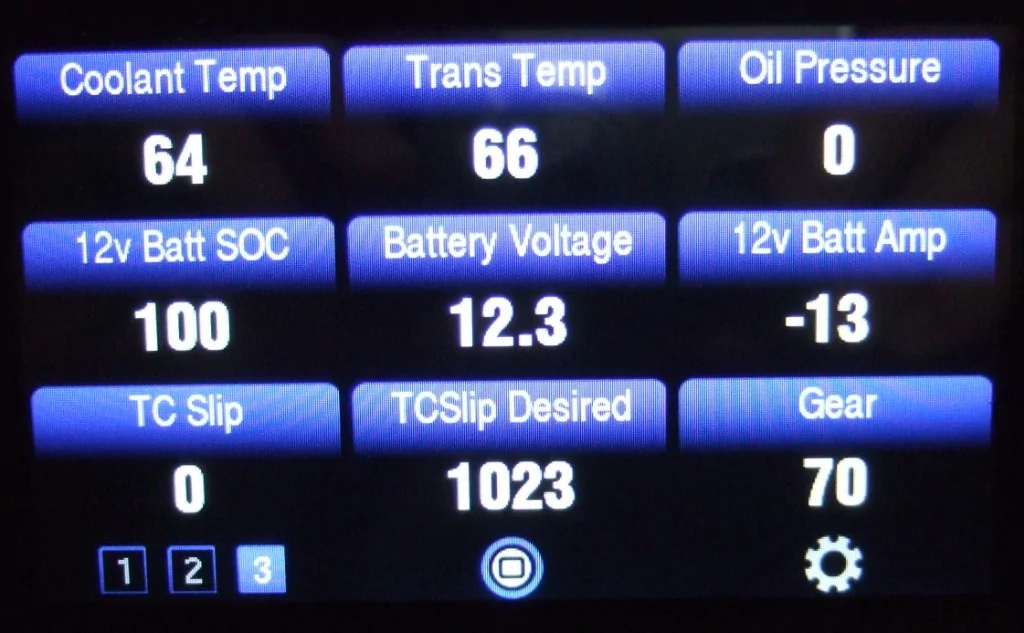
I'll check and see what PID the ScanGauge 3 is using..
Sponsored

 
OP
OP

TJC

Well-Known Member
First Name
Tony
Joined
Aug 28, 2020
Threads
45
Messages
3,932
Reaction score
9,868
Location
North Carolina
Vehicle(s)
93 Miata, 05 Ranger 4x4, 20 Ranger 4x4, 23 CX-5
My 10 amp charger was plenty to keep up in accessory mode while doing the upgrades. I think it was only charging at about 8 amps. Sorry, I disagree with your statement about not using a charger while in accessory mode without running the engine. The tech in the video had deliberately discharged the battery to cause the higher charger currents for demonstration purposes. If your battery has not been discharged, the 10 amp charger is fine for this purpose.
Put an amp meter on the battery and turn on the key but not start the truck. You're gonna see a big amperage drain. I see 18-23 amp draws all the time... the range varies depending on if the door is open or not. And I've turned off a lot of bells and whistles!

It doesn't matter the state of the battery, the truck electronics are going to pull what they are going to pull, until your battery reaches a critical low point where the BMS goes into Battery protection mode and drops the current draw.

I've done the same as you. If your charger is robust enough and has over current protection, you'll slow the battery drain by ~40%-50%. But your battery is still draining at a rapid rate.

I've had several 5amp smart chargers get very hot doing exactly what we are talking about.

A 720Ah battery will last 72 hours with a 10Amp draw, 20 Amps will cut that to 36 hours. This is BEST case with a fully charged healthy battery.

The problem is that the BMS keeps the battery at best 75% capacity, and it you're taking short trips or leaving doors open, etc., the battery may be at a much lower SOC.

I charge with my hood open, but I lock the latch so the truck thinks the hood is closed. Just another power drain the charger has to overcome. I also close the doors and wait for the truck to go to sleep. Come back in an hour and start charging.
 

RangerBill

Well-Known Member
First Name
Bob
Joined
Jun 8, 2022
Threads
3
Messages
1,601
Reaction score
2,125
Location
PA
Vehicle(s)
2019 Ford Ranger Lariat Super Crew FX4
Occupation
retired
Put an amp meter on the battery and turn on the key but not start the truck. You're gonna see a big amperage drain. I see 18-23 amp draws all the time... the range varies depending on if the door is open or not. And I've turned off a lot of bells and whistles!

It doesn't matter the state of the battery, the truck electronics are going to pull what they are going to pull, until your battery reaches a critical low point where the BMS goes into Battery protection mode and drops the current draw.

I've done the same as you. If your charger is robust enough and has over current protection, you'll slow the battery drain by ~40%-50%. But your battery is still draining at a rapid rate.

I've had several 5amp smart chargers get very hot doing exactly what we are talking about.

A 720Ah battery will last 72 hours with a 10Amp draw, 20 Amps will cut that to 36 hours. This is BEST case with a fully charged healthy battery.

The problem is that the BMS keeps the battery at best 75% capacity, and it you're taking short trips or leaving doors open, etc., the battery may be at a much lower SOC.

I charge with my hood open, but I lock the latch so the truck thinks the hood is closed. Just another power drain the charger has to overcome. I also close the doors and wait for the truck to go to sleep. Come back in an hour and start charging.
I did some testing to see if my memory on this topic was correct. I put a 10 amp battery charger on my Ranger and turned on the ignition without starting the engine. The battery voltage did not drop below 13.4 volts DC. I performed the test for about 30 minutes. At the end of the test the charger was charging at 10.1 amps, battery voltage at 13.4 volts. I turned off the ignition and the charging amps went to 6 amps with the battery voltage rising to 13.9 volts. I have done at least 6 Sync and map updates using the 10 amp charger with no issues. I remember one of the first map updates taking 1 hour and 50 minutes. I had no issues with a discharged battery. So at least in my Ranger, it is not discharging at a rapid rate, in fact, the charger is keeping up with the accessory load on the battery.

The state of the battery charge does matter, as the charger is charging the battery and providing current to the truck electrical load, since the engine is not running. So, if the battery is discharged, it will take more current from the charger and there will be less current to supply to the accessory load (since it is limited to 10 amps). If you start with a fully charged battery, then the charger is merely supplying the accessory load current and it will keep up.

These are the results that I have had with doing the software updates without running the engine and using a 10 amp battery charger. I don't know why your truck has different results.
 

airline tech

Well-Known Member
Joined
Aug 24, 2022
Threads
28
Messages
4,448
Reaction score
8,507
Location
Midwest - KS
Vehicle(s)
2022 Ranger Lariat-Super Crew, Cactus Gray
Occupation
Aircraft Tech
I did some testing to see if my memory on this topic was correct. I put a 10 amp battery charger on my Ranger and turned on the ignition without starting the engine. The battery voltage did not drop below 13.4 volts DC. I performed the test for about 30 minutes. At the end of the test the charger was charging at 10.1 amps, battery voltage at 13.4 volts. I turned off the ignition and the charging amps went to 6 amps with the battery voltage rising to 13.9 volts. I have done at least 6 Sync and map updates using the 10 amp charger with no issues. I remember one of the first map updates taking 1 hour and 50 minutes. I had no issues with a discharged battery. So at least in my Ranger, it is not discharging at a rapid rate, in fact, the charger is keeping up with the accessory load on the battery.

The state of the battery charge does matter, as the charger is charging the battery and providing current to the truck electrical load, since the engine is not running. So, if the battery is discharged, it will take more current from the charger and there will be less current to supply to the accessory load (since it is limited to 10 amps). If you start with a fully charged battery, then the charger is merely supplying the accessory load current and it will keep up.

These are the results that I have had with doing the software updates without running the engine and using a 10 amp battery charger. I don't know why your truck has different results.
I will say that even the service manuals call out to place on a battery charger to maintain battery voltage:

Bat Charger.webp
 

RangerBill

Well-Known Member
First Name
Bob
Joined
Jun 8, 2022
Threads
3
Messages
1,601
Reaction score
2,125
Location
PA
Vehicle(s)
2019 Ford Ranger Lariat Super Crew FX4
Occupation
retired
I will say that even the service manuals call out to place on a battery charger to maintain battery voltage:

Bat Charger.webp
The nice thing about doing it this way is no fuel is wasted running the engine during the updates.


airline tech

Well-Known Member
Joined
Aug 24, 2022
Threads
28
Messages
4,448
Reaction score
8,507
Location
Midwest - KS
Vehicle(s)
2022 Ranger Lariat-Super Crew, Cactus Gray
Occupation
Aircraft Tech
The nice thing about doing it this way is no fuel is wasted running the engine during the updates.
I usually just let it idle, as I am accustomed to (Idling) when running scan tools for diagnostics on any vehicle - The engine must be running for Live Data anyway for accurate readings.
Where the Charger would be needed is more prevalent to module programming such as the PCM etc where the engine cannot be running but requires ignition (on) for power to the module.
 
OP
OP

TJC

Well-Known Member
First Name
Tony
Joined
Aug 28, 2020
Threads
45
Messages
3,932
Reaction score
9,868
Location
North Carolina
Vehicle(s)
93 Miata, 05 Ranger 4x4, 20 Ranger 4x4, 23 CX-5
I will say that even the service manuals call out to place on a battery charger to maintain battery voltage:

Bat Charger.webp
I am NOT saying it is a bad Idea.

I AM saying a 10amp charger will not compensate for the "engine off key on" load.

The load the electrics are pulling will not vary unless there is code in the firmware to shut things down over time in the "engine off key on" state. I have not seen this happen to date, and I am not willing to leave my truck in that state for days on end to find out.

If your battery is in relatively good shape a 1.5 hour update with a 10 amp charger will not lower the battery charge appreciably, probably 15-18 Ah, but it will lower the charge of the battery.

And your charger has to be able to output its top rating without overheating.

That is all that I am pointing out.

Don't believe me, put an amp meter on, turn the key to on and see how much draw there is.

Never mind I just did. I have turned off every bell and whistle that I could in Forscan to limit current draw, and pulled the fuse and cable on Telematics modem. I'm still drawing 13 amps with the Key On Engine Off. So even with a 10amp charger outputting it max current, I'd be drawing down the battery at a rate of 3Ah. I have an XLT. I'm sure the Lariat pulls more current.

Amp Draw - Engine on, Key Off.webp


One final thought. I am sure that the battery chargers that Ford uses are powerful enough to counteract the power draw from the key on engine off condition,
 
Last edited:

Dean

Gold Sponsor
First Name
Dean
Joined
Jul 19, 2019
Threads
11
Messages
169
Reaction score
279
Location
19040
Vehicle(s)
2019 Ranger XLT, 1988 Merkur Scorpio, 1959 Austin Healey Sprite
Occupation
Embedded SW Engineer
I haven't had much success reviving AGM batteries over 8 years old with a desulfator. I have tried on at least three different occasions. Granted, I did not use your brand of desufator.

The AGM battery in my 2019 just died this year. But three years prior to the failure auto-start/stop disabled. I thought the battery was on the way out so I bought a new AGM two years ago figuring failure was imminent. But the original battery continued working for two more years. Anyway, I installed the new AGM this year and performed a BMS reset and auto-start/stop is now working again. I upgraded to the Lariet size battery. Tried to revive the old battery but no dice.

The optima redtop AGM I had in my sports car lasted 15 years. But this vehicle had no parasitic drain when parked.

I'm not so sure it is a good idea to mount and run the desulfator in the vehicle.
 
OP
OP

TJC

Well-Known Member
First Name
Tony
Joined
Aug 28, 2020
Threads
45
Messages
3,932
Reaction score
9,868
Location
North Carolina
Vehicle(s)
93 Miata, 05 Ranger 4x4, 20 Ranger 4x4, 23 CX-5
I haven't had much success reviving AGM batteries over 8 years old with a desulfator. I have tried on at least three different occasions. Granted, I did not use your brand of desufator.

The AGM battery in my 2019 just died this year. But three years prior to the failure auto-start/stop disabled. I thought the battery was on the way out so I bought a new AGM two years ago figuring failure was imminent. But the original battery continued working for two more years. Anyway, I installed the new AGM this year and performed a BMS reset and auto-start/stop is now working again. I upgraded to the Lariet size battery. Tried to revive the old battery but no dice.

The optima redtop AGM I had in my sports car lasted 15 years. But this vehicle had no parasitic drain when parked.

I'm not so sure it is a good idea to mount and run the desulfator in the vehicle.
The trick is not to revive them, it is to keep them dsulfated from the beginning... never letting them become sulfated.

My batteries typically die from a shorted/dead cell. Over the years lead shedding from the plates collects on the battom of the battery pan and pile up until the pile is tall enough to short two plates. Voltage drops 2v-3v. 9v-10v instead of 12v-13v. Game over.

My 2020 Ranger 4x4 SCab Sport was manufactured in March 2020 and is on the original battery. I just went out and measured the battery's condition. Desulfator was installed 18 months into ownership after I had low battery warning... (I should have installed it sooner... they are on all my other cars).

The battery is rated at 720 CCA and was manufactured earlier than March of 2020. But I am counting from date of manufacture of the triuck.

This battery is 5 years 8 months old and is better shape than when it rolled into my driveway new.
I anticipate at least another 5 years of reliable service. That's what I've been getting on average since installing them in my 1993 Miata, a 2003 Maxima, my 2005 Ranger, and hopefully my 2020 Ranger and 2023 CX-5.

So here is its present condition:

State of Health - 100%​
State of Charge - 100%​
Measured CCA - 913 (that's 127% of the stated rating of the battery when new - 720CCA)​
Voltage - 12.89v​
Internal Resistance - 3.28mOhms (this is an excellent reading)​

My 2003 Maxima was still on its 2nd battery when I gave it to my nephew in 2023.

My 2005 Ranger is on it 3rd battery, but only because the alternator died 124 miles from my destination on Christmas Eve in 2023, and I barely made it to the destination where an alternator was waiting for me. The battery was severely drained and never recovered, but it got me there!

It was so weak when I arrived that if I touched the brakes the engine would stutter and start to die. I had past through the "Not charging warning light phase", to the "Christmas tree light phase" where all the dash lights came on, to the "lights out phase where none of the dash lights were on" and I was driving at sunset with no lights and afraid to hit the brakes for fear of the truck stalling. So I really can't blame the battery for that one.

The longest lasting battery was 13 years, the 2005 Ranger battery that sacrificed itself lasted 9 years (the shortest time).
 
Last edited:

Dean

Gold Sponsor
First Name
Dean
Joined
Jul 19, 2019
Threads
11
Messages
169
Reaction score
279
Location
19040
Vehicle(s)
2019 Ranger XLT, 1988 Merkur Scorpio, 1959 Austin Healey Sprite
Occupation
Embedded SW Engineer
OK, I'll bite, but is it really safe to mount and run these desulfators permanently in the vehicle?

Obviously you have had no issues, but it is my understanding that these units work by spiking short pulses of higher voltage to the battery.

Seems risky to the rest of the electronics in the vehicle.

Did your desulfator instructions say anything about that?
 

RangerBill

Well-Known Member
First Name
Bob
Joined
Jun 8, 2022
Threads
3
Messages
1,601
Reaction score
2,125
Location
PA
Vehicle(s)
2019 Ford Ranger Lariat Super Crew FX4
Occupation
retired
I am NOT saying it is a bad Idea.

I AM saying a 10amp charger will not compensate for the "engine off key on" load.

The load the electrics are pulling will not vary unless there is code in the firmware to shut things down over time in the "engine off key on" state. I have not seen this happen to date, and I am not willing to leave my truck in that state for days on end to find out.

If your battery is in relatively good shape a 1.5 hour update with a 10 amp charger will not lower the battery charge appreciably, probably 15-18 Ah, but it will lower the charge of the battery.

And your charger has to be able to output its top rating without overheating.

That is all that I am pointing out.

Don't believe me, put an amp meter on, turn the key to on and see how much draw there is.

Never mind I just did. I have turned off every bell and whistle that I could in Forscan to limit current draw, and pulled the fuse and cable on Telematics modem. I'm still drawing 13 amps with the Key On Engine Off. So even with a 10amp charger outputting it max current, I'd be drawing down the battery at a rate of 3Ah. I have an XLT. I'm sure the Lariat pulls more current.

Amp Draw - Engine on, Key Off.webp


One final thought. I am sure that the battery chargers that Ford uses are powerful enough to counteract the power draw from the key on engine off condition,
I put an amp clamp DC meter on the lead from the battery connection to the Battery Junction Box and I measured 9.7 amps with accessory mode on - engine off. I am not seeing your 13 amps draw. Mine is a 2019 Lariat, original battery. So in my case, a 10 amp charger can keep up with accessory current draw for updating Sync or maps without draining the battery.
 
  • Like
Reactions: TJC
OP
OP

TJC

Well-Known Member
First Name
Tony
Joined
Aug 28, 2020
Threads
45
Messages
3,932
Reaction score
9,868
Location
North Carolina
Vehicle(s)
93 Miata, 05 Ranger 4x4, 20 Ranger 4x4, 23 CX-5
I put an amp clamp DC meter on the lead from the battery connection to the Battery Junction Box and I measured 9.7 amps with accessory mode on - engine off. I am not seeing your 13 amps draw. Mine is a 2019 Lariat, original battery. So in my case, a 10 amp charger can keep up with accessory current draw for updating Sync or maps without draining the battery.
Agreed.

Next step. Does the truck download the update or do you install via USB? If you have the truck download, have you measured the draw with the modem active.

I'm not sure of the current draw but I am curious.

Thank you for the data point! Time for me to start digging into the difference. I do have amp steps and my door was open. But they are not active once lowered.
 

RangerBill

Well-Known Member
First Name
Bob
Joined
Jun 8, 2022
Threads
3
Messages
1,601
Reaction score
2,125
Location
PA
Vehicle(s)
2019 Ford Ranger Lariat Super Crew FX4
Occupation
retired
Agreed.

Next step. Does the truck download the update or do you install via USB? If you have the truck download, have you measured the draw with the modem active.

I'm not sure of the current draw but I am curious.

Thank you for the data point! Time for me to start digging into the difference. I do have amp steps and my door was open. But they are not active once lowered.
I used a USB memory stick to do the updates and the doors were closed. My guess on the difference may be the accuracy of the battery monitoring sensor or the fact that your door was open with the dome lights on. A 3 amp error is likely not significant for its intended use in monitoring the battery state of charge. Just my thoughts on the issue.
 
Last edited:
OP
OP

TJC

Well-Known Member
First Name
Tony
Joined
Aug 28, 2020
Threads
45
Messages
3,932
Reaction score
9,868
Location
North Carolina
Vehicle(s)
93 Miata, 05 Ranger 4x4, 20 Ranger 4x4, 23 CX-5
I used a USB memory stick to do the updates and the doors were closed. My guess on the difference may be the accuracy of the battery monitoring sensor or the fact that your door was open with the dome lights on. A 3 amp error is likely not significant for its intended use in monitoring the battery state of charge. Just my thoughts on the issue.
The ScanGauge is reading the Ford BMS sensor (PIDs) directly. I suspect it was the door being open.
 

airline tech

Well-Known Member
Joined
Aug 24, 2022
Threads
28
Messages
4,448
Reaction score
8,507
Location
Midwest - KS
Vehicle(s)
2022 Ranger Lariat-Super Crew, Cactus Gray
Occupation
Aircraft Tech
@TJC I updated the Charging Sys Thread with the following, iDK if any of the info will help you as a compare to your results or not

Overtime I have gained some extra knowledge on the charging system, note still never found a full (This is how the Ranger system works)

Let's Start with this:
I was not having any charging issues but every time I plugged in my scanner, I noted that my Estimated SOC PID was always reading 86% or 87%, despite my raising my SOC to 90% then recently to 95%.
Decided I would perform a BMS Reset - and see if that corrected the issue - so it did
Since I did a new reset (even with the OE Battery - 3 yrs old)

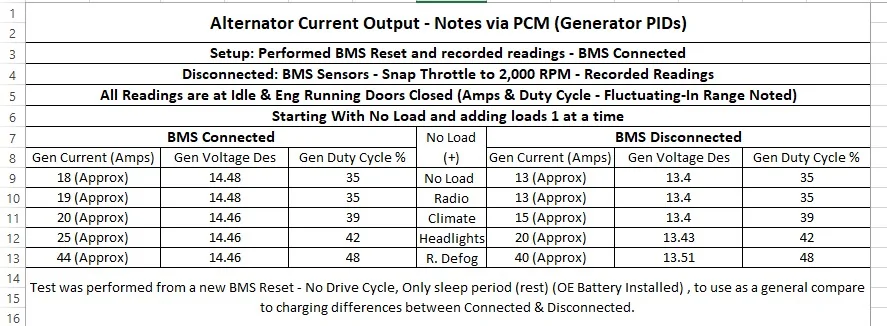
So, compare readings from a newly reset BMS Connected & The BMS Disconnected


Gen Output Data Compare.webp


Although I did not perform this test - Long Term it gave me some indication on what the system actually does with the BMS Sensor Disconnected.

The BMS Sensor: Measures
(Current Flow) In & Out of the battery
Indicated by example (3) = 3 Amps Charge or (-10) = Discharge

Estimated Battery Temperature:
I also CONFIRMED the BMS sensor includes a Temp Sensor, although it's not a direct reading sensor - I hit the sensor with a heat gun, no immediate response with the Estimated Battery Temperature Sensor (PID) after a couple of quick passes I was able to get a change in the temp reading.
Note: It held that reading for quite some time before it began dropping back down

Battery Voltage:
The Battery Voltage is picked up from the (+) wire that runs to the sensor.

This is where the BMS system calculates the Battery SOC, based on all parameters
This information is (Confirmed)

I figured out the reason for the statement in the manuals regarding the BMS (Recalibration) cycle
during SLEEP cycles -6 to 8 Hours of sleep to accurately determine the battery SOC.
It's a combination of 2 things:
1. Allow all modules to enter sleep
2. Allow the BMS Sensor to Reach (At Rest) temperatures without being influenced by Engine Running Temp & Electrical Influence from charging. - This is the main reason for the Time Length.
From my testing with the Heat Gun (Influence)
3. The BMS Sensor samples Battery Voltage after all modules are asleep and factors in (resting) sensor temp - To calculate the ESTIMATED BATTERY SOC and at next engine start this data table is used by the PCM to determine charging rate. (Desired Generator Output) Voltage via the Duty Cycle.

Information from the BMS Sensor is sent to the BCM, The BCM sends this data to the PCM via HS-CAN 1 data and this data is used by the PCM in partial factor of how it controls the Generator Output - Sets the Generator Voltage Desired & PWM Duty Cycle

Now, this is where the manuals leave you hanging and the following will be noted as confirmed or not confirmed

The PCM uses various data inputs to determine Generator output:
The PCM uses the (IAT) Intake Air Temp as a ref to perceived battery temp (Not Confirmed)
The PCM uses Throttle Position / Eng RPM / Vech Speed / Engine Load (Confirmed)
The PCM uses the BCM (input Data from the BMS Sensor) (Confirmed)
The Generator Regulator (has its own temp sensor) reports OH condition PID (Confirmed)
The PCM uses feedback (LIN) data to read the Generator -output current (Load) (Confimed)


The PCM has various MODES of operation:

Start-Up Mode: (Confirmed)
This mode turns off the gen output power, and it defaults to:
0% Duty Cycle and a Gen Voltage Desired of 10.6 Volts, I have noted with my voltmeter plugged into the Power Point - When you Crank the engine - the voltage reading drops to around this voltage. (This explains why)
This takes the load off of the crankshaft, faster starts
The system (if needed) ramps up (boosts) the Gen Desired Voltage up to 14.5 Volts, just after start to replenish voltage lost for engine start (approx. 30-Seconds) if battery was full charge.
Then drops the voltage back down to (normal charge mode)

Charge Mode: (Confirmed)
Activates when SOC is low, now if you have set the SOC to a higher SOC than the factory, it will spend most of its time in this mode.
Charge voltage still fluctuates depending on the PCM parameters it is seeing.
It also activates when there is a high load

Fuel Economy Mode / Voltage Reduction Mode: (Confirmed)
(This is mainly for the factory low SOC)
This is the PCM control to set the Desired Voltage Setpoint to a lower value, as low as 12.2 Volts (Float Charge)
This reduces load on the crankshaft and improves fuel economy - (PERCIEVED Statement)
This lets the generator turn off the charge voltage and the system relies on battery voltage.
More noted @ low RPM /idle settings, alternator not seeing RPM increase.
Since this Mode is not always seen (as I have raised my SOC) I never see it anymore.
Some D&O's State mode activates (IF) - (Not-Confirmed)
AMB Temp - above 32 Deg F
Caliculated Battery Current is less than 15 Amps and Greater Than (-8) Amps
Battery SOC is Greater Than 75%


Boost Charging: (Confirmed)
This is more noted if you have the factory SOC set.
This mode triggers during deceleration and uses the Alternator (OAD) pulley to achieve this
this will create the momentary boost charge using kinetic energy - More noted on a downhill coast.

Maintenance Refresh Mode: (Confirmed)
This is the mode that covers battery sulfation, and the manuals state that if the battery has been holding at 75% for extended periods of time it boosts the charge voltage up to 15.2 volts.
Another D&O - states if battery voltage is less than 13.2 Volts for 45-Minutes it sets a target charge voltage between 13.9 and 15.2 Volts for 5-Minutes.
I think this is where those that monitor the voltage with a meter are seeing some charging voltage variations.
Its intended function is to get the SOC to advance up out of the 75% setting.

The System Off to Save Battery Message: (Not Confirmed)
We know that the BMS Sensor (what it is reading) triggers this message, but I believe it's not really about the actual battery voltage reading, it's what the BMS Sensor is registering as the SOC reading.
This would explain why you have a good battery voltage test (12.2 Volts or Greater) but if you get this message (Check what the BCM is showing for the Estimated Battery SOC) this calculated reading comes from the BMS Sensor- it periodically updates the sensor while driving and performs a (True & Accurate) reading during sleep (rest)
Note: I think what is happening over time this sensor builds a (Drift Error) and reports false readings - throwing off the charging system and minimum error parameters that trigger the message.
Be it a - Sidetrack of the manuals and perform a BMS Reset, although there is only one Ford Document (GSB) that calls for a BMS Reset for System Error (T-Shoot) most of the document's state only with Battery Replacement
or
Replace as a precautionary maintenance item - depending on what your PID data is showing.

Something I have noticed but never really paid attention to:
All the BMS Sensor and Charging Targets - Relate to the SOC, in my mind it always went to battery voltage:
BUT if you actually think about it and with the BMS (Calibration) it references it being used to get an ACCURATE SOC - Hmm - What if the SOC is off, then then charging system will follow that SOC Calculation, no matter what the actual voltage is.
This would be the SOC Drift - Which is supposed to correct itself on the (Sleep Calibration)
So, a more accurate reading to correct the drift
During (Engine Running) it is measuring the in & Out Current as well as voltage & Temp so the SOC may drift while driving


PCM Control of the Generator (Note all PID data = Generator)
This is a single wire (LIN) circuit than takes place of the old (Gen-Com) & (Gen-Mon) & Sense Wire

LIN (Local Interconnect Network) - PWM with a Ground

PCM: (Master Node)
The PCM sets a Desired Generator Voltage (Setpoint) to the Regulator (PWM) 125 Hz Frequency
This is determined by the PCM From:
Set operation Mode: From Above
Engine Parameters -Such as: Throttle Position, RPM, VSS, Engine Load.
IAT (Intake Air Temp) (Perceived Battery Temp) outside of the BMS Sensor Reading
BCM - Input of Battery Condition (BMS Sensor Input)
Feedback from Generator (Current) Load
The Generator is also sending feedback of Generator Temp (Internal) as there is a PID for Gen Overtempt being reported (True/False) - so this would only be a DTC code monitor along with any other failure code DTCs that the PCM is monitoring for the LIN circuit.

Regulator (Slave-Node)
The Regulator in turn from the received data pulses the signal to ground rapidly producing a square wave signal (Duty Cycle) - The field current is being pulsed to ground this in turn controls the output voltage. (Based on the PCM Desired Voltage Setpoint)
The Duty Cycle is measured as a percent (On-Time)
The Duty Cycle (is what controls the voltage output) of the Generator, this is the current (Amps) reading.
The Higher the Duty Cycle - The Higher the output voltage will be.


So, on a PID data list you will see the Duty Cycle and Gen Current PIDs fluctuating.
Every 5-Seconds the Desired Generator Output Voltage is pulsed for change, if no change is required it will not change
To truly see the PWM (Duty Cycle Signals) it needs to be viewed on a Lab Scope

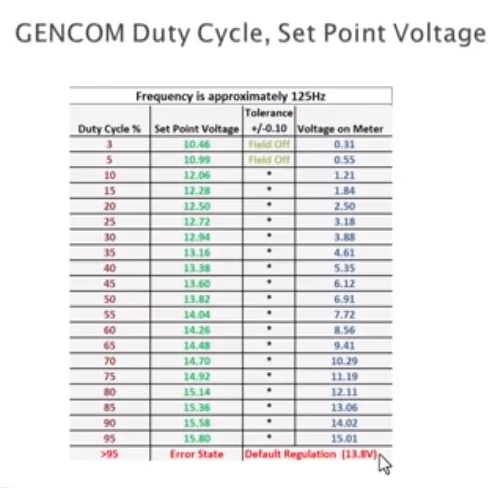
Here is a Ref Data Chart for Duty Cycle T-Shooting - Semi Accurate as a REF Only Guide
Note this is from the old style 3 Wire Control, but works for the LIN Control

Gen Com Duty Cycle Chart.webp


This is me playing:
Wanted to see the BCM PIDs -
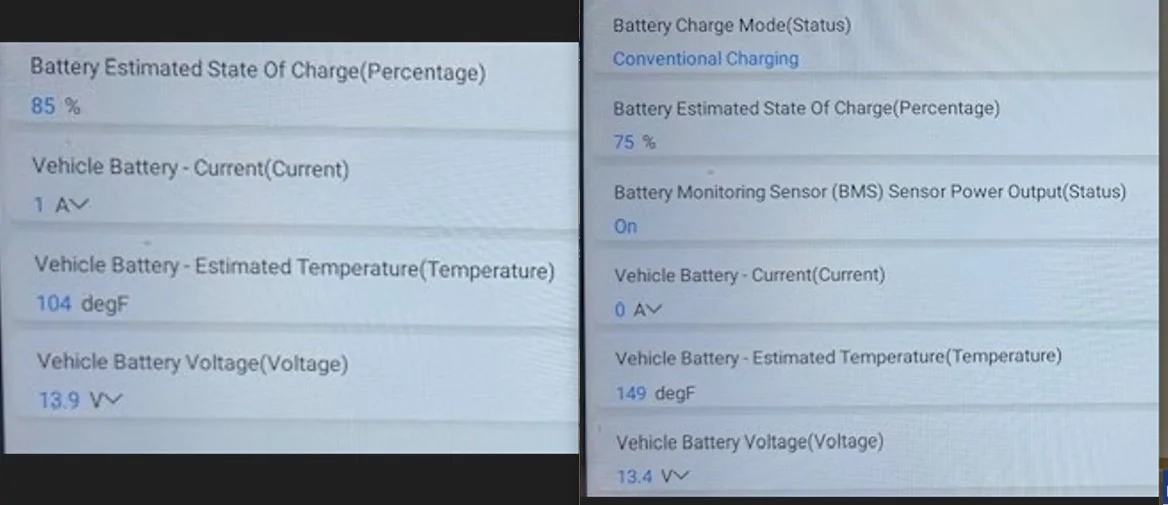
Sensor Disconnected Defaults and Sensor Disconnected & a BMS Reset Defaults
Sorry I did not realize I did not have matching PID data for the pics

But before disconnecting:
Bat Volt was 14.1 Volts
SOC 91%
Batt Temp 55 Deg


I was curious if (even though) it's not updating the BCM for data, is this data being transmitted to the PCM for charging data - or is is not being sent due to the fault code that is generated with it disconnected.

As Noted, The BCM still has it powered (ON) by its LIN Bus - so the LIN is still powering the connector for data (dead end connection)
I was questioning how long this default data remained and wanted to know if any of this default data was being transmitted to the PCM. IDK for sure but I believe the fault code blocks the data from being used and the PCM uses IAT as the back-up for battery temp

------BMS - Disconnected----------------------- BMS -Disconnected & Then BMS Reset

BMS Disconnected & Reset Disconnected.webp
Sponsored

 
Last edited:


Top