Sponsored

Maximizing Battery Life

got3fords

Well-Known Member
First Name
James
Joined
Apr 12, 2021
Threads
131
Messages
5,320
Reaction score
13,817
Location
22973
Vehicle(s)
2026 Marsh Gray Ranger Raptor, 1995 Harley XLH1200
Occupation
Mom Joke Professional
Well, it has been a while since I reported back on my results at maximizing battery life.

During this time I have simply driven the truck normally, and have let it sit for up to 2 weeks at a time. I have not charged it with an external charger for the last 3 months. No long distance driving over 70 miles at a time at all. Just around town averaging 20 miles / trip.

I have been actively monitoring charge voltages realtime while driving, and observing the desulvator panel when I shutdown the truck and when, for whatever reason I need the truck running with the hood up.

Two changes that I have recently noticed gave cause for concern.
  • The onboard desulvator was not running nearly as much. It flashes an LED whenever it is active, and it has been curiously absent.
  • The charge rate from the 12V port inside the cabin was reporting lower charge voltage that I had been previously experiencing. I was routinely seeing 14.3-14.5v charging voltages after starting the truck that would drop after 15-20 miles to 14.1v.

    I am now seeing 13.8v upon startup dropping very quickly to the 13.3v - 13.5v range.
Whenever I notice a change from the norm, I check to determine if there is a problem. So I broke out my battery tester to check the state of battery. I was somewhat surprised by what I found.

Battery Status
Battery Charge = 100%​
Battery Health = 100%​
CCA = 984 (rated at 760)​
Voltage = 12.66​
Internal Resistance = 3.05 mOhm​

My conclusion
I have the same desulvator installed on my 2005 Ranger and used it as the target goal to measure against changes I was making to optimize the 2020 Rangers BMS system.

The BMS system, when tuned properly, will outperform the standard charging system found on the 2005 Ranger. Based on my experience, the BMS does not overcharge the battery with a SOC at 95%.

The trick is to optimize for battery life over EPA mileage goals. Ford has set BMS up to gain some minuscule mileage increase by sacrificing battery life. I find this unacceptable, and I am forced to wonder if a fully charged optimized battery does more for EPA mileage (as the alternator is under far less load) than the present Ford BMS settings.

With the settings that I am using, BMS is literally trickle (Float Charging) charging my battery most of the time, instead of actively discharging it (down to 75% SOC) and then force feeding the battery with charge voltages well above optimal levels. Ford's BMS Regenerative charges are much higher than the charge rates listed below. To be blunt, the Ford BMS settings are abusing your battery, it is as simple as that!

Optimal AGM Absorption Charge = 14.2v - 14.6v​
Optimal AGM Float Charge = 13.2v - 13.8v​

To refresh all on what changes and additions have been made to my truck to insure a long life for my battery, here's the list that I have finally settled on:
  • Turned off ASS/BMS in Forscan (I don't think it actually turns off BMS, it simply neuters it! And the neutered algorithms are superior to those of the 2005 Ranger)
  • Raised Battery State of Charge Target (SOC) to 95% (from 75%) in Forscan
  • Minimized the headlight timers to shortest time or shut off entirely
  • Turned off various bells and chimes in Forscan
  • Installed a onboard BatteryMinder Desulfator Model OBD-12 that breaks down the sulfur crystals on the lead plates (lowering internal resistance) whenever the battery is being charged by the alternator.
I will sporadically monitor the system, but I am very satisfied with the results. I don't foresee any further work in this area.

Now on to the transmission issues!
I'm a tad confused. You stated the well tuned BMS will out perform the standard charging system, yet you have not been using it.
Sponsored

 
OP
OP

TJC

Well-Known Member
First Name
Tony
Joined
Aug 28, 2020
Threads
45
Messages
3,938
Reaction score
9,887
Location
North Carolina
Vehicle(s)
93 Miata, 05 Ranger 4x4, 20 Ranger 4x4, 23 CX-5
I'm a tad confused. You stated the well tuned BMS will out perform the standard charging system, yet you have not been using it.
Umm, I am absolutely using the Battery Management System (BMS). What do you think is charging my truck battery?

I just tuned the software aspects of BMS - I turned off Auto Stop Start (ASS), which turned off regenerative charging, and I set the SOC to 95 to stop the BMS from undercharging the battery. These are software parameters that tailor the BMS, not turn it off. If it were off the battery charging system would not be functional. My system diagnostics shows the BMS(charging system) functioning normally. No errors.

Ford tuned the BMS system to support the Automatic Start Stop system (ASS - how appropriate is that acronym!). I simply changed a few BMS settings to support optimal battery health.

Define it however you like. But the BMS will no longer be destroying my battery prematurely.

I no longer depend on constantly charging my battery in a futile attempt to maintain battery life...
only to watch the Ford tuned BMS drop the battery to a maximum of 75% charge (an unhealthy state for the battery to be in as the battery will sulfate at that charge level). Once the battery is sufficiently discharged, regenerative charging will then be sending 16+Volt charge spikes to an AGM battery designed to have the charge voltage not to exceed 14.8v. I am being generous here as 14.5v-14.6v is really the optimal charge limit, and Ford knows this!

So Ford consistently undercharges the battery resulting in raising internal resistance, and then periodically overcharges the battery when coasting or braking. Batteries don't respond well to either, and will die an early death.

My 2020 Ranger now behaves just like all my previous and current automobiles including my newer 2023 Mazda CX-5, which also does not eat batteries or need constant charging.

And I'll wager you that my battery outlasts a battery using the stock Ford BMS parameters - by double the life.

And most likely triple it. If past history is any indicator, I'm confident that I will get 9-10 years out of the stock Ford battery now. Spending $200 every 2-3 years for a battery is not in my plans.

Hope this clears up your confusion.
 
Last edited:

got3fords

Well-Known Member
First Name
James
Joined
Apr 12, 2021
Threads
131
Messages
5,320
Reaction score
13,817
Location
22973
Vehicle(s)
2026 Marsh Gray Ranger Raptor, 1995 Harley XLH1200
Occupation
Mom Joke Professional
Umm, I am absolutely using the Battery Management System (BMS). What do you think is charging my truck battery?

I just tuned the software aspects of BMS - I turned off Auto Stop Start (ASS), which turned off regenerative charging, and I set the SOC to 95 to stop the BMS from undercharging the battery. These are software parameters that tailor the BMS, not turn it off. If it were off the battery charging system would not be functional. My system diagnostics shows the BMS(charging system) functioning normally. No errors.

Ford tuned the BMS system to support the Automatic Start Stop system (ASS - how appropriate is that acronym!). I simply changed a few BMS settings to support optimal battery health.

Define it however you like. But the BMS will no longer be destroying my battery prematurely.

I no longer depend on constantly charging my battery in a futile attempt to maintain battery life...
only to watch the Ford tuned BMS drop the battery to a maximum of 75% charge (an unhealthy state for the battery to be in as the battery will sulfate at that charge level). Once the battery is sufficiently discharged, regenerative charging will then be sending 16+Volt charge spikes to an AGM battery designed to have the charge voltage not to exceed 14.8v. I am being generous here as 14.5v-14.6v is really the optimal charge limit, and Ford knows this!

So Ford consistently undercharges the battery resulting in raising internal resistance, and then periodically overcharges the battery when coasting or braking. Batteries don't respond well to either, and will die an early death.

My 2020 Ranger now behaves just like all my previous and current automobiles including my newer 2023 Mazda CX-5, which also does not eat batteries or need constant charging.

And I'll wager you that my battery outlasts a battery using the stock Ford BMS parameters - by double the life.

And most likely triple it. If past history is any indicator, I'm confident that I will get 9-10 years out of the stock Ford battery now. Spending $200 every 2-3 years for a battery is not in my plans.

Hope this clears up your confusion.
I am not criticizing you research. I am just confused that all, You said you " Turned off ASS/BMS in Forscan ". A lot of people unplug the BMS, so I assume it still charges ok.
 
OP
OP

TJC

Well-Known Member
First Name
Tony
Joined
Aug 28, 2020
Threads
45
Messages
3,938
Reaction score
9,887
Location
North Carolina
Vehicle(s)
93 Miata, 05 Ranger 4x4, 20 Ranger 4x4, 23 CX-5
I am not criticizing you research. I am just confused that all, You said you " Turned off ASS/BMS in Forscan ".
I understand and sought to clarity for Forscan users. Let me try to explain further.

I used the term that is listed in Forscan for the benefit of users of Forscan. Forscan lists the entry for turning off ASS as "ASS/BMS".

As you know, ASS can be manually turned off each time you start the truck by pressing the ASS button, but that does not turn off BMS. It is still doing its thing.

This fellow in the F150 forum gives a very good explanation... far better than mine.

"Battery charge voltage in the 13.x volt range does not prove that BMS is disabled or enabled. Standard charge mode voltage prior to BMS was 13.3 to 14.7v and based entirely on battery temperature assumed by the PCM.
Standard Charge Mode is also one of many charge operating modes in BMS. So even with BMS enabled, standard charge is often still used. This will occur in many instances depending on operating conditions.
The other charge modes, also known as regen charge modes, contain operating modes. (including one) that one is fuel economy related.
If BMS is using the fuel economy charge mode, expect voltages to be between 12.3 and 15.x (x because it various on year and program). The voltage applied is again mainly based on battery temperature, but also takes into consideration the engine efficiency (idle, acceleration, coasting, etc)."
I simply turned off the "Fuel Economy Mode", and want to use only the "Standard Charge Mode" he mentioned above.

Hope this clarifies things a bit.
 

airline tech

Well-Known Member
Joined
Aug 24, 2022
Threads
28
Messages
4,456
Reaction score
8,519
Location
Midwest - KS
Vehicle(s)
2022 Ranger Lariat-Super Crew, Cactus Gray
Occupation
Aircraft Tech
I will say this, when I did my research on this system, it was noted that with the BMS sensor disconnected at the battery or turned off via Forscan, I could still read battery temp with Forscan although I only disconnected and turned off for a short drive, never long term tested.
So at that point I assumed it was picking up last known or using the OAT and or ECT temp as a presumed temp, I never dug any further into that.
I actually have not done any more testing on the system since then as TJC appears to be on to something. I have left mine as factory 75% and have not yet installed the bat minder, it is in my plans though.
One thing to note I had ASS deleted from factory, and the Hex Code for ASS/BMS remained unchanged.
Note: I never found any clear-cut information on that anyway, exactly what was being disabled, I know that ASS is clearly disabled, but the BMS side of it all you see is the charging rate change and the regenerative charge (boost) disappear.
So, I cannot confirm with a valid test if BMS is fully disabled or as the F-150 member described and TJC is pointing out possibly only the Fuel Economy part of it is.
With the BMS sensor disconnected, the system is still charging, you will have a fault code triggered for it as well and if you have ASS, you will have a indicator light for it being disabled (I think)
Now precisely how the charging system is controlled with disconnected, it will have to use the internal regulator of the alternator, and long-term effects on the battery are unknown without further testing.

For ASS delete from factory:
The Hex-Codes that were changed was IPC (ASS-Indication-disabled) and Switch input (disabled) and the switch itself was deleted.


So, for comparison at just over 1 year of ownership I will battery test mine and compare results to TJC's and see what my battery test results show.

Like I said I have not dove back into the testing of the BMS, my only concern was overcharging / overheating the battery with any SOC changes or disconnect / disable etc.
Since there is not any clear and precise documentation on how this system operates, only vague descriptions from Ford and various on-line posts, it is trial and error on what works. My testing was not completed on my end since TJC took the ball and ran with it, it appears to be a confirmed viable solution for Ranger owners. For the owners that want a heathier longer lasting battery as of right now, TJC's solution appears to be the best option, with upping the SOC percentage from 75% to an amount that works the best. This is where I walked away with my testing, finding that right balance percentage and not damage the battery in the long term.

Thank You, TJC for picking my slack-off here and advancing the ball farther down the field.
Do we have a TD yet? IDK but time will tell.


OP
OP

TJC

Well-Known Member
First Name
Tony
Joined
Aug 28, 2020
Threads
45
Messages
3,938
Reaction score
9,887
Location
North Carolina
Vehicle(s)
93 Miata, 05 Ranger 4x4, 20 Ranger 4x4, 23 CX-5
Airline Tech,

You gave me a BIG head start on my work and kept me out to the ditch. I hope my findings correlate to others who choose to go down this path.

My BMS sensor is plugged in and has been since I turned off ASS in Forscan. An interesting side point. When I had the ASS switch turned off Forescan would not allow me to disable ASS. When I toggled ASS back on I was able to turn off ASS in Forscan.

Thank you for your kind words.
 

got3fords

Well-Known Member
First Name
James
Joined
Apr 12, 2021
Threads
131
Messages
5,320
Reaction score
13,817
Location
22973
Vehicle(s)
2026 Marsh Gray Ranger Raptor, 1995 Harley XLH1200
Occupation
Mom Joke Professional
I am not criticizing you research. I am just confused that all, You said you " Turned off ASS/BMS in Forscan ".
I understand and sought to clarity for Forscan users. Let me try to explain further.

I used the term that is listed in Forscan for the benefit of users of Forscan. Forscan lists the entry for turning off ASS as "ASS/BMS".

As you know, ASS can be manually turned off each time you start the truck by pressing the ASS button, but that does not turn off BMS. It is still doing its thing.

This fellow in the F150 forum gives a very good explanation... far better than mine.

"Battery charge voltage in the 13.x volt range does not prove that BMS is disabled or enabled. Standard charge mode voltage prior to BMS was 13.3 to 14.7v and based entirely on battery temperature assumed by the PCM.
Standard Charge Mode is also one of many charge operating modes in BMS. So even with BMS enabled, standard charge is often still used. This will occur in many instances depending on operating conditions.
The other charge modes, also known as regen charge modes, contain operating modes. (including one) that one is fuel economy related.
If BMS is using the fuel economy charge mode, expect voltages to be between 12.3 and 15.x (x because it various on year and program). The voltage applied is again mainly based on battery temperature, but also takes into consideration the engine efficiency (idle, acceleration, coasting, etc)."
I simply turned off the "Fuel Economy Mode", and want to use only the "Standard Charge Mode" he mentioned above.

Hope this clarifies things a bit.
Yes, that helps a lot. I didn't quite get that mode. Sounds like it would be preferable to just disconnecting the plug at the battery. It's hard to believe this system is so complicated.
Thanks!
 

got3fords

Well-Known Member
First Name
James
Joined
Apr 12, 2021
Threads
131
Messages
5,320
Reaction score
13,817
Location
22973
Vehicle(s)
2026 Marsh Gray Ranger Raptor, 1995 Harley XLH1200
Occupation
Mom Joke Professional
Thank You, TJC for picking my slack-off here and advancing the ball farther down the field.
Do we have a TD yet? IDK but time will tell.
Thanks to both of you for this very informative research. BTW, I am running the desulfator because of TJC, and every once in a while I will check batt health. Last check IR was 3 something mOhms.
 
OP
OP

TJC

Well-Known Member
First Name
Tony
Joined
Aug 28, 2020
Threads
45
Messages
3,938
Reaction score
9,887
Location
North Carolina
Vehicle(s)
93 Miata, 05 Ranger 4x4, 20 Ranger 4x4, 23 CX-5
Thanks to both of you for this very informative research. BTW, I am running the desulfator because of TJC, and every once in a while I will check batt health. Last check IR was 3 something mOhms.
And that is about as good as it gets. :like:

My 2005 Ranger is in the mid 2's, but it started its life on the desulfator.

My 2020 didn't get one installed until after I had the infamous low battery message even though ASS was automatically switched off by the switch module on startup.
 

ccasanova22

Well-Known Member
Joined
Oct 1, 2022
Threads
25
Messages
403
Reaction score
456
Location
Lakeland, MN
Vehicle(s)
2022 Ranger XLT Tremor
Something is wrong if the stock battery is getting worn out so quickly with a stock truck and BMS software. I’ve literally run entire block parties off my truck (1,000W continuous / 2,000W peak inverter with no key in the ignition) and after 6 hours of giving power to the DJ and tent decorative (string) lights, still had enough battery left to crank the truck over.

DJ drew 50-120W on the inverter, and the decorative lights were about 10W total. Obviously heavy bass songs drew more but average power was like 50-60W drawn.

Truck has a 18 month old battery and works like a charm. I’ve done block parties almost every Saturday with zero issues.
 

got3fords

Well-Known Member
First Name
James
Joined
Apr 12, 2021
Threads
131
Messages
5,320
Reaction score
13,817
Location
22973
Vehicle(s)
2026 Marsh Gray Ranger Raptor, 1995 Harley XLH1200
Occupation
Mom Joke Professional
Something is wrong if the stock battery is getting worn out so quickly with a stock truck and BMS software. I’ve literally run entire block parties off my truck (1,000W continuous / 2,000W peak inverter with no key in the ignition) and after 6 hours of giving power to the DJ and tent decorative (string) lights, still had enough battery left to crank the truck over.

DJ drew 50-120W on the inverter, and the decorative lights were about 10W total. Obviously heavy bass songs drew more but average power was like 50-60W drawn.

Truck has a 18 month old battery and works like a charm. I’ve done block parties almost every Saturday with zero issues.
I wish I were closer so I could attend one of those parties!
 

airline tech

Well-Known Member
Joined
Aug 24, 2022
Threads
28
Messages
4,456
Reaction score
8,519
Location
Midwest - KS
Vehicle(s)
2022 Ranger Lariat-Super Crew, Cactus Gray
Occupation
Aircraft Tech
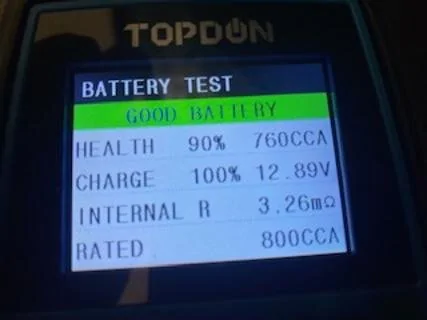
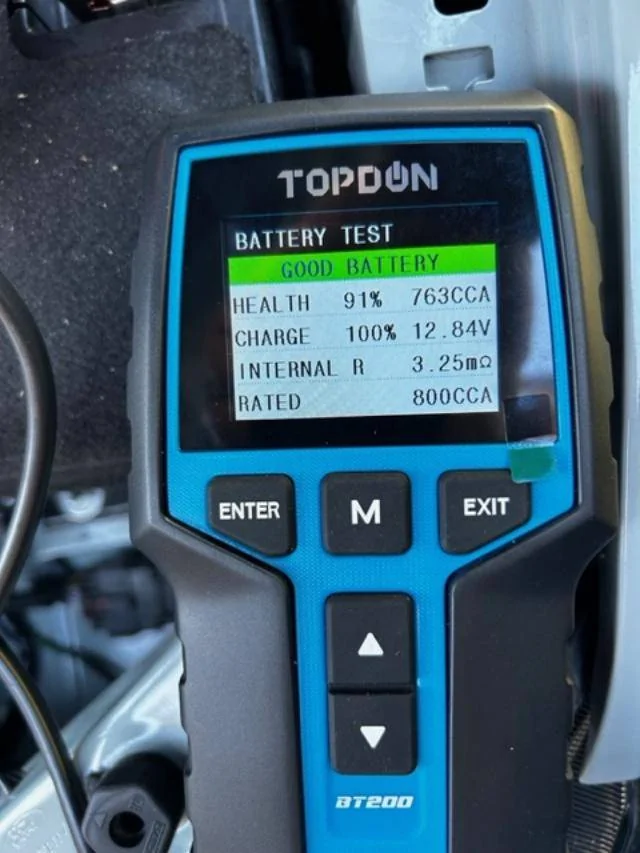
Battery Health Comparision.
All OEM settings - 22 Lariat 8,965 Miles 13 months of ownership, battery maintaining. status quo.

Jan 2023
Topdon Jan 23.jpg


Oct 23 (Today)
Topdon Oct 23.jpg
 

got3fords

Well-Known Member
First Name
James
Joined
Apr 12, 2021
Threads
131
Messages
5,320
Reaction score
13,817
Location
22973
Vehicle(s)
2026 Marsh Gray Ranger Raptor, 1995 Harley XLH1200
Occupation
Mom Joke Professional
Battery Health Comparision.
All OEM settings - 22 Lariat 8,965 Miles 13 months of ownership, battery maintaining. status quo.

Jan 2023

Oct 23 (Today)
So you have no mods or BMS changes and this is battery health so far? Not bad.
 
OP
OP

TJC

Well-Known Member
First Name
Tony
Joined
Aug 28, 2020
Threads
45
Messages
3,938
Reaction score
9,887
Location
North Carolina
Vehicle(s)
93 Miata, 05 Ranger 4x4, 20 Ranger 4x4, 23 CX-5
It is not bad, but notice the actual CCA is already slipping below the Rated CCA.... and resistance has started to climb. The battery is still in good shape, but the symptoms are already beginning to show themselves. The desulfator may be all you need, but it will not run as often due to the charge voltage being below the rate needed to activate it for a large period of time. It's that 75% SOC thing again.

My 18 month old Ford battery was in worse shape initially. Noticed that the CCA more than doubled... and it exceeded the manufacturer's rating! I see trhe same results on all my autos, 2005 Ranger, 2023 CX-5, and my 93 Miata LE.

Ford Battery Rated at 760 CCA

Initial starting measurements after receiving a Low Battery Warning - Battery 18 months after purchasing the truck ~6,000 miles

Voltage = 12.37
Internal Resistance = 5.19 mOhm
CCA = 485.7


Current Reading 18 Months Later
(Newer Battery Tester gives me SOC and SOH)
State of Health = 100%
State of Charge = 100%
Voltage = 12.66
Internal Resistance = 3.06 mOhm
CCA = 980


Both measured with battery at rest over night.
 
Last edited:

airline tech

Well-Known Member
Joined
Aug 24, 2022
Threads
28
Messages
4,456
Reaction score
8,519
Location
Midwest - KS
Vehicle(s)
2022 Ranger Lariat-Super Crew, Cactus Gray
Occupation
Aircraft Tech
I actually ordered the Batt Minder, will hook up and decide what to do with the SOC, I may try leaving the BMS alone and just raising the SOC from 75% to 80 or 85.
I plan to baby step it, ramp up aggressiveness as needed.
So, start out with just the SOC bump, to max 90 / 95.
Then if needed proceed to the BMS change with Forscan.
Monitor results every 2 weeks or once a month, for progressive changes.
Sponsored


Top