got3fords
Well-Known Member
I'm a tad confused. You stated the well tuned BMS will out perform the standard charging system, yet you have not been using it.Well, it has been a while since I reported back on my results at maximizing battery life.
During this time I have simply driven the truck normally, and have let it sit for up to 2 weeks at a time. I have not charged it with an external charger for the last 3 months. No long distance driving over 70 miles at a time at all. Just around town averaging 20 miles / trip.
I have been actively monitoring charge voltages realtime while driving, and observing the desulvator panel when I shutdown the truck and when, for whatever reason I need the truck running with the hood up.
Two changes that I have recently noticed gave cause for concern.
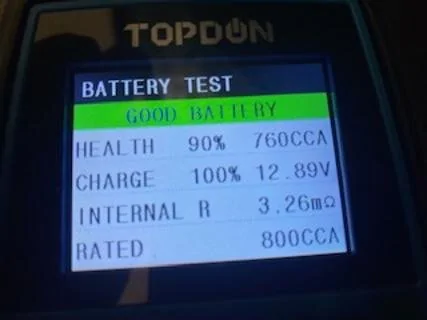
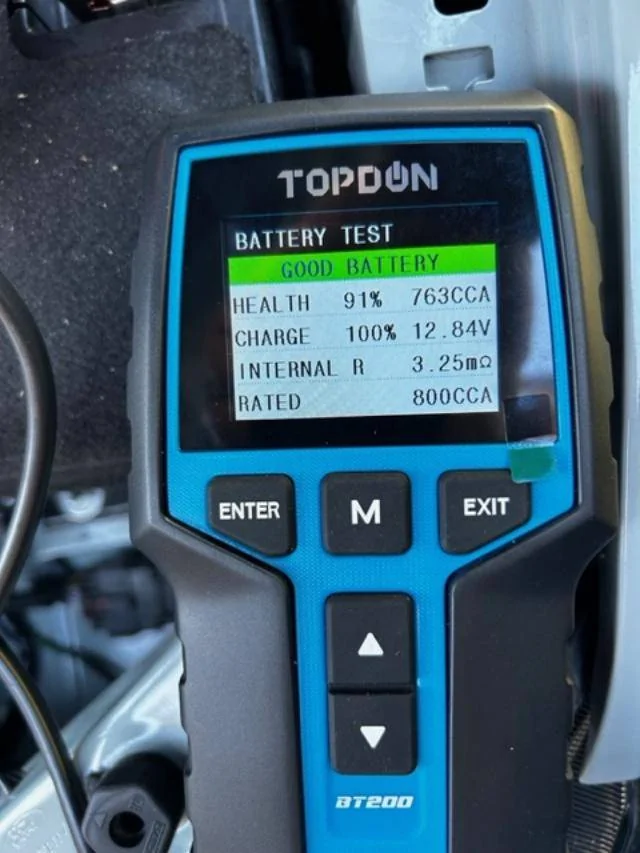
Whenever I notice a change from the norm, I check to determine if there is a problem. So I broke out my battery tester to check the state of battery. I was somewhat surprised by what I found.
- The onboard desulvator was not running nearly as much. It flashes an LED whenever it is active, and it has been curiously absent.
- The charge rate from the 12V port inside the cabin was reporting lower charge voltage that I had been previously experiencing. I was routinely seeing 14.3-14.5v charging voltages after starting the truck that would drop after 15-20 miles to 14.1v.
I am now seeing 13.8v upon startup dropping very quickly to the 13.3v - 13.5v range.
Battery StatusBattery Charge = 100%Battery Health = 100%CCA = 984 (rated at 760)Voltage = 12.66Internal Resistance = 3.05 mOhm
My conclusion
I have the same desulvator installed on my 2005 Ranger and used it as the target goal to measure against changes I was making to optimize the 2020 Rangers BMS system.
The BMS system, when tuned properly, will outperform the standard charging system found on the 2005 Ranger. Based on my experience, the BMS does not overcharge the battery with a SOC at 95%.
The trick is to optimize for battery life over EPA mileage goals. Ford has set BMS up to gain some minuscule mileage increase by sacrificing battery life. I find this unacceptable, and I am forced to wonder if a fully charged optimized battery does more for EPA mileage (as the alternator is under far less load) than the present Ford BMS settings.
With the settings that I am using, BMS is literally trickle (Float Charging) charging my battery most of the time, instead of actively discharging it (down to 75% SOC) and then force feeding the battery with charge voltages well above optimal levels. Ford's BMS Regenerative charges are much higher than the charge rates listed below. To be blunt, the Ford BMS settings are abusing your battery, it is as simple as that!
Optimal AGM Absorption Charge = 14.2v - 14.6vOptimal AGM Float Charge = 13.2v - 13.8v
To refresh all on what changes and additions have been made to my truck to insure a long life for my battery, here's the list that I have finally settled on:
I will sporadically monitor the system, but I am very satisfied with the results. I don't foresee any further work in this area.
- Turned off ASS/BMS in Forscan (I don't think it actually turns off BMS, it simply neuters it! And the neutered algorithms are superior to those of the 2005 Ranger)
- Raised Battery State of Charge Target (SOC) to 95% (from 75%) in Forscan
- Minimized the headlight timers to shortest time or shut off entirely
- Turned off various bells and chimes in Forscan
- Installed a onboard BatteryMinder Desulfator Model OBD-12 that breaks down the sulfur crystals on the lead plates (lowering internal resistance) whenever the battery is being charged by the alternator.
Now on to the transmission issues!
Sponsored