Sponsored

Bucking/Surging Epidemic

WalkerTexasRanger

New Member
First Name
Chris
Joined
May 19, 2019
Threads
0
Messages
2
Reaction score
16
Location
North Carolina
Vehicle(s)
2019 Ford Ranger XLT Sport 4X4
Occupation
Fleet Maintenance Technician at The Biltmore Company
I wanted to chime in on this conversation, if I may.

After reading through all 35 pages of the thread, I see there is a lot of high-quality information and also a little bit of confusion about the cause and the remedy.

To save everyone the trouble of reading through all 35 pages, the important bits are:
  • Tools Needed:
    • 8 mm socket with ratchet (or wrench/adjustable wrench)
    • Flat-head screwdriver
    • Needle-nose pliers
    • Step ladder if vertically impaired
    • Torque wrench capable of 97 lb.-in. if you're a freak for proper torque specifications.

  • Replacement Differential Pressure Feedback Exhaust (DPFE)
    • Sensor senses the difference in pressure across a fixed orifice. When the EGR valve is open, there is higher pressure on the EGR valve side of the orifice and lower pressure on intake manifold side. A larger difference in pressure comes from the EGR valve opening. When the valve closes, the pressure difference (the differential) becomes less, and the sensor reports back to the PCM that exhaust gases are no longer flowing.
      • The issue with these sensors is that they are internally exposed to acidic exhaust gases and moisture that degrade the pressure transducer inside the sensor housing.
      • As the sensor degrades, it "sees" less and less of the actual exhaust gas flow from the EGR valve and therefore "lies" to the PCM and reports less flow than what is actually occurring. What this means in practical terms is that the PCM is seeing that there is insufficient flow, so it commands the EGR valve to open even further to allow more exhaust gases to flow. The result is more exhaust gases than necessary flowing into the intake manifold, which causes misfires and the tell-tale bucking. This explains why the symptom shows up when cold, when taking off (high load), and when cruising around in 8th gear.
      • A good way to tell if your sensor may be the cause of your bucking is to do a simple power-brake test after your truck has warmed up and entered closed-loop fuel control mode (which generally occurs within a few minutes of starting a cold engine depending on coolant temp, ambient temp, and other various factors).
        • To perform the power-brake test:
          • Set parking brake
          • Hold down foot brake with left foot
          • Press accelerator pedal with right foot and aim for 1,000-1,200 rpm.
          • In my case the bucking was easily replicated in this range as this places the engine under load and duplicates the conditions that the engine experiences when taking off and coasting in 8th gear. You can also shift to reverse and repeat the test.
        • If the result of the test shows that the bucking is present, the next step is to prove the the DPFE sensor is the root cause.
          • In my case, I did this by unplugging the sensor, starting the truck, and redoing the test.
          • This will not set a DTC right away, but will after the next key cycle if you do not plug the sensor back in. If this happens and you don't have a scan tool, don't worry as the code will clear itself after 3-5 start cycles with the sensor properly plugged all the way in.
          • If the bucking has disappeared, you have just proven that the value being reported by the sensor is what the PCM is acting on when the bucking problem presents.
          • If you do have a scan tool, the data PID for the DPFE sensor will show +5V when the sensor is unplugged.
  • Sensor is available in two forms:
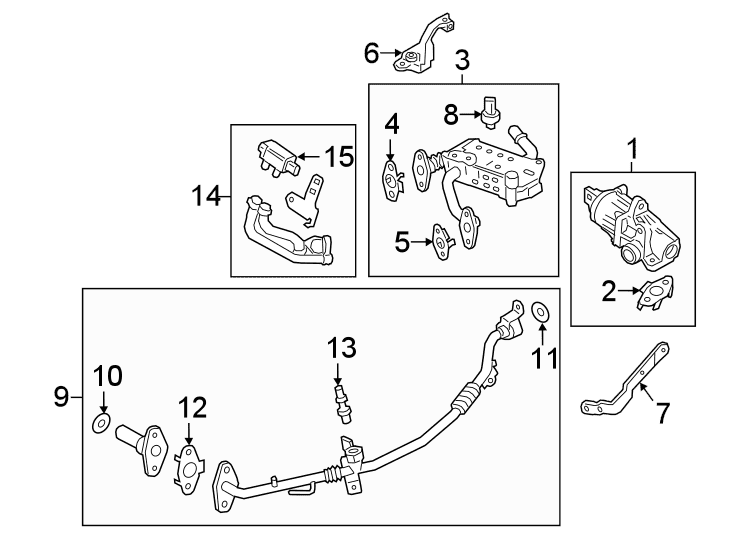
Parts diagram for DPFE sensor.png

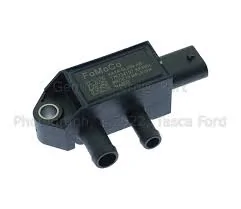
  • Sensor-only - KA1Z-5L200-A (Most diagrams call this "sensor. valve." #14 in attached parts diagram) The sensor itself is not a valve, but it does measure the flow of exhaust from the EGR valve to the intake manifold:
    • This option is cheaper if you don't mind using either worm-style hose clamps or sourcing the correct size oetiker clamps.
KA1Z-5L200-A.webp

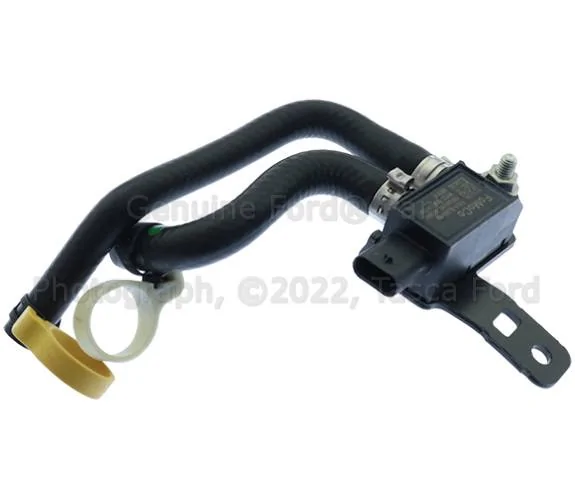
  • Sensor with bracket, new hoses, and quick-twist plastic-tabbed clamps for easy installation - LB5Z-9J433-B (Most diagrams call this version "Egr vacuum control" #15 in attached parts diagram):
    • This option is the one that I went with for my truck due to the convenience of the plastic twist-off hose clamp pieces that hold the spring clamps open so that you can install the sensor assembly with one hand. This also ensures that the hoses are fully and properly seated on the EGR tube and that the clamps are seated correctly on the hoses at the ends.
    • If you go with this option, installation is super easy as you just need to press the hoses on the EGR pipes (they are different sizes, so pay attention to the size of the openings on the pipe fittings and the sensor's hoses) and install the bracket bolt.
    • For those that are stiflers for torque like me, the torque specification for the sensor bracket bolt is 97 lb.-in. (97 INCH pounds). The bracket bolt itself is 8 mm.
LB5Z-9J433-B.webp

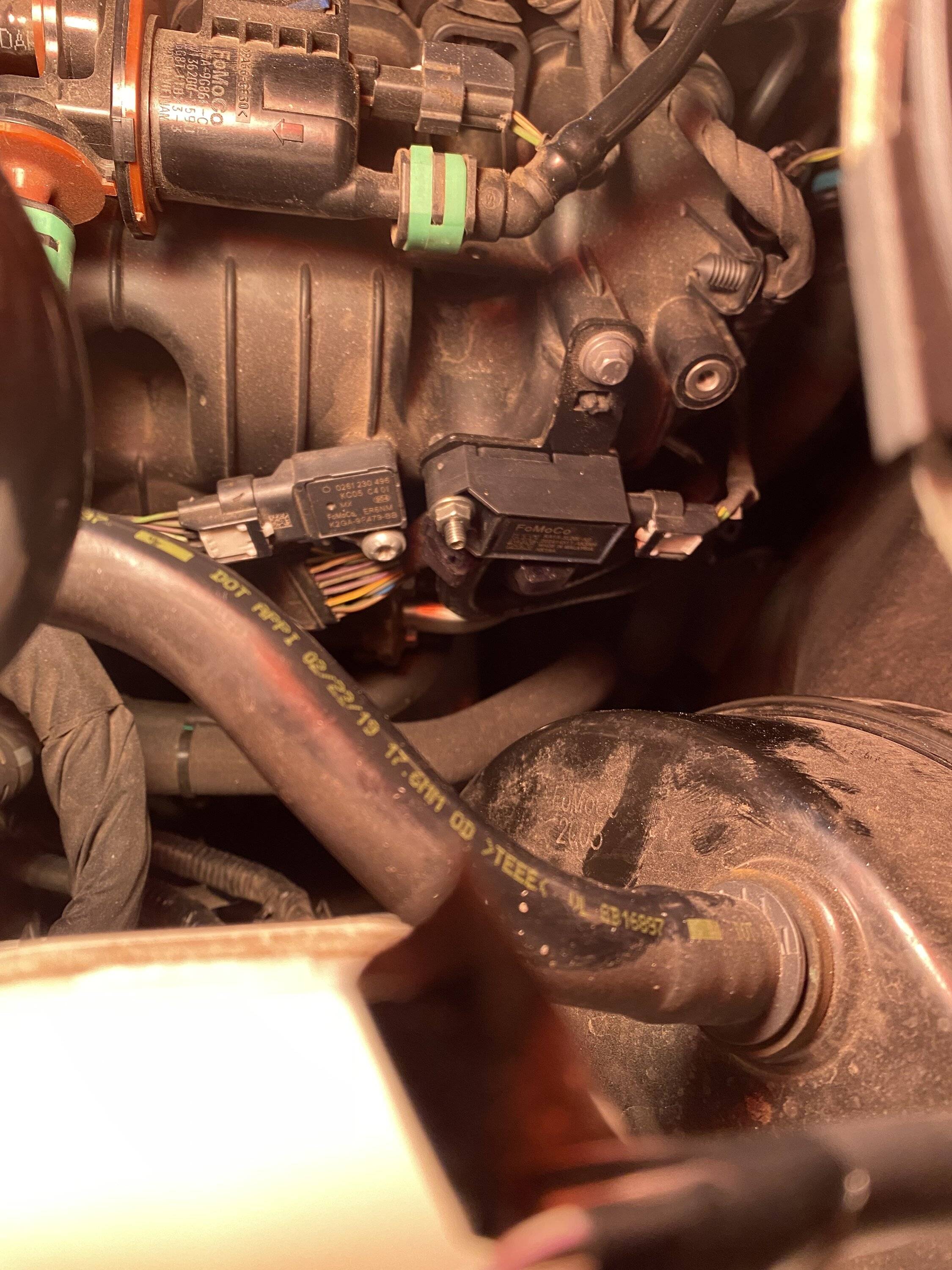
It is easiest to remove the sensor's hoses if you unbolt the 8 mm bolt first and then swing the old sensor down towards the brake booster. A good headlamp is essential for hands-free light so you can see the clamps and still have both hands to get at them.

Installation is the reverse of the installation with hoses pushed on first, then secure the sensor and tighten down the bolt.

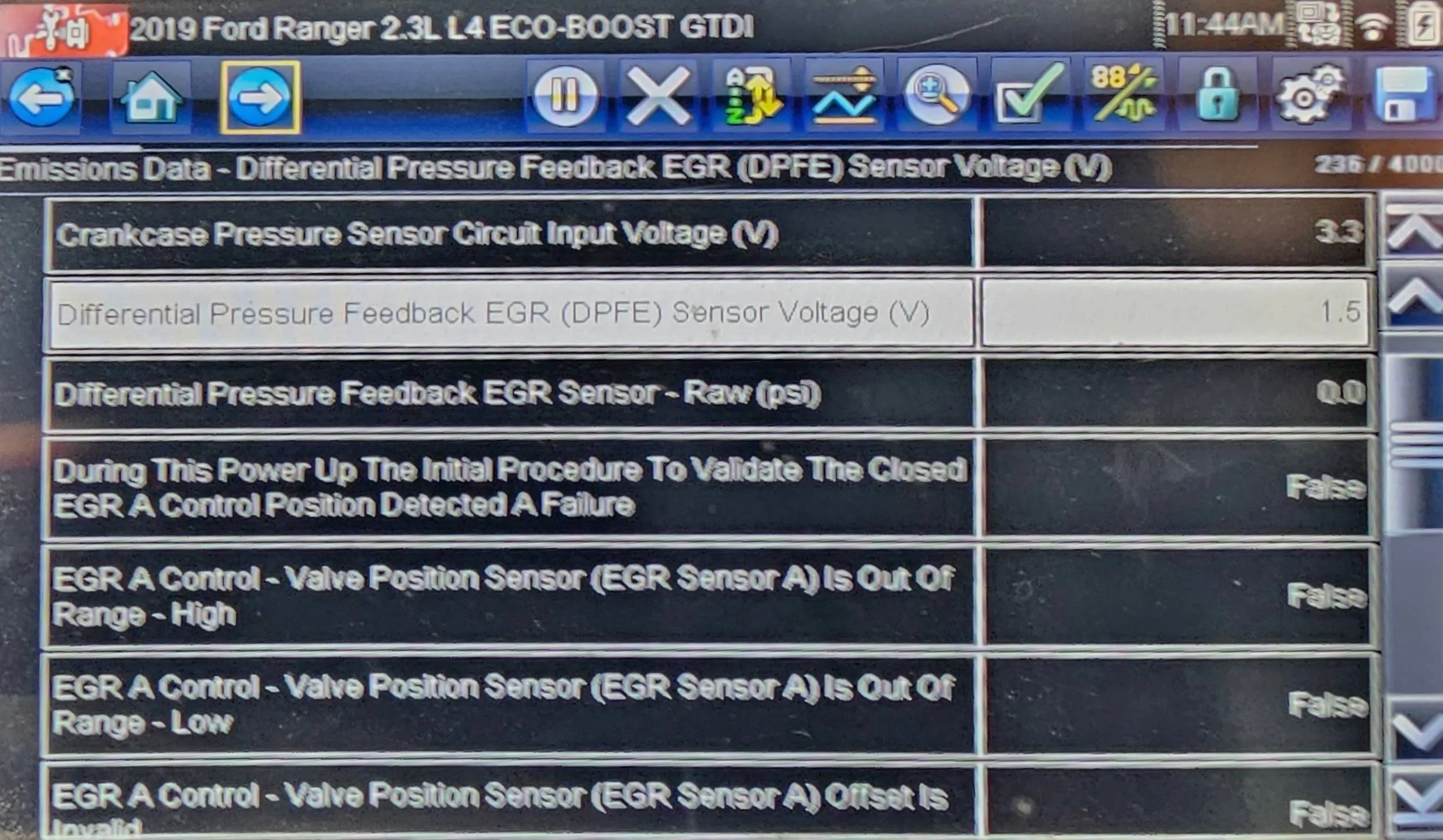
I've attached a picture of the DPFE data PID on the scan tool (Snap-On Solus Edge) after the repair was completed and am pleased to add my name to the list of people who had their issue completely resolved.


20230804_154251.jpg
Sponsored

 
Last edited:

Jefferylhenry

Member
First Name
Jeff
Joined
Aug 12, 2020
Threads
0
Messages
5
Reaction score
5
Location
Oregon
Vehicle(s)
2019 ford ranger
Occupation
Investor
My 2019 ranger had the classic symptoms and after 2 separate 2 week visits to my local ford dealer I was told that’s just how these trucks operate. I contacted ford corporate and was told I needed to take it back to the dealer. Yea right… so I decided to replace the egr sensor my self even though I purchased a 10 year bumper to bumper warranty when I bought the truck. I had to cut the stainless steel clamps with a dremel, but otherwise it was fairly straightforward. Took the truck for a test drive and smooth as can be. I had even taken copies of this forum thread into the dealer which shows their level of incompetence. Go figure.
1691337635437.jpeg
 

Devil6

Well-Known Member
First Name
Rob
Joined
Dec 14, 2019
Threads
3
Messages
72
Reaction score
59
Location
Germany
Vehicle(s)
Mustang
My truck started doing this some time ago and, I was annoyed.

Then my wife complained and I got really annoyed so in these forums I learned about the DPFE sensor. I saw that some people said it stopped shuddering when they accelerated more briskly or the RPMs raised like from shifting into “Sport.”

Here’s what I did and it seems to have made things better, permanently, I can’t say, but it was cheap. If this has been reported before please feel free to disregard it.

In the old days you might put your car on the freeway once a month and drive at around 3000 RPM for 5-10 miles to blow the carbon out.

A couple of weeks ago I did about 10 miles at 3000-4000 RPM, on the throttle and the shuddering has gone away. I guess I’ll do this monthly now.
 
Last edited:

airline tech

Well-Known Member
Joined
Aug 24, 2022
Threads
28
Messages
4,457
Reaction score
8,519
Location
Midwest - KS
Vehicle(s)
2022 Ranger Lariat-Super Crew, Cactus Gray
Occupation
Aircraft Tech
I wanted to chime in on this conversation, if I may.

After reading through all 35 pages of the thread, I see there is a lot of high-quality information and also a little bit of confusion about the cause and the remedy.

To save everyone the trouble of reading through all 35 pages, the important bits are:
  • Tools Needed:
    • 8 mm socket with ratchet (or wrench/adjustable wrench)
    • Flat-head screwdriver
    • Needle-nose pliers
    • Step ladder if vertically impaired
    • Torque wrench capable of 97 lb.-in. if you're a freak for proper torque specifications.

  • Replacement Differential Pressure Feedback Exhaust (DPFE)
    • Sensor senses the difference in pressure across a fixed orifice. When the EGR valve is open, there is higher pressure on the EGR valve side of the orifice and lower pressure on intake manifold side. A larger difference in pressure comes from the EGR valve opening. When the valve closes, the pressure difference (the differential) becomes less, and the sensor reports back to the PCM that exhaust gases are no longer flowing.
      • The issue with these sensors is that they are internally exposed to acidic exhaust gases and moisture that degrade the pressure transducer inside the sensor housing.
      • As the sensor degrades, it "sees" less and less of the actual exhaust gas flow from the EGR valve and therefore "lies" to the PCM and reports less flow than what is actually occurring. What this means in practical terms is that the PCM is seeing that there is insufficient flow, so it commands the EGR valve to open even further to allow more exhaust gases to flow. The result is more exhaust gases than necessary flowing into the intake manifold, which causes misfires and the tell-tale bucking. This explains why the symptom shows up when cold, when taking off (high load), and when cruising around in 8th gear.
      • A good way to tell if your sensor may be the cause of your bucking is to do a simple power-brake test after your truck has warmed up and entered closed-loop fuel control mode (which generally occurs within a few minutes of starting a cold engine depending on coolant temp, ambient temp, and other various factors).
        • To perform the power-brake test:
          • Set parking brake
          • Hold down foot brake with left foot
          • Press accelerator pedal with right foot and aim for 1,000-1,200 rpm.
          • In my case the bucking was easily replicated in this range as this places the engine under load and duplicates the conditions that the engine experiences when taking off and coasting in 8th gear. You can also shift to reverse and repeat the test.
        • If the result of the test shows that the bucking is present, the next step is to prove the the DPFE sensor is the root cause.
          • In my case, I did this by unplugging the sensor, starting the truck, and redoing the test.
          • This will not set a DTC right away, but will after the next key cycle if you do not plug the sensor back in. If this happens and you don't have a scan tool, don't worry as the code will clear itself after 3-5 start cycles with the sensor properly plugged all the way in.
          • If the bucking has disappeared, you have just proven that the value being reported by the sensor is what the PCM is acting on when the bucking problem presents.
          • If you do have a scan tool, the data PID for the DPFE sensor will show +5V when the sensor is unplugged.
  • Sensor is available in two forms:
Parts diagram for DPFE sensor.png

  • Sensor-only - KA1Z-5L200-A (Most diagrams call this "sensor. valve." #14 in attached parts diagram) The sensor itself is not a valve, but it does measure the flow of exhaust from the EGR valve to the intake manifold:
    • This option is cheaper if you don't mind using either worm-style hose clamps or sourcing the correct size oetiker clamps.
KA1Z-5L200-A.webp

  • Sensor with bracket, new hoses, and quick-twist plastic-tabbed clamps for easy installation - LB5Z-9J433-B (Most diagrams call this version "Egr vacuum control" #15 in attached parts diagram):
    • This option is the one that I went with for my truck due to the convenience of the plastic twist-off hose clamp pieces that hold the spring clamps open so that you can install the sensor assembly with one hand. This also ensures that the hoses are fully and properly seated on the EGR tube and that the clamps are seated correctly on the hoses at the ends.
    • If you go with this option, installation is super easy as you just need to press the hoses on the EGR pipes (they are different sizes, so pay attention to the size of the openings on the pipe fittings and the sensor's hoses) and install the bracket bolt.
    • For those that are stiflers for torque like me, the torque specification for the sensor bracket bolt is 97 lb.-in. (97 INCH pounds). The bracket bolt itself is 8 mm.
LB5Z-9J433-B.webp

It is easiest to remove the sensor's hoses if you unbolt the 8 mm bolt first and then swing the old sensor down towards the brake booster. A good headlamp is essential for hands-free light so you can see the clamps and still have both hands to get at them.

Installation is the reverse of the installation with hoses pushed on first, then secure the sensor and tighten down the bolt.

I've attached a picture of the DPFE data PID on the scan tool (Snap-On Solus Edge) after the repair was completed and am pleased to add my name to the list of people who had their issue completely resolved.


20230804_154251.webp
Great Write Up:like:

Sensor senses the difference in pressure across a fixed orifice. When the EGR valve is open, there is higher pressure on the EGR valve side of the orifice and lower pressure on intake manifold side. A larger difference in pressure comes from the EGR valve opening. When the valve closes, the pressure difference (the differential) becomes less, and the sensor reports back to the PCM that exhaust gases are no longer flowing.

Just wanted to expand on this:
When the EGR Valve is closed the D/Stream and Upstream pressures are equal across the Orifice Tube.
And when the EGR Valve opens the upstream pressure in the tube decreases (Exhaust Flow), this is what the DPFE sensor is measuring as you now have a pressure release on the downstream side of the tube due to the exhaust flow into the intake manifold.
The upstream pressure is greater than the downstream due to the restriction (Orifice) in the tube.
The pressure difference between the up/down stream is converted into a voltage reference signal and sent to the PCM for EGR valve open/close control via the stepper motor of the EGR valve.
The higher the voltage reference signal to further open the EGR Valve is.
And this is where the sensor registers exhaust flow and more importantly how much exhaust flow, so a misread flow will cause the EGR valve to be commanded open when it should not be open.

To be clear on this, you have a higher pressure on the upstream side of the orifice tube, when the EGR Valve opens, and the added exhaust flow into the Intake Manifold via downstream pressure will increase the Intake Manifold pressure. (Increased manifold pressure = Lower manifold vacuum) Manifold vacuum should be higher at idle and low rpm. This increased pressure and lowered manifold vacuum when at the wrong engine parameters is what causes the bucking/surging, the MAPT sensor now reading the higher intake manifold pressure tries to compensate and adjust fuel delivery the best it can, and this keeps the engine from actually stalling, but only enhances the bucking/surging drivability concern.

Scan Tool Note:
It is good to know that the DPFE PID, is actually viewable from a 3rd party tool, as Forscan and my Autel 906TS will not display that PID

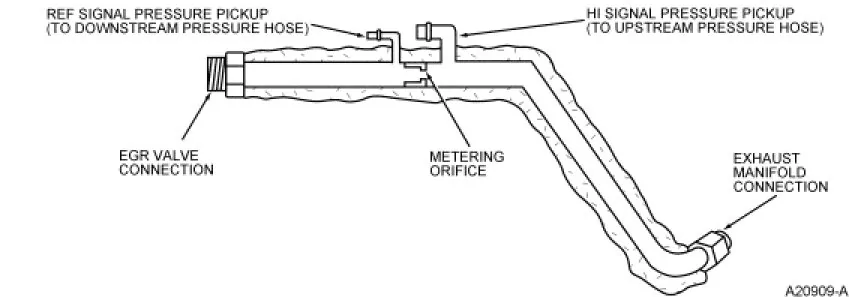
Here is a good pic of the Orifice Tube Assembly for a better understanding of system operation.

The smaller diameter hose is the feed into the intake (Downstream-Ref Signal)
This is what the DPFE sensor hoses connect to
1691354243950.png
 
Last edited:

Wytchdctr

Well-Known Member
First Name
Doug P.
Joined
Nov 18, 2021
Threads
54
Messages
1,541
Reaction score
4,266
Location
Westside Htown, Texas
Vehicle(s)
2021 XLT
Occupation
Retired Military/HR Manager
For those reading this; especially now the details on why... but are not yet bucking. It may still be getting ready to go. I am still amazed a good bit after the install on how much smoother it got, but I only recently noticed it was a bit grumpy. I thought it was just the outside temps pissing it off but no; it was that freaking sensor. So if you do think you might need plugs. Maybe so, but I'd throw this on as well to get it back to normal. I don't think it gained back power or anything, but a hard pull to get up a highway ramp sure as hell shows it's nicer with a new one. 25k miles at the time of replacement.

I do wonder if it's possible to clean out or repair them vs swapping. That or I'll just get the correct connectors and not replace the hose/bracket next time. Much cheaper with just the sensor. I just got lazy and getting the entire setup was super easy. Especially with Ford being nice and adding those pull rings for those little constant tension clamps.


Msfitoy

Well-Known Member
First Name
Sid
Joined
Mar 5, 2019
Threads
67
Messages
9,192
Reaction score
28,362
Location
North Carolina
Vehicle(s)
2019 Ranger, 2003 MINI Cooper S, 2021 Honda CT125
Occupation
NWO Robot Polisher
Vehicle Showcase
1
I wanted to chime in on this conversation, if I may.

After reading through all 35 pages of the thread, I see there is a lot of high-quality information and also a little bit of confusion about the cause and the remedy.

To save everyone the trouble of reading through all 35 pages, the important bits are:
  • Tools Needed:
    • 8 mm socket with ratchet (or wrench/adjustable wrench)
    • Flat-head screwdriver
    • Needle-nose pliers
    • Step ladder if vertically impaired
    • Torque wrench capable of 97 lb.-in. if you're a freak for proper torque specifications.

  • Replacement Differential Pressure Feedback Exhaust (DPFE)
    • Sensor senses the difference in pressure across a fixed orifice. When the EGR valve is open, there is higher pressure on the EGR valve side of the orifice and lower pressure on intake manifold side. A larger difference in pressure comes from the EGR valve opening. When the valve closes, the pressure difference (the differential) becomes less, and the sensor reports back to the PCM that exhaust gases are no longer flowing.
      • The issue with these sensors is that they are internally exposed to acidic exhaust gases and moisture that degrade the pressure transducer inside the sensor housing.
      • As the sensor degrades, it "sees" less and less of the actual exhaust gas flow from the EGR valve and therefore "lies" to the PCM and reports less flow than what is actually occurring. What this means in practical terms is that the PCM is seeing that there is insufficient flow, so it commands the EGR valve to open even further to allow more exhaust gases to flow. The result is more exhaust gases than necessary flowing into the intake manifold, which causes misfires and the tell-tale bucking. This explains why the symptom shows up when cold, when taking off (high load), and when cruising around in 8th gear.
      • A good way to tell if your sensor may be the cause of your bucking is to do a simple power-brake test after your truck has warmed up and entered closed-loop fuel control mode (which generally occurs within a few minutes of starting a cold engine depending on coolant temp, ambient temp, and other various factors).
        • To perform the power-brake test:
          • Set parking brake
          • Hold down foot brake with left foot
          • Press accelerator pedal with right foot and aim for 1,000-1,200 rpm.
          • In my case the bucking was easily replicated in this range as this places the engine under load and duplicates the conditions that the engine experiences when taking off and coasting in 8th gear. You can also shift to reverse and repeat the test.
        • If the result of the test shows that the bucking is present, the next step is to prove the the DPFE sensor is the root cause.
          • In my case, I did this by unplugging the sensor, starting the truck, and redoing the test.
          • This will not set a DTC right away, but will after the next key cycle if you do not plug the sensor back in. If this happens and you don't have a scan tool, don't worry as the code will clear itself after 3-5 start cycles with the sensor properly plugged all the way in.
          • If the bucking has disappeared, you have just proven that the value being reported by the sensor is what the PCM is acting on when the bucking problem presents.
          • If you do have a scan tool, the data PID for the DPFE sensor will show +5V when the sensor is unplugged.
  • Sensor is available in two forms:
Parts diagram for DPFE sensor.png

  • Sensor-only - KA1Z-5L200-A (Most diagrams call this "sensor. valve." #14 in attached parts diagram) The sensor itself is not a valve, but it does measure the flow of exhaust from the EGR valve to the intake manifold:
    • This option is cheaper if you don't mind using either worm-style hose clamps or sourcing the correct size oetiker clamps.
KA1Z-5L200-A.jpg

  • Sensor with bracket, new hoses, and quick-twist plastic-tabbed clamps for easy installation - LB5Z-9J433-B (Most diagrams call this version "Egr vacuum control" #15 in attached parts diagram):
    • This option is the one that I went with for my truck due to the convenience of the plastic twist-off hose clamp pieces that hold the spring clamps open so that you can install the sensor assembly with one hand. This also ensures that the hoses are fully and properly seated on the EGR tube and that the clamps are seated correctly on the hoses at the ends.
    • If you go with this option, installation is super easy as you just need to press the hoses on the EGR pipes (they are different sizes, so pay attention to the size of the openings on the pipe fittings and the sensor's hoses) and install the bracket bolt.
    • For those that are stiflers for torque like me, the torque specification for the sensor bracket bolt is 97 lb.-in. (97 INCH pounds). The bracket bolt itself is 8 mm.
LB5Z-9J433-B.jpg

It is easiest to remove the sensor's hoses if you unbolt the 8 mm bolt first and then swing the old sensor down towards the brake booster. A good headlamp is essential for hands-free light so you can see the clamps and still have both hands to get at them.

Installation is the reverse of the installation with hoses pushed on first, then secure the sensor and tighten down the bolt.

I've attached a picture of the DPFE data PID on the scan tool (Snap-On Solus Edge) after the repair was completed and am pleased to add my name to the list of people who had their issue completely resolved.


20230804_154251.jpg
Thank you for doing this, Chris...the mod(s) should pin this to first page....
 

airline tech

Well-Known Member
Joined
Aug 24, 2022
Threads
28
Messages
4,457
Reaction score
8,519
Location
Midwest - KS
Vehicle(s)
2022 Ranger Lariat-Super Crew, Cactus Gray
Occupation
Aircraft Tech
Rather than post a lengthy post on the internals of the DPFE sensor, I found this via Google, now it's an older publication and does not really cover the new generation of the EGR system but the DPFE sensor is broken down and explained. Thought I would share for those that are wanting to gain some knowledge on this small but very important part that is a thorn in many owner's sides.
Note: The Ranger uses a Electric Controlled EGR and the Vacuum Regulator is not installed, so just focus on the DPFE operation (internals) with this document.
 

Attachments

Devil6

Well-Known Member
First Name
Rob
Joined
Dec 14, 2019
Threads
3
Messages
72
Reaction score
59
Location
Germany
Vehicle(s)
Mustang
For those reading this; especially now the details on why... but are not yet bucking. It may still be getting ready to go. I am still amazed a good bit after the install on how much smoother it got, but I only recently noticed it was a bit grumpy. I thought it was just the outside temps pissing it off but no; it was that freaking sensor. So if you do think you might need plugs. Maybe so, but I'd throw this on as well to get it back to normal. I don't think it gained back power or anything, but a hard pull to get up a highway ramp sure as hell shows it's nicer with a new one. 25k miles at the time of replacement.

I do wonder if it's possible to clean out or repair them vs swapping. That or I'll just get the correct connectors and not replace the hose/bracket next time. Much cheaper with just the sensor. I just got lazy and getting the entire setup was super easy. Especially with Ford being nice and adding those pull rings for those little constant tension clamps.
On line it says you might be able to clean. Soak it over night in carb cleaner but ensure that any electrical connectors are protected.
 

Wytchdctr

Well-Known Member
First Name
Doug P.
Joined
Nov 18, 2021
Threads
54
Messages
1,541
Reaction score
4,266
Location
Westside Htown, Texas
Vehicle(s)
2021 XLT
Occupation
Retired Military/HR Manager
On line it says you might be able to clean. Soak it over night in carb cleaner but ensure that any electrical connectors are protected.
I still have the one that came off the thing. Maybe I can do some sort of testing on that since I also have a brand new one.
 

mgallo13

Well-Known Member
First Name
Matt
Joined
May 28, 2020
Threads
8
Messages
206
Reaction score
404
Location
Neptune City, NJ
Vehicle(s)
2015 MM Focus ST (sold), 2020 MM Ford Ranger XLT
Occupation
Financial Controller
Vehicle Showcase
1
I still have the one that came off the thing. Maybe I can do some sort of testing on that since I also have a brand new one.
following. still have my original as well.
 

ppfd

Well-Known Member
First Name
Tony
Joined
Mar 1, 2021
Threads
49
Messages
717
Reaction score
1,589
Location
WV
Vehicle(s)
2021 Tremor
Occupation
RN/Paramedic
Ford garage called and said if you can get here ASAP, we can get you fixed.
Off I went lights and sirens ?
Took them maybe a half hour for the install.
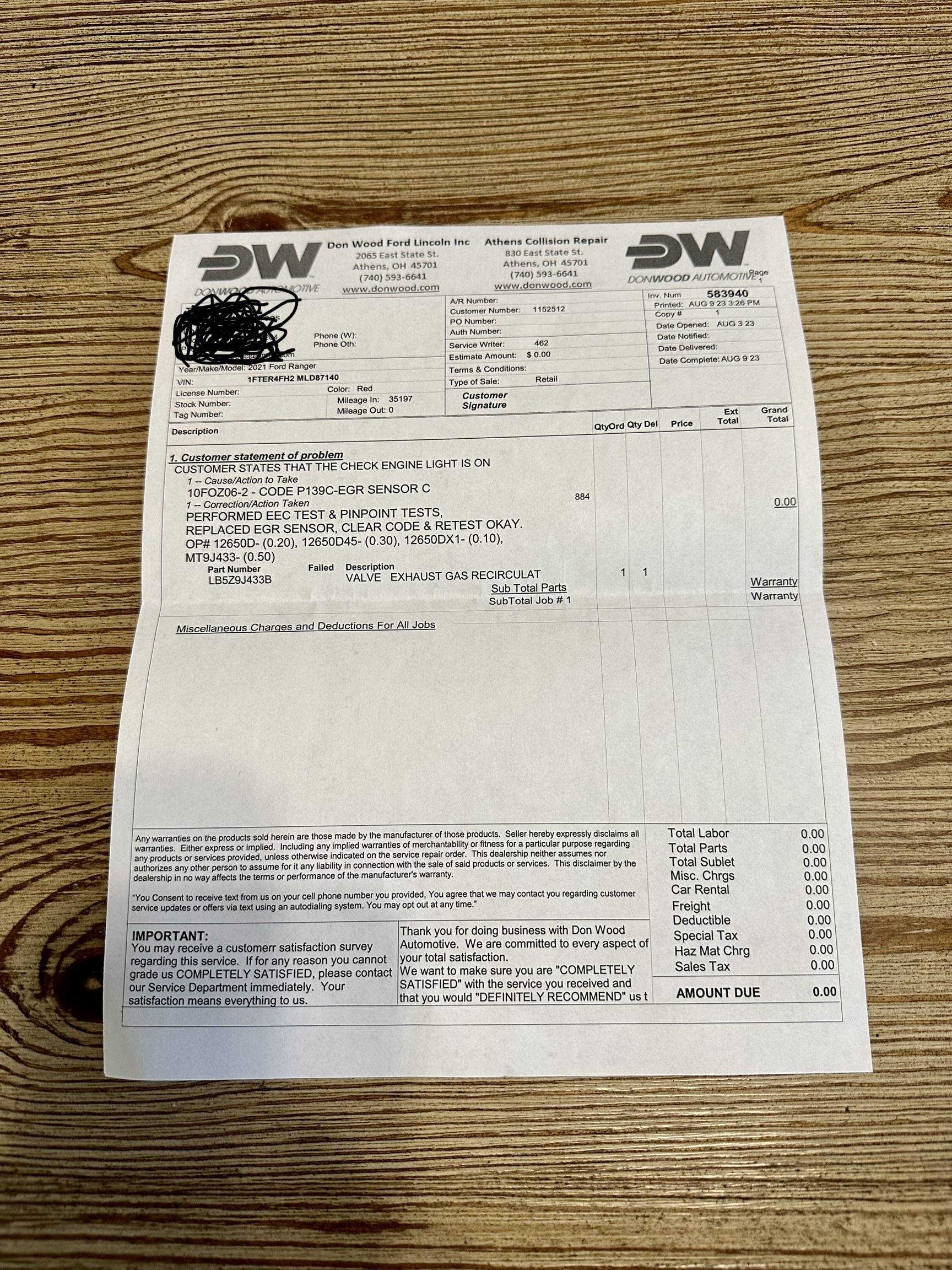
signed the papers and got my copy. Looked like the charge to ford was $250.00?
Driving was an immediate difference as mentioned by others.I noticed the transmission shifting and gearing up a down now . With the surging, bucking, coughing fits gone (hopefully) I can concentrate on how the trans behaves.

Might put the part up I have for sale for what I have in it if anyone wants it.

IMG_0058.jpeg
 

BS67

Well-Known Member
First Name
Brian
Joined
May 29, 2022
Threads
9
Messages
2,720
Reaction score
16,242
Location
Nebraska
Vehicle(s)
2022 Ranger XLT
Occupation
Eye Tech, 2A supporter, USMC "Doc" '89-'95
I have followed this thread from the beginning and bought the EGR sensor alone and not the full kit with included hoses and bracket. Noticed a couple weeks ago some of the bucking/surging in that 10-25mph range and 1000-1500 rpm range. Decided tonite after work was going to install the EGR sensor. Getting those clamps off was the $hits.......but, got 'em off. pulled off the hoses....disconnected the plug-in.....removed the sensor and bracket. Installed the sensor and installed everything with small hose clamps. Took about 45 minutes with removing the OEM clamps taking the majority of time. Will give a report after driving the XLT to work in the am! Miles on my '22 is 23,339.

Did it all without losing any tools, bolts or clamps.....
thumb.gif
 

Motorpsychology

Well-Known Member
First Name
Chris
Joined
Nov 13, 2019
Threads
21
Messages
3,294
Reaction score
11,503
Location
Prescott, WI
Vehicle(s)
2021 Ranger STX SuperCab 4X4 Carbonized grey; 2025 Mazda CX-90 Platinum Quartz
Occupation
Vagabond
I have followed this thread from the beginning and bought the EGR sensor alone and not the full kit with included hoses and bracket. Noticed a couple weeks ago some of the bucking/surging in that 10-25mph range and 1000-1500 rpm range. Decided tonite after work was going to install the EGR sensor. Getting those clamps off was the $hits.......but, got 'em off. pulled off the hoses....disconnected the plug-in.....removed the sensor and bracket. Installed the sensor and installed everything with small hose clamps. Took about 45 minutes with removing the OEM clamps taking the majority of time. Will give a report after driving the XLT to work in the am! Miles on my '22 is 23,339.

Did it all without losing any tools, bolts or clamps.....
thumb.gif
Must not have needed to use a 10mm socket
grin.webp
 

seasprite

Well-Known Member
Joined
Sep 1, 2022
Threads
25
Messages
468
Reaction score
1,111
Location
Missouri
Vehicle(s)
2022 Ranger XL STX
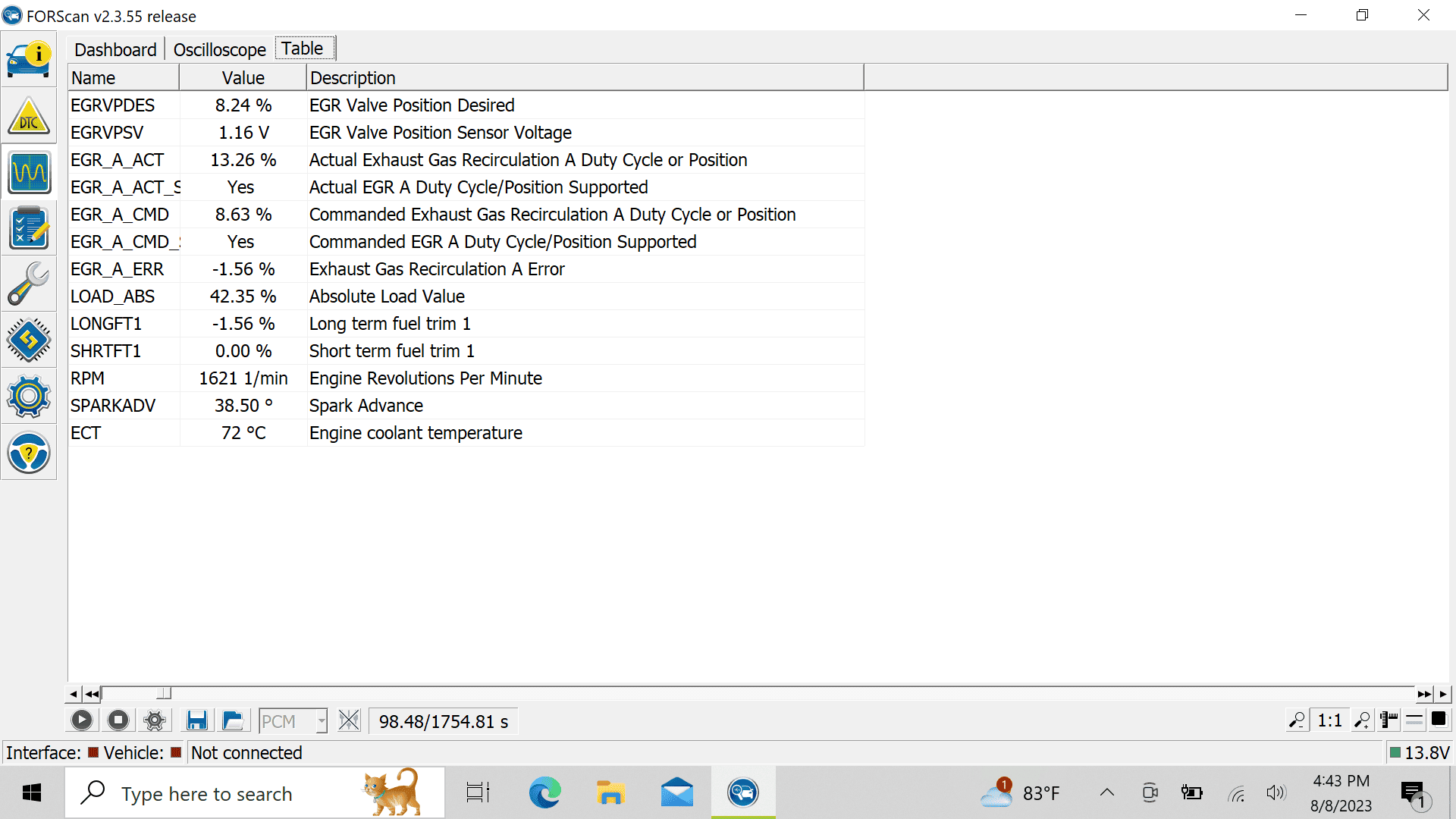
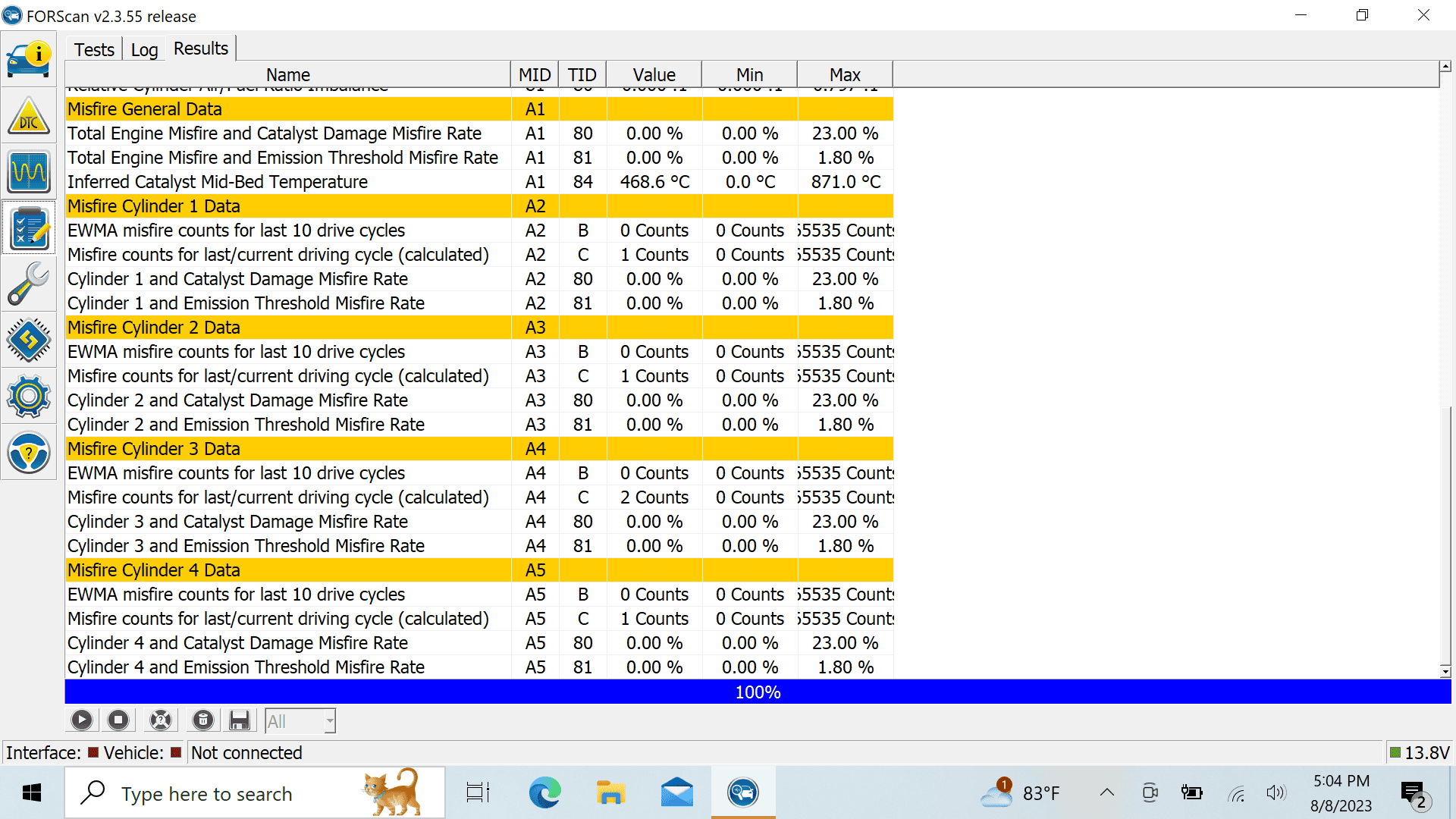
I keep trying to diag. this without just firing the parts cannon at it and keeps coming up inconclusive
:mad:
This is the data from Forscan close as I could get to the timeline of the misfire.
EGR Pids 08082023.png


Wish Forscan had the Pids for the DPFE sensor. At least mode 6 data did pick up on the miss.

Mode6egr08082023.png


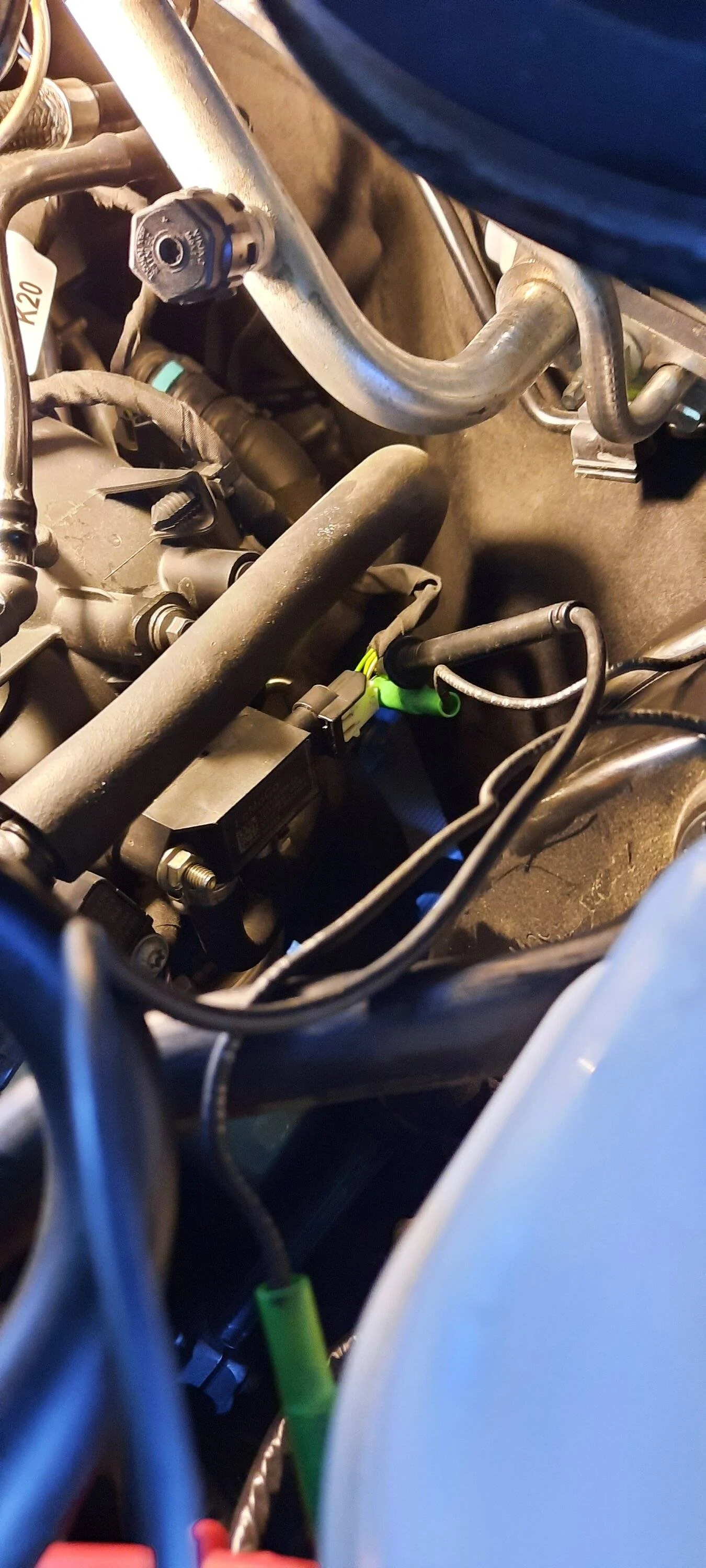
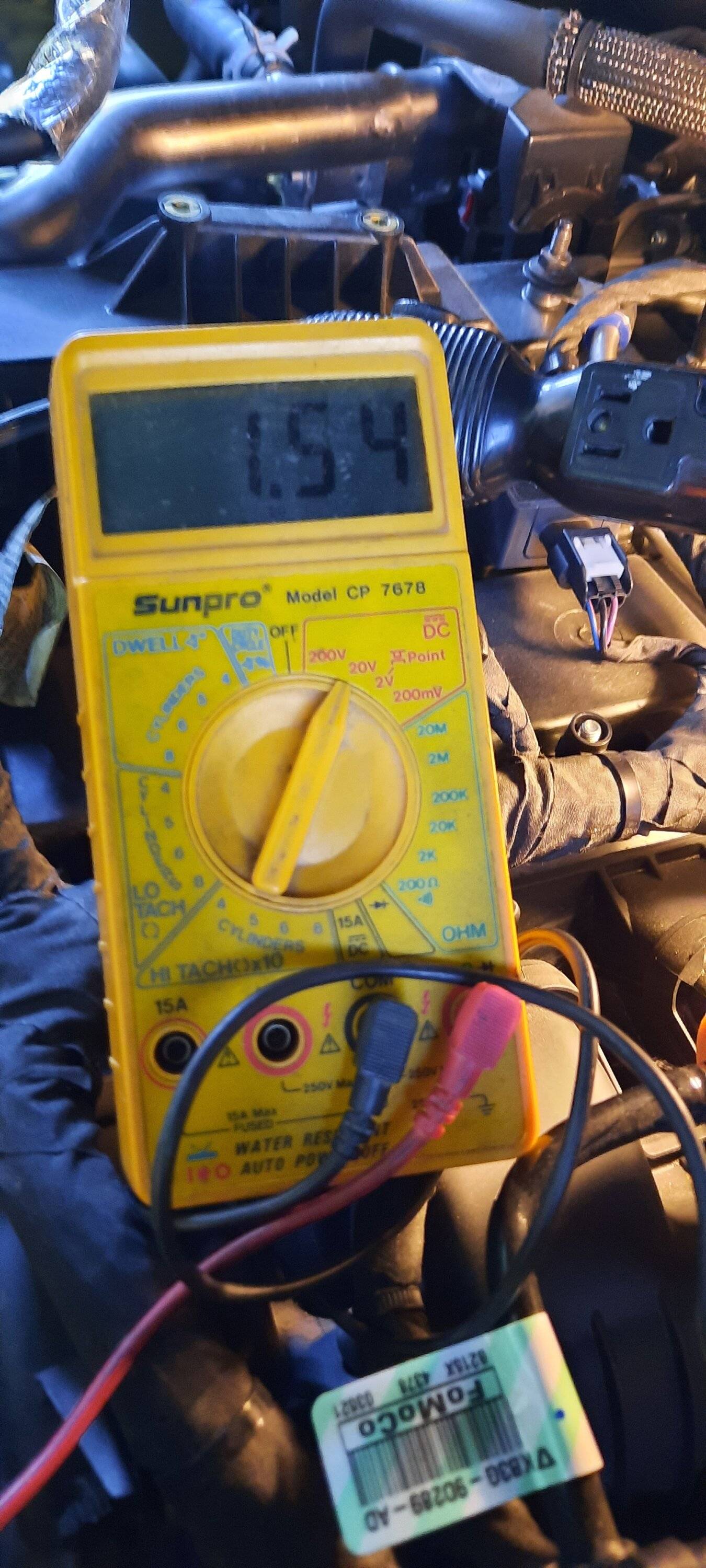
So today I decided to back probe the pins and this is my results.

20230810_093959.webp


20230810_094006.jpg


Would like to be able to diag. this but I'll probably just order the part and hope I'm another satisfied customer of Ranger 5G diagnostics forum:cool:
Sponsored


Top