Sponsored

Tremors and high octane fuel

Zvedza

Well-Known Member
First Name
David
Joined
Jul 28, 2021
Threads
2
Messages
242
Reaction score
575
Location
Florida
Vehicle(s)
'21 Ranger Tremor, '04 SVT Lightning, '16 ZX-10R
93 at shell/chevron/costco i always saw good mpg. I switched to 87 when prices got out of hand saw a .5-1mpg drop and it ran worse.

That said, with the FP tune, 33s, fox 2.5s i had roughly 18.0-18.6.
My raptor i get 18 mpg lol

Slightly offtopic, I will say a bed cover made huge difference on this truck, i tried exhaust, intake, that velossa tech thingy, none made a dent but that bed cover did a good bit, of course it went close to stock when it leveled.
Bed cover on the f150 didnt do much oddly enough.

EDIT: will say it always gave me slightly better mpg with a bottle of techron or lucas mixed in.
Sponsored

 

subquark

Well-Known Member
First Name
David
Joined
Jan 28, 2022
Threads
11
Messages
4,544
Reaction score
23,071
Location
Portsmouth, NH
Website
subQuark.com
Vehicle(s)
Soupie! Race Red '22 XL 101A Scab 4X2 w/steelies
Occupation
game publisher
In reality, you'll only get better fuel economy with premium if it has a lower ethanol content. There have been way too many studies on this to even begin to doubt it. But the internet is going to be the internet. :)
And from what little I know, isn't ethanol detrimental to engines?

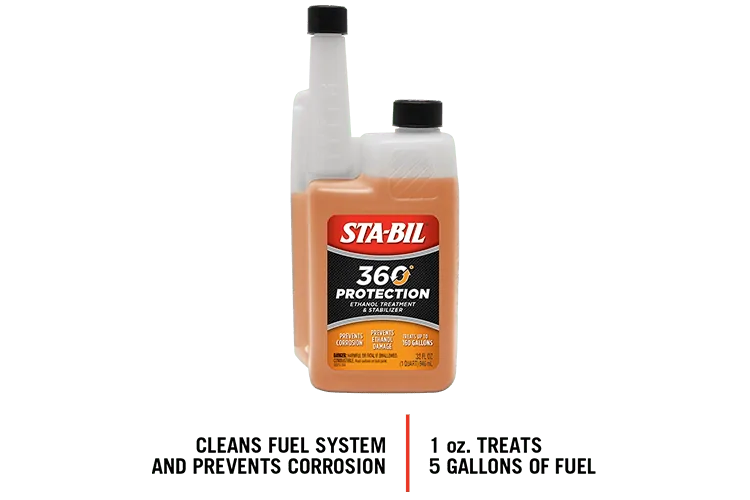
I use this stuff, mainly as a carry over from when the "Scorpion-Who-Must-Not-Be-Named " applied tremendous damper & graphene pressure on us all - from the 303 Gold Eagle company and supposedly for ethanol-blended gas:

1701802756867.webp

https://www.goldeagle.com/product/sta-bil-360-protection/
 

Jhbryaniv

Well-Known Member
First Name
John
Joined
Sep 19, 2022
Threads
5
Messages
2,788
Reaction score
7,470
Location
Colorado
Vehicle(s)
2023 Ranger Tremor
Vehicle Showcase
1
93 at shell/chevron/costco i always saw good mpg. I switched to 87 when prices got out of hand saw a .5-1mpg drop and it ran worse.

That said, with the FP tune, 33s, fox 2.5s i had roughly 18.0-18.6.
My raptor i get 18 mpg lol

Slightly offtopic, I will say a bed cover made huge difference on this truck, i tried exhaust, intake, that velossa tech thingy, none made a dent but that bed cover did a good bit, of course it went close to stock when it leveled.
Bed cover on the f150 didnt do much oddly enough.

EDIT: will say it always gave me slightly better mpg with a bottle of techron or lucas mixed in.
that little skinny pedal, tires, accessories, temperature, altitude, quality of fuel . . . Everyone will have a different result.

For me, it is the skinny pedal, bed rack, added weight and I love feeling that boost that makes me have low mpg. it is a fact of life.
 

Zvedza

Well-Known Member
First Name
David
Joined
Jul 28, 2021
Threads
2
Messages
242
Reaction score
575
Location
Florida
Vehicle(s)
'21 Ranger Tremor, '04 SVT Lightning, '16 ZX-10R
that little skinny pedal, tires, accessories, temperature, altitude, quality of fuel . . . Everyone will have a different result.

For me, it is the skinny pedal, bed rack, added weight and I love feeling that boost that makes me have low mpg. it is a fact of life.
i know, i thought the supercharger i slapped on would lower the front and get more mpgs, but for some odd reason im getting less, may lemon law it
 

Friday yet?

Well-Known Member
Joined
Oct 14, 2022
Threads
46
Messages
2,516
Reaction score
11,315
Location
Tennessee
Vehicle(s)
‘23 Lariat Tremor, Focus ST
Occupation
Corporate drone. Dilbert's world is alive & well.


Jhbryaniv

Well-Known Member
First Name
John
Joined
Sep 19, 2022
Threads
5
Messages
2,788
Reaction score
7,470
Location
Colorado
Vehicle(s)
2023 Ranger Tremor
Vehicle Showcase
1
i know, i thought the supercharger i slapped on would lower the front and get more mpgs, but for some odd reason im getting less, may lemon law it
I bet it is because of the poor engineering that caused the rear of the truck to already bo so high that the tailgate is acting as a sail, and you will need to remove the bed to increase MPG's.
 

bostonburner

Well-Known Member
Joined
Oct 26, 2022
Threads
4
Messages
76
Reaction score
140
Location
Boston
Vehicle(s)
2019 Ranger Lariat Fx4 hot pepper red metallic
93 at shell/chevron/costco i always saw good mpg. I switched to 87 when prices got out of hand saw a .5-1mpg drop and it ran worse.

That said, with the FP tune, 33s, fox 2.5s i had roughly 18.0-18.6.
My raptor i get 18 mpg lol

Slightly offtopic, I will say a bed cover made huge difference on this truck, i tried exhaust, intake, that velossa tech thingy, none made a dent but that bed cover did a good bit, of course it went close to stock when it leveled.
Bed cover on the f150 didnt do much oddly enough.

EDIT: will say it always gave me slightly better mpg with a bottle of techron or lucas mixed in.
That is a good point, since I've owned my truck I've only driven about 10 miles with the tonneau cover open. I'm basically running the same setup as you except I have 265/70 r17 tires which are about 31.6 inches vs 33's.
 

Dr_Strangelove

Well-Known Member
First Name
Adam
Joined
Oct 14, 2022
Threads
13
Messages
1,138
Reaction score
5,226
Location
Henderson, NV
Vehicle(s)
'22 XLT Supercrew 4x4
Occupation
Art, Design, Photo & Video
I'm not sure if this makes sense or not; but to me it seems if we were seeing huge variances in efficiency from 87 to 91/93 octane it would not speak very well to the performance of the engine. We shouldn't be seeing 3-4 mpg differences from fuel octane rating alone. There are so many freaking variables in calculating a vehicles per-tank mpg over the course of a year that could account for variances that I don't care to list right now - but let's leave it at daily wind speed and direction alone.

I think it's good that we can choose the fuel we'd like to use for the reasons we'd like and achieve similar performance in MPG.

I choose 91 because where I live the fuel is so expensive anyhow, I'm really only looking at a 40-cent per gallon difference to go premium. And with premium I get the "free" Shell V-power detergents that they put in their 91 and I don't have to fuss with any fuel system additives to de-gunk injectors and whatnot.
 

Dgc333

Well-Known Member
First Name
Dave
Joined
Aug 24, 2021
Threads
17
Messages
1,742
Reaction score
4,112
Location
Massachusetts
Vehicle(s)
21 Ranger Lariat
Occupation
Engineer
You don't understand engines very well do you? Under light load/ cruising you will have less advanced ignition timing compared to high load/WOT. When you have more available power(to an extent)you have the potential have better MPG especially at cruising speed since the Engine won't have to work as hard.

As for your 50+ years in driving I'm going to guess a majority of the vehicles you owned simply required 87 and nothing more. Take a vehicle that requires 91 and up and do a comparison between 87 and 91. I guarantee you will see a difference. The Ranger has more tolerance compared to some other vehicles on the market since Ford did state you can run 87.
I am going to say that you do not understand engines and the timing needs of the engine under various operating conditions if you believe an engine doesn't require more timing when cruising than at WOT. Simplest way I can explain it is to think of an older engine with a distributor. There is a mechanical advance that varies the timing based on rpm and a vacuum advance that varies the timing based on manifold vacuum level. When cruising your throttle is barely cracked so the manifold vacuum is high and the vacuum advance can is adding timing on top of the mechanical advance. A typical sbc Chevy wants about 35 degrees of advance for maximum power. A typical mechanical advance will have all the timing in around 2700 to 2800 rpm. Say you are cruising at 2200 rpm you won't have all 35 degrees of mechanical, maybe 30, but you will have high manifold vacuum. A typical vacuum advance will add 20 degrees of timing when you have high manifold vacuum. It is not unheard of for the engine to have 50 degrees of timing when cruising when 35 degrees is ideal for WOT and max power. Modern engines in general require much less timing because of more efficiently design cylinder heads and combustion chambers. A modern LS engine may only need 28 degrees of timing for max power but will still require more timing under light load cruising to see maximum efficiency.

As for my 50+ years of driving the majority of the vehicles I have had required 91/93 octane. I have been driving turbo charged 4cyl cars continuously for the past 38 years. My 13 Focus ST was the first one that said 87 was acceptable. The ST, my two Ecoboost Mustangs and the Range I have experimented with 87 and 93, never saw a difference in mileage and the reason being detonation rarely happens under cruising conditions so higher octane fuel will not have an impact.

As for my expertise I have been working on cars and engines since my teens. In college I had several lab classes where we performed experiments on all kinds of internal combustion engines to determine how to maximize power and economy. In college I taught an ASE engine basics class for mechanics looking to get ASE certification. I was a crew member on a NASCAR Late Model Sportsmen team all through college and for a number of years afterwards. I have built a number of performance engines over the years for my own hot rods and for friends. I have been a student of automotive performance all of my adult life.
 

Scott_Anderson_

Well-Known Member
First Name
Scott
Joined
Apr 26, 2023
Threads
4
Messages
100
Reaction score
362
Location
Arkansas
Vehicle(s)
2023 XLT Tremor - Cactus Gray
I’ve been running 93 since I bought mine in April. When it was stock, I’d run avg 21-22 mpg mixed city/hwy driving. Threw a rough country soft tri-fold tonneau on and, as another member mentioned above, the cover does make a big difference. I was averaging closer to 22-23 mpg. At that point, I was trying to eke out the best fuel economy possible.

But, coming from a Bronco Sport with the 2.3L engine, the main reason was the improved driving experience, shifting, responsiveness, etc. I played around with different octanes and hated how the 2.3L eco boost ran on 87 octane, which is why I ran 93 in the tremor from the start.

After I installed the Ford Performance tune on the Tremor, I’ve seen a substantial decrease in my fuel economy, from 22-23 mpg to now around 19 or 20 mpg, but no regrets.

On a side note, my Explorer Sport has the 3.5L ecoboost, and I’ve always run 87 Octane it and it runs great. No issues at all.
 

Frenchy

Well-Known Member
First Name
Chris
Joined
Mar 15, 2020
Threads
164
Messages
7,542
Reaction score
10,751
Location
Elizabeth, Colorado
Vehicle(s)
2012 Nissan Frontier, 1994 F150 XL, 2022 Ford Transit
Occupation
Field Service Technician
I am going to say that you do not understand engines and the timing needs of the engine under various operating conditions if you believe an engine doesn't require more timing when cruising than at WOT. Simplest way I can explain it is to think of an older engine with a distributor. There is a mechanical advance that varies the timing based on rpm and a vacuum advance that varies the timing based on manifold vacuum level. When cruising your throttle is barely cracked so the manifold vacuum is high and the vacuum advance can is adding timing on top of the mechanical advance. A typical sbc Chevy wants about 35 degrees of advance for maximum power. A typical mechanical advance will have all the timing in around 2700 to 2800 rpm. Say you are cruising at 2200 rpm you won't have all 35 degrees of mechanical, maybe 30, but you will have high manifold vacuum. A typical vacuum advance will add 20 degrees of timing when you have high manifold vacuum. It is not unheard of for the engine to have 50 degrees of timing when cruising when 35 degrees is ideal for WOT and max power. Modern engines in general require much less timing because of more efficiently design cylinder heads and combustion chambers. A modern LS engine may only need 28 degrees of timing for max power but will still require more timing under light load cruising to see maximum efficiency.

As for my 50+ years of driving the majority of the vehicles I have had required 91/93 octane. I have been driving turbo charged 4cyl cars continuously for the past 38 years. My 13 Focus ST was the first one that said 87 was acceptable. The ST, my two Ecoboost Mustangs and the Range I have experimented with 87 and 93, never saw a difference in mileage and the reason being detonation rarely happens under cruising conditions so higher octane fuel will not have an impact.

As for my expertise I have been working on cars and engines since my teens. In college I had several lab classes where we performed experiments on all kinds of internal combustion engines to determine how to maximize power and economy. In college I taught an ASE engine basics class for mechanics looking to get ASE certification. I was a crew member on a NASCAR Late Model Sportsmen team all through college and for a number of years afterwards. I have built a number of performance engines over the years for my own hot rods and for friends. I have been a student of automotive performance all of my adult life.
Yeah ASE is outdated unfortunately. With everything today it is all electronic based and the manufacturers have a nice thing called the ignition timing table that simply states what ignition timing should be with RPM and load. When cruising there is usually (key word here) low load compared to to WOT. With WOT you clearly want max power and the ECM will give you more ignition timing with that. I have seen this first hand with a few different vehicles that are computer controlled. Remember l, these are not the "good old days" anymore where all you need is a screw driver and a crescent to get yourself going down the road. There is a lot more involved now.
 

Saucy

Active Member
First Name
Mike
Joined
Jun 21, 2022
Threads
1
Messages
36
Reaction score
131
Location
Utah
Vehicle(s)
2022 Ranger Tremor, 2019 Hyundai Kona
Occupation
Software Slave
I noticed a minor difference in fuel economy (+2 mpg ish) running 91 octane vs 88 (mid grade). What really sold it for me was the throttle response from 0 mph was much better
 

Bsthroop

Well-Known Member
First Name
Brian
Joined
Oct 4, 2022
Threads
6
Messages
479
Reaction score
2,263
Location
New Mexico
Vehicle(s)
2019 Lariat 4x2 Sport
Occupation
Broadband/ Microwave Engineer
In terms of fuel economy and timing, the big impact will be when cruising under low load. The timing would mostly be advanced due to a low load on the engine, less so due to low engine RPM. The engine control would be maximizing the advance just below the detonation point, so higher octane fuel of good quality that reduces the inclination to detonate would allow some additional advance which would increase fuel mileage . Obviously the most impact would be those who drive long distance at constant speed, so city driving would negate much gain. The impact of timing at WOT would be to retard under heavy load and advance under low or no load.
Sponsored


Top