
Sponsored

Maximizing Battery Life

airline tech

Well-Known Member
Joined
Aug 24, 2022
Threads
28
Messages
4,447
Reaction score
8,498
Location
Midwest - KS
Vehicle(s)
2022 Ranger Lariat-Super Crew, Cactus Gray
Occupation
Aircraft Tech
I will highlight this from my above post - this may explain why the SOC drifts while you drive, along with the PCM side of the control.

Something I have noticed but never really paid attention to:
All the BMS Sensor and Charging Targets - Relate to the SOC, in my mind it always went to battery voltage:
BUT if you actually think about it and with the BMS (Calibration) it references it being used to get an ACCURATE SOC - Hmm - What if the SOC is off, then then charging system will follow that SOC Calculation, no matter what the actual voltage is.
This would be the SOC Drift - Which is supposed to correct itself on the (Sleep Calibration)
So, a more accurate reading to correct the drift
During (Engine Running) it is measuring the in & Out Current as well as voltage & Temp so the SOC may drift while driving
Sponsored
 
OP
OP

TJC

Well-Known Member
First Name
Tony
Joined
Aug 28, 2020
Threads
45
Messages
3,925
Reaction score
9,831
Location
North Carolina
Vehicle(s)
93 Miata, 05 Ranger 4x4, 20 Ranger 4x4, 23 CX-5
I will highlight this from my above post - this may explain why the SOC drifts while you drive, along with the PCM side of the control.

Something I have noticed but never really paid attention to:
All the BMS Sensor and Charging Targets - Relate to the SOC, in my mind it always went to battery voltage:
BUT if you actually think about it and with the BMS (Calibration) it references it being used to get an ACCURATE SOC - Hmm - What if the SOC is off, then then charging system will follow that SOC Calculation, no matter what the actual voltage is.
This would be the SOC Drift - Which is supposed to correct itself on the (Sleep Calibration)
So, a more accurate reading to correct the drift
During (Engine Running) it is measuring the in & Out Current as well as voltage & Temp so the SOC may drift while driving
I 'm going to have to read and reread you analysis. You've been busy! I do think the BMS sensor reports ambient temp, and it really doesn't need to have a high frequency sample rate to be effective. Your heat gun test showed how slowly the reading changed.

My truck is garaged, so I don't see large temperature variations overnight when sampling occurs. And once started I'm not sure the temperature is being monitored by the BMS, or if it is, it doesn't appear to be used until I turn off and restart the truck.

I do believe that SOC target drift is occurring. It is the only thoughtful explanation for what I have documented. I'm still in the middle of a test scenario to see if the drift occurs as the battery SOC drops over time.

I reset the BMS and fully charged the battery over several days to insure optimal battery health, then drove the truck 40 miles. SOC behaved normally and battery reached 100% SOC with 0 amps being reported.

Prior to this, my SOC charge dropped to 95%, and then down to 85%. Two distinct steps over several weeks.

I am now allowing the truck to sit for a week or so, then go for another 40 mile run. I am curious to see if the SOC target has changed. Most every variable is close to constant, temperature, battery condition, SOC.

BTW, at 100% SOC I see far less charge voltage variation only a 0.2v window, but amperage varies a great deal. I do see a large amperage spike for 10-20 seconds upon startup, and it quickly drops to the rate based on the delta between the actual SOC and the "drifted / perceived" Target SOC. The higher the difference between Actual vs Target the higher the amperage input to the battery. As the Actual SOC closes in to the Target SOC amperage decreases accordingly.

My ScanGauge reports the Actual SOC, and when I have validated the Actual SOC with both my Viking and TopDon battery testers, I see discrepancy. Both units report slight differences, but they are definable repeatable instances. The pattern of variance in their reports stays constant. Both read the SOC higher than what the BMS is reporting via the ScanGauge. But they have always been historically higher.

However, when I reset the BMS, all 3 recorded the same SOC level.

One last thought, THANK YOU for the investigative work. I very much appreciate your efforts and findings. I'll be adding your last report to my Ranger notebook.

I really wish the Target SOC would stay constant.

I'm going to keep monitoring the BMS system until I am sure I have a solid handle on what is going on and can manage it with some degree of success. Looking to define a rule of thumb (a heuristic) that I simply do every so often to keep things stable.

I am starting to work on lowing the transmission fluid temperature from the ~200F range down to the 150F-160F range. I've been monitoring the transmission temps and have noticed that my transmission is far happier at the 160F range than it is at the 180F range. Shifts are far smoother and balkiness disappears. I have also learned how to drive the truck to keep transmission temps lower... and it is contrary to what I would have thought.

I've got a couple of ideas, and have ordered and received a transmission cooler, and have PTFE hose, and AN-8 fittings on the way. I am still determining if I want to integrate the additional cooler into the system, or isolate the Ford heat exchanger from the system, using only the new cooler. There are advantages to both.

More on this in a different thread.
 

airline tech

Well-Known Member
Joined
Aug 24, 2022
Threads
28
Messages
4,447
Reaction score
8,498
Location
Midwest - KS
Vehicle(s)
2022 Ranger Lariat-Super Crew, Cactus Gray
Occupation
Aircraft Tech
First - Even though your PID for SOC (Scan Gauge) may call it SOC, if you look at the related video for the BMS Sensor - The Ford PID = Estimated SOC, if I recall when I played with FDRS this is the only PID.

Note: With the BMS sensor disconnected and a BMS Reset performed the SOC defaulted to 75%
I am seeing the same my SOC was dropping down to 85-87% when I plugged in as I am not live monitoring it.
This is why I reset it - curiosity to see what it does after this.

So, are we in agreement that the SOC reading and the Current Output are tied together?
Both of these factors dictate the - Desired Gen Voltage (Agree?)
The lower the SOC the higher the current and the higher the Desired Voltage will be. (Agree?)

I have fairly the same as you - my ASS was disabled from factory though.
So, we need to dig into the BCM - As-Built files to find the reason the SOC is shifting even with it set to 90-100%
I know there are some other settings related to the BMS system that remain constant throughout all trims, and I will go through them and post so we can determine (what each one actually does)
This may (Highlight) what is happening (Program/Software-Wise)
Keep in mind that some of the As-Built files leave you scratching your head (What the heck Is this for?) as they are not always cut & dry explained

You are the only one actually monitoring (Live-SOC) I suspect its normal for it to do this, the question is where in the programming does it happen - it would be nice to actually figure out why it does it.
 

RangerBill

Well-Known Member
First Name
Bob
Joined
Jun 8, 2022
Threads
3
Messages
1,600
Reaction score
2,121
Location
PA
Vehicle(s)
2019 Ford Ranger Lariat Super Crew FX4
Occupation
retired
First - Even though your PID for SOC (Scan Gauge) may call it SOC, if you look at the related video for the BMS Sensor - The Ford PID = Estimated SOC, if I recall when I played with FDRS this is the only PID.

Note: With the BMS sensor disconnected and a BMS Reset performed the SOC defaulted to 75%
I am seeing the same my SOC was dropping down to 85-87% when I plugged in as I am not live monitoring it.
This is why I reset it - curiosity to see what it does after this.

So, are we in agreement that the SOC reading and the Current Output are tied together?
Both of these factors dictate the - Desired Gen Voltage (Agree?)
The lower the SOC the higher the current and the higher the Desired Voltage will be. (Agree?)

I have fairly the same as you - my ASS was disabled from factory though.
So, we need to dig into the BCM - As-Built files to find the reason the SOC is shifting even with it set to 90-100%
I know there are some other settings related to the BMS system that remain constant throughout all trims, and I will go through them and post so we can determine (what each one actually does)
This may (Highlight) what is happening (Program/Software-Wise)
Keep in mind that some of the As-Built files leave you scratching your head (What the heck Is this for?) as they are not always cut & dry explained

You are the only one actually monitoring (Live-SOC) I suspect its normal for it to do this, the question is where in the programming does it happen - it would be nice to actually figure out why it does it.
Don't forget to factor in battery and/or ambient temperature, and battery age. These also factor in for the alternator charging voltage setpoint. (Colder equals higher setpoint). Age equals higher setpoint?
 
Last edited:

airline tech

Well-Known Member
Joined
Aug 24, 2022
Threads
28
Messages
4,447
Reaction score
8,498
Location
Midwest - KS
Vehicle(s)
2022 Ranger Lariat-Super Crew, Cactus Gray
Occupation
Aircraft Tech
Don't forget to factor in battery and/or ambient temperature, and battery age. These also factors in for the alternator charging voltage setpoint. (Colder equals higher setpoint). Age equals higher setpoint?
True - but with a BMS Reset - it resets the battery age, so as far as the system knows it's a new battery.
Yes, the PCM is using the IAT as a ref in addition to the BMS Sensor and it may also be using AMB as well.
The point is: I still think that (Temps) play a role in the algorithm even with the BMS Sensor disconnected and with it connected the PCM is using both the BMS & IAT and possibly AMB.
I think the SOC update is the sensor is reading (@ Rest) voltage on the battery and accounting for temp and battery age - The software (column counting) derives to an Estimated SOC
While driving you have a draw and the generator applying a charge, and how much the battery is being offset (Charge over the Draw) directly ties to what the BMS has as a (Estimated SOC)
even though you may have a fully charged battery the SOC may be reading lower as if it's under charged.

This is where the (?) lies as to why its set up this way - it appears to be in the programming, and most will never see any issue unless you start seeing the - System Off to Save Battery Message as the battery SOC is not a widely monitored (live data), I know I do not and only see it if I am plugged in.
I only (not all the time) monitor the voltage with the (Plug-In) voltmeter on the power point, so this is a new (not an issue) but want to know why it does this.
As I have always stated, in my career and T-Shooting a system, it greatly helps if you have a general understanding on what is happening with every action by the flight crew.
If you do not know - the various manuals will provide a DETAILED explanation, this is where the automotive manuals lack the detail and it forces you to do your own investigation into the system.
Which is the point we are at now.
This is why I like to pick a system and dissect it and fill in the blanks with the unknowns by either Google and then weed out the (Does Not Make Sense or Incorrect) D&O's and then also add in a true hands-on test with my meter and or scan tools.
Explanations of the BMS System are all over the place and there is not (One) document that puts it into a DETAILED D&O. We know the basics but it's the DETAILS I am interested in.
It may not be important but it's something that drives me for the knowledge of the unknown.


OP
OP

TJC

Well-Known Member
First Name
Tony
Joined
Aug 28, 2020
Threads
45
Messages
3,925
Reaction score
9,831
Location
North Carolina
Vehicle(s)
93 Miata, 05 Ranger 4x4, 20 Ranger 4x4, 23 CX-5
Don't forget to factor in battery and/or ambient temperature, and battery age. These also factors in for the alternator charging voltage setpoint. (Colder equals higher setpoint). Age equals higher setpoint?
This is exactly why I reset the BMS... I did not want the BMS to treat my battery as if it were in a weakened state due to age alone... So I reset it to determine if the SOC target reverted back to my 100% setting. And it did. That said, skid marks and stop signs do not cause accidents. Correlation is not causation.

I need to continue to monitor to see if the pattern reappears. It transitioned in a month or two from 100% down to 95%, then down to 85%. The ScanGauge showed the SOC target never reaching 100%, first drop was to 95% as amperage went to 0. Voltage stayed remarkably stable. Happened again at 85%...same pattern.

It is easy to validate this. All I need to do it change the target SOC with Forscan and see what ScanGauge reports.

I believe the "Estimated SOC" is possibly a derived target that is dynamic, based upon algos in the BMS Firmware. I can contact the ScanGauge Support folks and ask for the PID info to track it with ScanGauge. Their engineering guys are pretty good at delivering that information.

Edited to correct errors in my report
 
Last edited:
OP
OP

TJC

Well-Known Member
First Name
Tony
Joined
Aug 28, 2020
Threads
45
Messages
3,925
Reaction score
9,831
Location
North Carolina
Vehicle(s)
93 Miata, 05 Ranger 4x4, 20 Ranger 4x4, 23 CX-5
Your comments in bold

First - Even though your PID for SOC (Scan Gauge) may call it SOC, if you look at the related video for the BMS Sensor - The Ford PID = Estimated SOC, if I recall when I played with FDRS this is the only PID.

I misspoke in an earlier note. ScanGauge DOES show a drop in SOC and reports accurately what the present condition of the SOC is... It may very well be the "estimated SOC" that you speak of. Going back to update my previous post.

I believe the "Estimated SOC" is possibly a derived target that is dynamic, based upon algos in the BMS Firmware. I can contact the ScanGauge Support folks and ask for the PID info to see if they can confirm your findings. Their engineering guys are pretty good at delivering that information.

Note: With the BMS sensor disconnected and a BMS Reset performed the SOC defaulted to 75%
I am seeing the same my SOC was dropping down to 85-87% when I plugged in as I am not live monitoring it.
This is why I reset it - curiosity to see what it does after this.


I ran the same test. I'll have confirmation in a week or 3. I fully expect the SOC in ScanGauge to drop from 100%, with the amperage and voltage to also reflect a change in the "Estimated SOC" that you report. I expect to see charge amperage to drop to 0 well before reaching 100%. I have already driven the truck the first 40 mile trip since resetting the BMS and the truck charged the battery to 100% SOC. It has now sat a week, and I intend to drive another 40 miles trip later this week. I expect to see the amperage behave normally, but reach 0 before the SOC reaches 100% sometime in the next few trips... unless resetting the BMS changed the Algo parameters... a distinct possibility.

If this is the case, once every oil change I'll be resetting the BMS to insure optimal charging parameters continue. I would not recommend folks do this unless that have a healthy battery with an onboard desulfator installed, ASS turned off, and a high SOC target. I am actually hoping the BMS is intelligent enough to be doing this.

So, are we in agreement that the SOC reading and the Current Output are tied together?
Yes

Both of these factors dictate the - Desired Gen Voltage (Agree?)
Yes

The lower the SOC the higher the current and the higher the Desired Voltage will be. (Agree?)
Yes, <IF> BMS sensor is plugged in, and SOC is at default of 70%-75%.

I have not tested all the permutations, but I remember seeing regenerative voltage spikes with ASS off and everything else being stock. I had one of those ASS auto off switches installed.

I have fairly the same as you - my ASS was disabled from factory though.
So, we need to dig into the BCM - As-Built files to find the reason the SOC is shifting even with it set to 90-100%


Agreed, but we may find there is not much we can do about it.

I know there are some other settings related to the BMS system that remain constant throughout all trims, and I will go through them and post so we can determine (what each one actually does)
This may (Highlight) what is happening (Program/Software-Wise)


Agree

Keep in mind that some of the As-Built files leave you scratching your head (What the heck Is this for?) as they are not always cut & dry explained

I suspect Ford is protecting intellectual property much like John Deere did to farmers. Farmers sued and finally won the right to repair.

You are the only one actually monitoring (Live-SOC) I suspect its normal for it to do this, the question is where in the programming does it happen - it would be nice to actually figure out why it does it.

Why it does it, and how can we optimize / mitigate the negative aspects of the system parameters.

Thank you again for digging into this. I very much appreciate your efforts.
 
OP
OP

TJC

Well-Known Member
First Name
Tony
Joined
Aug 28, 2020
Threads
45
Messages
3,925
Reaction score
9,831
Location
North Carolina
Vehicle(s)
93 Miata, 05 Ranger 4x4, 20 Ranger 4x4, 23 CX-5
Don't forget to factor in battery and/or ambient temperature, and battery age. These also factors in for the alternator charging voltage setpoint. (Colder equals higher setpoint). Age equals higher setpoint?
I think temperatures are only checked upon start up. I suspect this as both my 4G and 5G changed parameters (voltage and amperage levels) only when I stopped and restarted the truck. Drove 20 miles and voltage only varied about .02v. Turned off and restarted the truck and voltage window dropped lower, then as the system charged again dropped ~0.2 volts. I never see it drop from 14.2v to 13.8v without restarting the truck.
 

airline tech

Well-Known Member
Joined
Aug 24, 2022
Threads
28
Messages
4,447
Reaction score
8,498
Location
Midwest - KS
Vehicle(s)
2022 Ranger Lariat-Super Crew, Cactus Gray
Occupation
Aircraft Tech
I will say that I just completed a - Test Drive with my scanner hooked up:
The drive was an in-town drive to dinner and back - 20-Min each way
I noted:
Started the SOC @ 88% and it climbed to 90% and at 90% Amps went to 0 - There
Started the SOC @ 89% and it stayed there and charging amps was 3 amps - Back
I think I need to DBL Check my SOC (Forscan) setting I thought I bumped it to 95%, maybe I forgot to write it(?) as I am wondering why my charging amps went to (0) @ 90%
So now this HIGHLIGHTs something for this PID, and question with my SOC set to 90 (Forscan) will this PID display anything over that, say 100% -TBD, I have not monitored this PID enough to see - yet as I have only viewed this PID - until today from a parked truck in the garage.
Note: This was also the first drive since a BMS Reset - might be a factor.
Of course, battery current varied:
I think I see and can possibly verify that - all the short drive issues that show up with the factory charging (SOC) and how SLOWLY it actually increases.
That YES, the SOC is what actually drives the charging and that if you are only making short trips consistent the SOC will never actually climb as I am set to 95% SOC.
Where TJC is driving 40-Mile Trips, he is actually seeing the SOC to hit 100%.
My work drive is back roads, and no HI Way drives 25-Min ea way - max speed 45 ;)

So, the task is getting the SOC to update faster as we know the battery is receiving the charge and @ shutdown the battery charge is full.
At least I THINK that this is what we need to look into - TBD
 
OP
OP

TJC

Well-Known Member
First Name
Tony
Joined
Aug 28, 2020
Threads
45
Messages
3,925
Reaction score
9,831
Location
North Carolina
Vehicle(s)
93 Miata, 05 Ranger 4x4, 20 Ranger 4x4, 23 CX-5
I will say that I just completed a - Test Drive with my scanner hooked up:
The drive was an in-town drive to dinner and back - 20-Min each way
I noted:
Started the SOC @ 88% and it climbed to 90% and at 90% Amps went to 0 - There
Started the SOC @ 89% and it stayed there and charging amps was 3 amps - Back
I think I need to DBL Check my SOC (Forscan) setting I thought I bumped it to 95%, maybe I forgot to write it(?) as I am wondering why my charging amps went to (0) @ 90%
So now this HIGHLIGHTs something for this PID, and question with my SOC set to 90 (Forscan) will this PID display anything over that, say 100% -TBD, I have not monitored this PID enough to see - yet as I have only viewed this PID - until today from a parked truck in the garage.

Note: This was also the first drive since a BMS Reset - might be a factor.
Of course, battery current varied:

I think I see and can possibly verify that - all the short drive issues that show up with the factory charging (SOC) and how SLOWLY it actually increases.
That YES, the SOC is what actually drives the charging and that if you are only making short trips consistent the SOC will never actually climb as I am set to 95% SOC.

Where TJC is driving 40-Mile Trips, he is actually seeing the SOC to hit 100%.
My work drive is back roads, and no HI Way drives 25-Min ea way - max speed 45 ;)

So, the task is getting the SOC to update faster as we know the battery is receiving the charge and @ shutdown the battery charge is full.
At least I THINK that this is what we need to look into - TBD
First, I am gratified that someone is validating my results.

A three amp charge is about what I see when I am within 5-6 points of the target SOC. If your target SOC is 95 It will drop to 1 amp charge about 2 points from target SOC. You'll be seeing a 1 amp charge rate just as it begins to shift to within 1 point of Target SOC.

Second, I do not see a great deal of current or voltage fluctuation with regards to engine RPM or current loads from headlights, AC, etc. The system is powerful enough to cover all those conditions without showing any signs of weakness. The charge rate is the quite predictable under all of those conditions. I see a burst of current upon initial startup that quickly drops to under a 10amp charge rate. It then drops to 5-6 amps until it closes within 5-6 points of the target SOC. The last few points take as long as the charge up to that point. The BMS is very careful to not overcharge the battery, it literally drops to a trickle charge when it is within 2-3 points of the target SOC... (What ever the system thinks the SOC is.)

Third, I think you just witnessed what I have observed when you went to dinner. 90% SOC going to dinner. And it sounds like it adjusted to the 95% target on the run back home.

I have only seen my system hit the 100% SOC target 3 times in my testing. It was low more than on target. It stayed at 95% SOC charge for several weeks, then it dropped to a low of 85% SOC. That's what prompted me to reset the BMS and fully charge the battery (including running the desulfator process for over a week. First drive after it charged to 100%. I have not taken it out since, but plan to in the next few days.

Be warned, the charge voltage will drop to the mid 13v range after a BMS reset, then slowly adjust up to 14.0v-14.2v range over the next several days of driving time. The amperage charge rate did not appear to be affected.

I'll report my findings.

I have no idea why it does this. Makes no logical sense to me.
 

airline tech

Well-Known Member
Joined
Aug 24, 2022
Threads
28
Messages
4,447
Reaction score
8,498
Location
Midwest - KS
Vehicle(s)
2022 Ranger Lariat-Super Crew, Cactus Gray
Occupation
Aircraft Tech
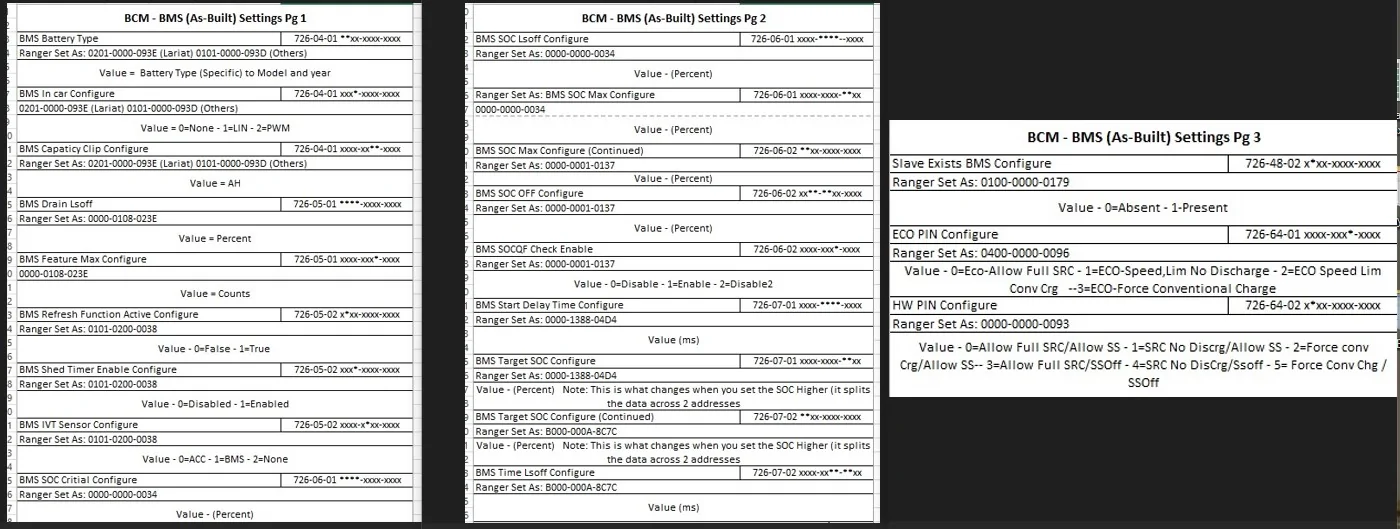
Here are the As-Built Addresses for the BMS, I only included the ones related to charging and battery.
I am curious what the ECO & Hardware PIN Config will do as well as the BMS Feature Max (Counts)
Which this is a prime example (BMS Max Configure) - Its hard-to-find specific information on what this is and there are many others like this within the databases that leave you (?) as what it is and there are a ton of abbreviations like (ex; Linsel - EXEEL and FEEL) I know the Linsel = LIN Select.
And I do not understand why we do not have (Public View) of the PCM Databases, I see some for other models but not the Ranger. Ok RANT Over:)

I should also add a FYI (Understand) that these lines are (Hex Data) and when you need to change something here - such as (Percent) you need to use a Decimal to Hex Convertor

BMS As-Built Post Final.webp
 
Last edited:
OP
OP

TJC

Well-Known Member
First Name
Tony
Joined
Aug 28, 2020
Threads
45
Messages
3,925
Reaction score
9,831
Location
North Carolina
Vehicle(s)
93 Miata, 05 Ranger 4x4, 20 Ranger 4x4, 23 CX-5
Another data point that I will validate later today. The last ride out I drove 50 miles during the night, 25 with the BMS sensor plugged in, and 25 miles back with the BMS Sensor unplugged.

Note that with the sensor unplugged I was flying blind. I only had voltage reporting real time to me via the ScanGauge. Amperage and SOC stayed fixed at the last reported state.

I started the first 25 mile leg with a SOC of 88% as reported by the ScanGauge. Amperage went to 0 at 91% and stayed there the entire 25 miles. I pulled into a gas station and unplugged the BMS sensor and drove the 25 miles back home. I turned off the truck, plugged the BMS sensor back in, the restarted the truck. SOC was at 100%, amperage at 0, and voltage the same in both instances, 14.1v. I manually checked the battery state with both the Viking and TopDon battery testers, both showed SOC at 100%.

I will be validating this test to determine if the pattern persists - definable and repeatable. I'll report back the results later today.
 

airline tech

Well-Known Member
Joined
Aug 24, 2022
Threads
28
Messages
4,447
Reaction score
8,498
Location
Midwest - KS
Vehicle(s)
2022 Ranger Lariat-Super Crew, Cactus Gray
Occupation
Aircraft Tech
I think what is confusing the SOC Reading (we are seeing-during the drive)
If I reflect back to my original dive into the system, I came across these 2 charts.
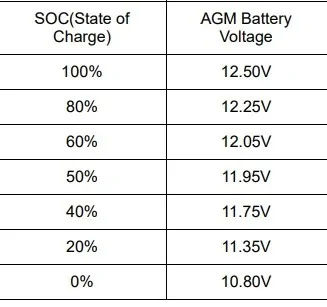
I suspect the SOC Reading we are seeing is relating to this chart:

This was a chart I found (Battery Under Load)
It may not be fully accurate, but I think that this MAY be what the sensor is reporting as we drive and see the SOC Climb.

SOC Under Load.webp


Once we shut down - the SOC now has a new reading to (Calculate) @ Rest Voltage
This is the (Recalibration Cycle) to read the true voltage at the battery since it cannot provide an accurate reading during the drive (Charging)

Ford SOC Chart.webp


Since: We are noting that the SOC is about 85%-88% or so @ just after start, this involves current draw on the battery (Door-Open) and (Drain from Engine Crank)
The BMS sensor reading would be (Displaying) the SOC it obtained from its last (Calculation) check which would have been during the sleep period (Rest)

I feel the above is what we are seeing, regarding the SOC, and the system is using the (Overnight) SOC as a reference to 100%.
I am trying to explain it, so it makes sense, the longer you drive the SOC will climb as its sampling the voltage periodically - so it's using the (Under Load-Chart) and may be the reason for it tapering off the charge to (0-Current)
It's not using the (Engine Off-Open Circuit Voltage) as its reference to 100% SOC

I may be incorrect here, but it would possibly explain - the SOC inconstancies and variations we are seeing - (During the Drive) and it's also about the time frame (on how often) the BCM sends a request for updated information from the (BMS Sensor) for the SOC Factor.
We know that the (Current In/out) and voltage readings are always live data.
I think the SOC factor is different.
And if we were to check the battery voltage with hood opened and latch closed - the battery voltage would match with the SOC chart 88% or so prior to opening the doors etc, and it drops to 12.1 or so.

Opinions on this welcome
Since this is not covered in the manuals it's my theory based on the PID data we are actually seeing.
 
Last edited:

airline tech

Well-Known Member
Joined
Aug 24, 2022
Threads
28
Messages
4,447
Reaction score
8,498
Location
Midwest - KS
Vehicle(s)
2022 Ranger Lariat-Super Crew, Cactus Gray
Occupation
Aircraft Tech
I am thinking (curiosity)
Pull up the SOC PID and Battery voltage,
Key on (only) battery discharge, we will see the voltage drop but does the SOC drop with it? It may take a while for the SOC range to lower, but curious if this follows the same as my temperature test.
No immediate response as this may also be a factor on what the SOC is actually displaying.
As both the SOC and Temp are listed as Estimated- this leads me to believe it’s just that and not a direct reading.
 
OP
OP

TJC

Well-Known Member
First Name
Tony
Joined
Aug 28, 2020
Threads
45
Messages
3,925
Reaction score
9,831
Location
North Carolina
Vehicle(s)
93 Miata, 05 Ranger 4x4, 20 Ranger 4x4, 23 CX-5
I had a chance to drive the ranger this evening and capture some data.

Before I begin, over a week ago I charged my battery to 100% SOC and let it desulfate for several days. Here are the result 24 hours after the charge cycle was complete... Right after the charge was completed I started the truck to capture the SOC via the ScanGauge. It was back to 100%. I started the truck and drove it just far enough to insure the 100% stayed. It did. I parked the truck, opened and kept the hood up, and locked the latch, and did not open doors or activate any power drains. I waited 2 hours and simply attached the tester and took the results.

State of Health - 100%​
State of Charge - 100%​
Measured CCA - 913 (that's 127% of the stated rating of the battery when new - 720CCA)​
Voltage - 12.89v​
Internal Resistance - 3.28mOhms (this is an excellent reading)​

Fast forward today. Remember it's been 8 or 9 days since the above test was performed. I again simply attached the tester and measured the battery status. Charge Voltage never changes - Stays within 14.1v - 14.3v.

State of Health - 100%​
State of Charge - 100%​
Measured CCA - 899 (Battery rated at 720 CCA)​
Voltage - 12.75v​
Internal Resistance - 3.34mOhms (this is an excellent reading)​

I am quite pleased with this result. Honestly, it surprised me that it was this high.

I then started the truck, drove 20 miles, shopped for an hour. and drove 20 miles back home. Upon starting the truck I took note of SOC. The BMS was reporting the following

SOC - 90%
Voltage - 14.1v - 14.3v (constantly moving, changing every second or so.
Amperage -
- Very briefly saw a -13 amp draw, that flashed on the screen for second​
- Briefly 13+ amps, dropped to 5 amps within ~100'.​
- Dropped to 3 within 1 mile​
- Dropped to 3 within another mile​
- At 7 miles dropped to 2, & SOC climbed to 91​
- At 11 miles dropped to 1. Nothing changed the next 9 miles to the store.​
Returned to the truck and started it up. The ScanGauge reported the following:

- SOC - back down to 90%​
- Very briefly saw a -26 amp draw, that flashed on the screen for second​
- Briefly 14+ amps, dropped to 6 amps within 1/4 mile.​
- Dropped to 5 amps within 1 mile, and stayed there for 3 miles​
- Dropped to 2 amps and stayed there for 10 miles​
- Dropped to 1 amp and stayed there the last 7 miles.climbed to 91​
- At 11 miles dropped to 1. Nothing changed the next 9 miles to the store.​
- SOC reached 92% at 19 miles & stayed there until I parked the truck.​

We unloaded our purchases, I raised the hood, locked the hood latch, closed the doors, and performed the battery test again. Results:

State of Health - 100%​
State of Charge - 100%​
Measured CCA - 887 (Battery rated at 720 CCA)​
Voltage - 12.81v​
Internal Resistance - 3.38mOhms (this is an excellent reading)​
I'll take the test again in the morning, allowing the battery to rest.. Remember I see a 13 amp draw when I open my doors.

Interesting results. Even with the BMS reporting a SOC of 90%, the actual condition of the battery was charged very consistently.

It took 9 miles to achieve the trickle charge state (1 amp charge) going to the store. Coming back took 13 miles to do the same. I was driving at night with headlights on, fog lights on, and AC on, with fan on low.

However, I have seen not a difference in charge rates under any of the conditions that I have tested, voltage and amperage charge behaves exactly the same no matter the load, day or night.

Your results will vary - Parameters that I have changed
- ASS - Turned off via ForScan​
- SOC set to 100% via ForScan​
- Misc Bells and Whistles turned off, or minimized via ForScan​
- BMS sensor plugged in​
- Installed BatteryMinder Onboard Desulfator​
- Installed AMP Research Power Steps​
- Telematics completely Disabled - Power removed​

I will update this note with the battery test tomorrow AM.

Morning Update - 10 Hours after drive and last battery health measurement

State of Health - 100%​
State of Charge - 100%​
Measured CCA - 882 (Battery rated at 720 CCA)​
Voltage - 12.83v​
Internal Resistance - 3.40mOhms (this is an excellent reading)​
Sponsored

 
Last edited:


Top