Sponsored

Fuel in oil

Porpoise Hork

Well-Known Member
First Name
Bret
Joined
Apr 28, 2020
Threads
19
Messages
1,316
Reaction score
2,366
Location
Houston
Vehicle(s)
2022 F150 XLT Powerboost FX4 302A Oxford White
Occupation
IT
This was an interesting read. I have 1800 miles on my Ranger and will be changing the oil soon. I haven't detected the gas smell, but I think I will have an oil analysis done.

A forum member in an oil thread posted that he was going to use Mobil 1 Annual Protection 5W-30 since it was recommended by Mobil 1 for for the Ranger. Looking at the specs, it meets the API SN Pluse Resource Conserving requirements as well as ACEA A5/B5 requirements.

Which ACEA requirements would be best for this engine was not stated in the article (that I could find anyways). ACEA A5/B5 is as follows:

"ACEA A5/B5 Stable, stay-in-grade Engine Oil intended for use at extended Drain Intervals in Passenger Car & Light Duty Van Gasoline & Diesel Engines designed to be capable of using Low Viscosity Oils with HTHS Viscosity of 2.9 to 3.5 mPa*s. These Oils are unsuitable for use in certain Engines - consult vehicle-OEM’s owner’s manual/handbook in case of doubt. "

Unless there is something more suitable, I think I'm going to give this oil a shot. Thoughts?

Recently I found out that Mobile 1 along with a large percentage of the private label oils on the market are produced by Warren Distributing. Curious to what brands Warren Distributing covers I found this list.

https://engineoil.api.org/Directory/EolcsResultsDetail?accountId=-1&companyId=10297


I also researched US available oils and saw that the GM rated 1 DEXOS Gen2 compliant oils meets or exceeds ACEA C3 standards.


https://www.gmdexos.com/brands/dexos1/index.html

What caught my eye was Amazon Basics 5w-30 Full Synthetic. Not only is it 1 DEXOS 2 approved, but it's produced by Warren Distributing. And it's fairly inexpensive compared to the prices at the local auto parts stores.

Bottom line is you don't have to necessarily spring for a specific brand as most of them are made by the same company anyway. And as long as they are 1 DEXOS Gen 2 rated they are in line with ACEA standards. Which is of course better for our engines anyway.
Sponsored

 

2ford

Banned
Banned
Joined
Jan 14, 2020
Threads
2
Messages
104
Reaction score
104
Location
Oregon
Vehicle(s)
19 ranger
I was trying to find more information about this potential issue, and came across the following article from a 2009 issue of MTZ Worldwide about the creation of the 3.5 L V6 Ecoboost, written by a bunch of folks at Ford.

Here's the Link. (Note: Since this is Springer, it might be paywalled, depending on where you're accessing it from).

The key quote for this thread is:
"Through this methodology, the combustion system achieved the program objectives:
. . .
– under all operating conditions, undetectable fuel/cylinder impingement and fuel/oil dilution comparable to other direct fuel injected engines (approximately 5 % dilution). " (My emphasis)

So if I understand this correctly, getting fuel dilution of ~5% is within the stated goals of engine development for this predecessor to our engine. If that's true, and thus the 6% that showed up on my first UOA may not be as damaging as I feared it might be.

I never had fuel dilution in my 2011 DI 2.4 buick had 40k on it when I traded it in. I did my oil changes never ever had increased level in oil never any fuel dilution
 
  • Like
Reactions: Doc

HenryMac

Well-Known Member
First Name
John
Joined
Sep 14, 2019
Threads
66
Messages
2,783
Reaction score
5,360
Location
Colorado
Vehicle(s)
2019 SuperCab XL - FX4 - Magnetic - Rocksliders
Occupation
Mech. Engineer - Retired
I never had fuel dilution in my 2011 DI 2.4 buick had 40k on it when I traded it in. I did my oil changes never ever had increased level in oil never any fuel dilution
Every internal combustion engine has fuel dilution. Rings leak, it's the nature of the beast.

Your Buick had it, but the fuel dilution was within spec, therefore it wasn't a problem.

Ford will get this sorted out. It's the price you pay for buying new(ish) technology.
 

2ford

Banned
Banned
Joined
Jan 14, 2020
Threads
2
Messages
104
Reaction score
104
Location
Oregon
Vehicle(s)
19 ranger
Every internal combustion engine has fuel dilution. Rings leak, it's the nature of the beast.

Your Buick had it, but the fuel dilution was within spec, therefore it wasn't a problem.

Ford will get this sorted out. It's the price you pay for buying new(ish) technology.
Explain what you call fuel dilution please. In my experience every engine may have a certain amount of "BLOW BY " which is spent combustion gases. The higher the cylinder pressure the more blow by depending on how well the rings have seated. Brand new engines will usually have more blow by gases till the rings seat. If any minuscule amount of non combusted fuel is in the blow by gases it would be re absorbed by the pcv system or evaporate when engine oil temperatures get up to normal operating temps. If what you are suggesting is true especially with the amount of gas in the oil that is happening to these folks that would be like in kind to cylinder washout which would effect the rings seating among other issues and is not normal. And I will repeat I had no gas EVER in my GDI regal nor in any of the vehicles I have owned that caused the oil to smell like gas or increase the crank case oil level.
 

HenryMac

Well-Known Member
First Name
John
Joined
Sep 14, 2019
Threads
66
Messages
2,783
Reaction score
5,360
Location
Colorado
Vehicle(s)
2019 SuperCab XL - FX4 - Magnetic - Rocksliders
Occupation
Mech. Engineer - Retired
Explain what you call fuel dilution please. In my experience every engine may have a certain amount of "BLOW BY " which is spent combustion gases. The higher the cylinder pressure the more blow by depending on how well the rings have seated. Brand new engines will usually have more blow by gases till the rings seat. If any minuscule amount of non combusted fuel is in the blow by gases it would be re absorbed by the pcv system or evaporate when engine oil temperatures get up to normal operating temps. If what you are suggesting is true especially with the amount of gas in the oil that is happening to these folks that would be like in kind to cylinder washout which would effect the rings seating among other issues and is not normal. And I will repeat I had no gas EVER in my GDI regal nor in any of the vehicles I have owned that caused the oil to smell like gas or increase the crank case oil level.
I agree with everything your saying... except... "I never had fuel dilution".. every internal combustion gasoline motor experiences it on some level.. It just normally not excessive, but it is always there.

Any fuel in the crankcase causes fuel dilution. This happens especially when the motor is cold. Once the motors comes up to temperature then the fuel, and any condensation, turns to vapors and are typically evacuated from the crankcase by the PCV system, if your vehicle has one.

My point is.. fuel dilution happens, it in itself is nothing new. The issue the folks are having is something other than the normal blow by.

Ford is working their way through the issue, and it appears they are finding it is high pressure fuel pump or injector related.... not blow by related.

As I said Ford will get this sorted out. It's the price you pay for buying new(ish) technology.
 
Last edited:


N. J. Jim

Well-Known Member
First Name
Jim
Joined
Apr 23, 2020
Threads
0
Messages
273
Reaction score
447
Location
Vineland,N. J.
Vehicle(s)
2019 Ford Ranger Lariat
Occupation
Retired
I agree with everything your saying... except... "I never had fuel dilution".. every internal combustion gasoline motor experiences it on some level.. It just normally not excessive, but it is always there.

Any fuel in the crankcase causes fuel dilution. This happens especially when the motor is cold. Once the motors comes up to temperature then the fuel, and any condensation, turns to vapors and are typically evacuated from the crankcase by the PCV system, if your vehicle has one.

My point is.. fuel dilution happens, it in itself is nothing new. The issue the folks are having is something other than the normal blow by.

Ford is working their way through the issue, and it appears they are finding it is high pressure fuel pump or injector related.... not blow by related.

As I said Ford will get this sorted out. It's the price you pay for buying new(ish) technology.
 

N. J. Jim

Well-Known Member
First Name
Jim
Joined
Apr 23, 2020
Threads
0
Messages
273
Reaction score
447
Location
Vineland,N. J.
Vehicle(s)
2019 Ford Ranger Lariat
Occupation
Retired
I agree with everything your saying... except... "I never had fuel dilution".. every internal combustion gasoline motor experiences it on some level.. It just normally not excessive, but it is always there.

Any fuel in the crankcase causes fuel dilution. This happens especially when the motor is cold. Once the motors comes up to temperature then the fuel, and any condensation, turns to vapors and are typically evacuated from the crankcase by the PCV system, if your vehicle has one.

My point is.. fuel dilution happens, it in itself is nothing new. The issue the folks are having is something other than the normal blow by.

Ford is working their way through the issue, and it appears they are finding it is high pressure fuel pump or injector related.... not blow by related.

As I said Ford will get this sorted out. It's the price you pay for buying new(ish) technology.
 

2ford

Banned
Banned
Joined
Jan 14, 2020
Threads
2
Messages
104
Reaction score
104
Location
Oregon
Vehicle(s)
19 ranger
I agree with everything your saying... except... "I never had fuel dilution".. every internal combustion gasoline motor experiences it on some level.. It just normally not excessive, but it is always there.

Any fuel in the crankcase causes fuel dilution. This happens especially when the motor is cold. Once the motors comes up to temperature then the fuel, and any condensation, turns to vapors and are typically evacuated from the crankcase by the PCV system, if your vehicle has one.

My point is.. fuel dilution happens, it in itself is nothing new. The issue the folks are having is something other than the normal blow by.

Ford is working their way through the issue, and it appears they are finding it is high pressure fuel pump or injector related.... not blow by related.

As I said Ford will get this sorted out. It's the price you pay for buying new(ish) technology.
I agree any fuel in the oil causes dilution and yes to some extent some fuel may make it's way into the crankcase for a variety of reasons and a properly running engine will absorb that minuscule amount of fuel as mentioned but like I said if there is no increase in crank case oil level there is no fuel in the oil. If raw fuel is getting in the crankcase past the rings during the combustion process your engine has issues. I've never suspected blow by as the problem on this engine
 

HenryMac

Well-Known Member
First Name
John
Joined
Sep 14, 2019
Threads
66
Messages
2,783
Reaction score
5,360
Location
Colorado
Vehicle(s)
2019 SuperCab XL - FX4 - Magnetic - Rocksliders
Occupation
Mech. Engineer - Retired
I agree any fuel in the oil causes dilution and yes to some extent some fuel may make it's way into the crankcase for a variety of reasons and a properly running engine will absorb that minuscule amount of fuel as mentioned but like I said if there is no increase in crank case oil level there is no fuel in the oil. If raw fuel is getting in the crankcase past the rings during the combustion process your engine has issues. I've never suspected blow by as the problem on this engine
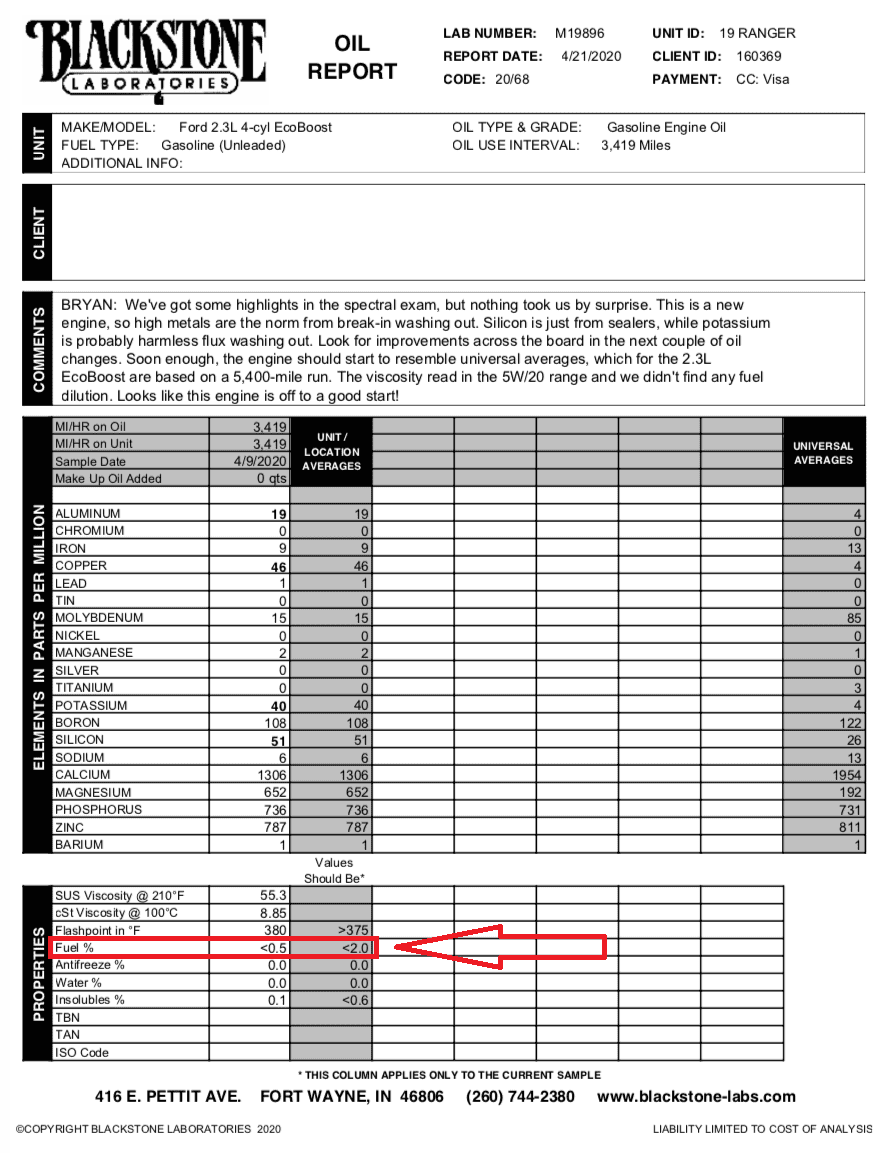
Sorry, but what you are saying is just flat out wrong. The only gasoline internal combustion engines that have zero fuel dilution are the ones that have never been run.

Every Blackstone analysis show fuel dilution... and there is always a value there and it's never 0... unless the engine has never been run.

1590756109683.png
 

N. J. Jim

Well-Known Member
First Name
Jim
Joined
Apr 23, 2020
Threads
0
Messages
273
Reaction score
447
Location
Vineland,N. J.
Vehicle(s)
2019 Ford Ranger Lariat
Occupation
Retired
Then why does every Blackstone analysis show fuel dilution... and there is always a value there and it's never 0?

1590756109683.png
I'd like to make a statement here, my oil level rose up to the twist in the stick in just 60 miles after an oil change. Now I am not the only one with a severe problem here. I had the HPFP changed 550 miles ago, since then the oil has risen to just below the top hole, but has stopped at that level. Now the jury is still out in my case but I'm hoping it straightens out. If not maybe injectors next if that doesn't do it could be a huge problem!
 

MotoWojo

Well-Known Member
Joined
Jan 13, 2019
Threads
9
Messages
324
Reaction score
412
Location
Wisconsin
Vehicle(s)
Mustang
I'd like to make a statement here, my oil level rose up to the twist in the stick in just 60 miles after an oil change. Now I am not the only one with a severe problem here. I had the HPFP changed 550 miles ago, since then the oil has risen to just below the top hole, but has stopped at that level. Now the jury is still out in my case but I'm hoping it straightens out. If not maybe injectors next if that doesn't do it could be a huge problem!
Interesting, I too had the HPFP replaced and they also replaced the injectors at the same time. I have just under 300 miles on since then and the oil level has also risen to just under the top hole. From where it started when I got the truck back, that is only about a 1/4" rise. Before the service it would have easily been twice that or more in 300 miles. I am hoping it stops where it is. I am keeping an eye on it hoping it is not going to progress further.
 

jsphlynch

Well-Known Member
First Name
Joe
Joined
Oct 16, 2018
Threads
11
Messages
913
Reaction score
2,448
Location
WV
Vehicle(s)
2019 Ford Ranger XL
If raw fuel is getting in the crankcase past the rings during the combustion process your engine has issues.
This is like saying "if your engine heats up, it has issues." Obviously, engines heat up to some extent when they run. It can't be eliminated, and all the engineering of the engines take that heat into account to minimize that heat accumulation where possible, and deal with the effects of the heat that can't be eliminated (to the extent that they only run properly once they have heated up!). However, there are problems that cause engines to get too hot, so you need to discern between "hot" and "too hot."

Raw fuel gets past the rings; it can't be eliminated, just dealt with. It's worse with direct injection. It's even worse with turbos. This isn't my opinion; it's been documented in numerous papers in SAE and other journals. The engineering of engines takes this blow-by into account, minimizing it where possible, and dealing with the effects where necessary. So the question becomes, how much dilution is to be expected, and how much indicates an actual problem? I think we can all agree that rising to the twist in 60 miles definitely indicates a problem. But what is that limit between "normal" and "too much"? Is 6% too much? Is anything above the Blackstone limit of 2% too much? Is any discernible rise too much?
 

jsphlynch

Well-Known Member
First Name
Joe
Joined
Oct 16, 2018
Threads
11
Messages
913
Reaction score
2,448
Location
WV
Vehicle(s)
2019 Ford Ranger XL
Sorry, but what you are saying is just flat out wrong. The only gasoline internal combustion engines that have zero fuel dilution are the ones that have never been run.

Every Blackstone analysis show fuel dilution... and there is always a value there and it's never 0... unless the engine has never been run.

1590756109683.png
Interesting that they note the viscosity is in the 5w/20 range. I wonder if that's just from degradation of the oil, or if the factory fill is a little thinner than 5w/30.
 

2ford

Banned
Banned
Joined
Jan 14, 2020
Threads
2
Messages
104
Reaction score
104
Location
Oregon
Vehicle(s)
19 ranger
This is like saying "if your engine heats up, it has issues." Obviously, engines heat up to some extent when they run. It can't be eliminated, and all the engineering of the engines take that heat into account to minimize that heat accumulation where possible, and deal with the effects of the heat that can't be eliminated (to the extent that they only run properly once they have heated up!). However, there are problems that cause engines to get too hot, so you need to discern between "hot" and "too hot."

Raw fuel gets past the rings; it can't be eliminated, just dealt with. It's worse with direct injection. It's even worse with turbos. This isn't my opinion; it's been documented in numerous papers in SAE and other journals. The engineering of engines takes this blow-by into account, minimizing it where possible, and dealing with the effects where necessary. So the question becomes, how much dilution is to be expected, and how much indicates an actual problem? I think we can all agree that rising to the twist in 60 miles definitely indicates a problem. But what is that limit between "normal" and "too much"? Is 6% too much? Is anything above the Blackstone limit of 2% too much? Is any discernible rise too much?
Any increase in crankcase level from raw fuel contamination is too much.
 

2ford

Banned
Banned
Joined
Jan 14, 2020
Threads
2
Messages
104
Reaction score
104
Location
Oregon
Vehicle(s)
19 ranger
Sorry, but what you are saying is just flat out wrong. The only gasoline internal combustion engines that have zero fuel dilution are the ones that have never been run.

Every Blackstone analysis show fuel dilution... and there is always a value there and it's never 0... unless the engine has never been run.

1590756109683.png
You are missing my point I'm talking about raw fuel contamination that increases the crankcase level. I agree that blow by contaniments get trapped in the oil hence the need to change oil periodically
Sponsored


Top