
Sponsored

One Piece Driveshaft

SigOris

Well-Known Member
First Name
John
Joined
May 18, 2022
Threads
47
Messages
1,242
Reaction score
4,088
Location
Greenwood Maine
Vehicle(s)
MY23 F150 CC Lariat PB & MY25 Mustang GT Convertible 60th #0807
Occupation
Retired DoD EE
I just stumbled upon something interesting. I was trying to help answer some questions for a guy, with a Tacoma with a stock two-piece rear shaft, 5.29 gears, and 32 inch tires. He wanted to know if it is safe for him to pass people at around 90 mph. I told him, "definitely don't buy our drive shaft" because at 90mph his shaft will be spinning at 5,000 rpm. But the interesting part came when I used the spicer calculator to try and figure out the critical speed of his stock shaft for him. I never calculate the critical speeds of two-piece shafts of shaft because we don't build two-piece shafts. What's really weird is that if I change the drive shaft type from one-piece to two-piece in the Spicer calculator it has no effect on the result. Actually, if you compare our one-piece to the stock Ranger two-piece, the results say that our shaft has a HIGHER critical speed than the stock shaft. Run the numbers yourself. Here's the important data for each shaft.

Stock ranger shaft:
  • Style B shaft
  • 3.5" 0.083" wall tube. In truth one section is 3.5 and the other section of the shaft is only 2.5 but lets pretend that they are both 3.5" diameter.
  • 1330 series joints
  • 62" center of joint to center of joint
Our shaft:
  • Style A shaft
  • 4" 0.083" wall tube.
  • 1350 series joints
  • 62" center of joint to center of joint
Here's the calculator https://spicerparts.com/calculators/critical-speed-rpm-calculator

For those of you who don't want to do use the calculator, here's the results. Stock shaft 3,392 critical speed. Our single piece shaft 3,888 critical speed.

What does this mean? If you take things at face value it means that our shaft is SAFER than the stock shaft at high speeds, even if we ignore all the other issues with the stock shaft and focus solely on the critical speed. If you want to read between the lines a bit more it means that spicer and other "authorities" on the matter don't always come up with results that make sense or are correct and that you have to take things with a grain of salt sometimes.


PS. I got my two-part urethane yesterday. I may work on casting some bushing dampeners tonight, maybe later this week. Stay tuned for that.
You actually expect us to believe “ The Science “??? ????

interesting results and I just remembered my 69 Camaro had a one piece shaft and NO safety loop ?
Sponsored
 

CO2Ranger

Well-Known Member
Joined
Apr 27, 2020
Threads
34
Messages
1,097
Reaction score
2,105
Location
Colorado
Vehicle(s)
2021 JLURD / Former: 2021 Ranger Lariat FX4
I just went out to my garage and validated that my Ford original 2 piece driveshaft was built by Spicer / Dana.

And to be a bit more fair, I took the average diameter of the front segment (2.5" and back segment (3.5") of the shaft and used 3" x 0.083 segment for both.

I will be the first to say that my logic may very well be flawed. But when I used two 2.5" shafts and averaged the results with Shawn's two 3.5" shafts I received the same outcome as two 3" shafts. This indicates the calculation and plot is linear.

What can be stated with a little more certainty is that by Spicer's calculations, Tom Wood's driveshaft has a 15% - 35% greater critical speed capability than the stock Ford driveshaft. even allowing for oversizing the stock Ford driveshaft diameter as Shawn did. I actually think that the 35% number is probably the more accurate figure. Details follow:

Stock Ranger shaft using 3.5" for both shafts (Shawn err's on the conservative side):
  • Style B shaft - 2 piece
  • 3.5" 0.083" wall tube. In truth one section is 3.5 and the other section of the shaft is only 2.5 but lets pretend that they are both 3.5" diameter.
  • 1330 series joints
  • 62" center of joint to center of joint
  • Critical Speed 3,392
Stock Ranger shaft averaging both shaft diameters to 3" ( Tony's Specs )
  • Style B shaft - 2 piece
  • 3.0" 0.083" wall tube. In truth one section is 3.5 and the other section of the shaft is only 2.5 but lets pretend that they are both 3.0' diameter.
  • 1330 series joints
  • 62" center of joint to center of joint
  • Critical Speed 2,896
Tom Wood's Ranger Driveshaft:
  • Style A shaft
  • 4" 0.083" wall tube.
  • 1350 series joints
  • 62" center of joint to center of joint
  • Critical Speed 3,888
Based on these numbers I doubt that Ford or its supplier, Spicer / Dana used this or a similar calculator to validate and certify the driveshaft, as it would certainly fail to meet the performance specification that we believe Ford uses.

Even if we discount the accuracy of the Spicer / Dana Web Calculator with regards to actual critical speed, using this calculator still demonstrates a substantial relative difference in quality that favors Tom Wood's Ford Ranger Driveshaft.

This calculator notably does not consider the approximately double length spline used at the slip joint in the Tom Wood's Driveshaft, which should further raise the critical speed.

- T
I think you'll find that the real figure to look at is the 1/2 true critical speed number. If that calculation is doubled you end up with your true critical speed. That puts both the factory and TW shafts well above safe levels.
 

Jason B

Well-Known Member
First Name
Jason
Joined
May 19, 2021
Threads
9
Messages
3,009
Reaction score
8,320
Location
Louisiana
Vehicle(s)
2021 XL STX SE 4x2
Occupation
machinist
I finally crawled under my truck just a look at the shaft and hanger bearing. There's not much room in the bushing, but kudos to NotBudule for his experiments with shimming the bushing. I verified that my center bearing is slight of center to the passenger side and that the bushing is not as soft as I thought but the shaft is movable. When I first looked at it, my immediate observation was 'Damn that's a lot of weights'.
To emphasize, I have the vibes at 70-75 and the shudder on takeoff. What's odd, is the shudder is slight when going forward, but really pronounced when reversing.
 

Fitzmotor

Gold Sponsor
First Name
Mike
Joined
May 6, 2021
Threads
24
Messages
1,388
Reaction score
5,834
Location
Saugus
Vehicle(s)
2021 Ranger Tremor, 75 crewcab F350, 65 Mustang
Occupation
Retired from Honda Racing.
That's super interesting about the different driveshafts and the critical shaft speeds.

Ford must figure very few people will ever get to the critical speed threshold, or they thought, "here, this should work and it's cheap to produce"


TJC

Well-Known Member
First Name
Tony
Joined
Aug 28, 2020
Threads
45
Messages
3,931
Reaction score
9,861
Location
North Carolina
Vehicle(s)
93 Miata, 05 Ranger 4x4, 20 Ranger 4x4, 23 CX-5
I think you'll find that the real figure to look at is the 1/2 true critical speed number. If that calculation is doubled you end up with your true critical speed. That puts both the factory and TW shafts well above safe levels.
Interesting thought, and a more reasonable number for all of the options. Thank you for enlightening me, and pointing out the obvious (now). I may yet end up learning 10% of what Tom Wood and Phil know about automotive engineering. So revised numbers are shown below.

Stock Ranger shaft using 3.5" for both shafts (Shawn err's on the conservative side):

  • Style B shaft - 2 piece
  • 3.5" 0.083" wall tube. In truth one section is 3.5 and the other section of the shaft is only 2.5 but lets pretend that they are both 3.5" diameter.
  • 1330 series joints
  • 62" center of joint to center of joint
  • Critical Speed 3,392
  • 1/2 True Critical Speed 6035 (Doubled)
Stock Ranger shaft averaging both shaft diameters to 3" ( Tony's Specs )

  • Style B shaft - 2 piece
  • 3.0" 0.083" wall tube. In truth one section is 3.5 and the other section of the shaft is only 2.5 but lets pretend that they are both 3.0' diameter.
  • 1330 series joints
  • 62" center of joint to center of joint
  • Critical Speed 2,896
  • 1/2 True Critical Speed 5154 (Doubled)
Tom Wood's Ranger Driveshaft:

  • Style A shaft
  • 4" 0.083" wall tube.
  • 1350 series joints
  • 62" center of joint to center of joint
  • Critical Speed 3,888
  • 1/2 True Critical Speed 6918 (Doubled)
IIRC, the 6918 number is very close to the 75% number that one of Shawn's engineering contacts came up with in his calculations.

Confirmed - the engineering contact came back with 5944.08
 
Last edited:

navsnipe

Well-Known Member
First Name
Dave
Joined
Sep 6, 2020
Threads
4
Messages
440
Reaction score
893
Location
Rockland County, NY
Vehicle(s)
20 Ranger FX4 Lariat (totaled), 23 Audi Q5
Occupation
Automating Buildings and confusing humans
I would think a two piece shaft critical speed would be calculated as each section being a separate shaft and the one with the lower critical speed would be the determining factor.

The factor that will skew this is a non rigid center bearing allowing oscillation of the shaft assembly.
 

NotBudule

Well-Known Member
Joined
Mar 6, 2022
Threads
43
Messages
2,984
Reaction score
11,852
Location
WV
Vehicle(s)
XLT
I finally crawled under my truck just a look at the shaft and hanger bearing. There's not much room in the bushing, but kudos to NotBudule for his experiments with shimming the bushing. I verified that my center bearing is slight of center to the passenger side and that the bushing is not as soft as I thought but the shaft is movable. When I first looked at it, my immediate observation was 'Damn that's a lot of weights'.
To emphasize, I have the vibes at 70-75 and the shudder on takeoff. What's odd, is the shudder is slight when going forward, but really pronounced when reversing.
Mine is low and to the drivers side , and LOTS of movement , maybe different carriers , or they have different dampening material ? I was thinking about loosening up the carrier and shim the bracket down so it rides in the center , since I live under there now , not that big a deal...
 

TJC

Well-Known Member
First Name
Tony
Joined
Aug 28, 2020
Threads
45
Messages
3,931
Reaction score
9,861
Location
North Carolina
Vehicle(s)
93 Miata, 05 Ranger 4x4, 20 Ranger 4x4, 23 CX-5
I would think a two piece shaft critical speed would be calculated as each section being a separate shaft and the one with the lower critical speed would be the determining factor.

The factor that will skew this is a non rigid center bearing allowing oscillation of the shaft assembly.
I tend to agree with you, but the Spicer Calculator doesn't allow one to configure it that way. Limitation of the Calculator is that both shafts must be the same size. I ran it at 2.5", 3", and Shawn had the 3.5" in his first note. I lean towards the 3" avg for the Ford DS, but in reality it may perform lower due to the 2.5" front section.

I am sure that the short lengths of the Ford DS allows them to use smaller diameter material, and I have come to the conclusion that the center carrier bearing is being used to allow and absorb the flex in the DS. It is an engineering compromise. Ford could have over engineered the 2 piece shaft with 4" tube instead, but I think other design criteria won the day. Weight savings, cost, etc,. were more important than ride quality and performance. I don't think they would compromise on safety.

I still don't know what I don't know... but things seem to be coming clearer.

I do instinctively know that the Tom Wood's Driveshaft is superior. The build is obviously stronger, and truck performs far better.
 

Stevedbvik1

Well-Known Member
First Name
Steve
Joined
Oct 4, 2021
Threads
38
Messages
2,708
Reaction score
8,043
Location
Michigan
Vehicle(s)
2022 Ranger Tremor XLT
Occupation
Retired
Mine is low and to the drivers side , and LOTS of movement , maybe different carriers , or they have different dampening material ? I was thinking about loosening up the carrier and shim the bracket down so it rides in the center , since I live under there now , not that big a deal...
I’d go check mine but my Tremor is at the dealership today for …. You guessed it. Vibration complaint. We’ll see how this “shakes” out ?‍♂
 

JohnnyO

Well-Known Member
First Name
Jon
Joined
Apr 8, 2021
Threads
23
Messages
1,969
Reaction score
6,143
Location
Pittsburgh, PA
Vehicle(s)
2020 Ranger STX 4x4
Occupation
Asst. Greenskeeper, Bushwood Country Club
You actually expect us to believe “ The Science “??? ????

interesting results and I just remembered my 69 Camaro had a one piece shaft and NO safety loop ?
If you went to a dragstrip they may have required one though.
 

Shawn at Tom Wood's

Well-Known Member
First Name
Shawn
Joined
Sep 13, 2022
Threads
0
Messages
50
Reaction score
312
Location
Ogden, UT
Vehicle(s)
Vespa Scooter
Occupation
Drive shaft guy
IIRC, the 6918 number is very close to the 75% number that one of Shawn's engineering contacts came up with in his calculations.
It's almost as though I've known what I'm doing all along. :sunglasses:

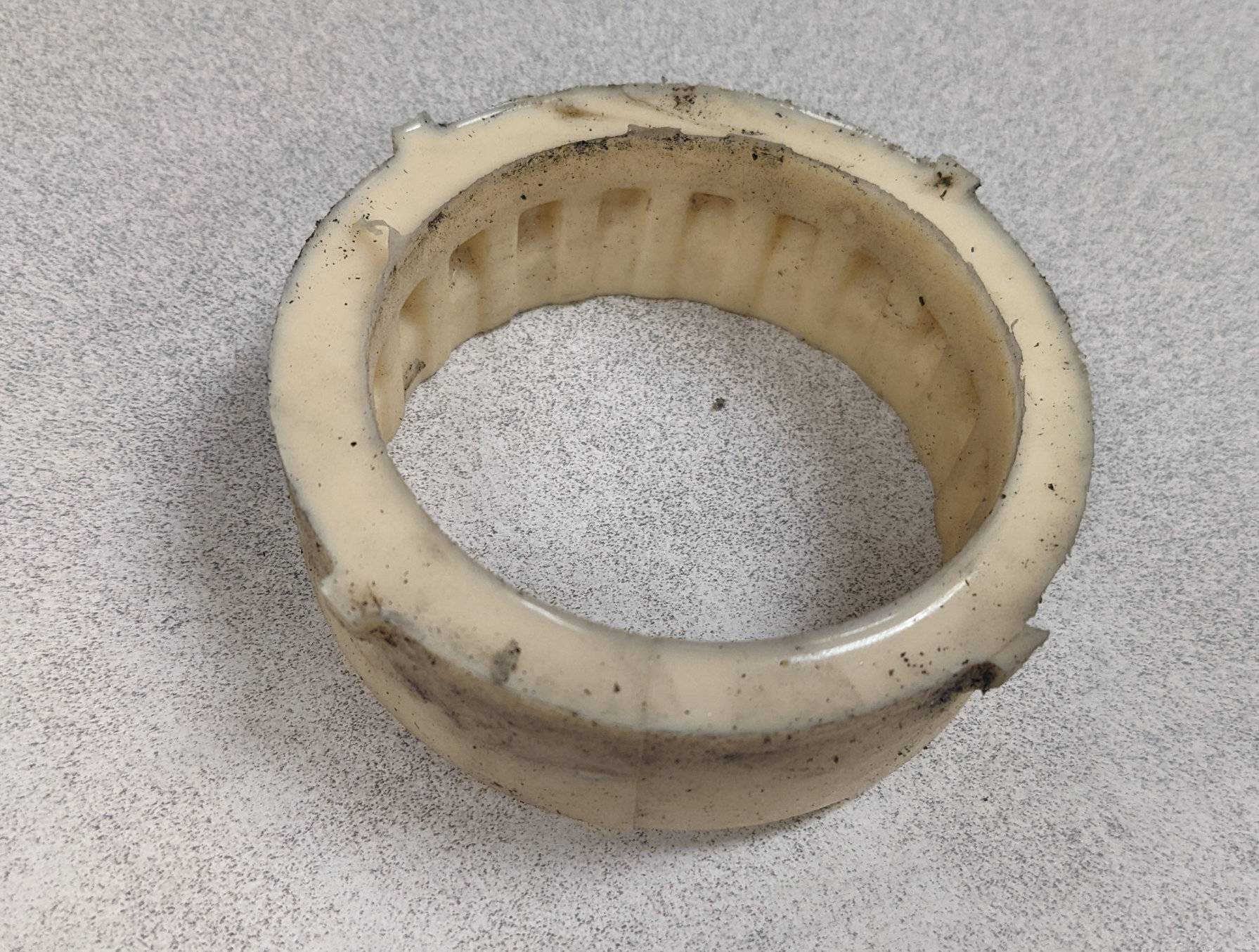
Update on the bushing. I made a bushing yesterday. Cast in out of urethane directly in the stock drive shaft. Turned out well. I then tried to use that bushing to make a negative mold out of more urethane. Unsurprisingly that didn't turn out well. Despite my use of a release agent it turned into basically one solid block of urethane. I was able to excavate the bushing but not without destroying the mold. I might try making a new mold out of plaster or something. I sure as heck don't want to make a bunch of these by balancing a wobbly 65" long drive shaft on end and pouring urethane into it. But I'll probably stop at 1 or 2 of these and get back to doing what I know and what I know works well in this application, drive shafts. For me, the reasons I'm experimenting with making urethane bushings are: I'm a generally inquisitive person who likes learning/trying new things and I enjoy making things, all things. I want be able to say/show, with a deep level of truth, that I've explored other options and left no stone unturned, and that I'm not jumping straight to the solution that seems to make us the most money, it's not all about selling drive shafts. Lastly, some of you speculated about a stiffer bushing. I am a man of action, I wanted to bring the speculation and the thought experiments into reality, test the hypothesis. We'll see what the results are.

I'm going to box and send a bushing to @NotBudule today. He'll test it out and report back to the group. A pic of the bushing is below. It is durable urethane, I surprisingly did not tear it while trying to pull it out of the urethane mold mess. It is about the softness of a gummy candy, like gummy bears or gummy worms, on the stiffer side though.

ranger bushing.jpg
 

SigOris

Well-Known Member
First Name
John
Joined
May 18, 2022
Threads
47
Messages
1,242
Reaction score
4,088
Location
Greenwood Maine
Vehicle(s)
MY23 F150 CC Lariat PB & MY25 Mustang GT Convertible 60th #0807
Occupation
Retired DoD EE
If you went to a dragstrip they may have required one though.
So when was the last time you took your everyday truck to the drag strip? Or was that an attempt at humor?
 

Stevedbvik1

Well-Known Member
First Name
Steve
Joined
Oct 4, 2021
Threads
38
Messages
2,708
Reaction score
8,043
Location
Michigan
Vehicle(s)
2022 Ranger Tremor XLT
Occupation
Retired
It's almost as though I've known what I'm doing all along. :sunglasses:

Update on the bushing. I made a bushing yesterday. Cast in out of urethane directly in the stock drive shaft. Turned out well. I then tried to use that bushing to make a negative mold out of more urethane. Unsurprisingly that didn't turn out well. Despite my use of a release agent it turned into basically one solid block of urethane. I was able to excavate the bushing but not without destroying the mold. I might try making a new mold out of plaster or something. I sure as heck don't want to make a bunch of these by balancing a wobbly 65" long drive shaft on end and pouring urethane into it. But I'll probably stop at 1 or 2 of these and get back to doing what I know and what I know works well in this application, drive shafts. For me, the reasons I'm experimenting with making urethane bushings are: I'm a generally inquisitive person who likes learning/trying new things and I enjoy making things, all things. I want be able to say/show, with a deep level of truth, that I've explored other options and left no stone unturned, and that I'm not jumping straight to the solution that seems to make us the most money, it's not all about selling drive shafts. Lastly, some of you speculated about a stiffer bushing. I am a man of action, I wanted to bring the speculation and the thought experiments into reality, test the hypothesis. We'll see what the results are.

I'm going to box and send a bushing to @NotBudule today. He'll test it out and report back to the group. A pic of the bushing is below. It is durable urethane, I surprisingly did not tear it while trying to pull it out of the urethane mold mess. It is about the softness of a gummy candy, like gummy bears or gummy worms, on the stiffer side though.

ranger bushing.jpg
I was going to comment about stiff gummy worms but I won’t
Sponsored


Top