Sponsored

One Piece Driveshaft

TJC

Well-Known Member
First Name
Tony
Joined
Aug 28, 2020
Threads
45
Messages
3,931
Reaction score
9,861
Location
North Carolina
Vehicle(s)
93 Miata, 05 Ranger 4x4, 20 Ranger 4x4, 23 CX-5
Glad you caught it before major problems. Sounds like you were pretty on top of the maintenance on that rig. Which kind of leads credence to my point.

Wonder what happened with that one? Impact damage anywhere? This was the factory driveshaft?

Good point about the slip joint lube. And a good reminder to me. Thank you.
Time and wear I think. We had been monitoring it for a month or two after the initial work was completed. And knew we had to figure it out. You can ignore the signs, but you will invariably end up on the side of a road if you let it go too long.

It was a massive overhaul effort as my wife loves the 2005 Ranger. We replaced a lot of front suspension parts, AC compressor, shocks, brakes (including rotors), all fluids, front wheel bearings, as well as engine and transmission. Only axles and transfer case are original now. We paid 19.5K for it new in 2005. We invested $12K in parts and labor to bring it back to new form. I think it is good for another 200K miles. It has 10K on it since the refresh. It has been garaged its entire life and looks great. The 2020 Range sits right next to it in the garage.

It was the factory driveshaft, and it had 150K on it. I think the yoke and u-joints simply wore out and it was time to replace them. There was dark scuff marks along one side of the shaft and they were not there before the work began, but the shaft appears to be straight. No obvious dings or dents, simply rather loose, but not sloppy loose u-joints. I would have not thought them bad.

I had the bed liner sprayed by Ford when new, and it has lifetime warranty. 17 years later it is going back to Ford to be redone - hopefully for no cost!
Sponsored


 

D Fresh

Banned
Banned
First Name
Doug
Joined
Dec 10, 2020
Threads
20
Messages
6,272
Reaction score
13,570
Location
Colorado
Vehicle(s)
'20 Lariat FX4, '17 FiST, '16 CX-5, '95 YJ
Occupation
Milkman
Time and wear I think. We had been monitoring it for a month or two after the initial work was completed. And knew we had to figure it out. You can ignore the signs, but you will invariably end up on the side of a road if you let it go too long.

It was a massive overhaul effort as my wife loves the 2005 Ranger. We replaced a lot of front suspension parts, AC compressor, shocks, brakes (including rotors), all fluids, front wheel bearings, as well as engine and transmission. Only axles and transfer case are original now. We paid 19.5K for it new in 2005. We invested $12K in parts and labor to bring it back to new form. I think it is good for another 200K miles. It has 10K on it since the refresh. It has been garaged its entire life and looks great. The 2020 Range sits right next to it in the garage.

It was the factory driveshaft, and it had 150K on it. I think the yoke and u-joints simply wore out and it was time to replace them. There was dark scuff marks along one side of the shaft and they were not there before the work began, but the shaft appears to be straight. No obvious dings or dents, simply rather loose, but not sloppy loose u-joints. I would have not thought them bad.

I had the bed liner sprayed by Ford when new, and it has lifetime warranty. 17 years later it is going back to Ford to be redone - hopefully for no cost!
Sounds like that driveshaft might have taken an impact, but who really knows? The important thing is that you got it squared away before ending up on the side of the road.

Sounds like you've got a couple of winners. The truck and the wife!
 

TJC

Well-Known Member
First Name
Tony
Joined
Aug 28, 2020
Threads
45
Messages
3,931
Reaction score
9,861
Location
North Carolina
Vehicle(s)
93 Miata, 05 Ranger 4x4, 20 Ranger 4x4, 23 CX-5
NotBudule,

I had a chance to look at the carrier bearing on the removed driveshaft today. It seems like it will be necessary to remove the shaft and hang it on end in order to fill the rubber seal evenly with whatever epoxy or silicone you'd be using to firm up the rubber mount. Mine is open on one side, and I am assuming that they all are.

I was wondering how you managed to get that electrical wire in there! After looking it over it is obvious.

The rubber damper is very flexible.

- T
 

NotBudule

Well-Known Member
Joined
Mar 6, 2022
Threads
43
Messages
2,984
Reaction score
11,852
Location
WV
Vehicle(s)
XLT
NotBudule,

I had a chance to look at the carrier bearing on the removed driveshaft today. It seems like it will be necessary to remove the shaft and hang it on end in order to fill the rubber seal evenly with whatever epoxy or silicone you'd be using to firm up the rubber mount. Mine is open on one side, and I am assuming that they all are.

I was wondering how you managed to get that electrical wire in there! After looking it over it is obvious.

The rubber damper is very flexible.

- T
I found some smaller hose and stuffed it behind the rubber cog thingy , don't expect it to stay but I will feel it when it comes out I guess , it will be spring before I have time to take it out and try and do it right , but to much flex seemed to be one of my issues , but mine wasn't very bad to begin with , somebody that has it bad should try it maybe , I wish I had one of those nifty cameras to mount under there and observe ...
 

RedDakooter05

Well-Known Member
Joined
Sep 17, 2021
Threads
7
Messages
2,772
Reaction score
9,554
Location
Illinois
Vehicle(s)
2024 Nissan Frontier S 4x4
I found some smaller hose and stuffed it behind the rubber cog thingy , don't expect it to stay but I will feel it when it comes out I guess , it will be spring before I have time to take it out and try and do it right , but to much flex seemed to be one of my issues , but mine wasn't very bad to begin with , somebody that has it bad should try it maybe , I wish I had one of those nifty cameras to mount under there and observe ...
Smart phone, duck tape.


TJC

Well-Known Member
First Name
Tony
Joined
Aug 28, 2020
Threads
45
Messages
3,931
Reaction score
9,861
Location
North Carolina
Vehicle(s)
93 Miata, 05 Ranger 4x4, 20 Ranger 4x4, 23 CX-5
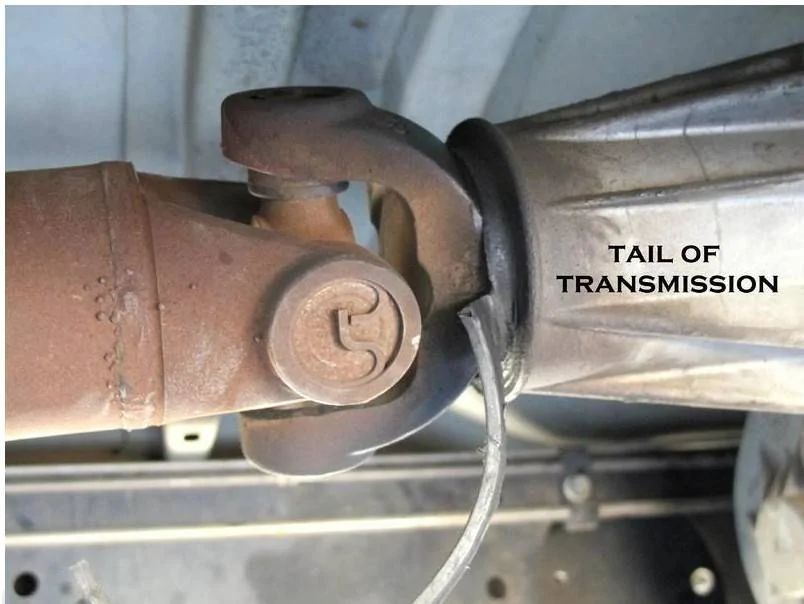
This is what happens when slip joints no longer slip (or your driveshaft is too long). Whenever the rear suspension is compressed, the driveshaft shoves everything toward the trans. I'd bet it could damage the carrier bearing as well. This is a two wheel drive situation as a 4x4 has a transfer case mated to the transmission, and typically has a plate that the driveshaft attaches to.
slipjoint.jpg
 
Last edited:

TJC

Well-Known Member
First Name
Tony
Joined
Aug 28, 2020
Threads
45
Messages
3,931
Reaction score
9,861
Location
North Carolina
Vehicle(s)
93 Miata, 05 Ranger 4x4, 20 Ranger 4x4, 23 CX-5
I wonder if the shudder is related to driving style. I am not a quick off the line kinda guy. Maybe the shudder is more noticeable to those who are in the 0-20 range longer. I can't test as I'm running the new DS.

Just a thought...
 

Jason B

Well-Known Member
First Name
Jason
Joined
May 19, 2021
Threads
9
Messages
3,009
Reaction score
8,320
Location
Louisiana
Vehicle(s)
2021 XL STX SE 4x2
Occupation
machinist
This is what happens when slip joints no longer slip (or your driveshaft is too long). Whenever the rear suspension is compressed, the driveshaft shoves everything toward the trans. I'd bet it could damage the carrier bearing as well. This is a two wheel drive situation as a 4x4 has a transfer case mated to the transmission, and typically has a plate that the driveshaft attaches to.
slipjoint.jpg
The only time when a shaft is too long! I'm usually told my shaft is too short.

I wonder if the shudder is related to driving style. I am not a quick off the line kinda guy. Maybe the shudder is more noticeable to those who are in the 0-20 range longer. I can't test as I'm running the new DS.

Just a thought...
I feel the shudder on take off, just rolling out no gas pedal.
 

NotBudule

Well-Known Member
Joined
Mar 6, 2022
Threads
43
Messages
2,984
Reaction score
11,852
Location
WV
Vehicle(s)
XLT
My clunk came back yesterday and things seamed off a little so i slithered back under there to see if the hose came out or shifted around some , couldn't really tell , it did feel like it had more play than i left it with though , i decided to pull it all back out and drive it stock to see if i could really feel any difference , ehhh , it did seem to be less smooth on acceleration than when shimmed , but it didnt seem as bad as i remember it , same at 75 80 , it seems smoother shimmed than not , but it still wasn't bad ... found some flat rubber/belt thats pretty tough so i cut some strips and shimmed it back up , time will tell i guess , it does seem to shift softer , especially down , the tighter it is , i had been almost clunk free until it softened up a bit ... almost wish mine was worse so i could tell for sure ...
 

Dereku

Well-Known Member
First Name
Derek
Joined
May 18, 2022
Threads
30
Messages
2,806
Reaction score
6,880
Location
Chicagoland Area
Vehicle(s)
2021 Ford Ranger
Occupation
Project Manager
My clunk came back yesterday and things seamed off a little so i slithered back under there to see if the hose came out or shifted around some , couldn't really tell , it did feel like it had more play than i left it with though , i decided to pull it all back out and drive it stock to see if i could really feel any difference , ehhh , it did seem to be less smooth on acceleration than when shimmed , but it didnt seem as bad as i remember it , same at 75 80 , it seems smoother shimmed than not , but it still wasn't bad ... found some flat rubber/belt thats pretty tough so i cut some strips and shimmed it back up , time will tell i guess , it does seem to shift softer , especially down , the tighter it is , i had been almost clunk free until it softened up a bit ... almost wish mine was worse so i could tell for sure ...
I have done this in the past, throw a zip tie through it and around the carrier bearing mount. Never had it fall out.
 
Last edited:

TJC

Well-Known Member
First Name
Tony
Joined
Aug 28, 2020
Threads
45
Messages
3,931
Reaction score
9,861
Location
North Carolina
Vehicle(s)
93 Miata, 05 Ranger 4x4, 20 Ranger 4x4, 23 CX-5
It happens to the best of us... HeavyD loses a rear driveshaft. (23 min in)
Yoke Broke! ?

Doesn't really apply to us, but it is entertaining to see that it happens... and where the failure occurs under load... and what part failed!

-T


Shawn at Tom Wood's

Well-Known Member
First Name
Shawn
Joined
Sep 13, 2022
Threads
0
Messages
50
Reaction score
312
Location
Ogden, UT
Vehicle(s)
Vespa Scooter
Occupation
Drive shaft guy
I just stumbled upon something interesting. I was trying to help answer some questions for a guy, with a Tacoma with a stock two-piece rear shaft, 5.29 gears, and 32 inch tires. He wanted to know if it is safe for him to pass people at around 90 mph. I told him, "definitely don't buy our drive shaft" because at 90mph his shaft will be spinning at 5,000 rpm. But the interesting part came when I used the spicer calculator to try and figure out the critical speed of his stock shaft for him. I never calculate the critical speeds of two-piece shafts of shaft because we don't build two-piece shafts. What's really weird is that if I change the drive shaft type from one-piece to two-piece in the Spicer calculator it has no effect on the result. Actually, if you compare our one-piece to the stock Ranger two-piece, the results say that our shaft has a HIGHER critical speed than the stock shaft. Run the numbers yourself. Here's the important data for each shaft.

Stock ranger shaft:
  • Style B shaft
  • 3.5" 0.083" wall tube. In truth one section is 3.5 and the other section of the shaft is only 2.5 but lets pretend that they are both 3.5" diameter.
  • 1330 series joints
  • 62" center of joint to center of joint
Our shaft:
  • Style A shaft
  • 4" 0.083" wall tube.
  • 1350 series joints
  • 62" center of joint to center of joint
Here's the calculator https://spicerparts.com/calculators/critical-speed-rpm-calculator

For those of you who don't want to do use the calculator, here's the results. Stock shaft 3,392 critical speed. Our single piece shaft 3,888 critical speed.

What does this mean? If you take things at face value it means that our shaft is SAFER than the stock shaft at high speeds, even if we ignore all the other issues with the stock shaft and focus solely on the critical speed. If you want to read between the lines a bit more it means that spicer and other "authorities" on the matter don't always come up with results that make sense or are correct and that you have to take things with a grain of salt sometimes.


PS. I got my two-part urethane yesterday. I may work on casting some bushing dampeners tonight, maybe later this week. Stay tuned for that.
 

NotBudule

Well-Known Member
Joined
Mar 6, 2022
Threads
43
Messages
2,984
Reaction score
11,852
Location
WV
Vehicle(s)
XLT
a guy, with a Tacoma with a stock two-piece rear shaft, 5.29 gears, and 32 inch tires. He wanted to know if it is safe for him to pass people at around 90 mph.
Oh it's probably safe , just not possible , in a Tacoma I mean ... downhill maybe...
 

JohnnyO

Well-Known Member
First Name
Jon
Joined
Apr 8, 2021
Threads
23
Messages
1,969
Reaction score
6,143
Location
Pittsburgh, PA
Vehicle(s)
2020 Ranger STX 4x4
Occupation
Asst. Greenskeeper, Bushwood Country Club
I crawled under mine today and gave the driveshaft a good shake and it moved very little.
41k on it. I guess I got a good one.
I do know what a bad one looks like. I had a 2008 Sport Trac before and the carrier bearing crapped out around 180k. Lotta folks in the Sport Trac world are losing the carrier bearings when they get north of 150k.
 

TJC

Well-Known Member
First Name
Tony
Joined
Aug 28, 2020
Threads
45
Messages
3,931
Reaction score
9,861
Location
North Carolina
Vehicle(s)
93 Miata, 05 Ranger 4x4, 20 Ranger 4x4, 23 CX-5
...
...
Spicer Draftshaft Critical Speed Calculator (Bold is my addition and hightlights)
Actually, if you compare our one-piece to the stock Ranger two-piece, the results say that our shaft has a HIGHER critical speed than the stock shaft. Run the numbers yourself. Here's the important data for each shaft.

Stock ranger shaft:
  • Style B shaft
  • 3.5" 0.083" wall tube. In truth one section is 3.5 and the other section of the shaft is only 2.5 but lets pretend that they are both 3.5" diameter.
  • 1330 series joints
  • 62" center of joint to center of joint
  • Critical Speed 3,392
Our shaft:
  • Style A shaft
  • 4" 0.083" wall tube.
  • 1350 series joints
  • 62" center of joint to center of joint
  • Critical Speed 3,888
Here's the calculator https://spicerparts.com/calculators/critical-speed-rpm-calculator

For those of you who don't want to do use the calculator, here's the results. Stock shaft 3,392 critical speed. Our single piece shaft 3,888 critical speed.

What does this mean? If you take things at face value it means that our shaft is SAFER than the stock shaft at high speeds, even if we ignore all the other issues with the stock shaft and focus solely on the critical speed.

If you want to read between the lines a bit more it means that Spicer and other "authorities" on the matter don't always come up with results that make sense or are correct and that you have to take things with a grain of salt sometimes.
I just went out to my garage and validated that my Ford original 2 piece driveshaft was built by Spicer / Dana.

And to be a bit more fair, I took the average diameter of the front segment (2.5" and back segment (3.5") of the shaft and used 3" x 0.083 segment for both.

I will be the first to say that my logic may very well be flawed. But when I used two 2.5" shafts and averaged the results with Shawn's two 3.5" shafts I received the same outcome as two 3" shafts. This indicates the calculation and plot is linear.

What can be stated with a little more certainty is that by Spicer's calculations, Tom Wood's driveshaft has a 15% - 35% greater critical speed capability than the stock Ford driveshaft. even allowing for oversizing the stock Ford driveshaft diameter as Shawn did. I actually think that the 35% number is probably the more accurate figure. Details follow:

Stock Ranger shaft using 3.5" for both shafts (Shawn err's on the conservative side):
  • Style B shaft - 2 piece
  • 3.5" 0.083" wall tube. In truth one section is 3.5 and the other section of the shaft is only 2.5 but lets pretend that they are both 3.5" diameter.
  • 1330 series joints
  • 62" center of joint to center of joint
  • Critical Speed 3,392
Stock Ranger shaft averaging both shaft diameters to 3" ( Tony's Specs )
  • Style B shaft - 2 piece
  • 3.0" 0.083" wall tube. In truth one section is 3.5 and the other section of the shaft is only 2.5 but lets pretend that they are both 3.0' diameter.
  • 1330 series joints
  • 62" center of joint to center of joint
  • Critical Speed 2,896
Tom Wood's Ranger Driveshaft:
  • Style A shaft
  • 4" 0.083" wall tube.
  • 1350 series joints
  • 62" center of joint to center of joint
  • Critical Speed 3,888
Based on these numbers I doubt that Ford or its supplier, Spicer / Dana used this or a similar calculator to validate and certify the driveshaft, as it would certainly fail to meet the performance specification that we believe Ford uses.

Even if we discount the accuracy of the Spicer / Dana Web Calculator with regards to actual critical speed, using this calculator still demonstrates a substantial relative difference in quality that favors Tom Wood's Ford Ranger Driveshaft.

This calculator notably does not consider the approximately double length spline used at the slip joint in the Tom Wood's Driveshaft, which should further raise the critical speed.

- T
Sponsored


Top