Sponsored

Maximizing Battery Life

airline tech

Well-Known Member
Joined
Aug 24, 2022
Threads
28
Messages
4,448
Reaction score
8,499
Location
Midwest - KS
Vehicle(s)
2022 Ranger Lariat-Super Crew, Cactus Gray
Occupation
Aircraft Tech
Although I still have some further testing to do to monitor battery temps, when upping the SOC above factory 75%, I had to postpone further testing as the weather turned colder.
As Battery Temp and Outside (Air Temp) plays a huge roll in battery charging voltages.
Since my postponement of further testing the OP of this thread has done his own testing and added the desulfator, I think this is a great addition and alternative to the battery minders and plan on trying it out as well.
As far as the SOC goes, at the time of my testing I had determined that 80% was the best setting and concluded that based on these factors.

1. AGM battery specs - state 80% (higher voltage then back off to a lower above 80%) however these specs are for charging a battery on a bench.

2. SOC setting of 80% is the same in the F-150, however F-150 owners report the same battery charging issues we have on the Ranger

3. To fully understand what the SOC actually does, it moves the base charging voltage up, that the truck will try to maintain and anything above the SOC setting is allowing room for the Regenerative Charging to be performed. and it is a short burst of charging voltage while decelerating. So the higher the SOC lessens the need and also lessens the room in the battery for the short bursts of higher charging voltage, as all this does is assists the charging system with free energy. You can see this in action on a daytime drive and temps are above 45-50 degrees. and the charging voltages while driving are 12.4 to 12.7 volts, dropping as low as 12.2 volts when sitting at a stoplight or stop and go traffic, the regenerative charge boosts the battery voltage up (momentarily) to replenish the battery back above the SOC setting to near 100% SOC, although it is just a short temporary burst and this is the reason short drive only drivers have the most issues, they do not get the full effect of being at or near 100% SOC, they will always hover around the lower (75% or 80%) battery voltage

This is the area that needs further testing, in raising the SOC, how does it affect Battery Temps, in the short term you see better voltage readings, but it is the long term I am curious about for battery health, now the Desulsifor being added into the mix appears to help as it is keeping the IR low at the battery, a low IR should keep the battery temps in a safe and healthy range


4. Note, the system uses Engine Braking and the Alternator Decoupler to accomplish this, we do not have Regenerative Braking, Regenerative Braking is something different, that system uses wheel speed sensors to provide a charging voltage - similar to a old school crank up battery pack

My only concern with raising the SOC above 80% or BMS disable is how the battery temp reacts to the changes. This is why I wanted to do more testing to check and monitor battery temps and take my testing a little deeper.
I did note, even though it was just a quick test that with the BMS sensor disconnected I still had a battery temp reading with Forscan and want to know where it is getting that temp reading from, as it was just a quick test, I am curious as if I was just getting the previous temp before disconnect.

One way to test it is have it disconnected long term, say a few days and before truck is started hook up Forscan and look at these 3 PIDS as this test is also good for T-Shoot a Air Inlet temp sensor. You look at the Coolant Temp Sensor Reading and Air (Intake) Temp sensor and Outside Ambient Temp sensor readings they should match when engine is cold.
Take those readings and compare to the Battery Temp reading and see if they match, and then determine which alternate sensor is picking up the reading for the now disconnected BMS sensor and using it as a battery temp monitor for voltage charging the conventional way.
 
Last edited:

dtech

Well-Known Member
Joined
May 10, 2020
Threads
37
Messages
3,135
Reaction score
7,574
Location
colorado
Vehicle(s)
Ranger Lariat FX4, chromed and forever damperless

dtech

Well-Known Member
Joined
May 10, 2020
Threads
37
Messages
3,135
Reaction score
7,574
Location
colorado
Vehicle(s)
Ranger Lariat FX4, chromed and forever damperless
Almost fearful of bring the hated EV word into this discussion, but regenerative braking is widely employed in EVs - the electric motor that powers the drive axles exerts braking force to slow the vehicle and the motor is used to recharge the battery, same thing that diesel electric locos use when going downhill .
In a much smaller sense this is occurring with the regen of the smart system as when the tranny is locked up so the load from the alternator will assist in engine braking .

question I have when you say decouple the alternator are you referring to physical decoupling as in a clutch or electrical ? I tend to assume the latter as once you break the circuit to the rotor it should be mostly a free spinning device .


OP
OP

TJC

Well-Known Member
First Name
Tony
Joined
Aug 28, 2020
Threads
45
Messages
3,930
Reaction score
9,840
Location
North Carolina
Vehicle(s)
93 Miata, 05 Ranger 4x4, 20 Ranger 4x4, 23 CX-5
RE: #3 Low and High voltages based upon throttle response
I have seen the same behavior, low 12V "charge" voltage (I doubt that you can call it that as it is NOT charging the battery at that voltage), and a burst of high charge voltage when off throttle.

RE:#4 Battery Temp Compensation
Where ever the ambient temp is being derived, I have seen a correlation with the temperature being checked when the truck is first started. That temperature seems to then be constant and not reset until the truck is turned off and restarted. I based this upon the charge voltage adjusting when I turn off the truck, and then restart it. However, the charge voltage could just as easily been adjusted by the battery voltage at startup.

This I know as fact, The voltage on both trucks stayed in a higher voltage range until I stopped and immediately restarted the trucks. Both trucks voltage ranges dropped 0.2v - ceiling and cellar. The charge rates recalibrated on both trucks. One would have thought that voltages would go up to compensate for the power drain used to start the trucks. Both trucks took the exact routes, and were both stopped and started the same distances.
 

airline tech

Well-Known Member
Joined
Aug 24, 2022
Threads
28
Messages
4,448
Reaction score
8,499
Location
Midwest - KS
Vehicle(s)
2022 Ranger Lariat-Super Crew, Cactus Gray
Occupation
Aircraft Tech
Almost fearful of bring the hated EV word into this discussion, but regenerative braking is widely employed in EVs - the electric motor that powers the drive axles exerts braking force to slow the vehicle and the motor is used to recharge the battery, same thing that diesel electric locos use when going downhill .
In a much smaller sense this is occurring with the regen of the smart system as when the tranny is locked up so the load from the alternator will assist in engine braking .

question I have when you say decouple the alternator are you referring to physical decoupling as in a clutch or electrical ? I tend to assume the latter as once you break the circuit to the rotor it should be mostly a free spinning device .
from my research it is a clutch - (OAD)
Overrun Drive Pulley) allows pulley to free spin (decouple)- which takes the load off of the drive belt - so the way I understand it - as the pulley decouples less friction in the pulley thus spins faster than the belt which provides the boost charge voltage - instead of belt being driven by the engine rpm - is is now driven by the rotating speed of the drive axles - thus engine braking as the truck is in deceleration- this also helps take load off of the braking action to help in slowing the truck to a stop

possibly think of it this way
The old school lawn mower that had the wind up handle crank - pull the lever and the motor spun up to start - instead of providing engine starting- it’s providing a boost charge voltage - except the momentum is carried further by the coasting (rotational) speed of the drive axles still spinning the crankshaft
 
Last edited:

dtech

Well-Known Member
Joined
May 10, 2020
Threads
37
Messages
3,135
Reaction score
7,574
Location
colorado
Vehicle(s)
Ranger Lariat FX4, chromed and forever damperless
from my research it is a clutch - (OAD)
Overrun Drive Pulley) allows pulley to free spin (decouple)- which takes the load off of the drive belt - so the way I understand it - as the pulley decouples less friction in the pulley thus spins faster than the belt which provides the boost charge voltage - instead of belt being driven by the engine rpm - is is now driven by the rotating speed of the drive axles - thus engine braking as the truck is in deceleration- this also helps take load off of the braking action to help in slowing the truck to a stop

possibly think of it this way
The old school lawn mower that had the wind up handle crank - pull the lever and the motor spun up to start - instead of providing engine starting- it’s providing a boost charge voltage - except the momentum is carried further by the coasting (rotational) speed of the drive axles still spinning the crankshaft
Thanks, maybe the clutch is above the alternator covered by a black shield? They go all out to improve efficiency. I'm the clutch must be reliable, haven't seen any reports of issues.
 

RangerBill

Well-Known Member
First Name
Bob
Joined
Jun 8, 2022
Threads
3
Messages
1,601
Reaction score
2,122
Location
PA
Vehicle(s)
2019 Ford Ranger Lariat Super Crew FX4
Occupation
retired
Thanks, maybe the clutch is above the alternator covered by a black shield? They go all out to improve efficiency. I'm the clutch must be reliable, haven't seen any reports of issues.
It is built into the alternator pulley.
 

Big Blue

Well-Known Member
First Name
Lee
Joined
May 5, 2020
Threads
16
Messages
3,927
Reaction score
9,352
Location
Wisconsin
Vehicle(s)
2019 Ford Ranger XLT FX4 Supercrew lighting blue
Occupation
Retired mechanical designer
from my research it is a clutch - (OAD)
Overrun Drive Pulley) allows pulley to free spin (decouple)- which takes the load off of the drive belt - so the way I understand it - as the pulley decouples less friction in the pulley thus spins faster than the belt which provides the boost charge voltage - instead of belt being driven by the engine rpm - is is now driven by the rotating speed of the drive axles - thus engine braking as the truck is in deceleration- this also helps take load off of the braking action to help in slowing the truck to a stop

possibly think of it this way
The old school lawn mower that had the wind up handle crank - pull the lever and the motor spun up to start - instead of providing engine starting- it’s providing a boost charge voltage - except the momentum is carried further by the coasting (rotational) speed of the drive axles still spinning the crankshaft
OK, now you have me totally confused! How does decoupling the alternator from the engine still drive it from the axles? Once you decouple the alternator there is nothing driving it but its own inertia.

As far as I understand the only way to increase the voltage output of the alternator is for the regulator curcuit to increase the voltage to the field coils in the alternators rotor. Which will increase the load the alternator puts on its drive. So spiking the voltage in an off throttle condition (coasting) would help with engine breaking.

I'm very interested in what exactly this alternator clutch does and how it fits into this whole charging system.
 

RangerBill

Well-Known Member
First Name
Bob
Joined
Jun 8, 2022
Threads
3
Messages
1,601
Reaction score
2,122
Location
PA
Vehicle(s)
2019 Ford Ranger Lariat Super Crew FX4
Occupation
retired
OK, now you have me totally confused! How does decoupling the alternator from the engine still drive it from the axles? Once you decouple the alternator there is nothing driving it but its own inertia.

As far as I understand the only way to increase the voltage output of the alternator is for the regulator curcuit to increase the voltage to the field coils in the alternators rotor. Which will increase the load the alternator puts on its drive. So spiking the voltage in an off throttle condition (coasting) would help with engine breaking.

I'm very interested in what exactly this alternator clutch does and how it fits into this whole charging system.
I am not sure how it relates to the charging system during coast or braking conditions, but this article explains the OAD pulley purpose and function. https://www.continental-engineparts...lternator-Decoupler/Products-(1)/Products/OAD
 

SigOris

Well-Known Member
First Name
John
Joined
May 18, 2022
Threads
47
Messages
1,242
Reaction score
4,088
Location
Greenwood Maine
Vehicle(s)
MY23 F150 CC Lariat PB & MY25 Mustang GT Convertible 60th #0807
Occupation
Retired DoD EE
hybrid vehicles many don't have starters and use their electric motor as a starter and alternator.

I wasn’t aware of hybrid rangers, thanks
 

Bsthroop

Well-Known Member
First Name
Brian
Joined
Oct 4, 2022
Threads
6
Messages
479
Reaction score
2,263
Location
New Mexico
Vehicle(s)
2019 Lariat 4x2 Sport
Occupation
Broadband/ Microwave Engineer
Based on @airline tech recommendation to not run higher than 80% soc that may damage battery, today I reduced mine from 90 to 80 and reactivated ass/BMS with Forscan. Realized that with ass deactivated I was also getting no bms action, always running at 14 volts when driving. Now it stays around 12.4 until coast then pops to 14.7. May try 85 to see if I get slightly higher soc when driving.
 
OP
OP

TJC

Well-Known Member
First Name
Tony
Joined
Aug 28, 2020
Threads
45
Messages
3,930
Reaction score
9,840
Location
North Carolina
Vehicle(s)
93 Miata, 05 Ranger 4x4, 20 Ranger 4x4, 23 CX-5
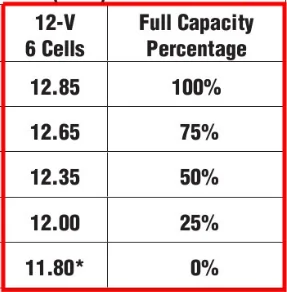
12.4V is actually discharging your battery, which is what the BMS system is designed to do. It is going to drop voltage until it hits the 75% SOC threshold. A fully charged auto 12V battery should be at 12.85V at rest (sitting unused for 8 hours). This voltage is temperature sensitive (~80F). Sulfation begins to occur at 12.6V. There is not a lot of wiggle room between 12.65V and 12.6V. If the truck is shutdown with the battery at 12.65V, it is very good bet that 8 hours later when the battery is at rest it will be well below 12.6V. The lower the voltage drops the faster the process is. Internal resistance increases causing internal battery temps to rise, which starts a vicious cycle, and ultimately results in battery failure.

I don't believe that those intermittent surges of high voltage when coasting to a stop are enough to keep a battery healthy if you are driving short distances everyday.

Charge voltage .png


Normal charge rates for a lead acid battery including AGMs are 13.5-14.7. Anything less is not charging the battery. Breaking down the range in more detail

Float Charge = 13.5V-13.8V - Battery will not be harmed
Standard Charge Rate = 14.4V - 14.7V - Dependent on Ambient Temperature - Higher when cold, Lower when hot. This voltage should drop when the battery reaches 70% full charge, or if it reaches a plateau (due to current leakage) and the charging system times out.

I have BMS disconnected. I go days between trips. In colder weather I see charge voltage at 14.4V (very briefly as in seconds @14.5V), then dropping as the battery charges to 14.2V. As temperatures warmed up I am now seeing 14.4V on startup, dropping to 13.8V-13.9V after 20 miles.
With ASS/BMS enabled, I believe that Airline Tech is correct, moving above 80% may be a problem...unless Ford has taken this into consideration in their charging algorithms. I don't think anyone knows this for sure, except for the Ford engineers who designed the system.

Too low a charge will sulfate the negative plate. Over saturation by not dropping to the float charge will result in grid corrosion on the positive plate.

This is why I chose to disable BMS rather then raise the SOC level. Disabling BMS defaults to the tried and true conventional charging algorithms used in the previous generation of Ford autos before the EPA mandates. It is also the fallback position if the BMS system fails.

When BMS is turned off, my truck drops to float charge rates once the battery is charged, exactly like my 2005 Ranger. I have taken both on the same 40 mile course and see identical behavior. The 2020 Ranger takes longer to charge the battery, but I think this is due to the much greater load placed on the electrical system. The 2005 is far more primitive electrically speaking.

Read up on the necessary charging voltage levels here for Lead Acid batteries including AGMs in the link below
https://batteryuniversity.com/article/bu-403-charging-lead-acid

Best of luck to you
 
Last edited:

got3fords

Well-Known Member
First Name
James
Joined
Apr 12, 2021
Threads
131
Messages
5,319
Reaction score
13,797
Location
22973
Vehicle(s)
2026 Marsh Gray Ranger Raptor, 1995 Harley XLH1200
Occupation
Mom Joke Professional
I have had the desulfator installed for about a month now. Way too early to say if its' helping. But I fired up the Toro lawn mower for the first time this year. I had used the desulftator on it for several hours before putting in permanently on the Ranger. The mower turned right over and fired right up. Mower is kept outside under the open part of the shed.

The battery in the Ranger is probably 2 years old or better and has almost 32k on the odometer. I have been seeing max charge voltage around 14.8, this has been in average cool weather. Regen charging apparently works when it is warmer out. I have seen cruise charge around 13.1ish, with regen charging back to 14.7ish.

Couple of questions:
How do modern battery testers test CCA's? I assume it's not like the old load testers.
Did someone say disabling the ASS also disables the BMS?
Sponsored


Top