Sponsored

Maximizing Battery Life

OP
OP

TJC

Well-Known Member
First Name
Tony
Joined
Aug 28, 2020
Threads
45
Messages
3,925
Reaction score
9,831
Location
North Carolina
Vehicle(s)
93 Miata, 05 Ranger 4x4, 20 Ranger 4x4, 23 CX-5
I live in central NC, and we get to ~100F in the summer. I started this personal battery adventure well after others, so I have benefited from their knowledge.

I have chosen to disable the BMS system and have the truck revert to a standard charging system. The interesting thing is that I have seen my charge voltages change in correlation with the ambient temps here. I saw higher charge voltages in cooler weather. I have never had a charge voltage higher than 14.4V since unplugging the BMS sensor. And it is at 14.2v at 80F. It does seem to only drop to 13.9v when charged.

The 5G conventional standard charging system appears to adapt to the ambient temps. I believe that the temperature is measured at started up. The 5G appears to follow the charging principles outlined in the article below, if this is true, there should not be an overcharging situation that causes out gassing.

From Battery University
Lead-acid: Lead acid is reasonably forgiving when it comes to temperature extremes, as the starter batteries in our cars reveal. Part of this tolerance is credited to their sluggish behavior. The recommended charge rate at low temperature is 0.3C, which is almost identical to normal conditions. At a comfortable temperature of 20°C (68°F), gassing starts at charge voltage of 2.415V/cell ( 14.49v ) . When going to –20°C (0°F), the gassing threshold rises to 2.97V/cell (17.82v ).​
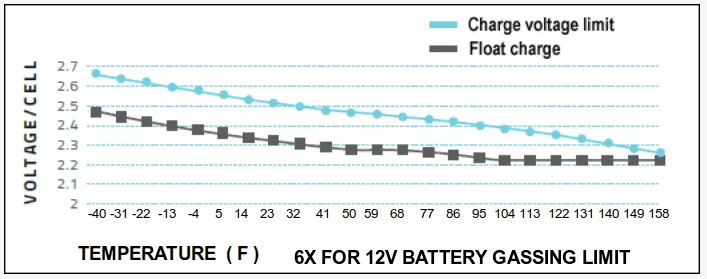
A lead acid battery charges at a constant current to a set voltage that is typically 2.40V/cell (14.4v) at ambient temperature. This voltage is governed by temperature and is set higher when cold and lower when warm. The Figure below illustrates the recommended settings for most lead acid batteries. In parallel, the figure also shows the recommended float charge voltage to which the charger reverts when the battery is fully charged. When charging lead acid at fluctuating temperatures, the charger should feature voltage adjustment to minimize stress on the battery.​
charge volts per cell .png
High-temperature Charge
Heat is the worst enemy of batteries, including lead acid. Adding temperature compensation on a lead acid charger to adjust for temperature variations is said to prolong battery life by up to 15 percent. The recommended compensation is a 3mV drop per cell for every degree Celsius rise in temperature. If the float voltage is set to 2.30V/cell at 25°C (77°F), the voltage should read 2.27V/cell at 35°C (95°F). Going colder, the voltage should be 2.33V/cell at 15°C (59°F). These 10°C adjustments represent 30mV change.​
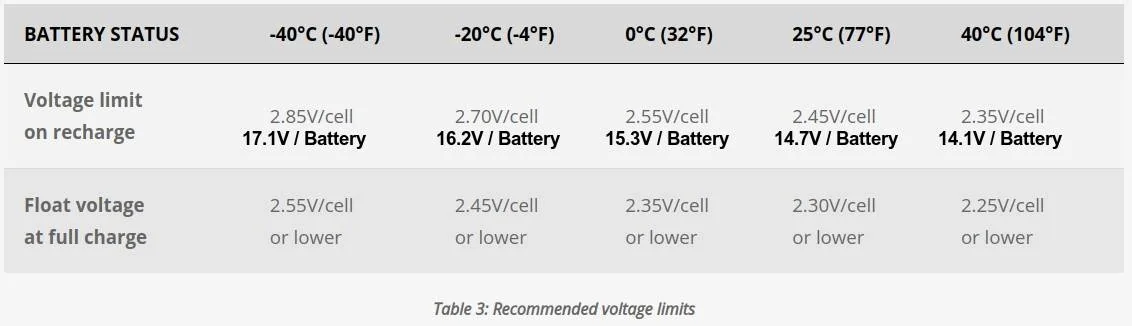
Table 3 indicates the optimal peak voltage at various temperatures when charging lead acid batteries. The table also includes the recommended float voltage while in standby mode.​
Peak Charging limits by temp.jpg
when charging and maintaining stationary lead acid batteries on float charge. Voltage compensation prolongs battery life when operating at temperature extremes.
Sponsored

 
Last edited:
pboggini

Well-Known Member
First Name
Pete
Joined
Nov 30, 2018
Threads
12
Messages
235
Reaction score
253
Location
San Jose, CA
Vehicle(s)
2019 Lightning Blue XL Ranger 4x2 Supercrew.
Noticed something interesting this weekend. As I think I mentioned, I bumped my SOC to 95% a month and a half ago after seeing my BMS turn off my radio right after turning off the truck. I also charged the battery with a really old charger (though I see that's a no-no?). More recently, I got a NOCO 5amp charger and I charged it last week mid week. I more recently dropped my SOC to 90% on the fear that at 95% it might over charge. My truck is 4 years old in a week or so. Battery in use count is over 4 years.

We drove to my mother-in-laws Friday afternoon (150 mile 3.5 hour drive). Noticed that the voltage would drop below 14 volts (I swapped the 12V outlets with USB outlets and one has voltage) for the first time in a long time and auto stop/start works much more regularly now. Seems the truck likes 90% and the long drive. Trip home was 2.5 hours and some very fun highway speeds.

The old Harbor Freight tester told me I had 685 CCA Thursday morning, 780, Sunday morning and 720 this morning. All temps around the mid 40's. Seeing the voltage drop to below 14 is leading me to believe the BMS seems to think the battery is better charged as does the auto stop/start working more consistently.

I'd really love to know the optimal setting for SOC. Is 90% best, 95%, 100%? Seems that those of you who've disabled BMS aren't finding it leads to over charging. That makes sense to me as my '96 Tacoma got 7 years out of its OEM battery and my 2008 Canyon got 6+. Both had old style charging with no BMS and both batteries were changed when I noticed it felt like the starter turned over a bit slower on a cold morning start up.

My only concern is this regenerative charging I've heard mentioned here and in that battery PDF floating around. I tend to think that my 90% is good but I can't help but think 95% or even 100% might be better as long as I could be assured that this regenerative charging thing wouldn't just randomly dump a bunch of current into a fully charged battery.

What are other's thoughts on this? What do others have their SOC set to? Like I said, 90% and long trips seems to have very much helped my battery and I'm hoping I can get at least 5 years out of it.
 
OP
OP

TJC

Well-Known Member
First Name
Tony
Joined
Aug 28, 2020
Threads
45
Messages
3,925
Reaction score
9,831
Location
North Carolina
Vehicle(s)
93 Miata, 05 Ranger 4x4, 20 Ranger 4x4, 23 CX-5
I have no idea, but I can hazard a guess, but you'll need to validate. But before I jump in I have a question.

Do you see voltage spikes when you let off the accelerator, or brake? When I tested with BMS active I would see spikes to over 14.5v (sometimes even above 15v!) when in those conditions, and that is regenerative braking doing its thing.

If you are still seeing regenerative braking, you may not have enough spare battery capacity, and overcharging will be the result, potentially harming the battery. If you don't see it, you are probably fine. Charge voltages should drop as ambient temps warm.
 

pboggini

Well-Known Member
First Name
Pete
Joined
Nov 30, 2018
Threads
12
Messages
235
Reaction score
253
Location
San Jose, CA
Vehicle(s)
2019 Lightning Blue XL Ranger 4x2 Supercrew.
I didn't see spikes to 14.5, 14.2 was the max voltage. And, it wasn't consistent. Meaning, while cruising home last night it was at 14.1 most of the time and would go to 14.2 from time to time. I don't think I've ever seen it regularly spike up when letting off the gas and coasting.
 
OP
OP

TJC

Well-Known Member
First Name
Tony
Joined
Aug 28, 2020
Threads
45
Messages
3,925
Reaction score
9,831
Location
North Carolina
Vehicle(s)
93 Miata, 05 Ranger 4x4, 20 Ranger 4x4, 23 CX-5
The old Harbor Freight tester told me I had 685 CCA Thursday morning, 780, Sunday morning and 720 this morning.
Edit - Sorry, you don't have a desulfator installed... I thought I was addressing someone else who had installed the desulfator.

Keep monitoring CCA over the next few months. I expect CCA to continue to rise as the onboard desulfator does its thing while you drive. It will ultimately reach a plateau and level off. With any luck it will be well above the rating of the battery.


pboggini

Well-Known Member
First Name
Pete
Joined
Nov 30, 2018
Threads
12
Messages
235
Reaction score
253
Location
San Jose, CA
Vehicle(s)
2019 Lightning Blue XL Ranger 4x2 Supercrew.
I don't have a desulfator hooked up. Are you saying the BMS will do that? That NOCO 5amp charger I mentioned isn't hooked up the entire time.
 
OP
OP

TJC

Well-Known Member
First Name
Tony
Joined
Aug 28, 2020
Threads
45
Messages
3,925
Reaction score
9,831
Location
North Carolina
Vehicle(s)
93 Miata, 05 Ranger 4x4, 20 Ranger 4x4, 23 CX-5
I don't have a desulfator hooked up. Are you saying the BMS will do that? That NOCO 5amp charger I mentioned isn't hooked up the entire time.
Yeah, I caught my error, and edited my post. Our updates crossed while being posted.

BMS will not do that! I've heard very positive reports about the NOCO chargers.
 

IdahoRanger

Well-Known Member
First Name
Steve
Joined
Sep 26, 2019
Threads
12
Messages
4,325
Reaction score
21,484
Location
Idaho
Vehicle(s)
2019 Lariat SuperCrew FX4
Occupation
RETIRED
I don't have a desulfator hooked up. Are you saying the BMS will do that? That NOCO 5amp charger I mentioned isn't hooked up the entire time.
You can use the Noco 5 to desulfate. Set to "repair" after you charge it. I repair it about once a week which should do some desulfating. It runs the repair for about 4 hours.
 

pboggini

Well-Known Member
First Name
Pete
Joined
Nov 30, 2018
Threads
12
Messages
235
Reaction score
253
Location
San Jose, CA
Vehicle(s)
2019 Lightning Blue XL Ranger 4x2 Supercrew.
OK, will do that. Assuming that I should disconnect the battery from the truck as there seem to be concerns that I could "fry something" with the higher voltage?
 

dtech

Well-Known Member
Joined
May 10, 2020
Threads
37
Messages
3,135
Reaction score
7,574
Location
colorado
Vehicle(s)
Ranger Lariat FX4, chromed and forever damperless
I'm been all in at a full 100% for over a year, ain't missing bms at all . Should you get a whiff of sulphur it could be a garbage fart from a garage rat.
 
  • Haha
Reactions: TJC

pboggini

Well-Known Member
First Name
Pete
Joined
Nov 30, 2018
Threads
12
Messages
235
Reaction score
253
Location
San Jose, CA
Vehicle(s)
2019 Lightning Blue XL Ranger 4x2 Supercrew.
I'm been all in at a full 100% for over a year, ain't missing bms at all . Should you get a whiff of sulphur it could be a garbage fart from a garage rat.

But to confirm, you don't have BMS hooked up so your 100% would be w/o any "regenerative charging" right?
 

IdahoRanger

Well-Known Member
First Name
Steve
Joined
Sep 26, 2019
Threads
12
Messages
4,325
Reaction score
21,484
Location
Idaho
Vehicle(s)
2019 Lariat SuperCrew FX4
Occupation
RETIRED
OK, will do that. Assuming that I should disconnect the battery from the truck as there seem to be concerns that I could "fry something" with the higher voltage?
I don't disconnect I just clamp on to the positive and negative terminals when doing the "repair" instead of clamping before the BMS.
 
OP
OP

TJC

Well-Known Member
First Name
Tony
Joined
Aug 28, 2020
Threads
45
Messages
3,925
Reaction score
9,831
Location
North Carolina
Vehicle(s)
93 Miata, 05 Ranger 4x4, 20 Ranger 4x4, 23 CX-5
I didn't see spikes to 14.5, 14.2 was the max voltage. And, it wasn't consistent. Meaning, while cruising home last night it was at 14.1 most of the time and would go to 14.2 from time to time. I don't think I've ever seen it regularly spike up when letting off the gas and coasting.
I saw those high spikes with BMS active and set to the stock % in my XLT Ranger. It ceased and behaved with the similar readings to what you are reporting with the BMS sensor unplugged.

I have yet to play with the BMS charge percent. I am simply turning off ASS/BMS and using Ford's conventional charging system.
 

pboggini

Well-Known Member
First Name
Pete
Joined
Nov 30, 2018
Threads
12
Messages
235
Reaction score
253
Location
San Jose, CA
Vehicle(s)
2019 Lightning Blue XL Ranger 4x2 Supercrew.
OK, good to know thanks! I'm hoping that the engineers planned for full batteries and so the BMS is smart enough that if the battery has enough charge those spikes won't happen. It does seem like mine is acting pretty normal and that long drive really seems to have helped. We will see what a week of normal commute (20 miles each way) does for it.
 
OP
OP

TJC

Well-Known Member
First Name
Tony
Joined
Aug 28, 2020
Threads
45
Messages
3,925
Reaction score
9,831
Location
North Carolina
Vehicle(s)
93 Miata, 05 Ranger 4x4, 20 Ranger 4x4, 23 CX-5
OK, good to know thanks! I'm hoping that the engineers planned for full batteries and so the BMS is smart enough that if the battery has enough charge those spikes won't happen. It does seem like mine is acting pretty normal and that long drive really seems to have helped. We will see what a week of normal commute (20 miles each way) does for it.
Ford states what they did in broad terms, but to understand where the sweet spot is between long battery life and EPA mandated requirements requires real world testing. The alternative is to do nothing and replace the battery every 18-30 months.

Looks like you are on the right path.
Sponsored


Top