TJC
Well-Known Member
- First Name
- Tony
- Joined
- Aug 28, 2020
- Threads
- 45
- Messages
- 3,930
- Reaction score
- 9,848
- Location
- North Carolina
- Vehicle(s)
- 93 Miata, 05 Ranger 4x4, 20 Ranger 4x4, 23 CX-5
- Thread starter
- #196
I live in central NC, and we get to ~100F in the summer. I started this personal battery adventure well after others, so I have benefited from their knowledge.
I have chosen to disable the BMS system and have the truck revert to a standard charging system. The interesting thing is that I have seen my charge voltages change in correlation with the ambient temps here. I saw higher charge voltages in cooler weather. I have never had a charge voltage higher than 14.4V since unplugging the BMS sensor. And it is at 14.2v at 80F. It does seem to only drop to 13.9v when charged.
The 5G conventional standard charging system appears to adapt to the ambient temps. I believe that the temperature is measured at started up. The 5G appears to follow the charging principles outlined in the article below, if this is true, there should not be an overcharging situation that causes out gassing.


I have chosen to disable the BMS system and have the truck revert to a standard charging system. The interesting thing is that I have seen my charge voltages change in correlation with the ambient temps here. I saw higher charge voltages in cooler weather. I have never had a charge voltage higher than 14.4V since unplugging the BMS sensor. And it is at 14.2v at 80F. It does seem to only drop to 13.9v when charged.
The 5G conventional standard charging system appears to adapt to the ambient temps. I believe that the temperature is measured at started up. The 5G appears to follow the charging principles outlined in the article below, if this is true, there should not be an overcharging situation that causes out gassing.
From Battery University
Lead-acid: Lead acid is reasonably forgiving when it comes to temperature extremes, as the starter batteries in our cars reveal. Part of this tolerance is credited to their sluggish behavior. The recommended charge rate at low temperature is 0.3C, which is almost identical to normal conditions. At a comfortable temperature of 20°C (68°F), gassing starts at charge voltage of 2.415V/cell ( 14.49v ) . When going to –20°C (0°F), the gassing threshold rises to 2.97V/cell (17.82v ).
A lead acid battery charges at a constant current to a set voltage that is typically 2.40V/cell (14.4v) at ambient temperature. This voltage is governed by temperature and is set higher when cold and lower when warm. The Figure below illustrates the recommended settings for most lead acid batteries. In parallel, the figure also shows the recommended float charge voltage to which the charger reverts when the battery is fully charged. When charging lead acid at fluctuating temperatures, the charger should feature voltage adjustment to minimize stress on the battery.
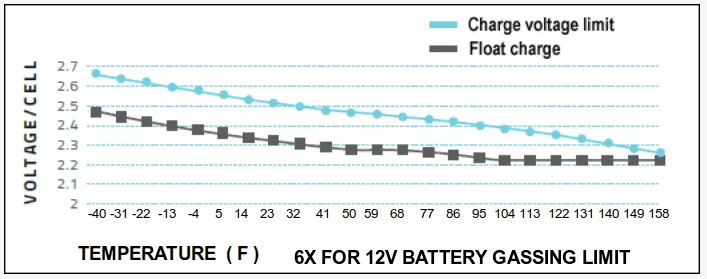
High-temperature Charge
Heat is the worst enemy of batteries, including lead acid. Adding temperature compensation on a lead acid charger to adjust for temperature variations is said to prolong battery life by up to 15 percent. The recommended compensation is a 3mV drop per cell for every degree Celsius rise in temperature. If the float voltage is set to 2.30V/cell at 25°C (77°F), the voltage should read 2.27V/cell at 35°C (95°F). Going colder, the voltage should be 2.33V/cell at 15°C (59°F). These 10°C adjustments represent 30mV change.
Table 3 indicates the optimal peak voltage at various temperatures when charging lead acid batteries. The table also includes the recommended float voltage while in standby mode.
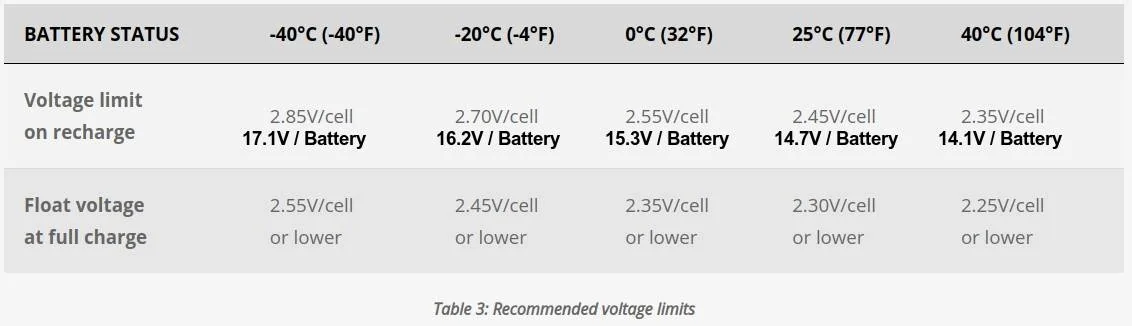
when charging and maintaining stationary lead acid batteries on float charge. Voltage compensation prolongs battery life when operating at temperature extremes.
Sponsored
Last edited: