Sponsored

Maximizing Battery Life

got3fords

Well-Known Member
First Name
James
Joined
Apr 12, 2021
Threads
131
Messages
5,319
Reaction score
13,797
Location
22973
Vehicle(s)
2026 Marsh Gray Ranger Raptor, 1995 Harley XLH1200
Occupation
Mom Joke Professional
I have several battery testing tools.

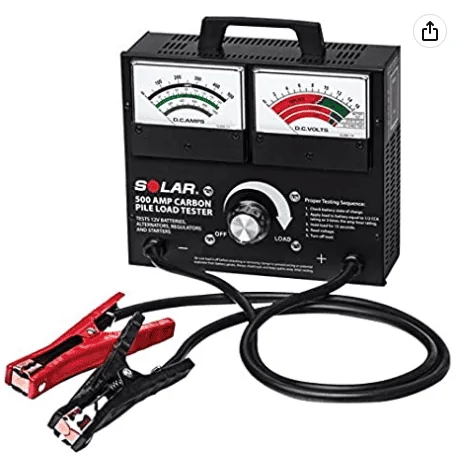
I have a carbon pile load tester. Read up carefully on usage. This will drain your battery quickly!
Load Tester.png


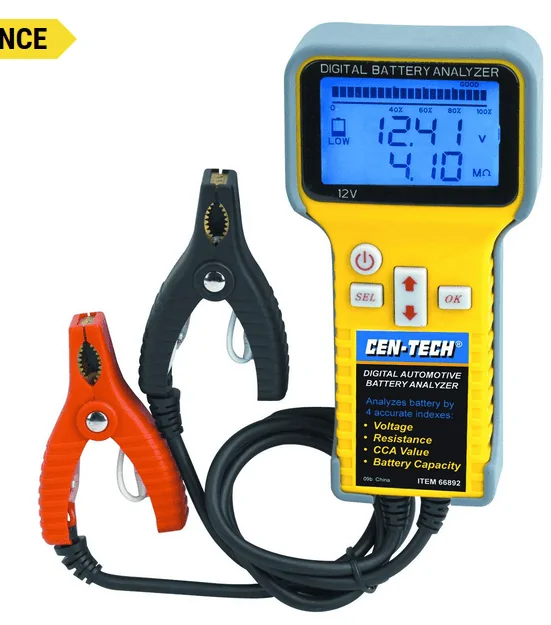
I have a battery tester that reports voltage, CCA, and internal resistance. My battery tester is at least 12 years old and is no longer on the market. But there are many to choose from that are available at Amazon. I stick to the basics. Less is more. The three readings above and optionally a resistive load test are enough to evaluate an automotive battery.

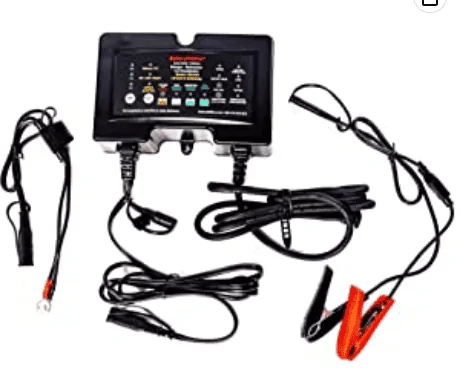
I have a half dozen or so different models of electrical meters that test resistance, AC/DC current and voltage, and many other functions. I have a dozen or so battery chargers - 75% are BatteryMinder Maintainers with built in desulfators, (one unit is homebuilt from the 1930's!) (some are testers as well), the best of which (my opinion) are the BatteryMinder series. They bring back batteries when others don't, and their desulfation features are the best that I have found. Other more expensive models that I own actually have not performed as well for me. I have this model

BM 128cec2 .png


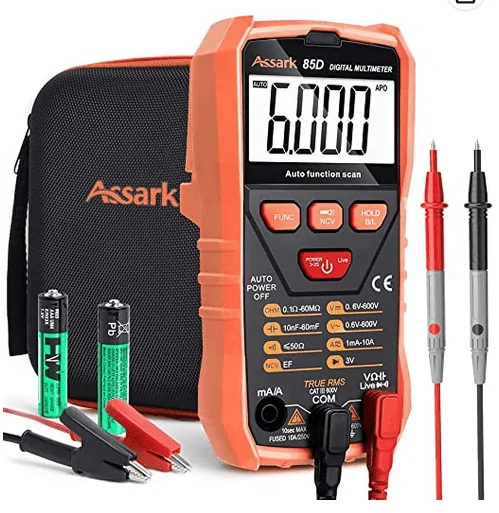
For folks just looking for a basic meter to occasionally check voltage, I'd recommend this VOM from Amazon. It has a nifty auto sense feature that will keep you from destroying it if the settings are incorrect. One is in a kitchen drawer right now for the wife! Assark auto sensing multimeter ($18 Amazon)

azark-85d-meter-png.png


- T
Wow, that's a lot of info on your meters. I have a carbon pile load tester, and two different Fluke meters (Fluke is probably the best on the market, use them at work also). Also have a clamp style ammeter adaptor. But I am interested in a tester that would give CCA without actually loading the battery, if it exists. As well as internal resistance.
Sponsored

 
OP
OP

TJC

Well-Known Member
First Name
Tony
Joined
Aug 28, 2020
Threads
45
Messages
3,930
Reaction score
9,844
Location
North Carolina
Vehicle(s)
93 Miata, 05 Ranger 4x4, 20 Ranger 4x4, 23 CX-5
Just checked my battery tonight. It has now been 1 month since I installed the Batterminder Model OBD-12 Desulfator on this truck. Battery health is now coming very close to the performance I see in my 2005 Ranger.

Voltage = 12.85V - 100% Charge!
Internal Resistance = 2.95 mOhms
CCA = 972 - Rated at 720

I am still monitoring charge voltages when driving. I plan to turn off BMS in ForScan and reconnect the BMS sensor to observe if there are any changes in the charging system.

My 2005 starts with a 14.5V charge rate and will drop the charge rate to 13.8v over a 30 mile drive. My 2020 Ranger starts at a 14.5V charge rate and only drops the charge rate to 14.3v over the same distance. But dark current draw is probably much greater in the 2020 Ranger.

When I finished up the initial 2 week charge/desulation conditioning, the charge voltage would drop to the 13.8v range just like in the 2005.
 
Last edited:
OP
OP

TJC

Well-Known Member
First Name
Tony
Joined
Aug 28, 2020
Threads
45
Messages
3,930
Reaction score
9,844
Location
North Carolina
Vehicle(s)
93 Miata, 05 Ranger 4x4, 20 Ranger 4x4, 23 CX-5
Wow, that's a lot of info on your meters. I have a carbon pile load tester, and two different Fluke meters (Fluke is probably the best on the market, use them at work also). Also have a clamp style ammeter adaptor. But I am interested in a tester that would give CCA without actually loading the battery, if it exists. As well as internal resistance.
I spent a couple of years working in an IBM electronic stress lab. We used multi-channel HP O-Scopes and Spectrum analyzers daily. Fine equipment.

Flukes are great meters. Fluke are to meters what Xerox was to copiers, or Cresent is to adjustable wrenches.

Clamp style ammeters are very handy.. Got one of those as well, and another multipurpose meter with the clamp adapter.

HarborFreight has 2 models of battery testers. Both report CCA, voltage, and internal resistance, drawing very very minimal current. They seem to be well received. The newer one is only $39. With a 20% off coupon that's a pretty good deal. If they don't pan out, simply return for a refund.

This one is old model - a buddy has this one and is happy with it. It's $59
HF1 .webp

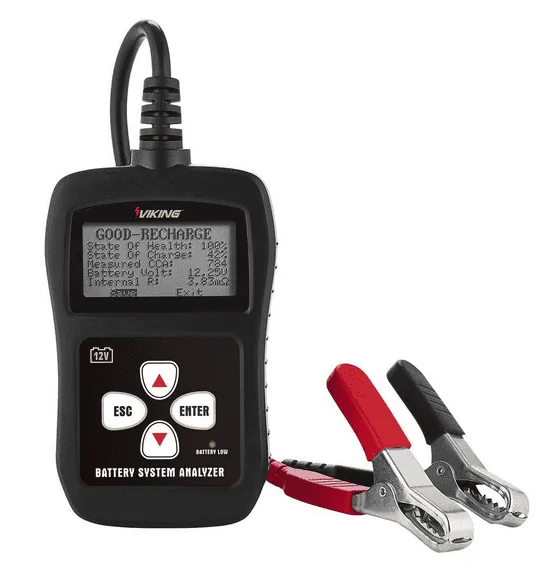
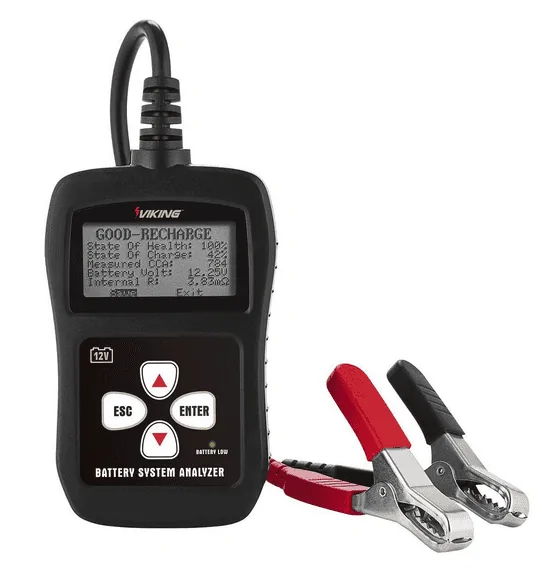
This Model appears to be replacing the one above. It has State of Charge (SOC) and State of Health. I don't need the battery tester to tell me the state of health... and state of charge is a simple voltage threshold percentage. I may pick up the new one and compare it to my tried and true ancient model. It looks much smaller than my old one.
HF2.webp
 
OP
OP

TJC

Well-Known Member
First Name
Tony
Joined
Aug 28, 2020
Threads
45
Messages
3,930
Reaction score
9,844
Location
North Carolina
Vehicle(s)
93 Miata, 05 Ranger 4x4, 20 Ranger 4x4, 23 CX-5
Stopped by Harbor Freight a few days ago and picked up their new $39 battery tester. Put it to the test this evening against my 15 year old $100 battery tester. Pleasantly surprised by how much smaller and faster it is. It actually tests a bit more functions too. Technology has certainly improved!

I had my old unit out, as well as my expensive meter, and the HF Viking Battery Tester reads accurate. Voltage and Internal Resistance were spot on, and CCA was within 3% of my old battery tester. I think it is a keeper!

State of Health came back at 100%
State of Charge is 82% (I would have guessed that it was lower based upon voltage reading)
Internal Resistance is 3.23 mOhms
Voltage is 12.49v ( Truck sitting a couple of days unused )
CCA is 929! On a 720 CCA rated battery!

My battery BMS sensor is still unplugged. I am now confident that the battery will not be subjected to an overcharged state. Since the temps have started to warm up, the charge voltage window has started to drop. The charging system (minus the BMS sensor) is still sensing the ambient temperature and appears to be adjusting the charge rate accordingly. I believe it sets the charge rate window when the truck is first started up. It does not appear to be capable of dynamically changing the charge rate window once running. I specifically tested for this with both my 2005 Ranger and the 2020 Ranger, They behaved in an identical manner (with the BMS sensor unplugged). The only difference is that the 2005 Ranger charges at .2v lower than the 2020 Ranger. I think the increased electrical demands on the 2020 Ranger required this adjustment.

The excellent results above are all due to the BatteryMinder desultator technology. My battery started out much weaker. I was getting the "weak battery turning stuff off messages" in the morning before starting the truck.

After a full 24 hour charge with full time desulator running, the CCA was only 450, and resistance was 7.8 Ohms. It took two weeks nonstop desulating to bring the battery back. And I am confident that the onboard unit will keep it there.

There are much better battery testers on the market, but at this price point, it is more than adequate for my purposes. We'll see how it holds up over time. I'm keeping my old one as backup.

HF2.png
 
Last edited:

pboggini

Well-Known Member
First Name
Pete
Joined
Nov 30, 2018
Threads
12
Messages
235
Reaction score
253
Location
San Jose, CA
Vehicle(s)
2019 Lightning Blue XL Ranger 4x2 Supercrew.
I've been reading thru the many battery threads we have here and all of this info is fantastic. A month or so ago I noticed for the first time my 3 year, 10 month old 2019 Ranger shut off its radio right when I turned off the key at work. Hmm, odd I thought, as it's never done that before. It quickly restarted so I went to work and thought to myself "hmm, I wonder if the truck is trying to save the battery?"

That weekend, I put my old charger on it and charged the battery. It took a couple of hours at 10amps and it was good to go. The next week, it stayed on and I watch the voltage on my USB connector and it stayed around 12.3 for a long time and generally acted normal.

I then started reading all these informative threads and so I picked this up:

https://www.amazon.com/gp/product/B081VQVD3F/ref=ppx_od_dt_b_asin_title_s00?ie=UTF8&psc=1

And then got Forscan in VMWare Fusion on and old macbook pro. I saw that in some threads folks were saying the Battery SOC was 70%, some 75% and some 80%. When I checked it was 75%. So, I upped it to 95% and bought a 5amp NOCO charger and once again topped it off.

Now, reading many of these threads I was mildly concerned that 95% was too high so I lowered it to 90%. The thing that I'm concerned about is the "regenerative recharging" and how it feels like something that might put me in an overcharge scenario? One the one hand, if it always does this I could see that leading to a possible overcharging scenario. On the other, I would think that Ford would try to make sure there were protections in place such that if the battery is seen as full by the system that it wouldn't overcharge.

I get that much of this is secret but does anyone have a sense of whether or not this would present a problem? My truck has now been at 95% for a week and 90% for the past 3 weeks and it acts normal. Testing in the morning nets me over 700 CA per the older Harbor Freight tester. I'm thinking that's good but then I'd also love to hear what others have their SOC set at and the reasoning behind it. Part of me things, why not just set it to 100% then you get the best of both worlds in a BMS system that should protect things but also a more fully charged battery:).

I didn't see a pole but maybe I should create one?


CB750F

Well-Known Member
Joined
Aug 9, 2019
Threads
28
Messages
1,076
Reaction score
3,389
Location
Qc
Vehicle(s)
Subaru BRZ / SCAB Ranger XLT/FX4 & various motos
Occupation
Human
2.5 yrs & keeping my fingers crossed.
My BRZ is now 8 yrs but I'll replace it in the next few weeks.
Been garaged on a trickle charger every winter(4 months) since 2015.
Pretty good, off to Costco...
 
OP
OP

TJC

Well-Known Member
First Name
Tony
Joined
Aug 28, 2020
Threads
45
Messages
3,930
Reaction score
9,844
Location
North Carolina
Vehicle(s)
93 Miata, 05 Ranger 4x4, 20 Ranger 4x4, 23 CX-5
On the very first post of this thread topic (Feb 16th) I started the process of trying to revive a long dead battery.

I am attempting to revive a long discharged / discarded sealed AGM battery (made in Jan 2006) through the BM desulfator charger
Battery is rated at 725 CCA.​
Here I am 6 weeks later with the final report on the battery. I think it is probably as strong as it is going to get. It has been on a onboard BatteryMInder Desulfator and BatteryMinder 2 amp trickle charger after the initial charge cycle with an 8Amp BatteryMinder Charger. The 8 Amp charger brought it back enough to allow the 2 amp trickle charger to finish the desulfating job.​
State of Health = 72%​
State of Charge = 100%​
Voltage = 12.71v​
CCA = 652​
Internal Resistance = 4.6 mOhms​
While I doubt that the battery will ever reach its original 725 CCA rating, it is strong enough to be serviceable in my 2003 Maxima for a few more years. I am actually surprised it revived this well. Internal Resistance under 5 Ohms is impressive. I am surprised and maybe very lucky to revive the battery. Heavily sulfated batteries rarely come back... and shorted cells in a battery are a death sentence.​
 
Last edited:

moorejl57

Well-Known Member
First Name
Jamie
Joined
Jun 21, 2021
Threads
3
Messages
253
Reaction score
934
Location
Corvallis Oregon
Vehicle(s)
2021 Ranger Lariat FX4, 501A, fully damped
Occupation
Engineer
On the very first post of this thread topic (Feb 16th) I started the process of trying to revive a long dead battery.

I am attempting to revive a long discharged / discarded sealed AGM battery (made in Jan 2006) through the BM desulfator charger
Battery is rated at 725 CCA.​
Here I am 6 weeks later with the final report on the battery. I think it is probably as strong as it is going to get. It has been on a onboard BatteryMInder Desulfator and BatteryMinder 2 amp trickle charger after the initial charge cycle with an 8Amp BatteryMinder Charger. The 8 Amp charger brought it back enough to allow the 2 amp trickle charger to finish the desulfating job.​
State of Health = 72%​
State of Charge = 100%​
Voltage = 12.71v​
CCA = 652​
Internal Resistance = 4.6 Ohms​
While I doubt that the battery will ever reach its original 725 CCA rating, it is strong enough to be serviceable in my 2003 Maxima for a few more years. I am actually surprised it revived this well. Internal Resistance under 5 Ohms is impressive. I am surprised and maybe very lucky to revive the battery. Heavily sulfated batteries rarely come back... and shorted cells in a battery are a death sentence.​
Something is fishy with your internal resistance reading. Using Ohm's law, you would expect the internal resistance to be around 12.7/652 ~= 0.02 ohms. (R = V/I)
 
OP
OP

TJC

Well-Known Member
First Name
Tony
Joined
Aug 28, 2020
Threads
45
Messages
3,930
Reaction score
9,844
Location
North Carolina
Vehicle(s)
93 Miata, 05 Ranger 4x4, 20 Ranger 4x4, 23 CX-5
Something is fishy with your internal resistance reading. Using Ohm's law, you would expect the internal resistance to be around 12.7/652 ~= 0.02 ohms. (R = V/I)
I just went out and tested the battery again, but it was not in a rested state. I simply removed the charger and tested immediately.

State of Health = 74%
State of Charge = 100%
Voltage = 13.28v
CCA = 659
Internal Resistance = 4.55 mOhms (that should help clear things up)

CCA is defined as how many Amps the battery can deliver at 0F continuously for 30 seconds before the battery drops to 7.2 VDC
 
Last edited:

dtech

Well-Known Member
Joined
May 10, 2020
Threads
37
Messages
3,135
Reaction score
7,574
Location
colorado
Vehicle(s)
Ranger Lariat FX4, chromed and forever damperless
I just went out and tested the battery again, but it was not in a rested state. I simply removed the charger and tested immediately.

State of Health = 74%
State of Charge = 100%
Voltage = 13.28v
CCA = 659
Internal Resistance = 4.55 Ohms

CCA is defined as how many Amps the battery can deliver at 0F continuously for 30 seconds before the battery drops to 7.2 VDC
that does seem high internal resistance, but if you had a charger on it might explain why - will be interesting to see how long that battery holds it's charge and how much use you get from it and what the resistance reads when it's been in a rested state.
 
Last edited:

airline tech

Well-Known Member
Joined
Aug 24, 2022
Threads
28
Messages
4,448
Reaction score
8,500
Location
Midwest - KS
Vehicle(s)
2022 Ranger Lariat-Super Crew, Cactus Gray
Occupation
Aircraft Tech
Not sure where this chart originated from - I think Dtech was the original poster of it, I was just curious where the info came from. Since we are on the topic of IR

Great Reference if correct.

If IR>30 milliohm, battery is in very bad condition. Probably unusable.
If IR is between 10 to 30 milliohm, still poor condition but may be usable or revivable.
If IR is between 5 to 10 milliohm, it is in good condition.
If IR is less than 5 milliohm, it is in very good condition.

Thanks
 
OP
OP

TJC

Well-Known Member
First Name
Tony
Joined
Aug 28, 2020
Threads
45
Messages
3,930
Reaction score
9,844
Location
North Carolina
Vehicle(s)
93 Miata, 05 Ranger 4x4, 20 Ranger 4x4, 23 CX-5
I corrected my readings to mlliOhm. Miscommunication on my part. I went back and edited all my old posts to correct. sheesh...

I was only off by a factor of 1000! :blush:
 
Last edited:
OP
OP

TJC

Well-Known Member
First Name
Tony
Joined
Aug 28, 2020
Threads
45
Messages
3,930
Reaction score
9,844
Location
North Carolina
Vehicle(s)
93 Miata, 05 Ranger 4x4, 20 Ranger 4x4, 23 CX-5
Not sure where this chart originated from - I think Dtech was the original poster of it, I was just curious where the info came from. Since we are on the topic of IR

Great Reference if correct.

If IR>30 milliohm, battery is in very bad condition. Probably unusable.
If IR is between 10 to 30 milliohm, still poor condition but may be usable or revivable.
If IR is between 5 to 10 milliohm, it is in good condition.
If IR is less than 5 milliohm, it is in very good condition.

Thanks
I posted something very similar somewhere a while back.
 

dtech

Well-Known Member
Joined
May 10, 2020
Threads
37
Messages
3,135
Reaction score
7,574
Location
colorado
Vehicle(s)
Ranger Lariat FX4, chromed and forever damperless
Not sure where this chart originated from - I think Dtech was the original poster of it, I was just curious where the info came from. Since we are on the topic of IR

Great Reference if correct.

If IR>30 milliohm, battery is in very bad condition. Probably unusable.
If IR is between 10 to 30 milliohm, still poor condition but may be usable or revivable.
If IR is between 5 to 10 milliohm, it is in good condition.
If IR is less than 5 milliohm, it is in very good condition.

Thanks

basically a general guide for la batts I found on one of the battery sites - it doesn't distinguish between wet flooded and agm, agm have lower internal resistance and when new resistance of < 2.5 milliohms, but as I've cautioned battery readings are subject to multiple variables - ambient temps being one of them and of course accuracy of test equipment.
 

raytwntrvlr

Well-Known Member
First Name
Mike
Joined
Sep 28, 2021
Threads
9
Messages
170
Reaction score
514
Location
Raytown, Missouri
Vehicle(s)
2021 Ranger XL
Occupation
retired
So, after reading this quite informative thread, I am considering setting up Forscan on an old computer. From what I have read, it looks like it's pretty much a no-brainer to raise the charging threshold to get more life out of the battery.
My question to you guys that know the most is... living and traveling to areas that get up to 100 degrees occasionally, what is a safe level to set it at?
Also, will connecting the Forscan program and fiddling with settings, mess with my warranty?
BTW, a short how-to would be very helpful.

TIA, Mike

BTW, Already have ordered a fancy charger to try to bring a coupla old batteries back to life.
Sponsored

 
Last edited:


Top