Sponsored

Bucking/Surging Epidemic

SteveL

New Member
First Name
Steve
Joined
Feb 19, 2020
Threads
0
Messages
1
Reaction score
5
Location
North Carolina
Vehicle(s)
2019 Ranger XLT 2WD
My apologies if this has been covered before. I've been watching the thread on Ranger bucking and surging issues while dealing with my own on my 2019 Ranger. I can report that it was finally fixed at my local Ford dealer after I suggested a few things that could cause this. Semi-retired now, but have a long background in engine driveability and tuning. I remembered this very issue that also affected other brands. Many vehicles use an Exhaust Gas Recirculation (EGR) valve to redirect measured amounts of burned exhaust back into the cylinder to reduce emissions at part throttle. It acts like a "filler" to keep cylinder combustion temps down when a "full" charge of fuel and air are not needed. High combustion temps produce NOX, an EPA focused pollution. A sensor is utilized to keep track of the amount of EGR gasses being directed through the valve and reports this to the engine computer. This sensor is commonly known as a pressure feedback sensor or delta pressure feedback sensor. If for any reason this electronic sensor fails to report the correct amount (or none) of exhaust passing through the EGR valve, the engine computer may interpret this as not enough EGR flow for the given throttle/load conditions and over "open" the EGR valve looking for that signal and flooding the cylinders with too much exhaust. This can create the ridiculous bucking at part throttle until the engine load demands increase enough to not notice it. My Ranger would hesitate, buck and surge cold or hot as soon as I depressed the throttle. I could still feel it on the highway up through 65 mph at 1000-1600 rpm. In my letter to the service department when I dropped my truck off, I asked them to please check the delta pressure feedback sensor for improper readings. No check engine was ever shown on my dash because electrically it is working, just not delivering the proper reading to the engine computer to adjust the EGR properly. The FIX: after leaving the truck with them for almost a week, I got a phone call that it was fixed. It turned out to be a defective delta pressure feedback sensor. The invoice also showed the latest reflash for trans hard shifting and cold bucking was done, with no improvement. I wished they didn't do that one because now the trans shifts too soft for me. I come from the "shift kit" era. I hope my experience helps others still dealing with this. No guarantee this will solve your same issue. My engine now runs great and I finally like my truck again.
Sponsored
 

BladeRanger

Well-Known Member
First Name
Bladimir
Joined
May 16, 2020
Threads
4
Messages
907
Reaction score
2,267
Location
Escondido Ca
Vehicle(s)
Ranger 2020 XLT FX4
Occupation
Electronic Engineer
Vehicle Showcase
1
My apologies if this has been covered before. I've been watching the thread on Ranger bucking and surging issues while dealing with my own on my 2019 Ranger. I can report that it was finally fixed at my local Ford dealer after I suggested a few things that could cause this. Semi-retired now, but have a long background in engine driveability and tuning. I remembered this very issue that also affected other brands. Many vehicles use an Exhaust Gas Recirculation (EGR) valve to redirect measured amounts of burned exhaust back into the cylinder to reduce emissions at part throttle. It acts like a "filler" to keep cylinder combustion temps down when a "full" charge of fuel and air are not needed. High combustion temps produce NOX, an EPA focused pollution. A sensor is utilized to keep track of the amount of EGR gasses being directed through the valve and reports this to the engine computer. This sensor is commonly known as a pressure feedback sensor or delta pressure feedback sensor. If for any reason this electronic sensor fails to report the correct amount (or none) of exhaust passing through the EGR valve, the engine computer may interpret this as not enough EGR flow for the given throttle/load conditions and over "open" the EGR valve looking for that signal and flooding the cylinders with too much exhaust. This can create the ridiculous bucking at part throttle until the engine load demands increase enough to not notice it. My Ranger would hesitate, buck and surge cold or hot as soon as I depressed the throttle. I could still feel it on the highway up through 65 mph at 1000-1600 rpm. In my letter to the service department when I dropped my truck off, I asked them to please check the delta pressure feedback sensor for improper readings. No check engine was ever shown on my dash because electrically it is working, just not delivering the proper reading to the engine computer to adjust the EGR properly. The FIX: after leaving the truck with them for almost a week, I got a phone call that it was fixed. It turned out to be a defective delta pressure feedback sensor. The invoice also showed the latest reflash for trans hard shifting and cold bucking was done, with no improvement. I wished they didn't do that one because now the trans shifts too soft for me. I come from the "shift kit" era. I hope my experience helps others still dealing with this. No guarantee this will solve your same issue. My engine now runs great and I finally like my truck again.
That is awesome, where is the delta feedback sensor located?
 

Jhbryaniv

Well-Known Member
First Name
John
Joined
Sep 19, 2022
Threads
5
Messages
2,788
Reaction score
7,470
Location
Colorado
Vehicle(s)
2023 Ranger Tremor
Vehicle Showcase
1

Msfitoy

Well-Known Member
First Name
Sid
Joined
Mar 5, 2019
Threads
67
Messages
9,191
Reaction score
28,344
Location
North Carolina
Vehicle(s)
2019 Ranger, 2003 MINI Cooper S, 2021 Honda CT125
Occupation
NWO Robot Polisher
Vehicle Showcase
1
It's called a DPFE sensor...$20 if you buy just the sensor, $80+ if you buy the assembly...
 

airline tech

Well-Known Member
Joined
Aug 24, 2022
Threads
28
Messages
4,447
Reaction score
8,499
Location
Midwest - KS
Vehicle(s)
2022 Ranger Lariat-Super Crew, Cactus Gray
Occupation
Aircraft Tech
That is awesome, where is the delta feedback sensor located?
Ref: Post 596 and 598 for detailed location and ident

DPFE - Differential Pressure is known as Delta Pressure or the most common name -Delta P
It is measuring the pressure (difference) between the upstream and downstream pressure.


BladeRanger

Well-Known Member
First Name
Bladimir
Joined
May 16, 2020
Threads
4
Messages
907
Reaction score
2,267
Location
Escondido Ca
Vehicle(s)
Ranger 2020 XLT FX4
Occupation
Electronic Engineer
Vehicle Showcase
1
Ref: Post 596 and 598 for detailed location and ident

DPFE - Differential Pressure is known as Delta Pressure or the most common name -Delta P
It is measuring the pressure (difference) between the upstream and downstream pressure.
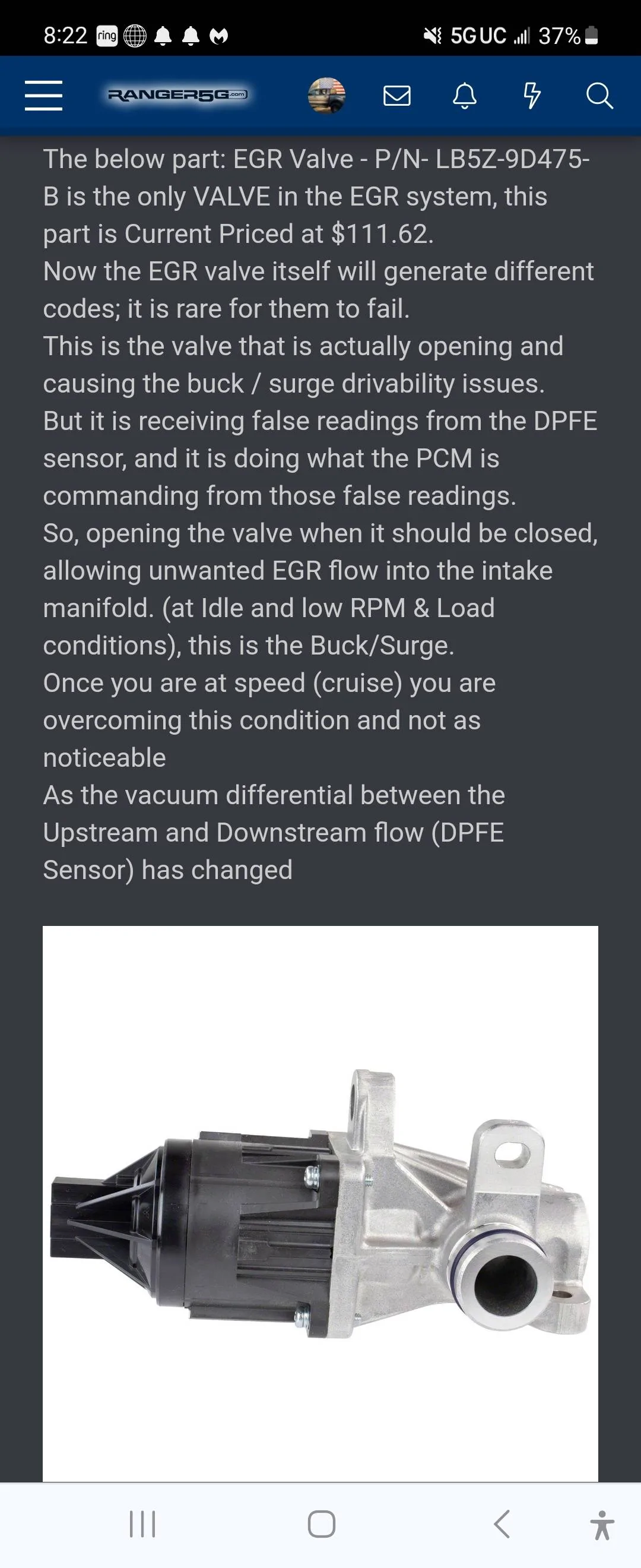
Is the Delta feedback the EGR sensor? Or is the pics showing on post 596-598?
Do we need to replace bothe the EGR and DPFE?

Screenshot_20231025_202227_Chrome.webp
 

airline tech

Well-Known Member
Joined
Aug 24, 2022
Threads
28
Messages
4,447
Reaction score
8,499
Location
Midwest - KS
Vehicle(s)
2022 Ranger Lariat-Super Crew, Cactus Gray
Occupation
Aircraft Tech
The DPFE sensor is the part that is fixing most of the issues owners are reporting.
The most common code is P139C and with an occasional associated code of P0401.
However, most of the symptom's buck / surge appear before it starts coding.
I see you have had a dealer already looking at it and they performed a valve clean via induction.
If you have replaced the DPFE sensor and no-help, then a deeper dive into it is needed.
There are other factors in the system, and this is where a live data monitor will be needed to see what is actually going on.

The most common fault part is the DPFE - moisture damage causes improper and false readings; those false readings cause improper control of EGR flow from the EGR Valve being commanded open, when it should be closed.

The EGR valve itself, could be electrically bad, and not actually fully closing - Stepper Motor

The tubing (Orifice Tube) could be clogged up, this is the metal tube that the DPFE sensor connects to.

The system uses sensor inputs from the ECT-CHT-TPS-CKP and MAPT sensors for engine parameters. (EGR Flow - Calculations) (When to open the EGR and how much)

The MAPT could be bad as this is feedback for EGR flow, when EGR is flowing the Manifold Pressure increases. (Possible)

The EGR system has 3 sensors - all 3 are mounted on the Orifice Tube, between the exhaust manifold and intake manifold.
DPFE - Feedback of exhaust flow to the PCM, for EGR valve control, measures the differential pressure between the upstream and downstream pressure of (exhaust flow / intake manifold)

EP - Exhaust Pressure Sensor - mainly used for EGR Cooler effectiveness but is also used for EGR Flow and Valve Position command, downstream of the EGR Cooler

EGRT - Exhaust Gas Temp Sensor - Used for EGR flow calculations, downstream of the EGR Cooler

So, as you will notice that with all the sensors mounted on the orifice tube, if there is any clogging in that tube it will affect all the sensors.
I question if the induction clean was done due to an actual inspection (borescope) of the valves and carbon buildup noted or was it an upsell or let's try this method.

If there was actual carbon buildup, then it is possible that the orifice tube and or intake inlet port for the EGR valve may be clogged up with carbon.

EGR Valve - Elec Controlled via stepper motor, opens and closes via commands from the PCM with the various engine and EGR sensor inputs.

EGR Cooler - uses engine coolant to lower the exhaust temp before it enters the intake manifold.

So, as you can see the EGR system is a bit complex to diagnose, most of the time will generate a fault code, however if not then it requires live data monitor and compare known good data or normal data to actual data on the truck.

I see you have replaced the DPFE, did the whole assy including hoses get replaced or just the sensor get replaced?
Are the hoses secure and connected to proper line?
Was there any water or carbon deposits noted at the hose connections?

I can give you the basic operation, but without proper testing it is just shot-gunning parts at it.
Hopefully, you can get it to code, to narrow down a possible solution.

For the most common code P139C:
Possible Causes:
Restricted or Damaged Downstream Hose / Tubing or Disconnected Hose
DPFE Sensor - Water or Carbon buildup at the sensor or hoses. Defective sensor

You MAY have a bad EGR Valve, but I would not replace it unless confirmed bad, that is an expensive part to just throw at it, plus a bad EGR valve itself will usually code it (electrically bad)
 
Last edited:

awelzel

Well-Known Member
First Name
Andrew
Joined
Oct 7, 2019
Threads
11
Messages
51
Reaction score
50
Location
Midcoast Maine
Vehicle(s)
2019 Ford Ranger XLT 302A Supercrew in Black
Vehicle Showcase
1
Has anyone with the issue of bucking/surging after a cold start usually between gears 3 and 4 during the first acceleration seen that this part fixes that problem?

I have had this issue since day 1 of ownership, Obviously letting the truck warm up for 2 to 3 minutes before driving it reduces the problem and I had already tried TSB 20-2339, but that did not work. I am pretty sure I had TSB 19-2052 done as well with no luck.
 
Last edited:

VAMike

Well-Known Member
First Name
Mike
Joined
Feb 22, 2019
Threads
1
Messages
3,390
Reaction score
4,408
Location
Virginia
Vehicle(s)
2019 Ranger Lariat SuperCab
Has anyone with the issue of bucking/surging after a cold start usually between gears 3 and 4 during the first acceleration seen that this part fixes that problem?

I have had this issue since day 1 of ownership, Obviously letting the truck warm up for 2 to 3 minutes before driving it reduces the problem and I had already tried TSB 20-2339, but that did not work. I am pretty sure I had TSB 19-2052 done as well with no luck.
Mine was like night and day after replacing the sensor, including stuff that I'd been asking the dealer to address since 2019. Dealer did all the TSBs faithfully after each one was released, and none of them really helped. (Which you can't verify when you pick it up because the damn transmission programming reset makes things act differently long enough to get you out of the shop.) The fact that ford hasn't issued a TSB on the DPFE sensor is one of the things I'm most pissed at them about with this truck. And it also seems idiotic on their part--the transmission work had to have cost man, many times what the sensor did, and as far as I can tell none of the issues were really transmission related. (Since the transmission TSBs didn't fix jack and the sensor did; I think a lot of "transmission problems" are the transmission trying to cover for an engine that's being suffocated by its own exhaust.) The part is so cheap it's worth just swapping it out rather than dealing with ford's bullshit. If it doesn't work you're only out a few bucks and less time than another trip through the ford service circus.

I used worm clamps at the top of the hoses, so it should be a 5 minute job when I need to replace it again. :mad:
 

awelzel

Well-Known Member
First Name
Andrew
Joined
Oct 7, 2019
Threads
11
Messages
51
Reaction score
50
Location
Midcoast Maine
Vehicle(s)
2019 Ford Ranger XLT 302A Supercrew in Black
Vehicle Showcase
1
Mine was like night and day after replacing the sensor, including stuff that I'd been asking the dealer to address since 2019. Dealer did all the TSBs faithfully after each one was released, and none of them really helped. (Which you can't verify when you pick it up because the damn transmission programming reset makes things act differently long enough to get you out of the shop.) The fact that ford hasn't issued a TSB on the DPFE sensor is one of the things I'm most pissed at them about with this truck. And it also seems idiotic on their part--the transmission work had to have cost man, many times what the sensor did, and as far as I can tell none of the issues were really transmission related. (Since the transmission TSBs didn't fix jack and the sensor did; I think a lot of "transmission problems" are the transmission trying to cover for an engine that's being suffocated by its own exhaust.) The part is so cheap it's worth just swapping it out rather than dealing with ford's bullshit. If it doesn't work you're only out a few bucks and less time than another trip through the ford service circus.

I used worm clamps at the top of the hoses, so it should be a 5 minute job when I need to replace it again. :mad:
Thanks for input, I am definitely going to do it, especially for that price. Hoping this solves almost 5 years of this issue.
 

ctechbob

Well-Known Member
First Name
Shawn
Joined
Feb 2, 2021
Threads
32
Messages
1,588
Reaction score
4,142
Location
30666
Vehicle(s)
2020 Ranger XL/FX2/STX
Occupation
Adult Daycare
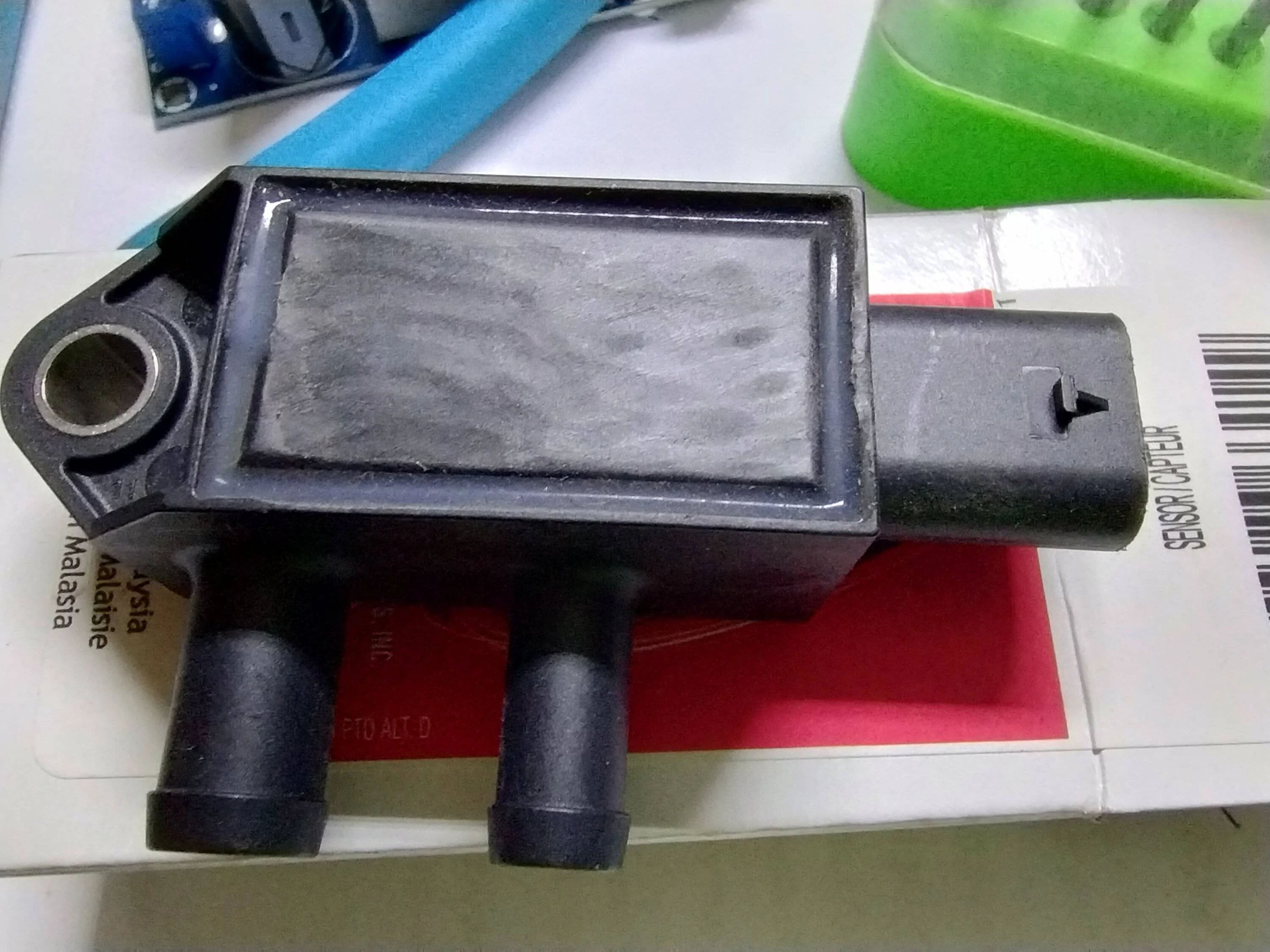
Got mine today. Before anyone flips out, you can clearly see where they scrubbed the FoMoCo lettering off the part, including a tiny bit of gold-colored dust I wiped off the side.

Not uncommon in the aftermarket.


IMG_20231121_164938303_HDR.webp
 

2021Ranger

Well-Known Member
First Name
Barry
Joined
Jan 29, 2023
Threads
46
Messages
453
Reaction score
667
Location
NJ
Vehicle(s)
2021 Ranger
So your saying that the standard part is a ford part?
 

ctechbob

Well-Known Member
First Name
Shawn
Joined
Feb 2, 2021
Threads
32
Messages
1,588
Reaction score
4,142
Location
30666
Vehicle(s)
2020 Ranger XL/FX2/STX
Occupation
Adult Daycare
So your saying that the standard part is a ford part?
Correct.

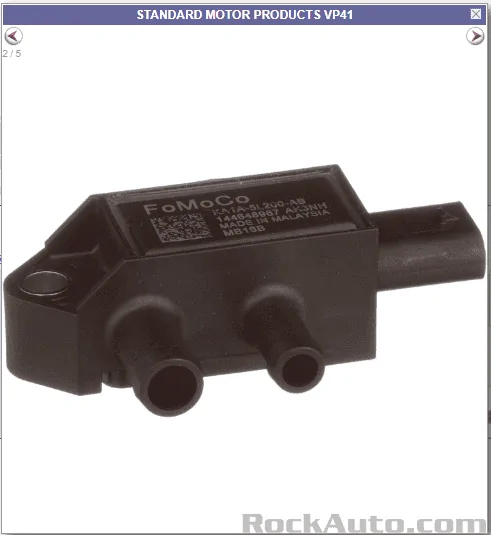
It might change in the future, but at the moment, the VP41 from Standard Motor Products is a Motorcraft part with the identifying marks scrubbed off.
Sponsored

 
Last edited:


Top