Sponsored

Maximizing Battery Life

chrisakz

Well-Known Member
First Name
Chris
Joined
Mar 3, 2022
Threads
0
Messages
162
Reaction score
248
Location
North Jersey
Vehicle(s)
2019 Magnetic Supercab XLT FX4
Got the Noco Genius 5 yesterday which does both. Charged first and showed a full charge. Ran the repair/desulfate which took 4 hours then charged again and it was still full charge. Still have 2019 OEM battery so happy. Don't have a battery tester to see what CCA's are.

I do have ASS off with the tune.
I have 2 handheld electronic battery testers and an analog tester. The electric ones allegedly somehow tests the battery electronically versus an old school tester applying a load on the battery to test it. I feel like some of the functions are kind of gimmicky on them. It said battery health 0 and SOC 9% then I proceeded to start the truck and drive away.
Sponsored

 
OP
OP

TJC

Well-Known Member
First Name
Tony
Joined
Aug 28, 2020
Threads
45
Messages
3,929
Reaction score
9,837
Location
North Carolina
Vehicle(s)
93 Miata, 05 Ranger 4x4, 20 Ranger 4x4, 23 CX-5
I have 2 handheld electronic battery testers and an analog tester. The electric ones allegedly somehow tests the battery electronically versus an old school tester applying a load on the battery to test it. I feel like some of the functions are kind of gimmicky on them. It said battery health 0 and SOC 9% then I proceeded to start the truck and drive away.
My tester asks for the Manufacturers CCA of the battery (on the label), then returns 3 results - Voltage, Resistance, and Actual CCA. It makes no claim to state of charge (SOC).
 

chrisakz

Well-Known Member
First Name
Chris
Joined
Mar 3, 2022
Threads
0
Messages
162
Reaction score
248
Location
North Jersey
Vehicle(s)
2019 Magnetic Supercab XLT FX4
My tester asks for the Manufacturers CCA of the battery (on the label), then returns 3 results - Voltage, Resistance, and Actual CCA. It makes no claim to state of charge (SOC).
Yeah as does mine. There’s also the option for CA . The instructions are vague and I haven’t thoroughly looked into it but wouldn’t testing CCA only apply if your testing it below 32F ambient temperature? I find it hard to believe it could simulate and account for that.
 
OP
OP

TJC

Well-Known Member
First Name
Tony
Joined
Aug 28, 2020
Threads
45
Messages
3,929
Reaction score
9,837
Location
North Carolina
Vehicle(s)
93 Miata, 05 Ranger 4x4, 20 Ranger 4x4, 23 CX-5
I just ran out and tested the battery in my 2005 Ranger (has sat for a week unused now and it is presently 44F - low last night low ~30F). The Battery was installed 8/22 and has a CCA rating of 750. The BM Desufator has been on the truck for over 10 years, so the battery has been actively conditioned since it was installed in the truck. See the results in the table below:

Remember - This is after the truck has sat a week unused in the garage.

These results are inline with every vehicle that I have installed the Batterminder Onboard Desulfator in. It is one very healthy battery! Even after sitting for a week.

I am kicking myself for not taking a baseline on my 2020 Ranger battery prior to installing the BM Desulfator and charging the battery for 2 days).

Both Rangers, 2005 and 2020 are housed in the same garage so conditions are identical.

Below are the readings on my 2020 Ranger battery minutes after being charged (It is NOT in a rested state so readings will be artificially high). The truck went into the low power mode once, and I have charged it multiple times to keep it from happening again.

Below the 2020 Ranger readings are the 2005 Ranger readings referenced earlier in this note.


2020 Ranger XLT 2.3L
Immediately after Charge
4 Hrs of Rest
8 Hrs of Rest
48 Hrs of Rest*
Voltage
12.9v​
12.75v​
12.37​
12.44*​
Resistance mOhms
3.66​
3.89​
5.19​
4.24*​
CCA Rated @ 720
792.2 +9%​
719.2 -0.2%​
485.7 -0.33%​
603.2*​
2005 Ranger XLT
4.0L V6
Battery Resting for 7 Days
Voltage
12.65​
Resistance mOhms
2.68​
CCA Rated @ 750
1012​
* Drove the truck twice in the 48 hours, 20 miles the first time and 45 miles the second time with the. BM Onboard Desulfator installed, but no external charging going on. Truck sat 14 hours after the last drive before being tested. Desulfator shows the battery in excellent health. The battery is still not in the condition I want. I'm looking for => than 725CCA. I am now charging the battery though the pigtail port on the desulfator. This insures the BMS sees the battery condition improvements.

It is clear to me which battery is healthier (my 2005 Ranger battery), and I attribute its health to the desulfator doing its thing whenever the Truck charges the battery. I'll do spot checks on both batteries once a month and report the result back on this thread.
 
Last edited:
OP
OP

TJC

Well-Known Member
First Name
Tony
Joined
Aug 28, 2020
Threads
45
Messages
3,929
Reaction score
9,837
Location
North Carolina
Vehicle(s)
93 Miata, 05 Ranger 4x4, 20 Ranger 4x4, 23 CX-5
Yeah as does mine. There’s also the option for CA . The instructions are vague and I haven’t thoroughly looked into it but wouldn’t testing CCA only apply if your testing it below 32F ambient temperature? I find it hard to believe it could simulate and account for that.
You may be correct, but I think the importance is in relativity. Whatever you start with continue with, be it CCA or CA. Get a baseline and watch for delta differences.

"Cold Cranking Amps (CCA) or Cranking Amps (CA) are ratings used when referring to the current (power) that a car battery can output. The difference between Cold Cranking Amps and Cranking Amps is that CCA is measured at around -18 degrees Celsius while CA is measured at only 0 degrees Celsius. From an inside battery perspective, the more and thinner plates a battery has, the larger the Cold Cranking Amp is due to the greater surface area. The higher the Cold Cranking Amp (CCA) rating, the greater the starting power of your battery. "


chrisakz

Well-Known Member
First Name
Chris
Joined
Mar 3, 2022
Threads
0
Messages
162
Reaction score
248
Location
North Jersey
Vehicle(s)
2019 Magnetic Supercab XLT FX4
You may be correct, but I think the importance is in relativity. Whatever you start with continue with, be it CCA or CA. Get a baseline and watch for delta differences.

"Cold Cranking Amps (CCA) or Cranking Amps (CA) are ratings used when referring to the current (power) that a car battery can output. The difference between Cold Cranking Amps and Cranking Amps is that CCA is measured at around -18 degrees Celsius while CA is measured at only 0 degrees Celsius. From an inside battery perspective, the more and thinner plates a battery has, the larger the Cold Cranking Amp is due to the greater surface area. The higher the Cold Cranking Amp (CCA) rating, the greater the starting power of your battery. "
I can get with that. Makes sense
 
OP
OP

TJC

Well-Known Member
First Name
Tony
Joined
Aug 28, 2020
Threads
45
Messages
3,929
Reaction score
9,837
Location
North Carolina
Vehicle(s)
93 Miata, 05 Ranger 4x4, 20 Ranger 4x4, 23 CX-5
Re: Battery internal Resistance ( my opinion based up prior experience )

<5 mOhm = Excellent Condition ( lower is better )
>5 <10 mOhm = Good Condition
>10 <20 mOhm = Marginal Condition ( I am looking to replace it )
>20 <30 mOhm = Poor Condition ( I use it in my garage to test 12V appliances - It stays on my workbench with a trickle charger attached)
>30 mOhm = Lead Weight - Recycle it
 
Last edited:

dtech

Well-Known Member
Joined
May 10, 2020
Threads
37
Messages
3,135
Reaction score
7,574
Location
colorado
Vehicle(s)
Ranger Lariat FX4, chromed and forever damperless
A lot of variables involved with batteries and testing them, ambient temps, soc, etc. but a battery will have higher power when just removed from a charger - surface charge I believe is the term, a higher priced battery tester that tests load will have high resistance capability to draw current and simulate starter drain, this current draw takes the batt voltage down and then the test indicates how the battery recovers to a degree, if it doesn't then it could be considered bad.
less expense testers I believe are only measuring voltage and internal resistance.
 
OP
OP

TJC

Well-Known Member
First Name
Tony
Joined
Aug 28, 2020
Threads
45
Messages
3,929
Reaction score
9,837
Location
North Carolina
Vehicle(s)
93 Miata, 05 Ranger 4x4, 20 Ranger 4x4, 23 CX-5
A lot of variables involved with batteries and testing them, ambient temps, soc, etc. but a battery will have higher power when just removed from a charger - surface charge I believe is the term, a higher priced battery tester that tests load will have high resistance capability to draw current and simulate starter drain, this current draw takes the batt voltage down and then the test indicates how the battery recovers to a degree, if it doesn't then it could be considered bad.
less expense testers I believe are only measuring voltage and internal resistance.
I have both a Battery tester, and the battery load tester. I use the tester and if I see a problem, I break out the load tester.
 

got3fords

Well-Known Member
First Name
James
Joined
Apr 12, 2021
Threads
131
Messages
5,319
Reaction score
13,797
Location
22973
Vehicle(s)
2026 Marsh Gray Ranger Raptor, 1995 Harley XLH1200
Occupation
Mom Joke Professional
The desulfator requires no external power. It does it's job when the alternator charge voltage reaches 13.5v. It stops desulvating when the battery voltage drops below 13.5v
Ah, interesting.
 
OP
OP

TJC

Well-Known Member
First Name
Tony
Joined
Aug 28, 2020
Threads
45
Messages
3,929
Reaction score
9,837
Location
North Carolina
Vehicle(s)
93 Miata, 05 Ranger 4x4, 20 Ranger 4x4, 23 CX-5
A desulphating device alone seems to provide marginal utility with respect to the real issue, which is the constant parasitic drain on the battery when the vehicle is not being driven enough to maintain a full charge.
I am going to test that hypothesis.

My Maxima draws dark current when off, and it has been equipped with an onboard desulfator as long as the 2005 Ranger. My batteries in it last just as long, 7-9 years. I never let either of them go more than a week or two without driving them somewhere.

My 2020 Ranger gets driven pretty regularly, and it seems to have more of a problem. But I just added the desulfator within the last week.

I am not going to tie my 2020 Ranger to a charger 3 times a week to keep the battery in optimal condition unless it is ABSOLUTELY necessary.

Time will tell the tale!

- T
 
OP
OP

TJC

Well-Known Member
First Name
Tony
Joined
Aug 28, 2020
Threads
45
Messages
3,929
Reaction score
9,837
Location
North Carolina
Vehicle(s)
93 Miata, 05 Ranger 4x4, 20 Ranger 4x4, 23 CX-5
My old battery is now at 91% charge capacity of the battery when new, @ 658.6 CCA and resistance has dropped from 30 mohms to 5.4 mOhms. This is much better than I had hoped for! See my first entry of this thread for details.

Meanwhile My 2020 Ranger Ford battery has rested 8 hours and its rating has dropped to 485.7 CCA with a resistance of 5.19 mOhms. See my entry on page three of this thread for details

I am using an 8amp BatteryMinder desulfating charger with the onboard desulfator. Basically this is sending twice the desulfating frequency power to the battery since the onboard Desulfator starts doing it thing when battery voltage exceeds 13.5v. The BatteryMinder Charger desulfates as it charges and continues when in maintenance mode when a full charge is achieved. So both desulfating units are running continuously.

Once I have the old battery optimized to its fullest potential. I will move the Batteryminder Charger over to the 2020 Ranger and see what life I can recover from that battery.
 
Last edited:
OP
OP

TJC

Well-Known Member
First Name
Tony
Joined
Aug 28, 2020
Threads
45
Messages
3,929
Reaction score
9,837
Location
North Carolina
Vehicle(s)
93 Miata, 05 Ranger 4x4, 20 Ranger 4x4, 23 CX-5
After a week on the BM desulfator my 2020 Ranger battery is showing remarkable progress. Note that this is NOT a rested reading. I did not test the battery before putting it on a charger and topping it off. I did test it after the initial charge and a 24 hour resting period.

Initial Results
Voltage = 12.44V
Internal Resistance = 4.24 mOhms
CCA = 603.2

1 Week Later
Voltage = 12.96V
Internal Resistance = 3.26 mOhms
CCA = 904.8 (well above its rating)

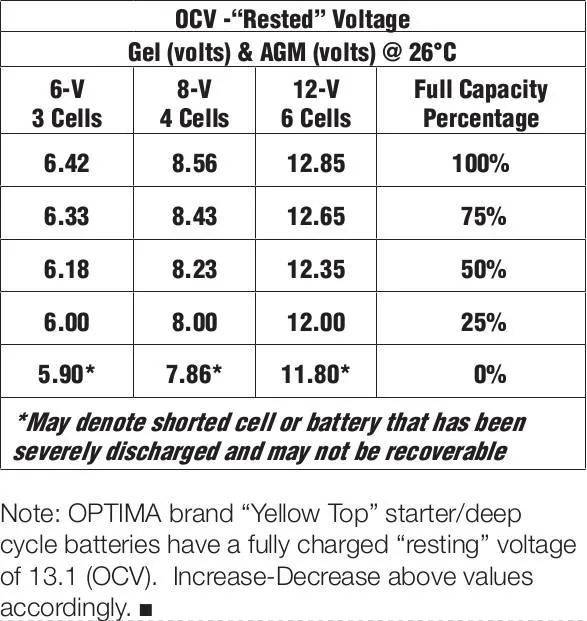
Charge of AGM battery based upon Resting Voltage
BM10.jpg

Based upon the above chart(an excerpt from the BM Desulfator user Guide) my Ranger battery was at a 57% charge 24 hours after charging to 100%.

I am going to leave on the battery maintainer for the next week to keep the Desulfator active. I'll record the results after allowing the battery to rest. Then remove the maintainer, and let the desulfator do its thing while the truck is running.

Remember, the Desulfator is only connected to the battery (no external power), and only desulfates when the alternator is charging the battery at =>13.5v. Once the charge voltage drops below 13.5v the unit goes dormant.

For those who may be interested I have linked to the Desulfator User Manual in PDF format. It has very good battery care info. I recommend reading it even if you are not interested in the Desulfator.
 
Last edited:

dtech

Well-Known Member
Joined
May 10, 2020
Threads
37
Messages
3,135
Reaction score
7,574
Location
colorado
Vehicle(s)
Ranger Lariat FX4, chromed and forever damperless
." In essence AGM battery’s do not like a full charge "

actually they love to be fully charged - it's just they are more sensitive to heat and characteristic of lead acid batteries internal resistance grows approaching a full charge which produces heat , so your higher power batt chargers will have an AGM setting which reduces the charging voltage as the SOC increases towards full , many trickle chargers don't need this setting as their charging isn't strong enough for heat to be an issue. Where I live I rarely see 90 temps so I opted to disco the BMS and battery has held it's own, having said that I'm going to visit the nearest Ford dealer - an hour drive to see if I qualify for a replacement batt right before warranty expiry. If I do get a new batt then I will likely reduce the SOC to 90% .
Sponsored


Top