Sponsored

Auto stop/start disable?

TJC

Well-Known Member
First Name
Tony
Joined
Aug 28, 2020
Threads
47
Messages
4,110
Reaction score
10,465
Location
North Carolina
Vehicle(s)
93 Miata, 05 Ranger 4x4, 20 Ranger 4x4, 23 CX-5
Yes, I am sure. There are other threads here that discuss it in detail. Its function is to calculate the battery state of charge. One reason is to make sure the battery has enough charge to restart the engine if ASS has stopped it. If there is not enough battery charge, it disables Auto Start Stop. But it also is used to control the charging rate of the battery. When you unplug the BMS, the state of charge can no longer be known.
I don't think that statement is absolutely true.

My research showed me that when the sensor was unplugged, the BMS defaulted to a charging system very much like the one in 2005 Ranger.

I monitored both trucks under identical conditions watching charging behaviors and the only difference between the two was that the unplugged 2020 Ranger charged the battery at 0.2v higher than the 2005 Ranger. The charge patterns were identical. That extra 0.2v I attributed to the 2020 algos being tuned for AGM vs standard flooded batteries that came with my 2005 Ranger.

I drove both trucks the same route(a 40 mile circuit with a stop at the 20 mile mark for 30 minutes) during the day and at night, one right after the other so weather conditions would be close. I watched both voltage and amperage. Both batteries were extremely healthy with 100% SOC and 100% SOH, and had sub 3.5milliOhm internal resistance. Those are pretty impressive numbers for 6 and 7 year old batteries.

My goal was to validate what was happening when the sensor was unplugged. I have since plugged it back in and set SOH to 100%. I'm not sure I'm going to leave it as it is. I can see the advanced BMS doing it's thing, but the SOC target setting drifts lower over time... and I think it is not intentional. I think there is an error in the firmware.
Sponsored

 
Last edited:
RangerBill

Well-Known Member
First Name
Bob
Joined
Jun 8, 2022
Threads
3
Messages
1,802
Reaction score
2,461
Location
PA
Vehicle(s)
2019 Ford Ranger Lariat Super Crew FX4
Occupation
retired
It does more than disabling Auto Start/Stop. Disconnecting it will also disable the Battery Management System that controls battery charging and presumably extends battery life and helps fuel economy.
The BMS also monitors battery temperature and voltage, which info is lost to the BCM if the sensor is unplugged.
 

TJC

Well-Known Member
First Name
Tony
Joined
Aug 28, 2020
Threads
47
Messages
4,110
Reaction score
10,465
Location
North Carolina
Vehicle(s)
93 Miata, 05 Ranger 4x4, 20 Ranger 4x4, 23 CX-5
The BMS also monitors battery temperature and voltage, which info is lost to the BCM if the sensor is unplugged.
I believe both the voltage and at least ambient air temp can still be used to charge the battery (old school method), and I can quickly confirm it again.

You're correct that the backup charging system isn't as advanced... You are also correct that the BMS senses temps from the neg battery terminal, and does read the voltage through the sensor.

The BMS normally gets its voltage measurement through its B+ sense connection, but the truck's charging system/PCM still has access to voltage information elsewhere.

The same goes for battery temperature... The backup system can use ambient air temps instead of those from the BMS sensor. My advanced chargers use precisely that technique to great effect -an ambient air temp sensor on a 4"- 8" pigtail from the charger.

You also lose the SOC and SOH (without severe penalty), which are derived from feedback and historical battery decay rates, and the key word here is "derived", and for me that has negative connotations.

If I can keep sulfation under control better than the general public (or Ford's in house testing which I suspect tends to follow a battery manufacture's standard degradation chart), my battery will age at a much slower rate. Ford's decay rate will have a serious negative impact on my efforts to extend the battery's useful life.

I accomplish this by keeping the battery at a full 100% SOC, (not a SOC of 70% or 75%), and constantly run a desulfation program when the truck is charging the battery above 13.5v. It is surprisingly simple, with a history of my batteries lasting at least 2X as long as most.

Once I do this I can throw Ford's charging Algo's out the window. This means I can unplug the BMS sensor, and use the backup charging methodology to achieve my battery longevity goals.

Presently, I'm testing the BMS system to determine the system reliability. And I've witnessed the SOC target drift lower twice in a relatively short time, and this bothers me enough that I am considering going back to disabling the BMS by removing the sensor from the equation. I've tried setting the BMS parameters with Forscan, and they have helped, but I do not like the SOC target drift down.

Time will tell....
 
Last edited:


RangerBill

Well-Known Member
First Name
Bob
Joined
Jun 8, 2022
Threads
3
Messages
1,802
Reaction score
2,461
Location
PA
Vehicle(s)
2019 Ford Ranger Lariat Super Crew FX4
Occupation
retired
I believe both the voltage and at least ambient air temp can still be used to charge the battery (old school method), and I can quickly confirm it again.

You're correct that the backup charging system isn't as advanced... You are also correct that the BMS senses temps from the neg battery terminal, and does read the voltage through the sensor.

The BMS normally gets its voltage measurement through its B+ sense connection, but the truck's charging system/PCM still has access to voltage information elsewhere.

The same goes for battery temperature... The backup system can use ambient air temps instead of those from the BMS sensor. My advanced chargers use precisely that technique to great effect -an ambient air temp sensor on a 4"- 8" pigtail from the charger.

You also lose the SOC and SOH (without severe penalty), which are derived from feedback and historical battery decay rates, and the key word here is "derived", and for me that has negative connotations.

If I can keep sulfation under control better than the general public (or Ford's in house testing which I suspect tends to follow a battery manufacture's standard degradation chart), my battery will age at a much slower rate. Ford's decay rate will have a serious negative impact on my efforts to extend the battery's useful life.

I accomplish this by keeping the battery at a full 100% SOC, (not an SOC of 70% or 75%), and constantly run a desulfation program when the truck is charging the battery above 13.5v. It is surprisingly simple, with a history of my batteries lasting at least 2X as long as most.

Once I do this I can throw Ford's charging Algo's out the window. This means I can unplug the BMS sensor, and use the backup charging methodology to achieve my battery longevity goals.

Presently, I'm testing the BMS system to determine the system reliability. And I've witnessed the SOC target drift lower twice in a relatively short time, and this bothers me enough that I am considering going back to disabling the BMS by removing the sensor from the equation. I've tried setting the BMS parameters with Forscan, and they have helped, but I do not like the SOC target drift down.

Time will tell....
I made the statements to inform others that unplugging the BMS sensor is doing more than disabling ASS. It disables ASS because the truck programming disables it when the battery state of charge is too low to ensure reliable restarts of the engine. Unplugging the sensor cuts off several of the parameters that are used for battery charging rates and battery state of charge calculation.
Disabling ASS is a side effect of unplugging it, not its main purpose. Some seem to believe it is only for the Auto Start/Stop function.
 
Last edited:

got3fords

Well-Known Member
First Name
James
Joined
Apr 12, 2021
Threads
134
Messages
5,479
Reaction score
14,362
Location
22973
Vehicle(s)
2026 Marsh Gray Ranger Raptor, 1995 Harley XLH1200
Occupation
Mom Joke Professional
I believe both the voltage and at least ambient air temp can still be used to charge the battery (old school method), and I can quickly confirm it again.

You're correct that the backup charging system isn't as advanced... You are also correct that the BMS senses temps from the neg battery terminal, and does read the voltage through the sensor.

The BMS normally gets its voltage measurement through its B+ sense connection, but the truck's charging system/PCM still has access to voltage information elsewhere.

The same goes for battery temperature... The backup system can use ambient air temps instead of those from the BMS sensor. My advanced chargers use precisely that technique to great effect -an ambient air temp sensor on a 4"- 8" pigtail from the charger.

You also lose the SOC and SOH (without severe penalty), which are derived from feedback and historical battery decay rates, and the key word here is "derived", and for me that has negative connotations.

If I can keep sulfation under control better than the general public (or Ford's in house testing which I suspect tends to follow a battery manufacture's standard degradation chart), my battery will age at a much slower rate. Ford's decay rate will have a serious negative impact on my efforts to extend the battery's useful life.

I accomplish this by keeping the battery at a full 100% SOC, (not an SOC of 70% or 75%), and constantly run a desulfation program when the truck is charging the battery above 13.5v. It is surprisingly simple, with a history of my batteries lasting at least 2X as long as most.

Once I do this I can throw Ford's charging Algo's out the window. This means I can unplug the BMS sensor, and use the backup charging methodology to achieve my battery longevity goals.

Presently, I'm testing the BMS system to determine the system reliability. And I've witnessed the SOC target drift lower twice in a relatively short time, and this bothers me enough that I am considering going back to disabling the BMS by removing the sensor from the equation. I've tried setting the BMS parameters with Forscan, and they have helped, but I do not like the SOC target drift down.

Time will tell....
IIRC, that lower SOC is there so when you are coasting, the regenerative charging can kick the charge voltage up to 14V or above and it has someplace to go. (I had a hard time putting that into words for some reason.)
I think with the BMS sensor disconnected it acts more like a traditional charging system without regen charging, no?
 

THORNRIDER

Active Member
First Name
Matt
Joined
Dec 10, 2024
Threads
1
Messages
26
Reaction score
72
Location
Six Mile, SC
Vehicle(s)
2020 Ford Ranger XLT FX2
Occupation
Investigator
This is all good information. I think we can all agree that ASS does harm to the engine and needs to be disabled. There are several ways to make that happen, and 5 years ago, I saw on YouTube disconnecting the BMS sensor will disable it. In those 5 years I have seen zero issues with my battery or charging system. I just purchased 2 USB LED lights to plug into the rear of my center console. I will try this on my 2020 Ranger and 2024 Bronco Sport. I learned about the USB LED lights from this forum so I will let you know if that works.

Are we not all glad that we don't own a GM 6.2L gas engine?????? Just read it could be as many as 1MM engines effected and they will blow up!!!!! Makes this BMS and ASS discussion seem very trivial.
 

TJC

Well-Known Member
First Name
Tony
Joined
Aug 28, 2020
Threads
47
Messages
4,110
Reaction score
10,465
Location
North Carolina
Vehicle(s)
93 Miata, 05 Ranger 4x4, 20 Ranger 4x4, 23 CX-5
IIRC, that lower SOC is there so when you are coasting, the regenerative charging can kick the charge voltage up to 14V or above and it has someplace to go. (I had a hard time putting that into words for some reason.)
I think with the BMS sensor disconnected it acts more like a traditional charging system without regen charging, no?
Essentially Yes.
 

twk

Well-Known Member
First Name
Tom
Joined
Mar 9, 2023
Threads
0
Messages
335
Reaction score
1,599
Location
Minnesota
Vehicle(s)
'17 Mustang GT drop top, '22 Ranger Lariat Fx4 SCABbie.
Occupation
Flight Simulator Engineer, retired, unemployed, burden on society.
If anyone would like to try out FORScan, it's quite simple once you work with it for a while. If you don't change & save anything, you won't hurt anything. --> Lots of YouTube vids out there make it easy. <--
If you need to change an "(AS BUILT format)" setting, then yes it can be a little un-nerving.

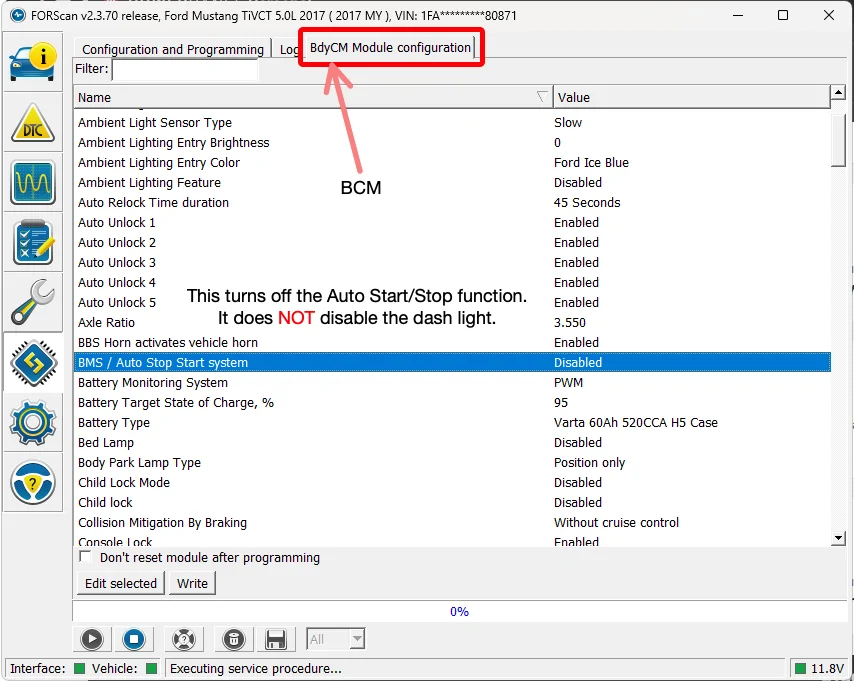
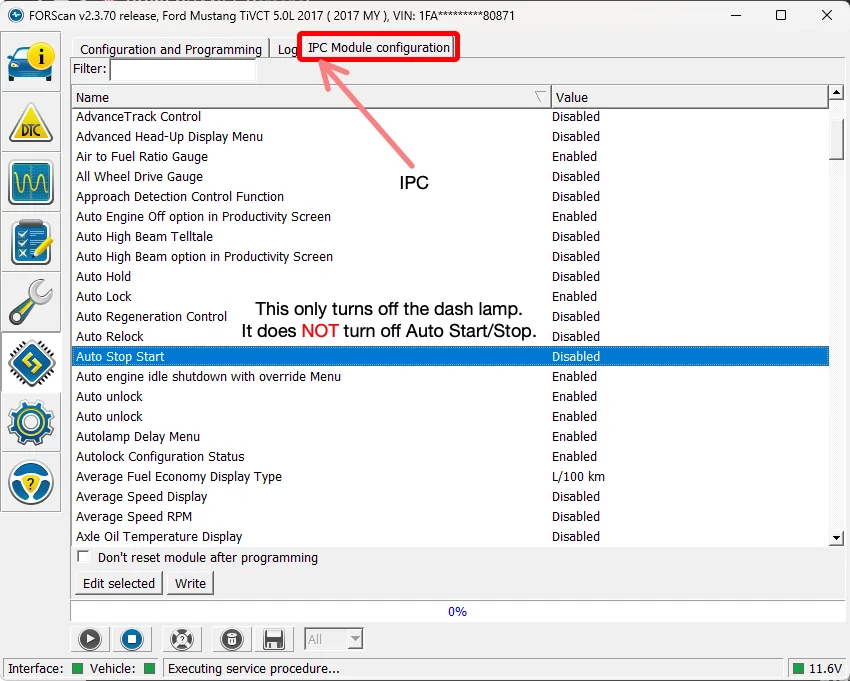
But not all changes are like that. Many are mouse driven with no editing involved. Here are two screenshots.
One is enable/disable the ASS system.
One is enable/disable the light on the dash.

Auto start stop enable-disable.webp


Auto Start Stop dash indication.webp


These screenshots show 'disabled' because mine are disabled.
Pictures! Because it did happen, a long time ago. :crackup:
 

airline tech

Well-Known Member
Joined
Aug 24, 2022
Threads
28
Messages
4,626
Reaction score
8,818
Location
Midwest - KS
Vehicle(s)
2022 Ranger Lariat-Super Crew, Cactus Gray
Occupation
Aircraft Tech
If anyone would like to try out FORScan, it's quite simple once you work with it for a while. If you don't change & save anything, you won't hurt anything. --> Lots of YouTube vids out there make it easy. <--
If you need to change an "(AS BUILT format)" setting, then yes it can be a little un-nerving.

But not all changes are like that. Many are mouse driven with no editing involved. Here are two screenshots.
One is enable/disable the ASS system.
One is enable/disable the light on the dash.

Auto start stop enable-disable.webp


Auto Start Stop dash indication.webp


These screenshots show 'disabled' because mine are disabled.
Pictures! Because it did happen, a long time ago. :crackup:
Yes, this is just a short-cut way to change the (2) As-Built lines
But - I am noting something here and am curious if this line (Auto-Changes) when you select (Disable) from this (BCM) Screen
I am looking at - BMS - PWM - with the BMS - ASS - Enabled - this reads LIN
If this is auto changing - this would explain why @TJC and his charging system monitoring (if he has this disabled) via Forscan - he still sees some sort of BMS (operation) behind the scenes and backs up the idea that (if disabled via Forscan) and gaining complete disablement of the BMS system + ASS is not a 100% true statement as it has been (commonly stated - here)

Yes for (ASS) Only - you are removing the (Slave) input for the ASS System to enable but I do not 100% think the BMS system is fully being disabled.

I know with my - Factory Delete - ASS
This Hex-Line section of the BCM- BMS - remained set to Enabled + LIN (Control)

I am curious if that line was changed to (None from LIN or PWM) would the BMS truly enable full charging control (same as old school)

The point I am trying to make is:
How does the BCM / PCM react (Behind The Scenes) is this is set to (PWM) as this setting is for BMS (In Car Configure) - so sensor type.
We do not know (100%) if changing this from LIN to PWM, we know that the sensor cannot communicate via PWM - but inside the BCM (programming) how does it respond to the switched data vs telling the BCM (No BMS Sensor - Installed (NONE)

I know I am overlapping here - ASS + Charging, but for those that have disabled via these screens - Did the Hex Line Change - to PWM like posted above? I am just curious if this is a factor for those that have done this (mod) and still report battery issues - this may be a factor
 
Last edited:
  • Like
Reactions: twk

twk

Well-Known Member
First Name
Tom
Joined
Mar 9, 2023
Threads
0
Messages
335
Reaction score
1,599
Location
Minnesota
Vehicle(s)
'17 Mustang GT drop top, '22 Ranger Lariat Fx4 SCABbie.
Occupation
Flight Simulator Engineer, retired, unemployed, burden on society.
Yes, this is just a short-cut way to change the (2) As-Built lines
But - I am noting something here and am curious if this line (Auto-Changes) when you select (Disable) from this (BCM) Screen
I am looking at - BMS - PWM - with the BMS - ASS - Enabled - this reads LIN
If this is auto changing - this would explain why @TJC and his charging system monitoring (if he has this disabled) via Forscan - he still sees some sort of BMS (operation) behind the scenes and backs up the idea that (if disabled via Forscan) and gaining complete disablement of the BMS system + ASS is not a 100% true statement as it has been (commonly stated - here)

Yes for (ASS) Only - you are removing the (Slave) input for the ASS System to enable but I do not 100% think the BMS system is fully being disabled.

I know with my - Factory Delete - ASS
This Hex-Line section of the BCM- BMS - remained set to Enabled + LIN (Control)

I am curious if that line was changed to (None from LIN or PWM) would the BMS truly enable full charging control (same as old school)

The point I am trying to make is:
How does the BCM / PCM react (Behind The Scenes) is this is set to (PWM) as this setting is for BMS (In Car Configure) - so sensor type.
We do not know (100%) if changing this from LIN to PWM, we know that the sensor cannot communicate via PWM - but inside the BCM (programming) how does it respond to the switched data vs telling the BCM (No BMS Sensor - Installed (NONE)

I know I am overlapping here - ASS + Charging, but for those that have disabled via these screens - Did the Hex Line Change - to PWM like posted above? I am just curious if this is a factor for those that have done this (mod) and still report battery issues - this may be a factor
Wow, you're right. My '22 Ranger, ASS disabled from the factory & BMS was enabled. But
My '17 Mustang, manual trans, so ASS disabled from the factory, and BMS was disabled.

I have no battery charging problems in the mustang that I know of, but I changed the BMS to enabled.
I did that because I drive the Mustang much more often in the summer. I'll keep an eye on the charging voltage. This could take a while.

Edited...
I have no battery charging problems in the Ranger either, but I think I'll change the Ranger to disabled tomorrow, and try to drive them both around quite a bit.
 
Last edited:

TJC

Well-Known Member
First Name
Tony
Joined
Aug 28, 2020
Threads
47
Messages
4,110
Reaction score
10,465
Location
North Carolina
Vehicle(s)
93 Miata, 05 Ranger 4x4, 20 Ranger 4x4, 23 CX-5
I turned both settings off on my Ranger, and the sensor is plugged in... and I still see strong signs that BMS is running... but with different algos. It is not simply dumping 14.4v into the battery nonstop. I've set several different SOC thresholds, and the voltage drops as it approaches the target SOC. and drops to 0 when it hits the target SOC.

If that is not a Battery Management System I don't know what is.
Sponsored


Top