Stevedbvik1
Well-Known Member
But you would think a 2022 with under 40K wouldn’t be there yetIt doesn't even take failing parts to make that happen. Just the transmission operating normally creates enough debris to cause issues over time.
Sponsored

But you would think a 2022 with under 40K wouldn’t be there yetIt doesn't even take failing parts to make that happen. Just the transmission operating normally creates enough debris to cause issues over time.
In a perfect world....no.But you would think a 2022 with under 40K wouldn’t be there yet
Stevedbvik1 said:
Not trying to a be a wise guy but mine went at 32,000 some even lessDang, that's pretty low for a failed trans.
I understand there are some failures at lower mileage. But I also keep seeing the 90k mark pop up a lot.Not trying to a be a wise guy but mine went at 32,000 some even less
I must have been an outlier. 2022 with 17K . Fluid level and condition were great. Driven normally and maybe 400-600 miles of towing each year. Short 50 to 200 mile round trips, flat and 60- 80 degree temps. Saw my trans temp reach 230 once for about 5-10 minutes in some hills then back down to 215. Took delivery of it new 04/01/22 and transmission replaced 07/2024. Tow haul mode pretty much all the time and if I used sport mode it was off road and low speeds. So basically using the truck as designed and very conservatively.I think it has to do with heat build up, and driving style. I am generally a conservative driver and never used Sport or Tow modes. I did a lot of distance traveling, 60% on rural roads, and generally at night. I did not have insight into transmission fluid temps at the time. At 12K miles I started seeing serious symptoms, by 18K miles I stopped driving the truck for fear of destroying the transmission.
I purchased and installed the FitzStick and PPE Deep pan. Added LubeGard Platinum when I changed the fluid 3x in 1,000 miles to reach a 95% clean fluid goal. The transmission is fine now, but I didn't stop there, I added a Scangauge III and started monitoring Transmission Fluid temps, Actual Slip and Target Slip. I found a direct correlation in fluid temps and transmission behavior.
And I could also derive driving patterns that raised fluid temps. Slow starts, lugging engine, long stoplight times, and stop and go traffic patterns all quickly raised the fluid temps to >200F.
IMO, Ford firmware decisions (shift patterns) excerabated the problem.
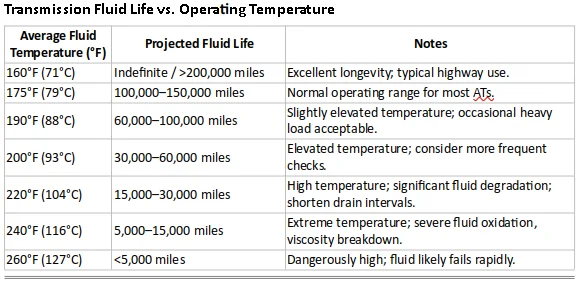
And owners had no insight to avoid the degradation of the transmission fluid. Take a look at this chart. This is the industry's projected fluid life chart based upon fluid temperature.

Key Points:
- Mercon ULV is formulated for high efficiency, low-viscosity operation, but low viscosity also means it’s more sensitive to high temperatures.
- Continuous temperatures above 200°F will significantly shorten fluid life.
- Stop-and-go driving, towing, or hilly terrain can elevate fluid temperature and accelerate oxidation.
- Transmission temperature sensors can be used to monitor and manage life.
If you are driving long distances. you are going to see ~200F fluid temps. I see 180F when I drive 40 miles on rural roads at 55mph. Stop and go traffic I see up to 205F. I watch fluid temps rise 3F-5F just sitting at a stop light in Drive. This is not under any load. This is in central NC where summers get hot, but not like out in the southwest. We see 95F-100F temps in the dog days of summer, and my transmission behavior reflects it.
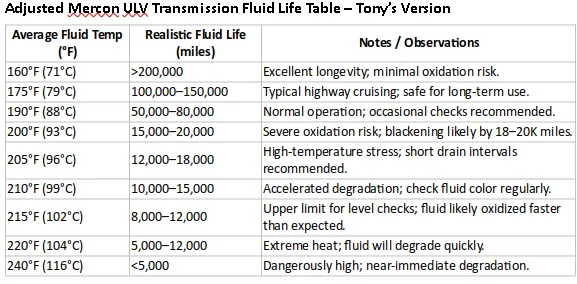
Winters no issues, but come summer as temps rise. so does the transmission fluid temps. At 18K miles when I changed the fluid, it came out BLACK, not transluscent red. And FWIW, I think the chart below is generous. My experience tells me that I was over 200F but never over 215F, and the fluid only lasted 12K-15K miles. And once the fluid degrades, symptoms cascade, and fluid degrades at a nonlinear rate.
I believe the Industry chart above is a best case scenario. My real world experience is listed in the my revised chart below. I want to err on the side of caution.

Practical Recommendations:
I am currently targeting the 150F-160F fluid temp range on my Ranger by adding a fluid cooler.
- Monitor fluid color and smell: ULV fluid turns dark brown/black when oxidized; burning smell indicates excessive heat.
- Drain intervals: If fluid operates near 200–205°F consistently, plan drain/replace around 15K miles.
- Transmission temperature monitoring: A gauge or OBD-II reader helps anticipate early degradation.
- Consider fluid cooling: Even a small drop in sustained temperature (~5–10°F) can significantly extend life.
*Edited to correct spelling and add the 210F and 215F rows to my chart. Seeing that this is where Ford requires us to accurately check the fluid level.
Very interesting.I think it has to do with heat build up, and driving style. I am generally a conservative driver and never used Sport or Tow modes. I did a lot of distance traveling, 60% on rural roads, and generally at night. I did not have insight into transmission fluid temps at the time. At 12K miles I started seeing serious symptoms, by 18K miles I stopped driving the truck for fear of destroying the transmission.
I purchased and installed the FitzStick and PPE Deep pan. Added LubeGard Platinum when I changed the fluid 3x in 1,000 miles to reach a 95% clean fluid goal. The transmission is fine now, but I didn't stop there, I added a Scangauge III and started monitoring Transmission Fluid temps, Actual Slip and Target Slip. I found a direct correlation in fluid temps and transmission behavior.
And I could also derive driving patterns that raised fluid temps. Slow starts, lugging engine, long stoplight times, and stop and go traffic patterns all quickly raised the fluid temps to >200F.
IMO, Ford firmware decisions (shift patterns) excerabated the problem.
And owners had no insight to avoid the degradation of the transmission fluid. Take a look at this chart. This is the industry's projected fluid life chart based upon fluid temperature.
Key Points:
- Mercon ULV is formulated for high efficiency, low-viscosity operation, but low viscosity also means it’s more sensitive to high temperatures.
- Continuous temperatures above 200°F will significantly shorten fluid life.
- Stop-and-go driving, towing, or hilly terrain can elevate fluid temperature and accelerate oxidation.
- Transmission temperature sensors can be used to monitor and manage life.
If you are driving long distances. you are going to see ~200F fluid temps. I see 180F when I drive 40 miles on rural roads at 55mph. Stop and go traffic I see up to 205F. I watch fluid temps rise 3F-5F just sitting at a stop light in Drive. This is not under any load. This is in central NC where summers get hot, but not like out in the southwest. We see 95F-100F temps in the dog days of summer, and my transmission behavior reflects it.
Winters no issues, but come summer as temps rise. so does the transmission fluid temps. At 18K miles when I changed the fluid, it came out BLACK, not transluscent red. And FWIW, I think the chart below is generous. My experience tells me that I was over 200F but never over 215F, and the fluid only lasted 12K-15K miles. And once the fluid degrades, symptoms cascade, and fluid degrades at a nonlinear rate.
I believe the Industry chart above is a best case scenario. My real world experience is listed in the my revised chart below. I want to err on the side of caution.
Practical Recommendations:
I am currently targeting the 150F-160F fluid temp range on my Ranger by adding a fluid cooler.
- Monitor fluid color and smell: ULV fluid turns dark brown/black when oxidized; burning smell indicates excessive heat.
- Drain intervals: If fluid operates near 200–205°F consistently, plan drain/replace around 15K miles.
- Transmission temperature monitoring: A gauge or OBD-II reader helps anticipate early degradation.
- Consider fluid cooling: Even a small drop in sustained temperature (~5–10°F) can significantly extend life.
*Edited to correct spelling and add the 210F and 215F rows to my chart. Seeing that this is where Ford requires us to accurately check the fluid level.
they are performing tsb 25-2134. I read it over doesn’t mention anything about the valve body from what I can see.The big concern is the debris created by the CDF drum failure causing friction material and possibly some fine metals to get in the valve body and can cause valves to stick or hang up. There’s been several posts on here where the CDF drum was repaired but nothing done with the valve body and resulted in a second repair.
Here’s from the TSB that explains that technicians are supposed to “carefully inspect and replace other transmission components as necessary “ while repairing the CDF issue.they are performing tsb 25-2134. I read it over doesn’t mention anything about the valve body from what I can see.
I would reach out to Nexgen diesel and get one of their upgraded valve bodies. They have been completely re-engineered to make up for the shortcuts in Fords manufacturing. I believe they offer drop in replacements that don't require reprogramming.Update. They ended up cleaning the valve body. Would have preferred a new valve body.

Just failed at 49k, along with water leaking. Going to dealer Monday. WTF!Not trying to a be a wise guy but mine went at 32,000 some even less
Yeah that sucks for sureJust failed at 49k, along with water leaking. Going to dealer Monday. WTF!