Sponsored

Sheared Lug Bolts

Johnpenn

Well-Known Member
First Name
John
Joined
Mar 31, 2019
Threads
1
Messages
248
Reaction score
126
Location
Rockwood TN
Vehicle(s)
2019 Ranger Lariat FX4, 2004 Corvette, 2005 Ranger Edge
Occupation
Retired Quality and EHS Manager
Random off topic thoughts...

The reason for nitrogen inflation is that the molecules are fatter, and can't escape between the tire rubber.

Regular air is made up of ~78% nitrogen

if the non-nitrogen portions of the air escape, it's roughly 2 refills before you achieve 90+% nitrogen fill in your tires.

So never agree to pay extra for nitrogen inflation.
Yeah, I refused to pay for that when I paid the bill.
Sponsored


Msfitoy

Well-Known Member
First Name
Sid
Joined
Mar 5, 2019
Threads
67
Messages
9,191
Reaction score
28,344
Location
North Carolina
Vehicle(s)
2019 Ranger, 2003 MINI Cooper S, 2021 Honda CT125
Occupation
NWO Robot Polisher
Vehicle Showcase
1
Not sure if this has been mentioned, but needless to say, the wheels with the sheared studs are toast as well...using aluminum to cut steel don't mix well...
 

VAMike

Well-Known Member
First Name
Mike
Joined
Feb 22, 2019
Threads
1
Messages
3,390
Reaction score
4,408
Location
Virginia
Vehicle(s)
2019 Ranger Lariat SuperCab
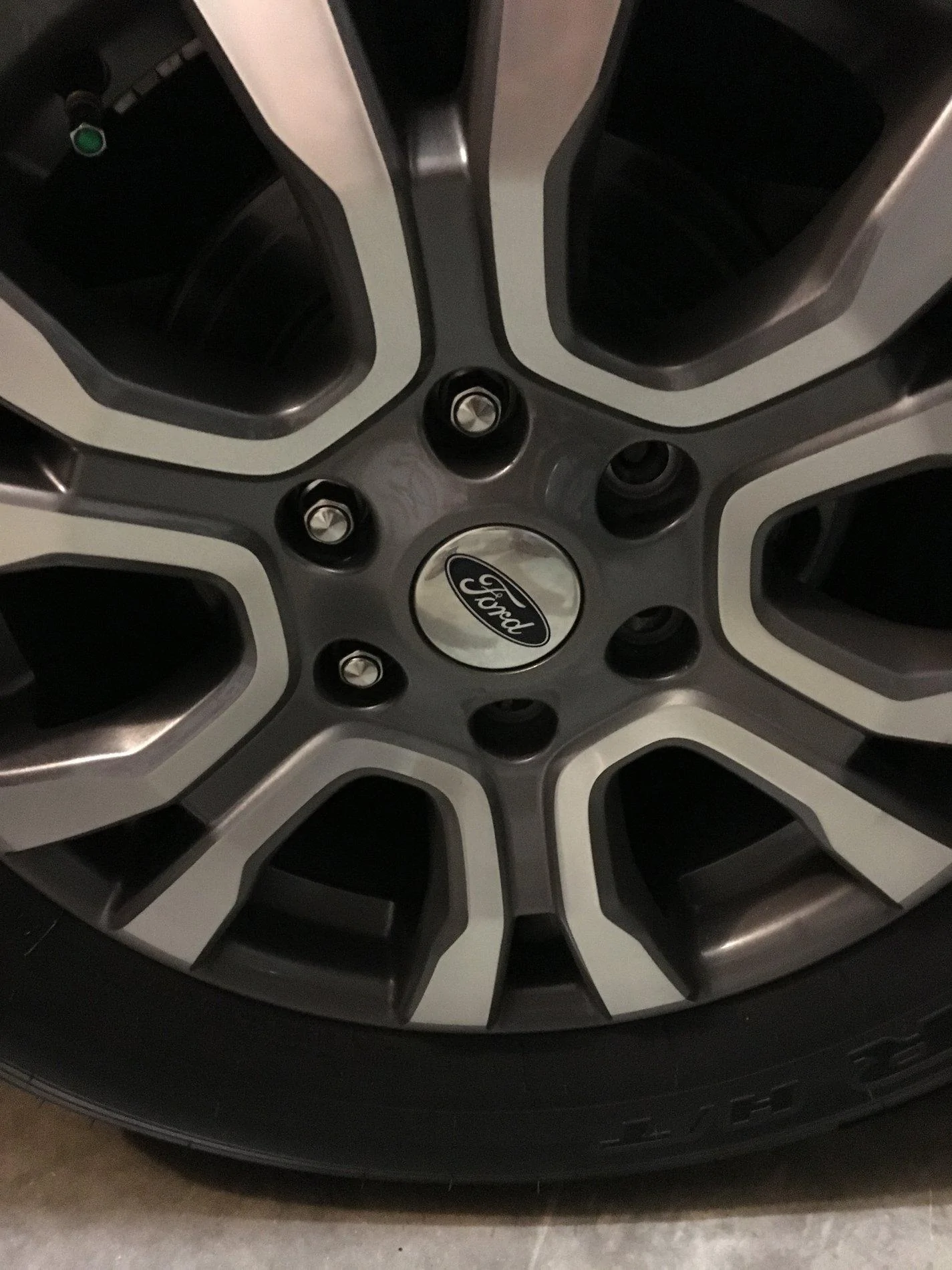
Nope the valve stem cover is from the dealership and shows they put nitrogen in the tires, as for swapping wheels I don’t think so but it’s certainly possible although these wheels are stock on a black lariat
oh, right, I forgot about the nitrogen scam.
 

KingsPoint75

Member
Joined
Aug 19, 2019
Threads
3
Messages
22
Reaction score
26
Location
SC
Vehicle(s)
2019 Lariat
Now since you’re all speculating here is what I have done to the vehicle
-instilled tonneau cover
-installed bug shield
-installed mud flaps
-installed Bed liner
-installed running bars

So I haven’t touched the suspension, brakes, tires, wheels. Other than the aftermarket parts displayed above this truck is bone stock from the dealer
========================
Ok, here's the probable source. On most mudflap installs I've done over the years, you take the wheels off to give yourself working room for the install, even if you do have a lift. This is particularly true if you need to drill holes but also in some cases with the no drill mudflaps. I had to take all 4 off (one at a time, replace, torque, go to the next and repeat) while installing Weathertech flaps early this month. If they didn't properly torque the wheels, you know the result.

Before I took the wheels off, I tried the "turn the wheel all the way (l/r)..." in Weathertech's directions....not enough room for an old man to do comfortably sitting on the ground. I really miss my lift! With the wheels off, it's bearable but you're probably going to be on a creeper for at least one flap.

For the newbies, anytime you take a wheel off, you must torque it to specification. The exception is if you make a side of the road tire change...then you torque it as soon as you get to your wrench! Torque specs are different for lubed vs. dry. Check your owner's manual. As to how I was taught (your mileage may vary, use at your own risk), 1) oil or use anti-seize on the studs. (a drop or three is enough) 2) with the wheel off the ground, run the first nut down close as you can by hand, skip one, run the third one down by hand, skip one and run the 5th down by hand. (If you have a 6 lug wheel, you'll have an even 1 skip 3 skip 5 skip 1 again. if a 5 lug, 1 skip 3 skip 5 1) 3) Now shake the wheel while hand tightening the three installed nuts. 4) Now use the wrench to snug those three up and your tire will be flat against the hub. 5) now lower the jack just enough so that the tire is touching the ground and won't slip when you tighten it. 6) put your other lug nuts on. snug them up with your wrench (not fully tight!) by tightening one, skipping one etc. If you have an even number, after your first go-round move to the un-snugged set (1-3-5 go to 2-4-6) and snug them up. At this point, everything is snug and flat to the hub. (If you tried to fully tighten it, you likely spun the wheel.) 7) Let the jack all the way down on the ground. 8) Get your torque wrench and set it to half the desired value (e.g. 50 lbft for the Ranger) and use the 1-skip-3-etc. to tighten all of the lug nuts. 9) Re-set your torque wrench to full torque and starting on a different nut, again use the (perhaps 2-skip...) until every nut is tightened to the specified torque. DO NOT GO BACK AND RECHECK the nuts. You're likely to over-torque them.

Again, your mileage may vary, use what works for you.

Other things to consider: Set the hand brake and if you can, block at least one wheel to reduce the chances you knock the car off the jack and onto yourself. If your studs are rusty, use a wire brush to remove the rust before you tighten the nuts. Carry a cruciform wrench that fits and ignore the silly excuse for a tool that most vehicles come with. You never know when you may be helping someone who forgot their wrench and their lug nuts may be a different size. You also have more leverage with a proper + cruciform wrench than a _/ hockeystick wrench.
 
OP
OP

GMatt

Member
First Name
Gregg
Joined
Jul 3, 2019
Threads
1
Messages
15
Reaction score
9
Location
McKinney, TX
Vehicle(s)
2019 Ford Ranger Lariat
========================
Ok, here's the probable source. On most mudflap installs I've done over the years, you take the wheels off to give yourself working room for the install, even if you do have a lift. This is particularly true if you need to drill holes but also in some cases with the no drill mudflaps. I had to take all 4 off (one at a time, replace, torque, go to the next and repeat) while installing Weathertech flaps early this month. If they didn't properly torque the wheels, you know the result.

Before I took the wheels off, I tried the "turn the wheel all the way (l/r)..." in Weathertech's directions....not enough room for an old man to do comfortably sitting on the ground. I really miss my lift! With the wheels off, it's bearable but you're probably going to be on a creeper for at least one flap.

For the newbies, anytime you take a wheel off, you must torque it to specification. The exception is if you make a side of the road tire change...then you torque it as soon as you get to your wrench! Torque specs are different for lubed vs. dry. Check your owner's manual. As to how I was taught (your mileage may vary, use at your own risk), 1) oil or use anti-seize on the studs. (a drop or three is enough) 2) with the wheel off the ground, run the first nut down close as you can by hand, skip one, run the third one down by hand, skip one and run the 5th down by hand. (If you have a 6 lug wheel, you'll have an even 1 skip 3 skip 5 skip 1 again. if a 5 lug, 1 skip 3 skip 5 1) 3) Now shake the wheel while hand tightening the three installed nuts. 4) Now use the wrench to snug those three up and your tire will be flat against the hub. 5) now lower the jack just enough so that the tire is touching the ground and won't slip when you tighten it. 6) put your other lug nuts on. snug them up with your wrench (not fully tight!) by tightening one, skipping one etc. If you have an even number, after your first go-round move to the un-snugged set (1-3-5 go to 2-4-6) and snug them up. At this point, everything is snug and flat to the hub. (If you tried to fully tighten it, you likely spun the wheel.) 7) Let the jack all the way down on the ground. 8) Get your torque wrench and set it to half the desired value (e.g. 50 lbft for the Ranger) and use the 1-skip-3-etc. to tighten all of the lug nuts. 9) Re-set your torque wrench to full torque and starting on a different nut, again use the (perhaps 2-skip...) until every nut is tightened to the specified torque. DO NOT GO BACK AND RECHECK the nuts. You're likely to over-torque them.

Again, your mileage may vary, use what works for you.

Other things to consider: Set the hand brake and if you can, block at least one wheel to reduce the chances you knock the car off the jack and onto yourself. If your studs are rusty, use a wire brush to remove the rust before you tighten the nuts. Carry a cruciform wrench that fits and ignore the silly excuse for a tool that most vehicles come with. You never know when you may be helping someone who forgot their wrench and their lug nuts may be a different size. You also have more leverage with a proper + cruciform wrench than a _/ hockeystick wrench.
Unfortunately these are the new weather tech no drill mudflaps, extremely easy install so again, I never removed the wheels


sbacpo

Well-Known Member
Joined
Jul 4, 2019
Threads
3
Messages
130
Reaction score
161
Location
Texas
Vehicle(s)
2019 Ranger
Occupation
Claybuster
Vehicle Showcase
1
"For the newbies, anytime you take a wheel off, you must torque it to specification. The exception is if you make a side of the road tire change...then you torque it as soon as you get to your wrench! Torque specs are different for lubed vs. dry. Check your owner's manual. As to how I was taught (your mileage may vary, use at your own risk), 1) oil or use anti-seize on the studs. (a drop or three is enough) 2) with the wheel off the ground, run the first nut down close as you can by hand, skip one, run the third one down by hand, skip one and run the 5th down by hand. (If you have a 6 lug wheel, you'll have an even 1 skip 3 skip 5 skip 1 again. if a 5 lug, 1 skip 3 skip 5 1) 3) Now shake the wheel while hand tightening the three installed nuts. 4) Now use the wrench to snug those three up and your tire will be flat against the hub. 5) now lower the jack just enough so that the tire is touching the ground and won't slip when you tighten it. 6) put your other lug nuts on. snug them up with your wrench (not fully tight!) by tightening one, skipping one etc. If you have an even number, after your first go-round move to the un-snugged set (1-3-5 go to 2-4-6) and snug them up. At this point, everything is snug and flat to the hub. (If you tried to fully tighten it, you likely spun the wheel.) 7) Let the jack all the way down on the ground. 8) Get your torque wrench and set it to half the desired value (e.g. 50 lbft for the Ranger) and use the 1-skip-3-etc. to tighten all of the lug nuts. 9) Re-set your torque wrench to full torque and starting on a different nut, again use the (perhaps 2-skip...) until every nut is tightened to the specified torque. DO NOT GO BACK AND RECHECK the nuts. You're likely to over-torque them."

I'm going to disagree with all of that. I've never, ever heard or read that anywhere. When installing lug nuts, you do so in a crossing pattern, hand tightening and then tightening to full toque spec, not half. Never put oil or anti-seize on lug nuts.

https://www.tirerack.com/tires/tiretech/techpage.jsp?techid=107
 

Junior Blue

Well-Known Member
First Name
Pete
Joined
Aug 21, 2019
Threads
5
Messages
91
Reaction score
200
Location
southern N.J.
Vehicle(s)
2019 Lightening Blue Ranger Lariat Crew
Thanks .....Chance and Tim for the socket info.
 

P. A. Schilke

Well-Known Member
First Name
Phil
Joined
Apr 3, 2019
Threads
149
Messages
7,083
Reaction score
37,187
Location
GV Arizona
Vehicle(s)
2019 Ranger FX4 Lariat 4x4, 2020 Lincoln Nautilus, 2005 Alfa Motorhome
Occupation
Engineer Retired
Vehicle Showcase
1
"For the newbies, anytime you take a wheel off, you must torque it to specification. The exception is if you make a side of the road tire change...then you torque it as soon as you get to your wrench! Torque specs are different for lubed vs. dry. Check your owner's manual. As to how I was taught (your mileage may vary, use at your own risk), 1) oil or use anti-seize on the studs. (a drop or three is enough) 2) with the wheel off the ground, run the first nut down close as you can by hand, skip one, run the third one down by hand, skip one and run the 5th down by hand. (If you have a 6 lug wheel, you'll have an even 1 skip 3 skip 5 skip 1 again. if a 5 lug, 1 skip 3 skip 5 1) 3) Now shake the wheel while hand tightening the three installed nuts. 4) Now use the wrench to snug those three up and your tire will be flat against the hub. 5) now lower the jack just enough so that the tire is touching the ground and won't slip when you tighten it. 6) put your other lug nuts on. snug them up with your wrench (not fully tight!) by tightening one, skipping one etc. If you have an even number, after your first go-round move to the un-snugged set (1-3-5 go to 2-4-6) and snug them up. At this point, everything is snug and flat to the hub. (If you tried to fully tighten it, you likely spun the wheel.) 7) Let the jack all the way down on the ground. 8) Get your torque wrench and set it to half the desired value (e.g. 50 lbft for the Ranger) and use the 1-skip-3-etc. to tighten all of the lug nuts. 9) Re-set your torque wrench to full torque and starting on a different nut, again use the (perhaps 2-skip...) until every nut is tightened to the specified torque. DO NOT GO BACK AND RECHECK the nuts. You're likely to over-torque them."

I'm going to disagree with all of that. I've never, ever heard or read that anywhere. When installing lug nuts, you do so in a crossing pattern, hand tightening and then tightening to full toque spec, not half. Never put oil or anti-seize on lug nuts.

https://www.tirerack.com/tires/tiretech/techpage.jsp?techid=107
I agree with you Sbacpo. The torque tension testing at Ford is with dry lugs and lugnuts which means if you put a lube on the lugs, you are way over torquing the lugnuts. I cannot speak for other manufacturers, where this may be required, but not to my knowledge on any Ford Light Truck, SUV, CUV or Car...

Back Story, Do you recall the wheel covers that simulated a "mag" wheel with lugnuts? My neighbor had such wheel covers and tried to take off the left wheel using the tire iron. Snapped off the plastic chrome lugnuts... Came over to my house to ask me why Ford was using plastic lugnuts...Popped off the wheel cover and showed him standard lugnuts... There was a design change to make the plastic nuts sized so the standard Âľ" socket would spin and not engage the fake lugnuts as he was not the only one that did that. A customer TGW.... By the way TGW and TGR are Things Gone Wrong or Things Gone Right in the world of Ford Acronyms.

Best,
Phil Schilke
Ranger Vehicle Engineering
Ford Motor Co. Retired
 

SandBaja

Well-Known Member
First Name
Larry
Joined
Jun 15, 2019
Threads
9
Messages
196
Reaction score
307
Location
San Diego
Vehicle(s)
2019 Silver FX4, 501A pkg, fully optioned,2012 Rubicon, 2017 Cherokee, 2018 Volt
Occupation
Almost retired
Update, checked the lug nuts on the wheel while waiting for the tow truck and discovered they ALL were loose. So I tightened them up before he took it away. Arrived at the dealership and they are puzzled as we also discovered that the center stud is totally missing from the truck while the outer two were just sheared off under the lug nut. Just waiting for my loaner car and will update again once the service department eyeballs it

AB642128-1A9D-4C4A-ADE4-02D7B197C19D.webp
Sorry for your pain and thank you for the reminder to check lug nut torque. Several of mine were not at 100 ft lbs, perhaps 90 or so.
 

P. A. Schilke

Well-Known Member
First Name
Phil
Joined
Apr 3, 2019
Threads
149
Messages
7,083
Reaction score
37,187
Location
GV Arizona
Vehicle(s)
2019 Ranger FX4 Lariat 4x4, 2020 Lincoln Nautilus, 2005 Alfa Motorhome
Occupation
Engineer Retired
Vehicle Showcase
1
Update, checked the lug nuts on the wheel while waiting for the tow truck and discovered they ALL were loose. So I tightened them up before he took it away. Arrived at the dealership and they are puzzled as we also discovered that the center stud is totally missing from the truck while the outer two were just sheared off under the lug nut. Just waiting for my loaner car and will update again once the service department eyeballs it

AB642128-1A9D-4C4A-ADE4-02D7B197C19D.webp
Hi Gregg,

Can you get a closeup of the sheared lugs? Not promising but I have some experience with fractured parts that may shed some light on the problem

Best,
Phil Schilke
Ranger Vehicle Engineering
Ford Motor Company, Retired
 
OP
OP

GMatt

Member
First Name
Gregg
Joined
Jul 3, 2019
Threads
1
Messages
15
Reaction score
9
Location
McKinney, TX
Vehicle(s)
2019 Ford Ranger Lariat
Hi Gregg,

Can you get a closeup of the sheared lugs? Not promising but I have some experience with fractured parts that may shed some light on the problem

Best,
Phil Schilke
Ranger Vehicle Engineering
Ford Motor Company, Retired
Truck is at the dealership since yesterday, service guy called and said they are checking for any damage to the wheel, tire, and the hub, besides replacing the lug studs. He has the suspension guys looking at it and will update me again maybe tomorrow or Thursday.
 

SemperVee

Well-Known Member
First Name
Dar
Joined
Aug 25, 2019
Threads
47
Messages
331
Reaction score
665
Location
Olympia WA
Vehicle(s)
2022 F150 LARIAT. 2019 Ranger XLT Traded in.
Vehicle Showcase
1
After reading all this I HAVE to go out and check my Lugnuts! :^)
 

Kataphrakt

Well-Known Member
First Name
Tim
Joined
Aug 6, 2019
Threads
6
Messages
144
Reaction score
229
Location
Grand Rapids Michigan
Vehicle(s)
Ranger XLT FX4 Offroad
Occupation
Mechanical Engineer - Mirrors
Torque specs are different for lubed vs. dry. Check your owner's manual. As to how I was taught (your mileage may vary, use at your own risk), 1) oil or use anti-seize on the studs. (a drop or three is enough)
Somewhere at Ford's engineering facility the Wheel engineers are getting headachs... Even the official service manuals explicitly say to not use antisieze on the lugs. While using Oil on a threaded fastener is a more consistent way to obtain a more repeatable preload on the fasteners, when you are not torquing to yield it's a bit excessive, and even more of a risk than using the manual specified dry torque (since there is no wet torque AFAIK). Lug nuts are not being torqued to yield (otherwise they would need to be replaced after each removal!) so a dry torque is accurate enough.

The rest of this though sounds similar to what the Wheel engineers i know do when they have to re-torque wheels on their vehicles, though they might have also had another step of torquing to 75% of spec in there.
 

P. A. Schilke

Well-Known Member
First Name
Phil
Joined
Apr 3, 2019
Threads
149
Messages
7,083
Reaction score
37,187
Location
GV Arizona
Vehicle(s)
2019 Ranger FX4 Lariat 4x4, 2020 Lincoln Nautilus, 2005 Alfa Motorhome
Occupation
Engineer Retired
Vehicle Showcase
1
Somewhere at Ford's engineering facility the Wheel engineers are getting headachs... Even the official service manuals explicitly say to not use antisieze on the lugs. While using Oil on a threaded fastener is a more consistent way to obtain a more repeatable preload on the fasteners, when you are not torquing to yield it's a bit excessive, and even more of a risk than using the manual specified dry torque (since there is no wet torque AFAIK). Lug nuts are not being torqued to yield (otherwise they would need to be replaced after each removal!) so a dry torque is accurate enough.

The rest of this though sounds similar to what the Wheel engineers i know do when they have to re-torque wheels on their vehicles, though they might have also had another step of torquing to 75% of spec in there.
The owners manual says 100FT LBs, that is the value to which the wheels should be torques based on wheel retention tests on the Flat Track machine, Torque tension testing etc. There is no 75% of this value in the owners manual, but if this is an intermediate step before torquing to 100 ft lbs, it would not hurt.

Best,
Phil Schilke
Ranger Vehicle Engineering
Ford Motor Co Retired
 

Kataphrakt

Well-Known Member
First Name
Tim
Joined
Aug 6, 2019
Threads
6
Messages
144
Reaction score
229
Location
Grand Rapids Michigan
Vehicle(s)
Ranger XLT FX4 Offroad
Occupation
Mechanical Engineer - Mirrors
The owners manual says 100FT LBs, that is the value to which the wheels should be torques based on wheel retention tests on the Flat Track machine, Torque tension testing etc. There is no 75% of this value in the owners manual, but if this is an intermediate step before torquing to 100 ft lbs, it would not hurt.

Best,
Phil Schilke
Ranger Vehicle Engineering
Ford Motor Co Retired
They did 50% torque, then 75% torque, then the final torquing
Sponsored


Top