Sponsored

Recommend a DC to DC converter

Joeiconic

Well-Known Member
First Name
Rob
Joined
Jan 31, 2021
Threads
27
Messages
1,747
Reaction score
5,922
Location
Georgia
Vehicle(s)
2021 Ranger XLT
Occupation
Retired
Just a laptop (60W USB-C power adapter), maybe a small PC monitor or television, emergency weather radio and cell phone charger. I have a jump pack that works for emergencies but the 2nd battery would also be a “just in case” for true emergencies when boondocking.

Laptop running at full tilt (and with a monitor at full brightness) would maybe be a max of 10A @ 12VDc which equals a run time of 8.8 hours. That would be plenty.

Also I’ve tried multiple household items off a DeWalt inverter and none of their power supplies mind the square wave output. Was surprised how tolerant most things are of square wave power…
I have the Bluetti unit I linked to as a UPS backup when I work my job from my cabin, where I lose power frequently. It will run my laptop and an additional 24” monitor for over 7 hours. I have my modem and router on a separate smaller backup that will also run those devices for about 7 hours. Also, there are other brands such as Jackery and Anker that sell similar products.
Sponsored

 
OP
OP

ccasanova22

Well-Known Member
Joined
Oct 1, 2022
Threads
25
Messages
403
Reaction score
456
Location
Lakeland, MN
Vehicle(s)
2022 Ranger XLT Tremor
Just looked at this one and it looks like the recommended fuse on the input side is 23A, and each side of the trailer would have approx. 3.5-4A for each brake actuator + the Autowbrake and interior lighting of the trailer. So I could see up to 32A when charging, driving down the road, and sudden braking.

My 2022 XLT has some super thin wires going to the 7 pin, can anyone here with a tow package confirm the gauge of wiring that comes from the factory?

Methinks I’d be pushing it with this sort of setup and may need to run direct lines from the battery to the rear bumper, but if the 7 pin lets you draw 40A over long periods, then why bother.
 

Frenchy

Well-Known Member
First Name
Chris
Joined
Mar 15, 2020
Threads
164
Messages
7,543
Reaction score
10,752
Location
Elizabeth, Colorado
Vehicle(s)
2012 Nissan Frontier, 1994 F150 XL, 2022 Ford Transit
Occupation
Field Service Technician
Just looked at this one and it looks like the recommended fuse on the input side is 23A, and each side of the trailer would have approx. 3.5-4A for each brake actuator + the Autowbrake and interior lighting of the trailer. So I could see up to 32A when charging, driving down the road, and sudden braking.

My 2022 XLT has some super thin wires going to the 7 pin, can anyone here with a tow package confirm the gauge of wiring that comes from the factory?

Methinks I’d be pushing it with this sort of setup and may need to run direct lines from the battery to the rear bumper, but if the 7 pin lets you draw 40A over long periods, then why bother.
If you have to take time to get a hold of Red ark and see what they recommend. From what I've seen when others usually hook up DC to DC charger on their camper trailer or caravan depending on what you want to call it they usually add an extra plug. That plug being an SB type by Anderson.
 

notsolinear

Well-Known Member
Joined
Apr 1, 2023
Threads
3
Messages
77
Reaction score
95
Location
Illinois
Vehicle(s)
2021 Ford Ranger Lariat
Just a laptop (60W USB-C power adapter), maybe a small PC monitor or television, emergency weather radio and cell phone charger. I have a jump pack that works for emergencies but the 2nd battery would also be a “just in case” for true emergencies when boondocking.

Laptop running at full tilt (and with a monitor at full brightness) would maybe be a max of 10A @ 12VDc which equals a run time of 8.8 hours. That would be plenty.

Also I’ve tried multiple household items off a DeWalt inverter and none of their power supplies mind the square wave output. Was surprised how tolerant most things are of square wave power…
Except for the PC monitor and maybe the laptop I’d try to power the rest of those things directly off DC instead of through the inverter. I found 40 and 60W USB-C outlets on Amazon that connect to the 12V system and that runs my laptop and charges all my devices more efficiency.

If you’re talking about the 88AH battery pictured above, I’ll warn you that everything I’ve seen in the travel trailer message boards says you should not go below 50% charge with Lead Acid/AGM batteries or it will seriously shorten their lifespan. Lithium batteries on the other hand advertise 100% depth of discharge with no adverse effects. If you follow that rule you’d be looking at only 44 usable amp-hours.

I’m a little surprised about all the discussion around DC-DC converters and worrying about charging through the 7-way plug because from the wiring diagrams I can see that the +12V from the 7-way is directly connected to my 2x56AH trailer batteries from the factory, implying no limiting or special charging being applied. The same 12V system is charging the truck’s battery every day too. Maybe there’s some scenario where that stuff is important, but it sounds overly complicated compared to what I’ve seen in my Airstream trailer.
 

Frenchy

Well-Known Member
First Name
Chris
Joined
Mar 15, 2020
Threads
164
Messages
7,543
Reaction score
10,752
Location
Elizabeth, Colorado
Vehicle(s)
2012 Nissan Frontier, 1994 F150 XL, 2022 Ford Transit
Occupation
Field Service Technician
Except for the PC monitor and maybe the laptop I’d try to power the rest of those things directly off DC instead of through the inverter. I found 40 and 60W USB-C outlets on Amazon that connect to the 12V system and that runs my laptop and charges all my devices more efficiency.

If you’re talking about the 88AH battery pictured above, I’ll warn you that everything I’ve seen in the travel trailer message boards says you should not go below 50% charge with Lead Acid/AGM batteries or it will seriously shorten their lifespan. Lithium batteries on the other hand advertise 100% depth of discharge with no adverse effects. If you follow that rule you’d be looking at only 44 usable amp-hours.

I’m a little surprised about all the discussion around DC-DC converters and worrying about charging through the 7-way plug because from the wiring diagrams I can see that the +12V from the 7-way is directly connected to my 2x56AH trailer batteries from the factory, implying no limiting or special charging being applied. The same 12V system is charging the truck’s battery every day too. Maybe there’s some scenario where that stuff is important, but it sounds overly complicated compared to what I’ve seen in my Airstream trailer.
You are correct with the Lead Acid and AGM batteries, as for the Lithium it is best to not go below 80%. That said it makes it real nice compared to a Lead Acid and AGM as they are much lighter and have more usable capacity


notsolinear

Well-Known Member
Joined
Apr 1, 2023
Threads
3
Messages
77
Reaction score
95
Location
Illinois
Vehicle(s)
2021 Ford Ranger Lariat
I may have answered my own question/confusion: The small wire gauge and long cable length in a typical travel trailer situation limits the max amperage to the TT battery due to the wire resistance. That probably explains why, among owners of my type of trailer, I’ve never heard of an issue with having the TT batteries connected directly to the 7-way plug.

That leads me to believe that for a simple system you can probably just connect the trailer battery to the 7-way directly and the isolated DC-DC is needed when you want to run bigger wiring to charge faster but not interfere with the trailer lighting?
 

ctechbob

Well-Known Member
First Name
Shawn
Joined
Feb 2, 2021
Threads
32
Messages
1,588
Reaction score
4,144
Location
30666
Vehicle(s)
2020 Ranger XL/FX2/STX
Occupation
Adult Daycare
This thread is a lot to unpack.

First off. OP, what loads are you looking to run when you're towing the trailer from point a to point b?

Several of us here have travel trailers and I haven't heard of a situation where the charging wire in the 7 pin connector wasn't enough to keep the battery topped up.

I personally run our fridge full time when towing and it is a 12v model that pulls 5-10 amps when it is running. Granted, it cycles on and off since I pre-cool it with the trailer plugged into shore power before we leave. At our destinations, the battery voltage is sitting right at 12.8 when I shut the truck off.

If you want to run an inverter while traveling, that's where it gets a bit sticky. If all you're doing is charging laptop/phone batteries in the trailer while you're traveling, why put them in the trailer? A 400 watt inverter will run comfortably off the 12v power socket in the truck and charge whatever laptop you need it to. Again, this is something I do when traveling as well, the wife is usually working on her laptop while I drive. Even then, there should be plenty of current in the factory wire to keep it charged.

I can't think of anything else I would need to power inside the camper that would need to be running when traveling.

The brake circuit is totally separate from the power supply circuit, so don't worry about that.

If you go for lithium batteries, then yes, you'll need a DC/DC charger for them.

If you're boondocking, you either need a generator or enough solar to get by on and keep the batteries topped up. If you're not, the batteries will be charged by shore power whenever you're at your campsite, so the truck only need maintain them when you're in motion.

What trailer are you towing?
 
Last edited:

bill_AUS

Well-Known Member
First Name
Billy
Joined
Oct 16, 2020
Threads
3
Messages
107
Reaction score
276
Location
Victoria, Australia
Vehicle(s)
2020.75 Ranger Raptor, 2013 Ranger XLT spacecab
Occupation
Vehicle fleet engineer
Redarc make good stuff, expensive, but very high quality. I use their chargers, relays etc on vehicles at work and have had no issues (even on the custom programmed stuff).

As for the wiring, run your own power cable to the trailer. Don't rely on the extra pin in the plug, the gauge of wire isn't heavy enough to do this. Most people here in Australia run a separate, fused, dual core cable to the back, with an Anderson type connector, dedicated to the power supply for the trailer.

You could use the additional power pin in the trailer to source an ignition over-ride trigger signal to turn the charger on. You will need this with the variable voltage smart alternator, as the alternator voltage can drop below the standard switch on voltage for most DC-DC chargers. Either way, you need an ignition switched wire to the DC-DC charger, in order to tell it to turn on when the alternator is outputting less than 12.7V.

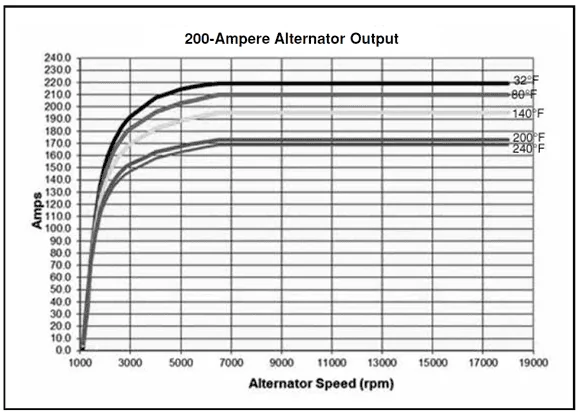
According to the Ford Body Builders manual your US market Rangers have a '150 Amp, 2025 Watt' alternator. Outputs as below:

1708322771578.webp
 

brroberts

Well-Known Member
First Name
Randy
Joined
Aug 20, 2021
Threads
10
Messages
439
Reaction score
999
Location
Overbrook, KS
Vehicle(s)
2021 Ford Ranger XLT 2WD SuperCab
Occupation
audio / semi retired
I cannot run my RV absorption fridge and have the 12V feed as stock keep the battery up. My fridge simply draws too much. Hence, I will eventually also upgrade when I have time so I don’t have to run the fridge on propane while driving. That’s what I do, but would prefer not.
 
OP
OP

ccasanova22

Well-Known Member
Joined
Oct 1, 2022
Threads
25
Messages
403
Reaction score
456
Location
Lakeland, MN
Vehicle(s)
2022 Ranger XLT Tremor
This thread is a lot to unpack.

First off. OP, what loads are you looking to run when you're towing the trailer from point a to point b?

Several of us here have travel trailers and I haven't heard of a situation where the charging wire in the 7 pin connector wasn't enough to keep the battery topped up.

I personally run our fridge full time when towing and it is a 12v model that pulls 5-10 amps when it is running. Granted, it cycles on and off since I pre-cool it with the trailer plugged into shore power before we leave. At our destinations, the battery voltage is sitting right at 12.8 when I shut the truck off.

If you want to run an inverter while traveling, that's where it gets a bit sticky. If all you're doing is charging laptop/phone batteries in the trailer while you're traveling, why put them in the trailer? A 400 watt inverter will run comfortably off the 12v power socket in the truck and charge whatever laptop you need it to. Again, this is something I do when traveling as well, the wife is usually working on her laptop while I drive. Even then, there should be plenty of current in the factory wire to keep it charged.

I can't think of anything else I would need to power inside the camper that would need to be running when traveling.

The brake circuit is totally separate from the power supply circuit, so don't worry about that.

If you go for lithium batteries, then yes, you'll need a DC/DC charger for them.

If you're boondocking, you either need a generator or enough solar to get by on and keep the batteries topped up. If you're not, the batteries will be charged by shore power whenever you're at your campsite, so the truck only need maintain them when you're in motion.

What trailer are you towing?
ctechbob,

The loads I'm looking to run while towing the trailer from point A to B are minimal. Maybe some chargers, but as you said, they are going to be in the truck while traveling.

I did a few tests today, with a clamp-on AC multimeter. With a buddy's fancy laptop (with high-end GPU and 8-core i9 processor) and two 24" monitors, I was only able to get 1.1A drawn from the AC outlet, which comes out to a little over 130W. If I slim that down to one monitor it's 0.9A.

So realistically, the loads I would run while boondocking are a much smaller laptop and single monitor, which even if the laptop battery were depleted, shouldn't draw more than 10A at 12VDC which means almost a full day of battery life (plus the laptop battery).

I've also done a few tests with inverters and the power supplies in the laptops, monitors, even PC speakers and peripherals worked fine. Didn't try a laser printer due to amp draw, but an inkjet would probably be fine.

With regards to the brake circuit, I'm running an Autowbrake, which mimics a surge brake (does not have anything to do with the truck, it makes the trailer towable by virtually anything as the trailer brakes engage via a gyroscope and accelerometer, mounted in the trailer, not the usual trailer brake controller).

This means that there needs to be 15A of reserve current for the autowbrake (as it is what drives the brake actuators, not the blue wire from the truck, and is powered by the +12V AUX black wire). Why do I do this? Because if I ever have a breakdown a friend can easily pull the rig with a van, Tahoe, Traverse, etc. or even a U-haul without a brake controller. Basically anything.

My travel trailer is a DIY project, based upon a shell I purchased from a trailer company in NE. It says "UNKNOWN TRAILER / TRAILER" on my registration due to it just being a unfinished frame. I do plan on using an inverter, connected to the 88Ah trailer battery, and then charging it with a DC-DC converter (since I really need to limit current for the Autowbrake, if I find myself in a steep mountain pass and the Autowbrake failed, I only have the truck brakes remaining).

The DC-DC converter would also help prevent the Autowbrake from being on 24/7 and draining the battery - even though it says when the accelerometer detects no motion it's in "sleep" it's still a small draw on that battery.

I can then run interior lights, the inverter for the laptop, and PC monitors off that battery. I'd also have the truck battery which means if one goes dead, I'm not completely without power.

This is probably more geared towards an RV forum but I do appreciate the thoughtful responses. I hope to have this rig completed before the summer and take it cross country sometime.
 

Frenchy

Well-Known Member
First Name
Chris
Joined
Mar 15, 2020
Threads
164
Messages
7,543
Reaction score
10,752
Location
Elizabeth, Colorado
Vehicle(s)
2012 Nissan Frontier, 1994 F150 XL, 2022 Ford Transit
Occupation
Field Service Technician
Something to keep in mind, regardless of what you may have hooked up to a inverter, the inverter will still pull a fair amount of the battery. A 1000 watt inverter can easily pull more that what it's being loaded as it is required to have the available energy. Same idea for a 500 watt inverter, but of course at a smaller rate
 

ctechbob

Well-Known Member
First Name
Shawn
Joined
Feb 2, 2021
Threads
32
Messages
1,588
Reaction score
4,144
Location
30666
Vehicle(s)
2020 Ranger XL/FX2/STX
Occupation
Adult Daycare
ctechbob,

The loads I'm looking to run while towing the trailer from point A to B are minimal. Maybe some chargers, but as you said, they are going to be in the truck while traveling.

I did a few tests today, with a clamp-on AC multimeter. With a buddy's fancy laptop (with high-end GPU and 8-core i9 processor) and two 24" monitors, I was only able to get 1.1A drawn from the AC outlet, which comes out to a little over 130W. If I slim that down to one monitor it's 0.9A.

So realistically, the loads I would run while boondocking are a much smaller laptop and single monitor, which even if the laptop battery were depleted, shouldn't draw more than 10A at 12VDC which means almost a full day of battery life (plus the laptop battery).

I've also done a few tests with inverters and the power supplies in the laptops, monitors, even PC speakers and peripherals worked fine. Didn't try a laser printer due to amp draw, but an inkjet would probably be fine.

With regards to the brake circuit, I'm running an Autowbrake, which mimics a surge brake (does not have anything to do with the truck, it makes the trailer towable by virtually anything as the trailer brakes engage via a gyroscope and accelerometer, mounted in the trailer, not the usual trailer brake controller).

This means that there needs to be 15A of reserve current for the autowbrake (as it is what drives the brake actuators, not the blue wire from the truck, and is powered by the +12V AUX black wire). Why do I do this? Because if I ever have a breakdown a friend can easily pull the rig with a van, Tahoe, Traverse, etc. or even a U-haul without a brake controller. Basically anything.

My travel trailer is a DIY project, based upon a shell I purchased from a trailer company in NE. It says "UNKNOWN TRAILER / TRAILER" on my registration due to it just being a unfinished frame. I do plan on using an inverter, connected to the 88Ah trailer battery, and then charging it with a DC-DC converter (since I really need to limit current for the Autowbrake, if I find myself in a steep mountain pass and the Autowbrake failed, I only have the truck brakes remaining).

The DC-DC converter would also help prevent the Autowbrake from being on 24/7 and draining the battery - even though it says when the accelerometer detects no motion it's in "sleep" it's still a small draw on that battery.

I can then run interior lights, the inverter for the laptop, and PC monitors off that battery. I'd also have the truck battery which means if one goes dead, I'm not completely without power.

This is probably more geared towards an RV forum but I do appreciate the thoughtful responses. I hope to have this rig completed before the summer and take it cross country sometime.
As long as you're sticking with flooded lead acid or AGM batteries I would forgo the DC/DC and just run anderson connectors with an 8AWG wire up to the battery +/- on the truck, being mindful of putting the negative on the correct side of the BMS sensor, and fused within 18" of the battery. There will be naff all voltage drop to the back and your coach batteries will charge just fine.

Lithium would be a different story, but you would probably still want to run a separate run back to supply the converter.

I'm not sure about your 'limit the current to the autobrake'. You don't need to limit it, just connect it to the battery, it will draw what it needs to from the battery when in use.
 

Frenchy

Well-Known Member
First Name
Chris
Joined
Mar 15, 2020
Threads
164
Messages
7,543
Reaction score
10,752
Location
Elizabeth, Colorado
Vehicle(s)
2012 Nissan Frontier, 1994 F150 XL, 2022 Ford Transit
Occupation
Field Service Technician
As long as you're sticking with flooded lead acid or AGM batteries I would forgo the DC/DC and just run anderson connectors with an 8AWG wire up to the battery +/- on the truck, being mindful of putting the negative on the correct side of the BMS sensor, and fused within 18" of the battery. There will be naff all voltage drop to the back and your coach batteries will charge just fine.

Lithium would be a different story, but you would probably still want to run a separate run back to supply the converter.

I'm not sure about your 'limit the current to the autobrake'. You don't need to limit it, just connect it to the battery, it will draw what it needs to from the battery when in use.
I disagree with this a bit. Due to the Variable Voltage system on the Ranger it is best to have a DC DC Charger for the House Battery. If the Variable Voltage system wasn't there then it would be ok
 

ctechbob

Well-Known Member
First Name
Shawn
Joined
Feb 2, 2021
Threads
32
Messages
1,588
Reaction score
4,144
Location
30666
Vehicle(s)
2020 Ranger XL/FX2/STX
Occupation
Adult Daycare
I disagree with this a bit. Due to the Variable Voltage system on the Ranger it is best to have a DC DC Charger for the House Battery. If the Variable Voltage system wasn't there then it would be ok
I would add to it then, turn your SOC in Forscan up. I forget that not everyone does this. I have mine set at 95% and my house battery always stays topped up.

Actually, pretty much anyone should probably do that if they're interested in longevity of batteries.
 
OP
OP

ccasanova22

Well-Known Member
Joined
Oct 1, 2022
Threads
25
Messages
403
Reaction score
456
Location
Lakeland, MN
Vehicle(s)
2022 Ranger XLT Tremor
As long as you're sticking with flooded lead acid or AGM batteries I would forgo the DC/DC and just run anderson connectors with an 8AWG wire up to the battery +/- on the truck, being mindful of putting the negative on the correct side of the BMS sensor, and fused within 18" of the battery. There will be naff all voltage drop to the back and your coach batteries will charge just fine.

Lithium would be a different story, but you would probably still want to run a separate run back to supply the converter.

I'm not sure about your 'limit the current to the autobrake'. You don't need to limit it, just connect it to the battery, it will draw what it needs to from the battery when in use.
The autowbrake has to run off the truck AUX +12V power, not the battery. I think that is for liability reasons. If you can’t stop and the trailer battery is dead, that could open up some legal issues.

Limiting the current meant “charge as little as possible when braking” so the autowbrake gets priority. That would hook to the truck’s Aux +12V (black pin) and the DC-DC would either come after or be a totally separate Anderson plug.

That would also keep the Autowbrake from killing the trailer battery when parked, as I don’t know how it can “sense” a moving trailer without some standby circuitry looking for gyro or accelerometer changes.
Sponsored


Top