Sponsored

10R80 Transmission Cooler Project

got3fords

Well-Known Member
First Name
James
Joined
Apr 12, 2021
Threads
131
Messages
5,323
Reaction score
13,832
Location
22973
Vehicle(s)
2026 Marsh Gray Ranger Raptor, 1995 Harley XLH1200
Occupation
Mom Joke Professional
American Volt had a great deal on a 40 row stacked cooler with thermostatically controlled fan, with a manual override circuit I can run to a switch in the cab. The fan draws 9 amps, produces 1860 CFM, and the temp sensor will screw into my 1/8" NPT port on the PPE pan. Temp control for the fan is adjustable from 104F-230F. All for $200. In for penny, In for a pound!
Do they spec the turn-on current?
Sponsored

 
OP
OP

TJC

Well-Known Member
First Name
Tony
Joined
Aug 28, 2020
Threads
45
Messages
3,944
Reaction score
9,900
Location
North Carolina
Vehicle(s)
93 Miata, 05 Ranger 4x4, 20 Ranger 4x4, 23 CX-5
Do they spec the turn-on current?
I don't see startup amperage. Most likely at least double the run amp rate. Here's the description. It is fused at 30 amps and can support 2 fans with 40 amp relay. Link to product page is here

Fluid Cooler:
  • 40 row stacked plate aluminum heavy duty engine transmission oil cooler.
  • Furnace brazed aluminum construction with integrated mounting brackets.
  • 2 inch deep turbulator-equipped plates and matte black powder coat finish.
  • 0.95 liters of fluid intake capacity with a max 246 psi burst pressure rating.
  • Dimensions: 2" x 11.8" x 13" with AN hose fittings and 56000 BTU per hour.
Electric Fan:
  • Universal 12 volt high performance 10-11 inch electric cooling fan.
  • Upgraded 90 watt motor draws 9 amps, producing over 1861 CFM.
  • Configured as an air puller by default or reversible to an air pusher.
  • Includes mounting bracket feet and complete cooler fin tie strap kit.
  • Measures 11.5" x 10.75" x 2.5" thickness at center and 1.4" at edge.
Wiring Kit:
  • 104-230'F digital adjustable electric fan thermostat switch wire kit.
  • Various NPT brass temperature sensor sizes thread into any port.
  • 40 amp relay harness with 14AWG wire powers up to 2 electric fans.
  • Maximum 30 amp continuous draw with 30 amp in-line fuse per fan.
  • A/C override or manual toggle switch wire built directly into harness.
  • Installation instructions, wiring diagram and components included.
 

got3fords

Well-Known Member
First Name
James
Joined
Apr 12, 2021
Threads
131
Messages
5,323
Reaction score
13,832
Location
22973
Vehicle(s)
2026 Marsh Gray Ranger Raptor, 1995 Harley XLH1200
Occupation
Mom Joke Professional
I don't see startup amperage. Most likely at least double the run amp rate. Here's the description. It is fused at 30 amps and can support 2 fans with 40 amp relay. Link to product page is here

Fluid Cooler:
  • 40 row stacked plate aluminum heavy duty engine transmission oil cooler.
  • Furnace brazed aluminum construction with integrated mounting brackets.
  • 2 inch deep turbulator-equipped plates and matte black powder coat finish.
  • 0.95 liters of fluid intake capacity with a max 246 psi burst pressure rating.
  • Dimensions: 2" x 11.8" x 13" with AN hose fittings and 56000 BTU per hour.
Electric Fan:
  • Universal 12 volt high performance 10-11 inch electric cooling fan.
  • Upgraded 90 watt motor draws 9 amps, producing over 1861 CFM.
  • Configured as an air puller by default or reversible to an air pusher.
  • Includes mounting bracket feet and complete cooler fin tie strap kit.
  • Measures 11.5" x 10.75" x 2.5" thickness at center and 1.4" at edge.
Wiring Kit:
  • 104-230'F digital adjustable electric fan thermostat switch wire kit.
  • Various NPT brass temperature sensor sizes thread into any port.
  • 40 amp relay harness with 14AWG wire powers up to 2 electric fans.
  • Maximum 30 amp continuous draw with 30 amp in-line fuse per fan.
  • A/C override or manual toggle switch wire built directly into harness.
  • Installation instructions, wiring diagram and components included.
It looks like they took start-up current into consideration. Good luck!
 

2021Ranger

Well-Known Member
First Name
Barry
Joined
Jan 29, 2023
Threads
46
Messages
455
Reaction score
674
Location
NJ
Vehicle(s)
2021 Ranger
IMO sucking air threw the cooler is better than pushing it threw.


OP
OP

TJC

Well-Known Member
First Name
Tony
Joined
Aug 28, 2020
Threads
45
Messages
3,944
Reaction score
9,900
Location
North Carolina
Vehicle(s)
93 Miata, 05 Ranger 4x4, 20 Ranger 4x4, 23 CX-5
It looks like they took start-up current into consideration. Good luck!
The new cooler, fan, and controller just arrived. The stacked 40 row cooler is the same form factor as the 30, just taller.

I tested current draw of the fan. 10 amp startup, 5.5 amp running draw.
 
OP
OP

TJC

Well-Known Member
First Name
Tony
Joined
Aug 28, 2020
Threads
45
Messages
3,944
Reaction score
9,900
Location
North Carolina
Vehicle(s)
93 Miata, 05 Ranger 4x4, 20 Ranger 4x4, 23 CX-5
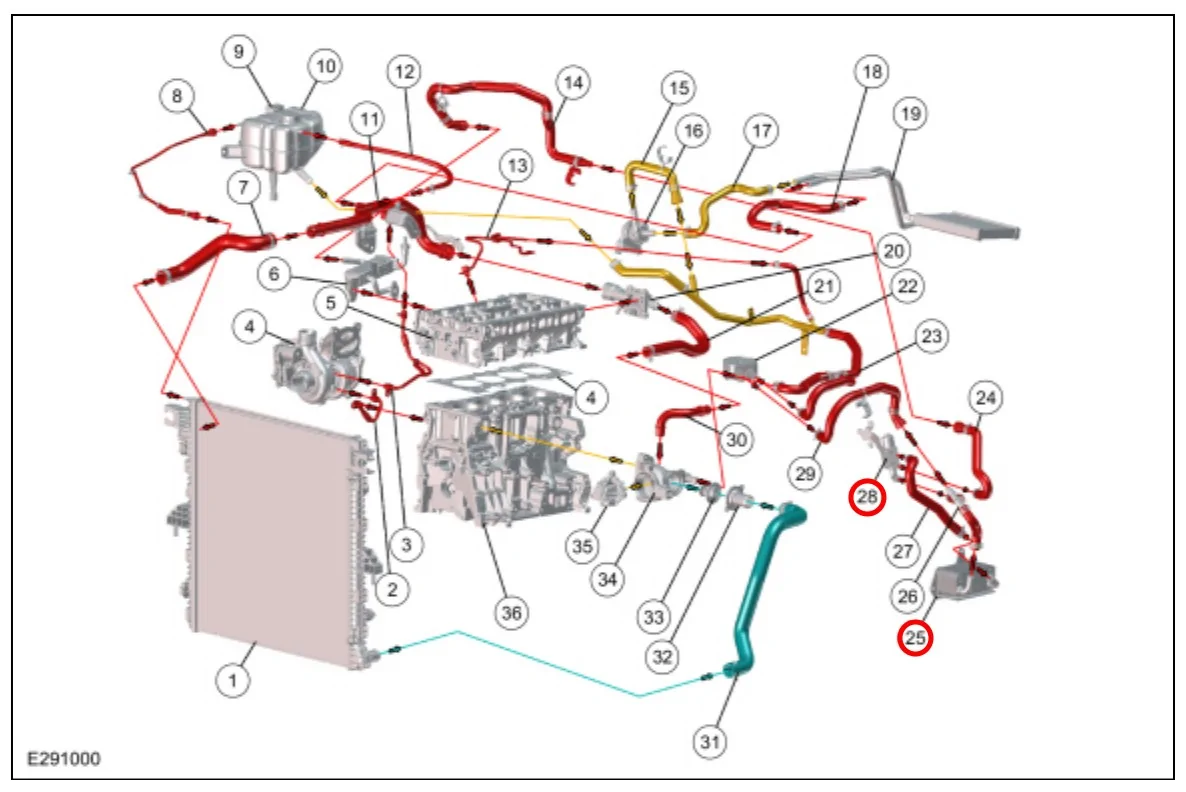
The diagram below is the 5G cooling system pulled directly from the Service Manual

Item 25 is the Transmission Oil Cooler
Item 28 is the Transmission Cooler Control Valve
Item 6 is the EGR Cooler

Coolant flows out of the EGR Cooler across the back of the engine down to the input of the Transmission Cooler Control Valve (the center port). Above 195F coolant flows out the Transmission cooler inlet hose (27), exits the Transmission cooler via the Transmission Outlet Hose (26) up to the Engine Oil Cooler (22).

I'll be removing the Transmission Cooler completely, replacing it with an adapter plate with a pair of AN8 fittings. I'll remove all hoses from the Transmission Control Valve and cap them. The Control Valve will stay in position and remain electrically connected.

It appears that the EGR Cooler Outlet Hose (14) can be connected directly to the inlet port of the Engine Oil Cooler (22), eliminating all the downstream hoses. I will validate once I begin the work.

Anyone see any issues with this thought process?

Cooling System.webp
 

airline tech

Well-Known Member
Joined
Aug 24, 2022
Threads
28
Messages
4,462
Reaction score
8,529
Location
Midwest - KS
Vehicle(s)
2022 Ranger Lariat-Super Crew, Cactus Gray
Occupation
Aircraft Tech
The diagram below is the 5G cooling system pulled directly from the Service Manual

Item 25 is the Transmission Oil Cooler
Item 28 is the Transmission Cooler Control Valve
Item 6 is the EGR Cooler

Coolant flows out of the EGR Cooler across the back of the engine down to the input of the Transmission Cooler Control Valve (the center port). Above 195F coolant flows out the Transmission cooler inlet hose (27), exits the Transmission cooler via the Transmission Outlet Hose (26) up to the Engine Oil Cooler (22).

I'll be removing the Transmission Cooler completely, replacing it with an adapter plate with a pair of AN8 fittings. I'll remove all hoses from the Transmission Control Valve and cap them. The Control Valve will stay in position and remain electrically connected.

It appears that the EGR Cooler Outlet Hose (14) can be connected directly to the inlet port of the Engine Oil Cooler (22), eliminating all the downstream hoses. I will validate once I begin the work.

Anyone see any issues with this thought process?

Cooling System.webp
My only thoughts are

1. I think it would be better to (Loop) the valve and leave some coolant inside, to protect the internals of the valve (seals etc) from drying out as electrically it will still be operational and loop it so it can still move fluid as the valve opens and closes vs capped dead end pressure changes as the valve opens and closes.

2. Bypass straight to the (Eng Oil Cooler), may provide slightly higher oil temps (engine coolant temps) as you are removing some restriction of flow, so it may flow faster through the cooler and lower its effectiveness. ---Just an outside the box thought, how much if any notable difference (IDK)

3. Since you are focused on (Transmission Cooling) and the secondary function of the valve is to provide heat to the transmission - how much does it actually contribute? during the cold start process - you may note a longer warm up time for the transmission.
Now you have been monitoring (deeper) than I have, in fact I have not had time to dive deep into the operating aspects yet
 
OP
OP

TJC

Well-Known Member
First Name
Tony
Joined
Aug 28, 2020
Threads
45
Messages
3,944
Reaction score
9,900
Location
North Carolina
Vehicle(s)
93 Miata, 05 Ranger 4x4, 20 Ranger 4x4, 23 CX-5
My only thoughts are

1. I think it would be better to (Loop) the valve and leave some coolant inside, to protect the internals of the valve (seals etc) from drying out as electrically it will still be operational and loop it so it can still move fluid as the valve opens and closes vs capped dead end pressure changes as the valve opens and closes.

2. Bypass straight to the (Eng Oil Cooler), may provide slightly higher oil temps (engine coolant temps) as you are removing some restriction of flow, so it may flow faster through the cooler and lower its effectiveness. ---Just an outside the box thought, how much if any notable difference (IDK)

3. Since you are focused on (Transmission Cooling) and the secondary function of the valve is to provide heat to the transmission - how much does it actually contribute? during the cold start process - you may note a longer warm up time for the transmission.
Now you have been monitoring (deeper) than I have, in fact I have not had time to dive deep into the operating aspects yet
Thanks for the feedback.

1) I'll investigate the valve design to determine the mechanics of it. I don't need it failing prematurely. I'll probably cap it with coolant fluid inside just in case..

2) It's an interesting point made. I'd considered the opposite effect. Less heat from transmission fluid, and faster fluid flow means coolant should complete the circuit faster and be cooler, but I can easily seeing it go the other way. I'm sure there is an optimal coolant speed.

3)I've tested Transmission Fluid warmup times at idle and documented it up to 180F. Almost 39 minutes to reach 180F. I drove 40 miles with a 15 minute stop at 20 miles. Transmission temps never exceeded 185F. But in stop and go traffic and long lights I see it go up faster due to torque converter slip. I start to see ever so slightly rougher shifts above 170F. By 200F they are not severe. but not as smooth as 150F - 165F, where the transmission is silky smooth.

Thank you again. I appreciate your thoughts.
 

Dereku

Well-Known Member
First Name
Derek
Joined
May 18, 2022
Threads
31
Messages
2,813
Reaction score
6,892
Location
Chicagoland Area
Vehicle(s)
2021 Ford Ranger
Occupation
Project Manager
All this nonsense in the diagram makes a 7 speed conversion seem like a pain. This looks worse than the smog pump nonsense on old 5.0s.

Good luck and I hope it works well. I would not be against loosing a few hundred feet of hoses under the truck.
 
OP
OP

TJC

Well-Known Member
First Name
Tony
Joined
Aug 28, 2020
Threads
45
Messages
3,944
Reaction score
9,900
Location
North Carolina
Vehicle(s)
93 Miata, 05 Ranger 4x4, 20 Ranger 4x4, 23 CX-5
Yeah, an EGR cooler, an engine oil cooler and a transmission fluid "heat exchanger", all in a (almost) Christmas tree light strand configuration. That's elegant engineering! :facepalm:

Looks like spaghetti!
 
OP
OP

TJC

Well-Known Member
First Name
Tony
Joined
Aug 28, 2020
Threads
45
Messages
3,944
Reaction score
9,900
Location
North Carolina
Vehicle(s)
93 Miata, 05 Ranger 4x4, 20 Ranger 4x4, 23 CX-5
Has some time yesterday and put the truck on the lift. Changed the oil (5w30 Valvoline Protect and Restore), and took a good look around at both target locations to determine the feasibility. Even with both plastic air dams removed there is not enough room to easily mount in the lower front grill. Running a pair of AN8 seems problem some as well. The driver side of the engine has the FWD driveshaft and steering column taking up a lot of space. I need to pull the drivers fender well to get a better look, and to access the transmission heat exchanger anyway. That's next.

There is room in front of the gas tank using the driver side frame and transmission cross mount as a mounting points.

I intentionally went with a cooler that I could manage the temperature control. I want to be able to select the fluid temperature range. With a passive system this is impossible to do. I'm targeting 150F-160F.

Removing the transmission heat exchanger and the coolant hoses is going to be a challenge. Very similar to the UPR Catch Can Installation. I'm working in that area... I see scratched knuckles in my future.

Before I begin the installation on the truck, I'm going to build a plenum for the fan and a mounting system to insure it fits cleanly. I've got plenty of length and width space, but only 8.5" of height to work with. Once I have completed the plenum and mounting points and secured the cooler/fan assembly to basically a skid plate that can be bolted to the truck, I'll turn my attention to removing the heat exchanger and building / installing the fluid lines and AN8 adapter plate.

I am beginning to understand why no one has attempted this. It is not going to be easy. I've got to work around the driveshaft from the transfer case to the front axle, and a boatload of coolant line plumbing in a very tight area.

--------------------
I've only found one other person who did anything close to what I am attempting, and he was quite clever. I've captured his note, and the article that he references as an attached PDF..

He basically installed a 170F thermostat in the engine, then bypassed the heat exchanger valve so coolant would flow continuously through the transmission heat exchanger. He also installed a PPE aluminim transmission pan. He reported average temp at 177F, with highest temp reaching 185F. A nice drop in temps.

I've also included an article that he referenced (and I had previously found when doing my research). This is the interesting Q & A line from the article.

FM: How much does heat play a part in the 10R80’s longevity?
JB: Cooling is a huge part of keeping the 10R80 alive and working well. I run a transmission cooler on anything above 700 horsepower. For a more intense transmission cooler, I run the Derale external transmission cooler mounted underneath the trunk with a fan. In most cases, I wire the fan to run continuously, regardless of whether I’m racing or just riding around town.
I also take out the thermal bypass, which lets the transmission fluid get to a certain temperature. The 10R80 works best at 150-160 degrees – anything cooler and the transmission gets finicky. With the thermal bypass removed, the fluid is allowed to flow all the time and is essentially creating a cooling process.
--------------------
I am targeting that 150F-160F sweet spot,
 

Attachments

Dereku

Well-Known Member
First Name
Derek
Joined
May 18, 2022
Threads
31
Messages
2,813
Reaction score
6,892
Location
Chicagoland Area
Vehicle(s)
2021 Ford Ranger
Occupation
Project Manager
Correct me if I am wrong but isn’t the thermal bypass on our transmission mounted inside, possibly the valve body? I know the 1/2 tons and up are or were externally mounted so removing them was easy.
Sponsored


Top