
Racket
Well-Known Member
- First Name
- John
- Joined
- Jan 21, 2020
- Threads
- 22
- Messages
- 2,205
- Reaction score
- 3,407
- Location
- Here and There
- Vehicle(s)
- 2019 Lariat Supercrew 2WD
- Occupation
- Transient
It's science. And history.
Sponsored

It's science. And history.

@RANGER PRIDEis this mythical 30hp gain available through any range of use, or is it only when the computers determine its worth, ie: while towing up a steep slope on a hot day?
it would be embarassing to offer a performance tune that makes an extra 45 horsepower when 30hp of it is from a required octane change alone.
It's science. And history.



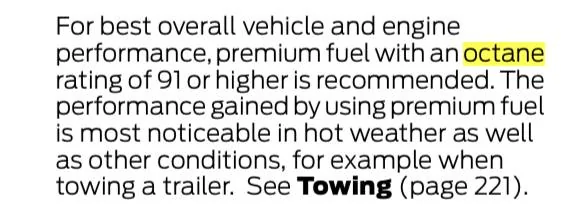

I get better performance and milage on my Suzuki V Strom (V-twin 650cc) with 91 oct than with 87 oct. The main reason I do is because 91-oct is the only no-ethanol fuel in my area, and my Butt-O-Meter detects an improvement in performance, real or imagined. Besides, I get 60+mpg so the extra ~70¢/gal. doesn't amount to much. In my Ranger, I fill with premium if I will be towing, and/or driving 75-80 in hot weather or hilly terrain.I’m currently running 91 because of the hot summer months here. The manual recommends 91 during hot temperatures use. As soon as it cools off I’m switching to 87. 91 prices has been killing me.


This is incorrect. Best power and efficiency is made at maximum brake torque or MBT. Assuming you have enough octane to reach this point, further advancing timing to the point of knock will not gain you anything...... the best power is right on the edge of knock, it is most efficient at that point as well.
I live in Colorado. Your equivalencies are off. Due to altitude (less oxygen less propensity to combust) 85 is equivalent to 87, 87 is equivalent to 89, and 91 is equivalent to 93.So many people don't understand octane, but I'm not directing this at you.
The higher the octane, the lower the propensity for the fuel to burn before desired, or precombust. Standard compression and heat is enough to make lower octane fuel precombust (burn before it should based on the position of the piston/valves due to heat) which would be a knock if the engine didn't adjust for it - which leads to crappier mileage. Conversely, there is a point where a higher-octane fuel becomes moot and doesn't make any difference as long as it begins to burn 1-6 degrees before top dead center of the piston and the valves are all closed. FWIW, mid-grade fuel wherever we're all at is fine. 87 octane in Colorado (mid-grade) is the same as 91 octane (mid-grade) in Cali because of the altitude. I get the same mileage on the 87 here (Colorado) as I do running the 91 (Premium). While towing across the State, I'll run 91 due to engine load. Wherever you're at, you only need to run mid-grade fuel because turbo. The extra compression will precombust lower-grade fuel.
Another common misconception is that diesel has a higher octane rating than gasoline. Diesel has an octane rating of 25-40 because it uses compression/heat only to ignite the fuel.
There is a f-ton of science that goes into air/fuel ratios and octane ratings for engines and it is interesting to me.
I live in Colorado. Your equivalencies are off. Due to altitude (less oxygen less propensity to combust) 85 is equivalent to 87, 87 is equivalent to 89, and 91 is equivalent to 93.
Nobody in their right mind puts premium in their car just for an MPG increase. Especially when prices are this high. Higher octane is for safety and performance.
Higher octane allows for advanced timing without knock or predetonation. If you're tuned, real custom tune not OTS, on premium you should run premium. Even stock Ford's knock sensing system will advance timing.
Also, why did you quote me if "you're not directing this at me."
It IS interesting, and complicated. You should study it some more. It's exactly the opposite of what you think. Turbo = premium.


