Calmdown
Active Member
- Joined
- May 23, 2020
- Threads
- 2
- Messages
- 32
- Reaction score
- 85
- Location
- New Mexico
- Vehicle(s)
- 2019 tri-pearl white
- Occupation
- IT Technician
- Thread starter
- #1
There was an incident where a cable-net vehicle barrier came up under my Ranger, and I'm trying to figure out how high up the ass of the truck was.
True story. Some places have these security devices to stop traffic and prevent people from coming or going. A few of these places have multiples of these allowing for different entrances from different roads. Think something like the image below.

Anywho, to make a story as long as it needs to be; there was an incident where someone set this sucker off, and the audible warning system wasn't working. And the barrier wasn't tied to the street lights. So when the light went green, I went. And the barrier came up under my truck.
Here's where it gets good: The trucks inertia made it completely over the barrier. Also good, but not so good, but still pretty awesome in a "hey this shit works like it's supposed to" way...
The barrier was strong enough to lift my truck... pretty frickin high in the air. I was in the truck and working on getting a video of it if it exists, so what happened next is me piecing together shit based on dead reckoning and how much I didn't have to replace on the truck compared to how expensive it would have been had it happened a different way.
Phase 1. Front end of truck over barrier, barrier starts to come up. Lifts front end of truck up while inertia pushes the front tires up and over barrier. Bounce 1.
Phase 2. Truck "lands" frame to barrier, roughly middle of drivers door distance, and bounces again. Bounce 2.
Phase 3. Truck "lands" past center of gravity and slides on the frame down the barrier until it reaches rear wheels.
Phase 4. Rear tires contact barrier and drive up and over it. Barrier most likely fully extended at this point.
Phase 5. Truck clears the barrier with the rest of the bed (like no scratches or scrapes or anything), and drops to the ground.
Aftermath:
The barrier decided it wanted my muffler as a trophy, and the truck was like "no" so they compromised by stretching out my flex pipe a good 8-10 inches, and sheered a nylon bung next to the transmission.
Truck drives straight, even with "jesus take the wheel" tests, no pulling on acceleration, decel, braking, or hard launches. No noise when I compress the suspension at speed. No mudflap damage, no hits on the spare tire, hitch receptacle untouched, etc...
I was eating a breakfast sandwich and it got launched into the windshield cheese first, so had to have that cleaned.
I'm going to get the frame dimensionally measured by Ford, as well as a 4 wheel alignment when I take the truck in for an oil change and some warranty (unrelated) work, but other than those items, and the tow hooks being scraped up, there seems to be absolutely nothing wrong with this truck.
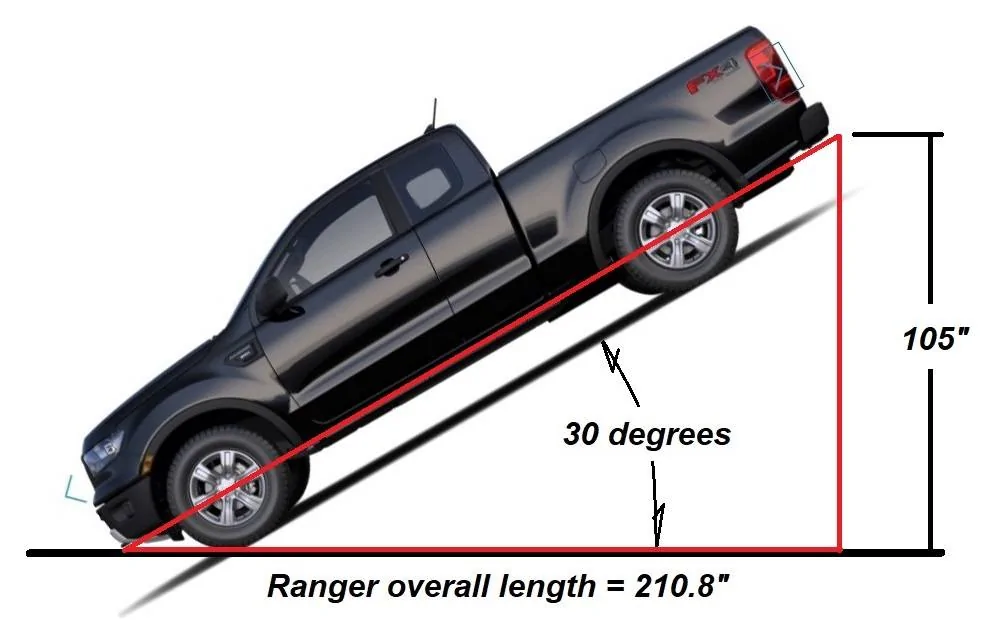
Which, of course brings us to the question: Does anyone know how high up the rear of the truck needs to be in order for the tow hooks to scrape the ground?
True story. Some places have these security devices to stop traffic and prevent people from coming or going. A few of these places have multiples of these allowing for different entrances from different roads. Think something like the image below.

Anywho, to make a story as long as it needs to be; there was an incident where someone set this sucker off, and the audible warning system wasn't working. And the barrier wasn't tied to the street lights. So when the light went green, I went. And the barrier came up under my truck.
Here's where it gets good: The trucks inertia made it completely over the barrier. Also good, but not so good, but still pretty awesome in a "hey this shit works like it's supposed to" way...
The barrier was strong enough to lift my truck... pretty frickin high in the air. I was in the truck and working on getting a video of it if it exists, so what happened next is me piecing together shit based on dead reckoning and how much I didn't have to replace on the truck compared to how expensive it would have been had it happened a different way.
Phase 1. Front end of truck over barrier, barrier starts to come up. Lifts front end of truck up while inertia pushes the front tires up and over barrier. Bounce 1.
Phase 2. Truck "lands" frame to barrier, roughly middle of drivers door distance, and bounces again. Bounce 2.
Phase 3. Truck "lands" past center of gravity and slides on the frame down the barrier until it reaches rear wheels.
Phase 4. Rear tires contact barrier and drive up and over it. Barrier most likely fully extended at this point.
Phase 5. Truck clears the barrier with the rest of the bed (like no scratches or scrapes or anything), and drops to the ground.
Aftermath:
The barrier decided it wanted my muffler as a trophy, and the truck was like "no" so they compromised by stretching out my flex pipe a good 8-10 inches, and sheered a nylon bung next to the transmission.
Truck drives straight, even with "jesus take the wheel" tests, no pulling on acceleration, decel, braking, or hard launches. No noise when I compress the suspension at speed. No mudflap damage, no hits on the spare tire, hitch receptacle untouched, etc...
I was eating a breakfast sandwich and it got launched into the windshield cheese first, so had to have that cleaned.
I'm going to get the frame dimensionally measured by Ford, as well as a 4 wheel alignment when I take the truck in for an oil change and some warranty (unrelated) work, but other than those items, and the tow hooks being scraped up, there seems to be absolutely nothing wrong with this truck.
Which, of course brings us to the question: Does anyone know how high up the rear of the truck needs to be in order for the tow hooks to scrape the ground?
Sponsored