Sponsored

Mishimoto R&D: 2019+ Ranger Catch Can Kit

Status
Not open for further replies.
OP
OP
Mishimoto

Mishimoto

Well-Known Member
First Name
Mishimoto
Joined
Jun 9, 2019
Threads
11
Messages
190
Reaction score
423
Location
Wilmington, DE
Vehicle(s)
2019 Ford Ranger Lariat
Glad to see you guys are getting into this market!

If you need any help with R&D or anything else let us know!
Thank you! I'll let you know if we need any 3rd-party testing!

I have looked into other Catch Cans and they specifically stated they would not work with Ranger Lariat because of the engine cover. Has your catch can addressed this issue?
Their development ranger is a Lariat so I think it would, but maybe Mishimoto can confirm.
Sorry for the delayed response! Our catch can will fit with the Lariat engine cover (we bought a fully-loaded Lariat for development so we'd know where all the bells and whistles are mounted ;) ). We will be mounting the can on the driver's side of the upper radiator support beam,right behind the headlight. We usually avoid mounting the can on the engine so that there's not a 1 lb. chunk of aluminum getting swung around on the bracket when the engine moves.

Feel free to let me know if you have any other questions!

Thanks,
-Steve
 
OP
OP
Mishimoto

Mishimoto

Well-Known Member
First Name
Mishimoto
Joined
Jun 9, 2019
Threads
11
Messages
190
Reaction score
423
Location
Wilmington, DE
Vehicle(s)
2019 Ford Ranger Lariat
JLTs catch can mounts in an area where the Lariat engine cover exists. You can remove the cover or modify the cover (not sure that would look good) for those kits if you have a Lariat. But it would be nice if it ended up located where @RCMUSTANG installed his, this should allow Lariat owners to retain cover... But we’ll see
Our can actually mounts very close to @RCMUSTANG 's - apparently great minds do think alike :D

Thanks!
-Steve
 

Jim C

Well-Known Member
Joined
Jun 22, 2019
Threads
2
Messages
244
Reaction score
614
Location
MI
Vehicle(s)
19 Ranger
i traded my "15" eco mustang for the ranger, had the mishimoto CC in it & can attest to the product. fitment was great as well as function. the only thing i would have liked would have been if the quick drain was not an option (separate purchase).

ill wait for them & see how it compares to the last one i had
 

u wish u could ride

Well-Known Member
First Name
robert
Joined
Jul 30, 2019
Threads
17
Messages
290
Reaction score
445
Location
lakeland florida
Vehicle(s)
19 xlt in blue
Occupation
building maintenance
can I use this in 0 to 32 degree winter months ?interested if I can.


CoastieN70

Well-Known Member
First Name
Lee
Joined
May 31, 2019
Threads
10
Messages
410
Reaction score
628
Location
Travelers Rest, SC
Vehicle(s)
2019 Ranger Lariet
Occupation
Retired
Thank you! I'll let you know if we need any 3rd-party testing!


Sorry for the delayed response! Our catch can will fit with the Lariat engine cover (we bought a fully-loaded Lariat for development so we'd know where all the bells and whistles are mounted ;) ). We will be mounting the can on the driver's side of the upper radiator support beam,right behind the headlight. We usually avoid mounting the can on the engine so that there's not a 1 lb. chunk of aluminum getting swung around on the bracket when the engine moves.

Feel free to let me know if you have any other questions!

Thanks,
-Steve
Thanks for the response Steve! I look forward to getting one and I hope you will consider an inaugural group buy! :)
 
OP
OP
Mishimoto

Mishimoto

Well-Known Member
First Name
Mishimoto
Joined
Jun 9, 2019
Threads
11
Messages
190
Reaction score
423
Location
Wilmington, DE
Vehicle(s)
2019 Ford Ranger Lariat
i traded my "15" eco mustang for the ranger, had the mishimoto CC in it & can attest to the product. fitment was great as well as function. the only thing i would have liked would have been if the quick drain was not an option (separate purchase).

ill wait for them & see how it compares to the last one i had
Thank you for the great feedback! This catch can will be a little easier to access than the 15+ EcoBoost Mustang catch can, so hopefully the drain kit won't be necessary.

can I use this in 0 to 32 degree winter months ?interested if I can.
in my use of them the cold weather is when i dot the most out of it. mostly a slurry of oil & condensation
Yes you can! You will catch more water vapor in the winter as @Jim C mentioned, but you shouldn't have a problem in those temps.

Thanks for the response Steve! I look forward to getting one and I hope you will consider an inaugural group buy! :)
Thank you! We will be having our discounted pre-sale in mid-October, so keep an eye out for that :like:

Thanks everybody,
-Steve
 

Indy650

Well-Known Member
First Name
john
Joined
Aug 27, 2019
Threads
10
Messages
295
Reaction score
217
Location
Eastern USA
Vehicle(s)
2019 Ford Ranger Lariat
In my opinion, Ford addressed this concern with the Ranger 2.3L and it is a waste of time and money. All testing on the Ranger was done without a aftermarket catch.can.

Best,
Phil Schilke
Ranger Vehicle Engineering
Ford Motor Co. Retired
As a mechanic I must agree I don't see the possible harm of a very small amount of oil/water vapor going back through the intake. Many engines and I think all modern on-road 4-stroke engines have this design and I don't know of a single one that comes stock with a catch can. The real problem is the exhaust gas re-circulation mixing with the oil vapors causing a sludge but I'd almost guarantee the Ranger has a oil separator from the factory
It's such a small amount of oil vapor the idea of a catch can IMO is nothing but a money grabber.
 
Last edited:

DavidR

Well-Known Member
First Name
David
Joined
Jul 22, 2019
Threads
4
Messages
389
Reaction score
328
Location
Eastern CA
Vehicle(s)
2019 Ranger XLT Supercab Saber FX4
Occupation
Engineer
Thanks! We'll have pricing nailed down closer to the start of the pre-sale in mid-October.
I'm curious to hear how Ford addressed this in your experience. They do include an oil separator on the PCV side of the system, but from what we've seen, no factory oil separator is 100% effective and our testing on the Ranger collected significant amounts of blow-by after the oil separator.

Thanks!
-Steve
Like with some of the other controversial topics (transmission oil changes, for example), it probably depends on how long you plan to keep the truck and how you view the tradeoff of spending smaller amounts of money early on to postpone possible larger expenditures later. We kept our last Ranger for 260,000 miles, so I'm going to tend to tweak things for longevity.

I installed a JLT can since they had a kit early on. I didn't like it that much and after doing some research, I installed a Provent 200 instead, but while it works much better, it's a weird design and I needed to make several mods to it. I think the Mishimoto might be a better choice at this point. After about 1500 miles of driving, it had captured around 1-1.5ml of oil that would have been sent to the intake. Also, I installed short pieces of transparent hose at the inlet and outlet of the can to be able to get a quick view, and the difference is dramatic. I don't have a photo right now, but the input side is yellow and oily and the output side is clear and clean.

So, yeah, it's catching oil that would otherwise be sent over your intake valves, but the million dollar question that makes this so controversial is will it make a difference down the road? I do believe the 2.3L EB is improved in this regard. Even though I'm catching oil, it is considerably less than what you see in many of the online videos for driving a similar distance with earlier GDI engines. It may be fine to ignore it if you're only planning to keep the truck for 100,000 miles, shorten the oil change intervals a bit, and tend to do mostly highway driving. OTOH, if you're biasing things for longevity past the manufacturer's design lifetime, I don't see the harm in having one. There is what appears to be a flow sensor in the breather side PCV hose, so if the PCV flow is insufficient, you'll get an error thrown and will know that you need to check your setup. I had that happen once when I forgot to hook a line up.
 
Last edited:

RCMUSTANG

Well-Known Member
First Name
Ray
Joined
Jan 22, 2019
Threads
22
Messages
1,867
Reaction score
2,191
Location
Los Angeles
Vehicle(s)
2017 Fusion 1995 Ranger
Since I tied in the breather side I'm picking up much more junk. There's a significant amount being sent back into the intake tract. Having the throttle body off allowed me to look inside and it's dry now. No one says you're going to have major issues but I for one don't subscribe into the idea of allowing oil into the intake and being burned. The engine should see air and fuel. Not oil. This allows a cleaner running engine overall and less octane.
 

Randy2400h

Well-Known Member
First Name
Randy
Joined
Oct 23, 2018
Threads
23
Messages
300
Reaction score
309
Location
Colorado
Vehicle(s)
2019 Ford Ranger Lariat Sport FX4, 2015 Ford Edge Sport
Vehicle Showcase
1
Since I tied in the breather side I'm picking up much more junk. There's a significant amount being sent back into the intake tract. Having the throttle body off allowed me to look inside and it's dry now. No one says you're going to have major issues but I for one don't subscribe into the idea of allowing oil into the intake and being burned. The engine should see air and fuel. Not oil. This allows a cleaner running engine overall and less octane.
Right. And the primary issue is not the residual oil being burned in the combustion chamber, it’s the oil being baked onto the backside of the intake valves because with direct fuel injection there in no fuel present to wash the valves; just a lot of air (with a little oil and water vapor mixed in). Previously with port injection the fuel and air was mixed before reaching the intake valves.

This is a legitimate and well documented issue that unfortunately hasn’t been fixed on our 2.3L EcoBoost engines. Panda also has a baffle plate that supposedly stops oil/water vapor before it leaves the crankcase; which is great for addressing the residual oil into the intake issue, but you’re also trapping water vapor in the crankcase which could cause your oil to be contaminated faster. A catch-can seems like a janky and annoying way to address the problem, but it’s the only effective fix that doesn’t cause another issue.

Edit: And I just realized if you click on Mishimoto’s “Keep Reading” that I just repeated their message.
 

Randy2400h

Well-Known Member
First Name
Randy
Joined
Oct 23, 2018
Threads
23
Messages
300
Reaction score
309
Location
Colorado
Vehicle(s)
2019 Ford Ranger Lariat Sport FX4, 2015 Ford Edge Sport
Vehicle Showcase
1
Hey Steve, how’s the drop-in Mishimoto intercooler for our Rangers coming along?
 
OP
OP
Mishimoto

Mishimoto

Well-Known Member
First Name
Mishimoto
Joined
Jun 9, 2019
Threads
11
Messages
190
Reaction score
423
Location
Wilmington, DE
Vehicle(s)
2019 Ford Ranger Lariat
Hey everybody,

It sounds like all of the points that I would make have already been made, so thanks! :like:

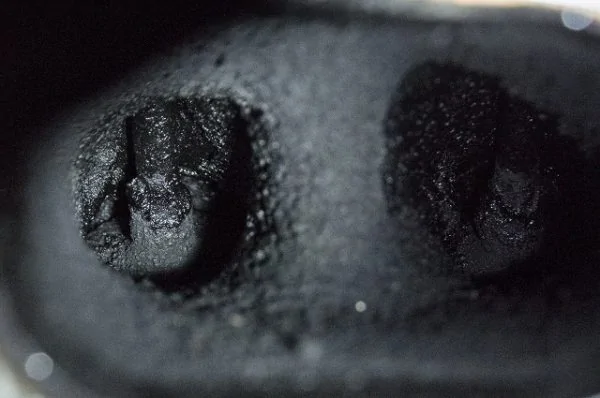
Like others have said, the biggest issue is not the burning of blow-by, but what it does to the valves and everything before the cylinder. Without dual-injection like the new-gen 3.5L any oil vapor and carbon is going to build up on the back of the valves. Below is what we captured from the first-gen 3.5L EcoBoost and what bad carbon buildup can look like (this image is from a VW but demonstrates the concept well).

Unless you're building a bio-diesel system, gasoline engines aren't designed to run on oil—sure, the engineers account for blow-by in the cylinder, but that comes at the compromise of lower cylinder pressure and timing adjustments to reduce knock potential. The engine will always perform its best when it gets clean air and clean fuel. It's not going to be noticeable on the butt-dyno, but over time it adds up.

MG_7012_UL.webp


Valve-Gunkr-600x398.webp


Hey Steve, how’s the drop-in Mishimoto intercooler for our Rangers coming along?
Haha, I have no idea what you're talking about :angel::lipssealed:

Thanks!
-Steve
 

DavidR

Well-Known Member
First Name
David
Joined
Jul 22, 2019
Threads
4
Messages
389
Reaction score
328
Location
Eastern CA
Vehicle(s)
2019 Ranger XLT Supercab Saber FX4
Occupation
Engineer
One of my rationales is that it's better to spend a smaller amount up front to delay or eliminate potentially more later, so I decided to take a look at the actual economics.

BMW and VW are among the earliest to have large numbers of GDI engines in the market. They still don't seem to officially recommend catch cans, but they no longer deny that valve coking is a problem and now recommend walnut shell blasting as a more-or-less a regular maintenance item.

Online estimates of the cost of walnut shell blasting vary a lot, from $300 to $800, but the average seems to be $500-600. For earlier generation GDI engines, many vehicles seem to need it somewhere between 50K and 100K miles. It's likely the 2.3L EB has improvements over older engines, so let's pick 100K. For catch cans, I'm just guessing on installation cost because I did mine myself, but it was a quick job, so I'll assume $150 as a wild guess. If you get a high-quality can, fittings, and hoses like Mishimoto, that puts the installed cost around $300-400 depending on which can you get.

On the surface that makes the walnut blasting seem not too horrible, especially since it will be 5+ years down the road for most people. There are some hidden costs, though. By the time you start having actual symptoms like hard starts or a rough running engine, you have likely been experiencing reduced fuel economy for a while. The cost of that can add up over time. Also, there will be a period of time where you will probably notice it even on the "butt-dyno".

There are also some drawbacks to catch cans, though: If you live in CA and maybe some other states, you will likely need to remove it every 2 years for smog check. If you're not a do-it-yourselfer, the cost of that can add up over time. It's also possible you could get denied certain warranty repairs, especially if your car needs to get towed to the dealer and you don't have a chance to remove the can and hoses.

Overall, being an engineer, I like the thought of providing maximally clean combustion air for the engine and I've installed a catch can, but economically, I can see how it could swing either way for many people.
Sponsored

 
Last edited:
Status
Not open for further replies.


Top