Sponsored

Maximizing Battery Life

got3fords

Well-Known Member
First Name
James
Joined
Apr 12, 2021
Threads
131
Messages
5,319
Reaction score
13,797
Location
22973
Vehicle(s)
2026 Marsh Gray Ranger Raptor, 1995 Harley XLH1200
Occupation
Mom Joke Professional
I disconnected the BMS sensor last evening, then charged the battery 12 hours with a 1 hour rest period before each trip. Then started and drove 20 miles, did a little shopping and business, then drove the 20 miles back home.

I monitored the charge rate from beginning to end. i made the very same trip the day before with the BMS sensor connected.

I revisited this test after running the BMS with SOC set to 95%
and ASS disabled via Forscan for the last 6 months.

I have not been happy with the results. I have had to charge the battery on a regular basis to keep it healthy.

So I revisited the issue for the last time. And this last 2 day test has convinced me that running with the BMS Sensor disconnected is a better option with regards to battery health.

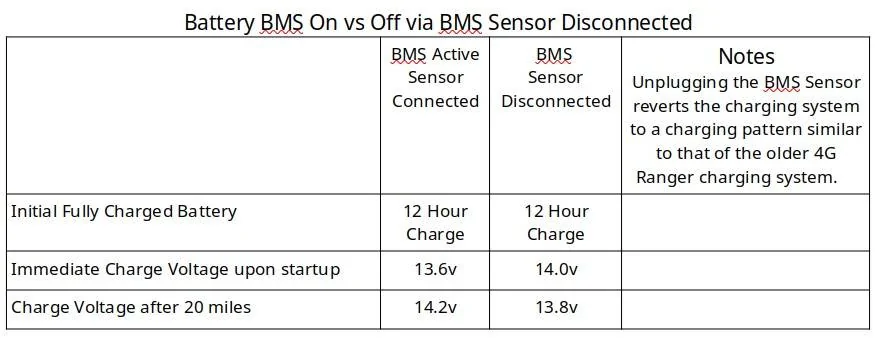
The simple table below tells me all I need to know.
BMS test 1.jpg

With the battery fully charged exactly the same amount of time, I started the truck and drove it 20 miles, stopped for 30 minutes, the drove the 20 miles back home.

The voltages recorded are "in cab" voltages and are ~.2 to .3 v lower than when you measure at the battery terminals).

Here is the interesting thing, the starting and stopping voltages are inverse to each other.

When first starting the truck I would expect a higher charge rate due to battery drain from starting the engine. As I drive I would expect the charge voltage to slowly drop as the battery nears 100% charge.

This is exactly what happens when the sensor is disconnected. My voltage starts off at 14V (14.2 at the battery) and slowly drops down to 13.8v as I drive the truck the 20 miles. Turning on/off the headlights made no difference.

With BMS sensor connected, my initial startup voltage was 13.6v (13.5v on the first day test) and stayed low for over half the 20 mile trip. The charge rate then began to climb to 14.2v by the time I stopped at the end of the 20 mile trip. The trip back was different, The charge voltage was higher at 14v, then climbed to 14.2v. (Remember to add 0.2v to each voltage to obtain the actual voltage at the battery)

My conclusion is that even at an SOC of 95% with ASS disabled, the battery is still initially drained from a full charge to some lower state, then held at that lower state.

Based upon this latest test result, I've pulled the BMS plug permanently. I want my battery fully charged, and never intentionlly discharged unless I am using some function that draws power.

IMO, keeping the battery in an intentionally less the optimal charge state will lead to premature failure of the battery.
Excellent information. But I would like to see about 20 entries in the chart to see if the trend is repeatable. As I mentioned previously, my charge voltage is almost always different day to day.
Sponsored

 
OP
OP

TJC

Well-Known Member
First Name
Tony
Joined
Aug 28, 2020
Threads
45
Messages
3,929
Reaction score
9,837
Location
North Carolina
Vehicle(s)
93 Miata, 05 Ranger 4x4, 20 Ranger 4x4, 23 CX-5
Both vary by seasonal temps, but the BMS is really erratic. My 4G is like clock work in its pattern, the voltage scale may change but the pattern is definable repeatable.

With the BMS sensor unplugged, the 5G pattern is the same as the 4g, but about .2v higher. Probably due to the AGM battery being standard now.

I know this to be the case, as I tested the 2005 Ranger charging patterns on the same days that I tested the 2020 Ranger patterns with the BMS sensor unplugged. The 2020 had the same definable repeatable charge pattern, but was .2v higher... Now that I think about it, the 2005 Ranger 12v cab port reads the same as the voltage measured at the battery terminals. The 2020 12v cabin port voltages are .2v lower. So the voltage may even be the same.

I'll test both trucks again to see. I ran those tests well over a year ago and remember the patterns well.
 

got3fords

Well-Known Member
First Name
James
Joined
Apr 12, 2021
Threads
131
Messages
5,319
Reaction score
13,797
Location
22973
Vehicle(s)
2026 Marsh Gray Ranger Raptor, 1995 Harley XLH1200
Occupation
Mom Joke Professional
The same thing should happen when you switch on headlights with BMS active. I saw my charge rate jump to 14.4v when headlights were turned on. Esp in winter.
So on the way home, I tried both turing on headlights and cycling tow mode. Neither one changed charging voltage. As I said, I do not get repeatable charging voltages day to day, or even drive to drive in the same day.
 
OP
OP

TJC

Well-Known Member
First Name
Tony
Joined
Aug 28, 2020
Threads
45
Messages
3,929
Reaction score
9,837
Location
North Carolina
Vehicle(s)
93 Miata, 05 Ranger 4x4, 20 Ranger 4x4, 23 CX-5
So on the way home, I tried both turing on headlights and cycling tow mode. Neither one changed charging voltage. As I said, I do not get repeatable charging voltages day to day, or even drive to drive in the same day.
It is amazing in it's unpredictable behavior. My lights raised the voltage last year during winter.
 

airline tech

Well-Known Member
Joined
Aug 24, 2022
Threads
28
Messages
4,448
Reaction score
8,499
Location
Midwest - KS
Vehicle(s)
2022 Ranger Lariat-Super Crew, Cactus Gray
Occupation
Aircraft Tech
I feel the most important thing is the Long Term (IR) readings, as long as we can adjust the SOC to a reasonable level (90% or 95%) - Mine is set at 90% or disconnect the sensor.
The main goal they both achieve is keeping the IR level of the battery from climbing out of 3.2 to 3.6 range.

So, the long-term testing of the battery monitoring as we have been doing thus far with the SOC adjustments should continue to have a comparison match to see if there is a minor or huge difference in the IR testing, see if the numbers (test results) greatly improve over the SOC bumps.

My hunch is that won't provide a huge difference but at least possibly a minor improvement.
We shall see, for now I am holding at the 90% SOC setting. IR still holding status quo with both meters.


OP
OP

TJC

Well-Known Member
First Name
Tony
Joined
Aug 28, 2020
Threads
45
Messages
3,929
Reaction score
9,837
Location
North Carolina
Vehicle(s)
93 Miata, 05 Ranger 4x4, 20 Ranger 4x4, 23 CX-5
Good Objective and Plan
 

Nellieg

Well-Known Member
Joined
Feb 9, 2020
Threads
0
Messages
330
Reaction score
1,203
Location
Maryland
Vehicle(s)
2019 ford ranger crew cab
Observed my ASS was not working on a 4.5y old battery. Disconnected BMS and recover mode on noco genius did not result in my ASS working. Figured battery was soon for the recycling bin. Just towed 100 mi. ASS started to work again. Something with the tow mode and BMS might assist in battery recovery. I tow with headlights on...tow mode...and trailer was near optimal voltage.
 
OP
OP

TJC

Well-Known Member
First Name
Tony
Joined
Aug 28, 2020
Threads
45
Messages
3,929
Reaction score
9,837
Location
North Carolina
Vehicle(s)
93 Miata, 05 Ranger 4x4, 20 Ranger 4x4, 23 CX-5
My guess is that when towing that 100 miles, ASS is turned off, and BMS rules are relaxed to allow for towing, and your battery liked the extra juice.

ASS and BMS are not your battery's friend.
 
  • Like
Reactions: EJH

Nellieg

Well-Known Member
Joined
Feb 9, 2020
Threads
0
Messages
330
Reaction score
1,203
Location
Maryland
Vehicle(s)
2019 ford ranger crew cab
My guess is that when towing that 100 miles, ASS is turned off, and BMS rules are relaxed to allow for towing, and your battery liked the extra juice.

ASS and BMS are not your battery's friend.
Agreed. The significant part is that it went through a battery recovery cycle no BMS in loop... Full cycle charged... ASS would still not work. Towed with BMS connected... In camp BMS in loop the ASS started to work. BMS impacts the battery life recharge cycle ... But surprised the tow mode forced the BMS to allow the ASS even after a battery recovery recharge from the NOCO. Tow mode ...age of battery...ASS got into a weak battery state and even after a recharge would not come back even with a recovery on a battery. I am using ASS mode as the canary for a weakening battery and I am wondering if somewhat true but there is time of life logic in BMS sensor that trigger but get overridden in tow mode.
 
OP
OP

TJC

Well-Known Member
First Name
Tony
Joined
Aug 28, 2020
Threads
45
Messages
3,929
Reaction score
9,837
Location
North Carolina
Vehicle(s)
93 Miata, 05 Ranger 4x4, 20 Ranger 4x4, 23 CX-5
...The significant part is that it went through a battery recovery cycle no BMS in loop... Full cycle charged... ASS would still not work.
If I am reading this correctly, BMS was unplugged during the charging/recovery cycle. If this is the case, BMS would not be aware of the charging state, and would keep ASS disabled.

I am not sure how smart the BMS is. None of us are privy to what BMS is really doing when we charge our batteries. Is it simply monitoring or capping the charge at 75%.

What I do know is that I do not trust the BMS to have battery life as its top priority. I think we can all agree that forcing a led acid battery to stay at a 75% charge is detrimental to battery life. And that is exactly what the BMS does. I do not believe that sporadic bursts of up to 15.1v of regenerative charging can make up the 25% difference.

With BMS active with default settings, I have actually charged my battery to 100%, and driven my truck (which should be maintaining that 100%) only to watch the charge rate drop low enough to discharge the battery to the 75% SOC floor. I then see spurts of high voltage charging when coasting and braking, but no/minimal charging when cruising.

I am uncomfortable with this less then optimal charging algorthym.

What I do know from observation is that the 2005 Ranger charging system looks at charging parameters each time the truck is turned on, and it sets the charging window for the battery at that time. And it stays within the window parameters until the truck is shut down, and when restarted the charging window is adjusted up or down depending on the battery state. It appears that the window is about 0.3v-0.4v volts wide. It may start at 14.4, but will only drop to 14.1v - 14.0v. and stay there. Turn the truck off and then restart, and the top charge voltage is adjusted to 13.9v and will drop to 13.6v - 13.5v over time.

When I disconnect the BMS sensor I see the same pattern in my 2020 Ranger, except the window is 0.2v higher than the 2005 Ranger. I suspect this is due to the AGM battery in the 2020 vs standard flooded battey in the 2005. AGMs like a slightly higher charge rate.
 
Last edited:

airline tech

Well-Known Member
Joined
Aug 24, 2022
Threads
28
Messages
4,448
Reaction score
8,499
Location
Midwest - KS
Vehicle(s)
2022 Ranger Lariat-Super Crew, Cactus Gray
Occupation
Aircraft Tech
Good description on the BMS, yes this it the programed intention of the programing of the system.

Utilize the Battery Voltage (Only) to operate the systems until the 75% SOC threshold, it operates in whatever means possible to maintain that 75%.

If you bump to 90% SOC, then you move that threshold up the scale.
Good observation notes on operation with the BMS disconnected. It is one avenue I have not tried yet.
I think that no matter what you do, bump SOC or Disconnect, it is still beneficial to the battery over the OEM settings.
The main goal is to keep the battery IR in the low range, either way will be beneficial.
 
  • Like
Reactions: TJC

LawnMM

Well-Known Member
First Name
Rich
Joined
Oct 9, 2023
Threads
9
Messages
945
Reaction score
3,031
Location
Colorado
Vehicle(s)
'23 Ranger Tremor
I feel the most important thing is the Long Term (IR) readings, as long as we can adjust the SOC to a reasonable level (90% or 95%) - Mine is set at 90% or disconnect the sensor.
The main goal they both achieve is keeping the IR level of the battery from climbing out of 3.2 to 3.6 range.

So, the long-term testing of the battery monitoring as we have been doing thus far with the SOC adjustments should continue to have a comparison match to see if there is a minor or huge difference in the IR testing, see if the numbers (test results) greatly improve over the SOC bumps.

My hunch is that won't provide a huge difference but at least possibly a minor improvement.
We shall see, for now I am holding at the 90% SOC setting. IR still holding status quo with both meters.
I thought reading your other thread you were getting a smell at 90% indicating overcharge?
 

airline tech

Well-Known Member
Joined
Aug 24, 2022
Threads
28
Messages
4,448
Reaction score
8,499
Location
Midwest - KS
Vehicle(s)
2022 Ranger Lariat-Super Crew, Cactus Gray
Occupation
Aircraft Tech
I thought reading your other thread you were getting a smell at 90% indicating overcharge?
At one point in time, yes- it appeared as so, but the truck was still new.
Plus, I never actually had it disconnected long term, it was only for a short drive.
I might chalk it up to - the truck had never seen that type of charge yet or like kicking on the furnace for the first time in the cooler months smell:LOL:

So, it appears I was WRONG on that point of my testing, mislead by the smell.
 

pboggini

Well-Known Member
First Name
Pete
Joined
Nov 30, 2018
Threads
12
Messages
235
Reaction score
253
Location
San Jose, CA
Vehicle(s)
2019 Lightning Blue XL Ranger 4x2 Supercrew.
At one point in time, yes- it appeared as so, but the truck was still new.
Plus, I never actually had it disconnected long term, it was only for a short drive.
I might chalk it up to - the truck had never seen that type of charge yet or like kicking on the furnace for the first time in the cooler months smell:LOL:

So, it appears I was WRONG on that point of my testing, mislead by the smell.
I've been at 95% for quite some time now with no ill effects. I think 95% and the desulfator have really helped my battery. I havent gotten really high CCA readings yet but they've been right around 700. But auto stop start works when I don't hit the button and everything else acts normal and the battery is now 4 years and 1 months old. Recall that at 2 years and 9 months the radio would shut off then I turned off the truck so I think battery health is much better even if it won't get to full capacity.

My goal back then was for my battery to make it to 5 years. My 96 Tacoma's battery made it to just over 7 and still had some life. My 08 Canyon made it 6-1/2 years and still had a bit of life left.
 
  • Like
Reactions: TJC
OP
OP

TJC

Well-Known Member
First Name
Tony
Joined
Aug 28, 2020
Threads
45
Messages
3,929
Reaction score
9,837
Location
North Carolina
Vehicle(s)
93 Miata, 05 Ranger 4x4, 20 Ranger 4x4, 23 CX-5
Well, who hasn't been wrong? The only way you figure out what's right is to be wrong. It's what makes getting it right so satisfying.

Just ask Edison...

I respect Airline Tech. I like the way his mind works. There are several very bright engineering type folks on this forum, and Airline Tech is one of them.
Sponsored


Top