Sponsored

Transmission fluid level

TJC

Well-Known Member
First Name
Tony
Joined
Aug 28, 2020
Threads
45
Messages
3,928
Reaction score
9,835
Location
North Carolina
Vehicle(s)
93 Miata, 05 Ranger 4x4, 20 Ranger 4x4, 23 CX-5
I've added several very important parts to my Truck. The UPR catch can, the Tom Woods single piece driveshaft, the Amp Research Power Steps, the ScanGauge III, and the FitzStick.

The Fitzstick was the least expensive, and the biggest bang for the buck of all of them.

And it ranks right near the top for value add at any price point!


Checking the transmission fluid level from a cold start makes life so much easier for maintenance and piece of mind. And it is near impossible to do without the Fitzstick! I can't say thank you enough to Fitz for taking the time to design and make such an important and high quality part.

A couple of years before Fitz decided to build the Fitzstick, I purchased the B&M alternative, but simply couldn't install it... and I paid a great deal of $$ for it. I was just ready to install it when Fitz announced he was working on the project. I put the B&M back on the shelf, stopped driving the truck, and waited patiently while the engineering work proceeded.

And I am glad that I did.

I probably would have sold the truck by now had Fitz not pulled it off.... but he did... and I see a light at the end of the tunnel as far as reaching some degree of reliability from my 2020 Ranger.

I'm still fine tuning the transmission, this time the focus is cooling the ULV fluid to around 160F. I think I can get there.

Watched the recent "Valvoline Protect and Restore oil" video, and I'm convinced this stuff works as well. This should help with keeping the oil screens in oil line feed to the turbo open. Just picked up 3 5 quart jugs. It's going in all three autos.


Sponsored

 

Msfitoy

Well-Known Member
First Name
Sid
Joined
Mar 5, 2019
Threads
67
Messages
9,191
Reaction score
28,344
Location
North Carolina
Vehicle(s)
2019 Ranger, 2003 MINI Cooper S, 2021 Honda CT125
Occupation
NWO Robot Polisher
Vehicle Showcase
1
Before filling make absolutely sure your transmission fluid is hot, between 206F - 215F
You filled the transmission with hot fluid? Must be a PIA to heat it on a stove top...😜
 

TJC

Well-Known Member
First Name
Tony
Joined
Aug 28, 2020
Threads
45
Messages
3,928
Reaction score
9,835
Location
North Carolina
Vehicle(s)
93 Miata, 05 Ranger 4x4, 20 Ranger 4x4, 23 CX-5
You filled the transmission with hot fluid? Must be a PIA to heat it on a stove top...😜
Not quite to a boil, but the wife loves the aroma!

In reality, she'd banish me from the house best case, worst case she'd shoot me! But not before she had me cleaning the pot. :LOL: ....

No... she wouldn't let me clean the pot, she'd send me to the store to find a replacement.
 

TJC

Well-Known Member
First Name
Tony
Joined
Aug 28, 2020
Threads
45
Messages
3,928
Reaction score
9,835
Location
North Carolina
Vehicle(s)
93 Miata, 05 Ranger 4x4, 20 Ranger 4x4, 23 CX-5
You filled the transmission with hot fluid? Must be a PIA to heat it on a stove top...😜
Man! What a major mental fart! :blush:

Went back and corrected the original post from filling to CHECKING.

There, It is all better now! :rockon:


DukeCanBuildit

Well-Known Member
First Name
Duke
Joined
Jul 27, 2020
Threads
66
Messages
9,608
Reaction score
45,996
Location
Kitchener, Ontario
Vehicle(s)
2019 XLT SuperCab - FTW!
Occupation
Retired (P/T) Caregiver (F/T)
Vehicle Showcase
1

Msfitoy

Well-Known Member
First Name
Sid
Joined
Mar 5, 2019
Threads
67
Messages
9,191
Reaction score
28,344
Location
North Carolina
Vehicle(s)
2019 Ranger, 2003 MINI Cooper S, 2021 Honda CT125
Occupation
NWO Robot Polisher
Vehicle Showcase
1
Before filling CHECKING make absolutely sure your transmission fluid is hot, between 206F - 215F. You won't get it there by simply driving your truck until it is hot. You'll usually be at 195F - 200F and that 15F makes all the difference in the world. ULV has a dramatic expansion rate. It is very easy to overfill the transmission....

And you won't know it until you do hit the higher temps, when the fluid foams up and pukes out the transmission vent. Foaming fluid is not good for an already fragile transmission.

I started my truck and let it idle, tracking fluid temps vs time using a time piece and a ScanGauge III, which reads off the transmission's internal sensor. It took almost 39 minutes to reach 180F. I also tracked my fluid temps while driving a 40 mile round (shopping) trip, I stopped for 30 minutes at the 20 mile mark, then drove the last 20 home. When I pulled into the driveway my fluid temps were just reaching 175F. This was sustained speeds up to 55mph from most of the trip - 2 lane state highway with 4 of 5 stops / stop lights each way, but largely rural highway.

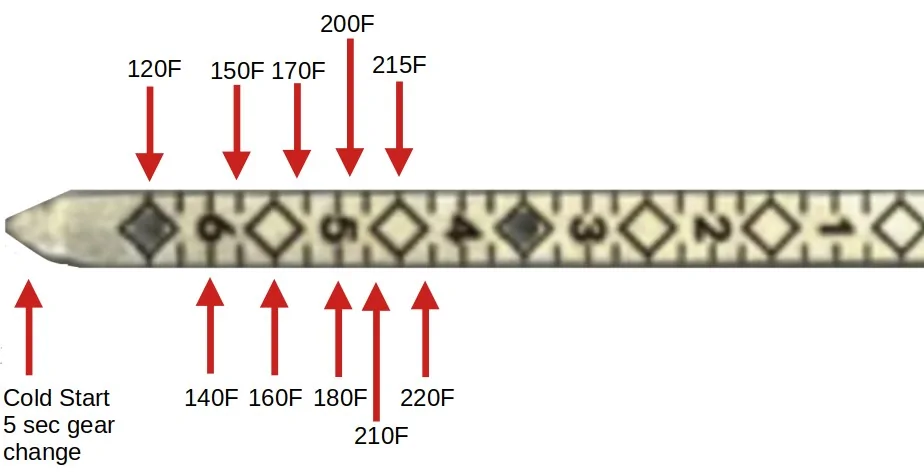
These are my results calibrated on the FitzStick (MBS Dipstick). These are definable/repeatable measurements taken on a 75F day (Truck sat 10 hours overnight, initial fluid temp (key on engine off) started at 77.9F.

The first measurement was taken after starting the truck, immediately shifting through the transmission from park to drive and back to park, then immediately taking the first measurement. The fluid just touches the tip of the dipstick...no more than 1/8". It didn't make it to the bend.

The Fitzstick makes this check very simple, accurate, and quick. The ScanGauge insure you know the exact temperature of the fluid.

Forscan may work as well. Disclaimer: I haven't tried to do this with Forscan, but I suspect you can see the temps using it.

Transmission Levels at temperature ( F).webp
Invaluable calibration! Question is how the heck were you able to read the fluid level so accurately? The best I can do is kinda "guess" where the fluid is on the stick, it's so clear...even after 3 repeats, it's hard to see exactly where the fluid is at on the stick...maybe I'll try reading glasses next time...
 

TJC

Well-Known Member
First Name
Tony
Joined
Aug 28, 2020
Threads
45
Messages
3,928
Reaction score
9,835
Location
North Carolina
Vehicle(s)
93 Miata, 05 Ranger 4x4, 20 Ranger 4x4, 23 CX-5
Invaluable calibration! Question is how the heck were you able to read the fluid level so accurately? The best I can do is kinda "guess" where the fluid is on the stick, it's so clear...even after 3 repeats, it's hard to see exactly where the fluid is at on the stick...maybe I'll try reading glasses next time...
I cheated! :LOL:

Before I begin, I would advise everyone to NOT attempt this as the steel is very hard. I drilled a small hole in the middle of the diamond between 4 and 5. The fluid stays in the hole when it reaches that point. That's how I got the original hot temp measurement so accurately.

It is very easy to damage or destroy your dipstick if you screw it up... Don't do it! You'll probably damage your dipstick if you try. it is difficult to drill through the dipstick! I even attempted to punch a dimple to set the drill bit. It was not having it. You need a high quality drill press, drill bits, and a way to solidly anchor and support the piece to even have a chance of success. It is a very slow deliberate process. Painfully slow.

I had an original dipstick and received a newer upgraded version, so I gave it a try on the original. I actually broke the first drill bit trying...

I prefer the older dipstick slightly more than the newer one. My old eyes see the lettering better (they are a bit bigger and darker I think). The newer one looks more refined / professional. They both read the same level! A sign of manufacturing consistency and a tribute to Fitz!

The cooler fluid readings are easier to see as the fluid is thicker and doesn't flow so quickly. with a bright light at the correct angle you can see the level. But if the fluid is hot, you must hold the dipstick level or the fluid will easily flow up or down the dipstick!.

It is esp easy to check the level when the truck has sat overnight. It shows right up on the very tip of the dipstick. No more than 1/8". Very easy to see.

You can actually go a tad higher, but I'd rather be dead center than pushing the top level, as you have no margin for error.

The last thing you want is to overfill, with the resultant foaming fluid that will quickly overheat the transmission. And it is deceiving, as it will only be a problem when you stress the transmission, and the fluid level rapidly expands, then foams, and vents out the top of the transmission. By that time your transmission is balking and clutches are overheating.

You can drive around all day long on short trips of ~40 miles and still not have a transmission fully warmed up, and everything will appear fine, until you take a long trip, get stuck in heavy traffic, or pull a trailer or boat. That's when the over full transmission gremlins show themselves.
 

Msfitoy

Well-Known Member
First Name
Sid
Joined
Mar 5, 2019
Threads
67
Messages
9,191
Reaction score
28,344
Location
North Carolina
Vehicle(s)
2019 Ranger, 2003 MINI Cooper S, 2021 Honda CT125
Occupation
NWO Robot Polisher
Vehicle Showcase
1
I cheated! :LOL:

Before I begin, I would advise everyone to NOT attempt this as the steel is very hard. I drilled a small hole in the middle of the diamond between 4 and 5. The fluid stays in the hole when it reaches that point. That's how I got the original hot temp measurement so accurately.

It is very easy to damage or destroy your dipstick if you screw it up... Don't do it! You'll probably damage your dipstick if you try. it is difficult to drill through the dipstick! I even attempted to punch a dimple to set the drill bit. It was not having it. You need a high quality drill press, drill bits, and a way to solidly anchor and support the piece to even have a chance of success. It is a very slow deliberate process. Painfully slow.

I had an original dipstick and received a newer upgraded version, so I gave it a try on the original. I actually broke the first drill bit trying...

I prefer the older dipstick slightly more than the newer one. My old eyes see the lettering better (they are a bit bigger and darker I think). The newer one looks more refined / professional. They both read the same level! A sign of manufacturing consistency and a tribute to Fitz!

The cooler fluid readings are easier to see as the fluid is thicker and doesn't flow so quickly. with a bright light at the correct angle you can see the level. But if the fluid is hot, you must hold the dipstick level or the fluid will easily flow up or down the dipstick!.

It is esp easy to check the level when the truck has sat overnight. It shows right up on the very tip of the dipstick. No more than 1/8". Very easy to see.

You can actually go a tad higher, but I'd rather be dead center than pushing the top level, as you have no margin for error.

The last thing you want is to overfill, with the resultant foaming fluid that will quickly overheat the transmission. And it is deceiving, as it will only be a problem when you stress the transmission, and the fluid level rapidly expands, then foams, and vents out the top of the transmission. By that time your transmission is balking and clutches are overheating.

You can drive around all day long on short trips of ~40 miles and still not have a transmission fully warmed up, and everything will appear fine, until you take a long trip, get stuck in heavy traffic, or pull a trailer or boat. That's when the over full transmission gremlins show themselves.
Wow!
 

TJC

Well-Known Member
First Name
Tony
Joined
Aug 28, 2020
Threads
45
Messages
3,928
Reaction score
9,835
Location
North Carolina
Vehicle(s)
93 Miata, 05 Ranger 4x4, 20 Ranger 4x4, 23 CX-5
I wanted a definable repeatable easy to use process to check the fluid level. Best to check on cold (overnight) startup, run through the gears to insure fluid is in all passages.

So start the truck on level ground, immediately run through the gears at 5 second intervals, then back to park at 5 second intervals, then hop out and check the fluid. Should be just on the tip of the dip stick up 1/8".

This equates to being on the middle of the diamond between 4 and 5 at 215F and all the other readings on the dipstick at their respective temperatures. It is dead center in the normal range at the high end of the temp window. This was intentional on my part.

I had real time monitoring using a ScanGauge III hooked up via the OBDII port reporting the transmission fluid temps.

For the lower temps I started from a bone cold truck that sat two days before I fired it up. I timed the temps at 10 degree increments and measured the fluid levels to achieve the dipstick settings you see on the image that I provided. This on done on a 75F ambient air temp day, with fluid temp at 77.9F key on engine off, then the clock started when the engine started and timing and measurements began up to to 190F.

2 days before the lower range temps were measured I has set the high range by power braking the truck to increase the fluid temps to 220F, and insured the fluid level was midway between 4 and 5 at 215F. I then monitored the fluid level as the temps slowly dropped to 195F.

I did not move the truck during the entire testing period.
 
Last edited:

Blue Streak

Well-Known Member
First Name
Larry
Joined
Jul 11, 2019
Threads
38
Messages
1,309
Reaction score
5,023
Location
New Location still in Missouri
Vehicle(s)
2019 Ranger XL STX FX 2021 Honda CR V
Occupation
Retired
Vehicle Showcase
1
I wanted a definable repeatable easy to use process to check the fluid level. Best to check on cold (overnight) startup, run through the gears to insure fluid is in all passages.

So start the truck on level ground, immediately run through the gears at 5 second intervals, then back to park at 5 second intervals, then hop out and check the fluid. Should be just on the tip of the dip stick up 1/8".

This equates to being on the middle of the diamond between 4 and 5 at 215F and all the other readings on the dipstick at their respective temperatures. It is dead center in the normal range at the high end of the temp window. This was intentional on my part.

I had real time monitoring using a ScanGauge III hooked up via the OBDII port reporting the transmission fluid temps.

For the lower temps I started from a bone cold truck that sat two days before I fired it up. I timed the temps at 10 degree increments and measured the fluid levels to achieve the dipstick settings you see on the image that I provided. This on done on a 75F ambient air temp day, with fluid temp at 77.9F key on engine off, then the clock started when the engine started and timing and measurements began up to to 190F.

2 days before the lower range temps were measured I has set the high range by power braking the truck to increase the fluid temps to 220F, and insured the fluid level was midway between 4 and 5 at 215F. I then monitored the fluid level as the temps slowly dropped to 195F.

I did not move the truck during the entire testing period.
I for one am glad you went thru all of this & shared the results on this great forum. I plan on keeping my truck & hope to prevent or prolong any transmission issues. By changing fluid & adding lube gaurd. This to me is much more accurate than just doing it Fords way of not quit beening shure.
Sponsored


Top