
Sponsored

talked with my dealers service manager today about the direct injection

u wish u could ride

Well-Known Member
First Name
robert
Joined
Jul 30, 2019
Threads
17
Messages
290
Reaction score
445
Location
lakeland florida
Vehicle(s)
19 xlt in blue
Occupation
building maintenance
while getting first service done today the service writer wrote 5w 20 oil on work order after work done I wanted oil dumped so the service MANAGER brought me to the tech assuring me he used 5/w30 .so while there I asked manager about the carbon built up !!he said "those that don't drive like little old ladies are fine" and even, most are good its not a vw!! so for whatever its worth at least I asked someone you actually messes with these engines everyday!!
Sponsored

 

SFB

Well-Known Member
First Name
Daniel
Joined
Sep 14, 2019
Threads
8
Messages
319
Reaction score
532
Location
Fullerton California
Vehicle(s)
2019 Ranger Crew XLT Sport Black on Black with Magnetic trim, package 302A
Vehicle Showcase
1
while getting first service done today the service writer wrote 5w 20 oil on work order after work done I wanted oil dumped so the service MANAGER brought me to the tech assuring me he used 5/w30 .so while there I asked manager about the carbon built up !!he said "those that don't drive like little old ladies are fine" and even, most are good its not a vw!! so for whatever its worth at least I asked someone you actually messes with these engines everyday!!
My trade in for my Ranger was a 2012 Edge with the 2.0 Eco. It had 110K on the odo and never had an engine issue! Never had a miss fire. I purchased the car in 2014 and it was a lease return and had 38K on it then. Excellent drive train.
 

P. A. Schilke

Well-Known Member
First Name
Phil
Joined
Apr 3, 2019
Threads
149
Messages
7,083
Reaction score
37,187
Location
GV Arizona
Vehicle(s)
2019 Ranger FX4 Lariat 4x4, 2020 Lincoln Nautilus, 2005 Alfa Motorhome
Occupation
Engineer Retired
Vehicle Showcase
1
while getting first service done today the service writer wrote 5w 20 oil on work order after work done I wanted oil dumped so the service MANAGER brought me to the tech assuring me he used 5/w30 .so while there I asked manager about the carbon built up !!he said "those that don't drive like little old ladies are fine" and even, most are good its not a vw!! so for whatever its worth at least I asked someone you actually messes with these engines everyday!!
Hi Robert,

Interesting. I cannot keep my foot off the accel pedal as I love the "big thumb" pushing me back in the seat! Love the acceleration out of this 4 banger! So no catch can for me as I accelerate briskly as they say.

Best,
Phil Schilke
Ranger Vehicle Engineering
Ford Motor Co. Retired
 
OP
OP
u wish u could ride

u wish u could ride

Well-Known Member
First Name
robert
Joined
Jul 30, 2019
Threads
17
Messages
290
Reaction score
445
Location
lakeland florida
Vehicle(s)
19 xlt in blue
Occupation
building maintenance
I actually think one might be doing themselves a disservice by putting one on. there is a tech bulletin on the f 150 forum 2.7 section has a tech bulletin some blow by is beneficial to the intake valve seats. if folks like yourself who are mechanical minded are not running with one, I at least feel good about not. I had a opportunity to ask and he didn't hesitate or seem to be giving a ford line just talking straight.
 

P. A. Schilke

Well-Known Member
First Name
Phil
Joined
Apr 3, 2019
Threads
149
Messages
7,083
Reaction score
37,187
Location
GV Arizona
Vehicle(s)
2019 Ranger FX4 Lariat 4x4, 2020 Lincoln Nautilus, 2005 Alfa Motorhome
Occupation
Engineer Retired
Vehicle Showcase
1
I actually think one might be doing themselves a disservice by putting one on. there is a tech bulletin on the f 150 forum 2.7 section has a tech bulletin some blow by is beneficial to the intake valve seats. if folks like yourself who are mechanical minded are not running with one, I at least feel good about not. I had a opportunity to ask and he didn't hesitate or seem to be giving a ford line just talking straight.
Hi Robert,

Ford tests durability to the equivalent of 150,000 miles of a 90 percentile customer (Oil field rig service, Downtown LA delivery, NYC taxi). All this testing was run without a catch can. At the end of the durability test, the total vehicle is disassembled into its components and the parts are breadoraded on huge panels for all of Engine, Transmission, Truck Engineering etc. This is done for quite a few prototypes. We see how the vehicles perform. If Engine Engineering saw trouble with intake valves, they would have address the issue. Thus, knowing the process of delivering a robust vehicle to the customer. If a catch can was needed, it would be pia the vehicle (purchased in assembly). I frankly see no need for a catch can, but do buy into using the throttle pedal.

Remember the days of unleaded fuel and the intake valve rescission. The concern was valid and the manufactures response was to harden the valve seats to mitigate the problem. Now, today, we do not have a choice of leaded or unleaded fuel, and there is no valve seat concern... I seem to think at best the catch can does not affect anything, and in the worst degrades things.
The "engineering video" was laughable as it did not address key test procedures to arrive at the conclusion that the catch can was of benefit... There are so many variables that must be addressed and these were glossed over...

Best,
Phil Schilke
Ranger Vehicle Engineering
Ford Motor Co. Retired


OP
OP
u wish u could ride

u wish u could ride

Well-Known Member
First Name
robert
Joined
Jul 30, 2019
Threads
17
Messages
290
Reaction score
445
Location
lakeland florida
Vehicle(s)
19 xlt in blue
Occupation
building maintenance
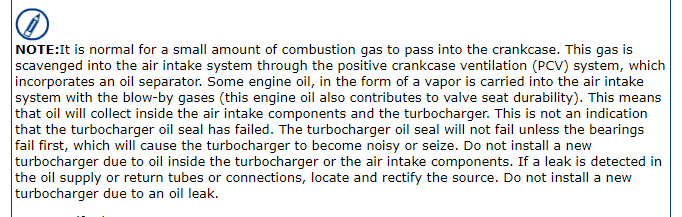
NOTE: It is normal for a small amount of combustion gas to pass into the crankcase. This gas is scavenged into the air intake
system through the PCV system, which incorporates a crankcase vent oil separator. Some engine oil, in the form of a vapor is
carried into the air intake system with the blow-by gases (this engine oil also contributes to valve seat durability). This means that
oil will collect inside the air intake components and the turbocharger. This is not an indication that the turbocharger oil seal has
failed. The turbocharger oil seal will generally not fail unless the bearings fail first, which will cause the turbocharger to become
noisy or seize. Do not install a new turbocharger due to oil inside the turbocharger or the air intake components. If a leak is
detected in the oil supply or return tubes or connections, locate and rectify the source. Do not install a new turbocharger due to
an oil leak. this is a general service bulletin for a leaky turbo charger
 

HenryMac

Well-Known Member
First Name
John
Joined
Sep 14, 2019
Threads
66
Messages
2,783
Reaction score
5,360
Location
Colorado
Vehicle(s)
2019 SuperCab XL - FX4 - Magnetic - Rocksliders
Occupation
Mech. Engineer - Retired
NOTE: It is normal for a small amount of combustion gas to pass into the crankcase. This gas is scavenged into the air intake
system through the PCV system, which incorporates a crankcase vent oil separator. Some engine oil, in the form of a vapor is
carried into the air intake system with the blow-by gases (this engine oil also contributes to valve seat durability). This means that
oil will collect inside the air intake components and the turbocharger. This is not an indication that the turbocharger oil seal has
failed. The turbocharger oil seal will generally not fail unless the bearings fail first, which will cause the turbocharger to become
noisy or seize. Do not install a new turbocharger due to oil inside the turbocharger or the air intake components. If a leak is
detected in the oil supply or return tubes or connections, locate and rectify the source. Do not install a new turbocharger due to
an oil leak. this is a general service bulletin for a leaky turbo charger
Link to bulletin (applies to a 2.0L Duratorq-TDCi (DW) Diesel): https://workshop-manuals.com/ford/c.../turbocharger_2.0l_duratorq-tdci_(dw)_diesel/

Blow By.png
 
OP
OP
u wish u could ride

u wish u could ride

Well-Known Member
First Name
robert
Joined
Jul 30, 2019
Threads
17
Messages
290
Reaction score
445
Location
lakeland florida
Vehicle(s)
19 xlt in blue
Occupation
building maintenance
OP
OP
u wish u could ride

u wish u could ride

Well-Known Member
First Name
robert
Joined
Jul 30, 2019
Threads
17
Messages
290
Reaction score
445
Location
lakeland florida
Vehicle(s)
19 xlt in blue
Occupation
building maintenance
a BS answer, after he put the wrong oil in your engine...or at least the paperwork. how can you take anything he says after that seriously at all???
I can’t but it’s all I have to go off !
 
OP
OP
u wish u could ride

u wish u could ride

Well-Known Member
First Name
robert
Joined
Jul 30, 2019
Threads
17
Messages
290
Reaction score
445
Location
lakeland florida
Vehicle(s)
19 xlt in blue
Occupation
building maintenance
I honestly think Ford, and other manufacturers, send their service people to the College of Deflect and Deferral.
A graduates diploma proves you have the skills available to answer any question with a zero substance response which draws the attention away from the fact they dont want to acknowledge the problem before them because they're morons. You walk away impressed, but about what you have no idea.

My Stealership I believe has the top of the class graduates. But I'm onto them now.
lol I was trying to use my ford pass points and should of just bought oil and filters from the parts counter!!
 

t4thfavor

Well-Known Member
First Name
Chance
Joined
Feb 5, 2019
Threads
32
Messages
2,607
Reaction score
2,357
Location
Michigan
Vehicle(s)
2019 Ranger XLT FX4 Fox 2.0, 2011 Ford Edge Sport
Check the oil... When I got my Focus ST, I took it in for an oil change at 4800 miles, they put in 4.7 quarts of 5w20 and I drove it like that without knowing for about 1000 miles. The only reason I figured it out is I checked the oil at 1000 miles, and there wasn't any. So I pulled my receipt and read what it said. They would only top it off, and told me they meant to put 5w30 on the bill, but someone did that wrong.

Pretty odd that the standard NA focus takes 4.7Q of 5W20... Last time I ever had the oil changed by someone other than me.
 

DavidR

Well-Known Member
First Name
David
Joined
Jul 22, 2019
Threads
4
Messages
389
Reaction score
328
Location
Eastern CA
Vehicle(s)
2019 Ranger XLT Supercab Saber FX4
Occupation
Engineer
Hi Phil,

Interesting post :) While I understand Ford can't release all of it's testing data, it's good to have some insight into how they test things. There are still a few points/questions I have:

- Who are the remaining 10%? Are those the "grannies" who are light on the pedal or do almost exclusively short trip driving where the engine spends a lot of time not fully warmed up? From an engineering perspective, I understand that might be considered a "corner case", but telling those folks they shouldn't use the vehicle according to their needs doesn't seem like a good solution. In the past, they were told to accelerate the maintenance schedule, which I think is now done automatically by the on-board computer rather than in the owner's manual, but that might not address things like carbon deposits. Only Ford knows for sure.

- People's catch cans are catching a lot of extra oil that pretty clearly ends up coating the intake system (see other threads). You can also find cases of carbon deposits in Ecoboost engines. While those things might not pose a day-to-day problem or affect the 90% use cases, Ford does sell a catch can setup that is billed as being for racing/off-road use (mostly, I'm guessing, because it's not EPA certified). The system is quite expensive as well. One question I have is what are the benefits for racing/off-road use of having considerably less oil in your intake system and crankcase return gasses? Is it efficiency? Power? Eliminating octane degradation? There must be something. Why wouldn't those benefits also be of use to on-road driving, as long as they don't cause an increase in emissions, which a catch can wouldn't do other than the extracted oil that needs to be disposed of properly with the rest of your used oil.

Most of us who have installed things like catch cans and other enhancements understand that Ford has competitive cost and maintenance-schedule pressures and they can't include all possible performance and/or reliability enhancing devices in the stock vehicles, nor can they afford to do the extra EPA testing and such that would be required, but that doesn't necessarily mean that those devices don't have some utility even if they aren't absolutely required to meet the fundamental design goals. Just my $0.02 :)

Hi Robert,

Ford tests durability to the equivalent of 150,000 miles of a 90 percentile customer (Oil field rig service, Downtown LA delivery, NYC taxi). All this testing was run without a catch can. At the end of the durability test, the total vehicle is disassembled into its components and the parts are breadoraded on huge panels for all of Engine, Transmission, Truck Engineering etc. This is done for quite a few prototypes. We see how the vehicles perform. If Engine Engineering saw trouble with intake valves, they would have address the issue. Thus, knowing the process of delivering a robust vehicle to the customer. If a catch can was needed, it would be pia the vehicle (purchased in assembly). I frankly see no need for a catch can, but do buy into using the throttle pedal.

Remember the days of unleaded fuel and the intake valve rescission. The concern was valid and the manufactures response was to harden the valve seats to mitigate the problem. Now, today, we do not have a choice of leaded or unleaded fuel, and there is no valve seat concern... I seem to think at best the catch can does not affect anything, and in the worst degrades things.
The "engineering video" was laughable as it did not address key test procedures to arrive at the conclusion that the catch can was of benefit... There are so many variables that must be addressed and these were glossed over...

Best,
Phil Schilke
Ranger Vehicle Engineering
Ford Motor Co. Retired
 

P. A. Schilke

Well-Known Member
First Name
Phil
Joined
Apr 3, 2019
Threads
149
Messages
7,083
Reaction score
37,187
Location
GV Arizona
Vehicle(s)
2019 Ranger FX4 Lariat 4x4, 2020 Lincoln Nautilus, 2005 Alfa Motorhome
Occupation
Engineer Retired
Vehicle Showcase
1
Hi Phil,

Interesting post :) While I understand Ford can't release all of it's testing data, it's good to have some insight into how they test things. There are still a few points/questions I have:

- Who are the remaining 10%? Are those the "grannies" who are light on the pedal or do almost exclusively short trip driving where the engine spends a lot of time not fully warmed up? From an engineering perspective, I understand that might be considered a "corner case", but telling those folks they shouldn't use the vehicle according to their needs doesn't seem like a good solution. In the past, they were told to accelerate the maintenance schedule, which I think is now done automatically by the on-board computer rather than in the owner's manual, but that might not address things like carbon deposits. Only Ford knows for sure.

- People's catch cans are catching a lot of extra oil that pretty clearly ends up coating the intake system (see other threads). You can also find cases of carbon deposits in Ecoboost engines. While those things might not pose a day-to-day problem or affect the 90% use cases, Ford does sell a catch can setup that is billed as being for racing/off-road use (mostly, I'm guessing, because it's not EPA certified). The system is quite expensive as well. One question I have is what are the benefits for racing/off-road use of having considerably less oil in your intake system and crankcase return gasses? Is it efficiency? Power? Eliminating octane degradation? There must be something. Why wouldn't those benefits also be of use to on-road driving, as long as they don't cause an increase in emissions, which a catch can wouldn't do other than the extracted oil that needs to be disposed of properly with the rest of your used oil.

Most of us who have installed things like catch cans and other enhancements understand that Ford has competitive cost and maintenance-schedule pressures and they can't include all possible performance and/or reliability enhancing devices in the stock vehicles, nor can they afford to do the extra EPA testing and such that would be required, but that doesn't necessarily mean that those devices don't have some utility even if they aren't absolutely required to meet the fundamental design goals. Just my $0.02 :)
Hi David,

Not sure I will address all the questions. But here goes. 90th percentile is that the 10% are more extreme in usage, not Grandma using the vehicle only for church a block a way on Sundays only. For any program there are quite a few prototypes that have different usages, and if there are systemic problems they bubble up from these prototypes as well as those dedicated to our durability testing. Engines are torn down and assessed...wear is measured, carbon build up is assessed. If there were a need for a catch can, it would be included on the motor, but where do you dump the catchcan? How much volume can they hold until a oil change? How bad is a oil coating on the intake plenum. There have been threads here that the oil benefits intake valve recession. I do not have the answers and have no experience on any Ford Performance part release except that many sanctioning bodies for racing require catch cans for safety and environmental.

As far as "enhancements", Suspension and engine modes put in OEM untested territory. We cannot test all aftermarket parts wrt oem designs. When Ford Performance offers up certain items, you can be assured there was engineering assessment and testing if testing was required. For Off Highway parts, it is stated as such as Ford does not want on road vehicles to install these items, but there is no policing of such. eg the catchcan. If it is determined by a State to be emission modification, far be it for Ford to stop this as is it is labelled OHO. Off Highway Operation.

Yes cost in in the equation for any vehicle program, but minimum performance specifications for the program have to be met, and if it costs more than objective, there is a process that is in place to allow a " fresh eyes" evaluation that takes the program people out of the decision process. If a Fresh eyes review dictated a catchcan, it would be incorporated into the vehicle.

My take is that a catchcan is one of the devices that lines the pocket of the catchcan vendor, but is not necessary from an OEM standpoint. I think there is a possibility that for DI boosted engines it may actually hurt the motor. Just my opinion. All my racecars had catchcans, as it was dictated by the sanctioning body...Keep oil off the track.

I was PM'd about a Suspension company asking my assessment and I gave it a thumbs down...the PM'er became upset. Why even ask? So you pays your money, you takes your chances.

Not sure if I addressed you mutil questions but feel free to respond . I decided, based on backlash that I would rarely comment on vehicle modification. I suggested to a fellow that lifted his vehicle and was having suspension problems that he increase his caster by 1 to 2 degrees. His reply is "you suggest beyond stock?. Well. His vehicle was lifted beyond stock so all bets are off, eh?

Best,
Phil Schilke
Ranger Vehicle Engineering
Ford Motor Co. Retired
 

HenryMac

Well-Known Member
First Name
John
Joined
Sep 14, 2019
Threads
66
Messages
2,783
Reaction score
5,360
Location
Colorado
Vehicle(s)
2019 SuperCab XL - FX4 - Magnetic - Rocksliders
Occupation
Mech. Engineer - Retired
"those that don't drive like little old ladies are fine" and even, most are good its not a vw!!
Logically.. that made sense for carburetor motors. Was the guy that told you this older than 30?

For a turbo motor, does this makes sense? Keeping your foot in the throttle means turbo boost, which results in blow by, which creates gunk that ends up in the pcv system, which exaggerates carbon issues.

The guys here that have catch cans report more gunk in the catch can when the motor is under boost (keep their foot in the throttle or towing).

What am I missing?

Also... my dealer said when I bought the truck that they had a "Service Procedure" they run every 20,000 miles to reduce carbon build up. Anybody heard about that or was that salesman talk?
Sponsored

 
Last edited:


Top