Friday yet?
Well-Known Member
+1. Sadly, +1.Plus if it’s popular scumbag dealers will add at least 20k “market adjustment”.
Sponsored

+1. Sadly, +1.Plus if it’s popular scumbag dealers will add at least 20k “market adjustment”.

Awesome video. I’ve been enjoying this rabbit hole. The extra energy conversion step being the bottleneck makes sense. Can you explain to me what would be the issue with having to pull the truck over and run only the generator when the battery pack gets low? Admittedly this could be annoying, however it could be done out on trails or anywhere else compared to finding a gas station or charging port. Pulling over anywhere on the road 3-4 times to charge for let’s just say 10 mins. Could be much better than route planning for gas stations and charging ports. Also with solid state batteries on the horizon, wouldn’t progression of battery technology only make this system better in the future?There's a reason that series hybrids aren't more popular, Stellantis just hasn't figured out the physics of it yet. You can't insert another power conversion step into the driveline and increase efficiency. They are counting on you to use the truck mostly after plugging it in, which a huge percentage of PHEV drivers don't do.
And before someone states it, yea there is something to be said for operating an engine at its peak efficiency, something you can do very well in a series hybrid, but that isn't going to make up for the conversion losses.
Even the Edison guys freely admit that their series hybrid only really works in a handful of very specific use cases.
I've seen their videos and it's compelling to think you could drive that whole house generator wherever you needed it.Y’all check out Edison Motors, a company out of Canada that began retrofitting semis with generators, batteries and electric axles. They recently passed gov inspections and regs with their own in house semi. A YouTuber that builds diesel pickups has partnered with them to develop a kit for older pickups using the same tech.
https://www.edisonmotors.ca/edison-pickup-kit
I've never heard of the term "series hybrid" until now, so I stand corrected. The vast majority of hybrids on the road today use the gas engine to drive the wheels and the electric to assist. It's a much more practical setup than this thing.The truck is absolutely a hybrid btw.

The only way it makes even close to sense is if you engineer a motor to specifically power a generator. Meaning it spends all of its working life at one most efficient RPM. I highly doubt the Stellantis people are going to change the Pentastar that much to make it a dedicated generator motor.Awesome video. I’ve been enjoying this rabbit hole. The extra energy conversion step being the bottleneck makes sense. Can you explain to me what would be the issue with having to pull the truck over and run only the generator when the battery pack gets low? Admittedly this could be annoying, however it could be done out on trails or anywhere else compared to finding a gas station or charging port. Pulling over anywhere on the road 3-4 times to charge for let’s just say 10 mins. Could be much better than route planning for gas stations and charging ports. Also with solid state batteries on the horizon, wouldn’t progression of battery technology only make this system better in the future?
A whole house generator, with the ability to power every circuit in the house (not necessarily at the same time), needs a transfer switch, and it must be wired in between the service entrance and main panel. You're not going to just drive up to any house and power it up. Any setup other than that, such as backfeeding the main panel, will require that the main breaker be shut off to avoid killing linesmen working on the poles. This kind of setup is illegal in most states, and for good reason.I've seen their videos and it's compelling to think you could drive that whole house generator wherever you needed it.
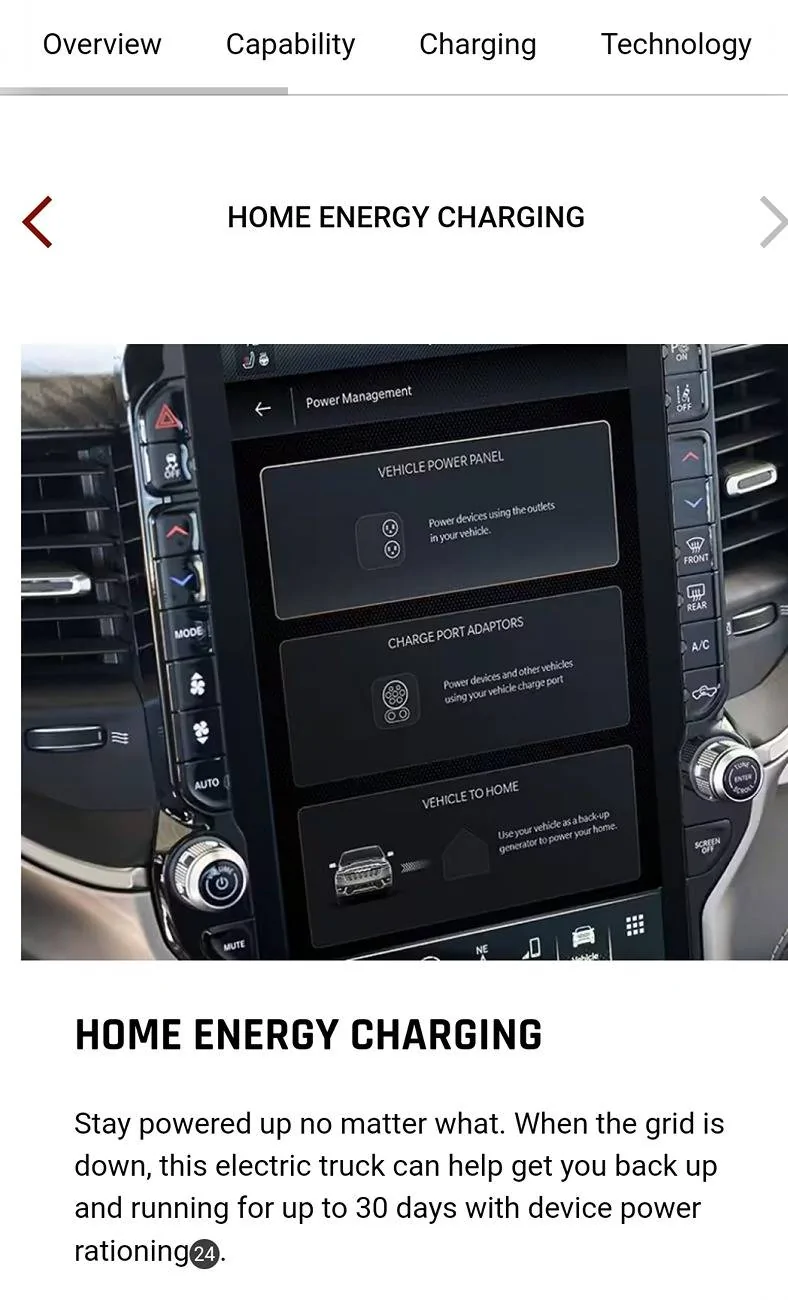
As for the Dodge it seems to have a limited function:
That's how the Chevy Volt works, and it's no longer made. Was it before its time? Who knows.The only way it makes even close to sense is if you engineer a motor to specifically power a generator. Meaning it spends all of its working life at one most efficient RPM. I highly doubt the Stellantis people are going to change the Pentastar that much to make it a dedicated generator motor.
I believe humans can make pretty solid combustion engines that operate at one steady rpm. We only have 100+ years and untold trillions $$ of r&d put into them. The three 90% energy conversions you spoke of seem to theoretically come close to the efficiency of a standard ICE vehicle. Now the Germans not being able to figure it out, not sure. Maybe it is a dead end. Did anyone let Porsche know?The only way it makes even close to sense is if you engineer a motor to specifically power a generator. Meaning it spends all of its working life at one most efficient RPM. I highly doubt the Stellantis people are going to change the Pentastar that much to make it a dedicated generator motor.
Better only in regards to how far you can go before having to charge or fall back to gasoline is what new battery technology will bring.
You can't argue with physics and until we can make very high temp superconductors there is always going to be a loss when you're converting energy from one form to another. So, does it make more sense to use (These are just numbers I'm pulling out of my ass) 200hp into a generator that might convert 90% of that into useable power, to charge a battery that only stores 90% of the power put into it (rest lost as heat) and then turn around and pull from storage to an electric motor that is only 90% efficient? Or do you go straight from the motor into driving the wheels (which has its own losses).
There have only been a couple of series hybrid vehicles in the past 10 years or so, for good reason. It's just not the right technology for consumer vehicle work. The germans over at BMW couldn't make it work very well in their I3, I doubt the Stellantis engineers will fare any better.
Yes, there’s obvious problems just hooking up to your house. But in 5-10 years when battery power storage is more common in housing, don’t you think there would be a way to safely feed that power as a link to your home’s circuit?A whole house generator, with the ability to power every circuit in the house (not necessarily at the same time), needs a transfer switch, and it must be wired in between the service entrance and main panel. You're not going to just drive up to any house and power it up. Any setup other than that, such as backfeeding the main panel, will require that the main breaker be shut off to avoid killing linesmen working on the poles. This kind of setup is illegal in most states, and for good reason.
Now if this thing has a power distribution panel that provides circuits that can be wired individually to household appliances, lamps, etc. via extension cords, that's legal, but it's not a whole house generator.
Solar/geothermal/hydro/whatevergreeniepowersourceulike residential systems today all have transfer switches if they are connected to the grid. It's required by the NEC in all states. The question is, how does a vehicle with an electric power source safely tie into it? It's not hard from an electrical control system standpoint. I'm not an expert in the practical side of this kind of system, so I don't know what is available today to enable what RAM is trying to do. However, if this capability is available today, it's only available to homes that already have an alternative whole house power source set up. All this assumes that the RAM whole house power feature delivers 220VAC (in the NAR). If not, then there's a whole host of other stuff that's needed to make it work.Yes, there’s obvious problems just hooking up to your house. But in 5-10 years when battery power storage is more common in housing, don’t you think there would be a way to safely feed that power as a link to your home’s circuit?
Shovel, I am definitely no electrician and much of that went pretty far over my head. I am no longer useful in this conversation lol. Will try to understand with some research what you’re talking aboutSolar/geothermal/hydro/whatevergreeniepowersourceulike residential systems today all have transfer switches if they are connected to the grid. It's required by the NEC in all states. The question is, how does a vehicle with an electric power source safely tie into it? It's not hard from an electrical control system standpoint. I'm not an expert in the practical side of this kind of system, so I don't know what is available today to enable what RAM is trying to do. However, if this capability is available today, it's only available to homes that already have an alternative whole house power source set up. All this assumes that the RAM whole house power feature delivers 220VAC (in the NAR). If not, then there's a whole host of other stuff that's needed to make it work.