veedubtuner
Well-Known Member
- Thread starter
- #1



I’m quite sure all the deregulation will get postponed by radical judges or tree huggers.This along with the fuel economy standards that were rolled back in December are a huge win. Now there's no need to have "fake" models with huge MPG ratings to get your average mileage of the cars you sell to some high number. The 50 mpg requirement was clearly designed to kill off ICE vehicles. Only small diesels could meet that and the EPA has done a good job of killing those off by overly stringent emission standards. This is rolling back to the standards that were in place in 2022, and continuing to have fuel economy growth at a more measured pace. The cafe average by 2032 will be 34.5 MPG. This is most likely the cause for the huge slowdown in the development and production of EVs and battery technology. I don't think this will affect BEVs as they were growing by leaps and bounds back in 2021-22, and the new standards haven't even taken effect.
AFAIK the one I posted went through as it was done in early December and doesn't require any votes. These judges have just about all been shut down but I guess they can keep trying and looking foolish.I’m quite sure all the deregulation will get postponed by radical judges or tree huggers.

Let’s hope they’re all silenced.AFAIK the one I posted went through as it was done in early December and doesn't require any votes. These judges have just about all been shut down but I guess they can keep trying and looking foolish.
YUPI’m quite sure all the deregulation will get postponed by radical judges or tree huggers.

He just needs a slap back to reality. And a job……
He/she lolHe just needs a slap back to reality. And a job……
Insert (IT)He/she lol
Didn't want to steal your thunder lol
States don't have a say what manufacturers can do that's all regulated by the EPA which is Federal. The 1/3 of the states are just your typical ones who try to push all this nonsense on the rest of our country.Just because the EPA says you no longer have to meet a certain standard, it doesn’t necessarily mean things will change.
About a third of U.S. states have adopted California emission standards (not all the CARB rules) and the automakers build to those standards. If ASS is needed to help automakers meet those standards, which are typically higher than national standards, they’ll continue to include it.
Even if they don’t need it to meet those standards, who says they won’t continue to use it so they can boast about “best-in-class fuel economy“ to help them sell more vehicles.
Hopefully, it is not needed and becomes something that can be toggled on or off in settings, much like other features.
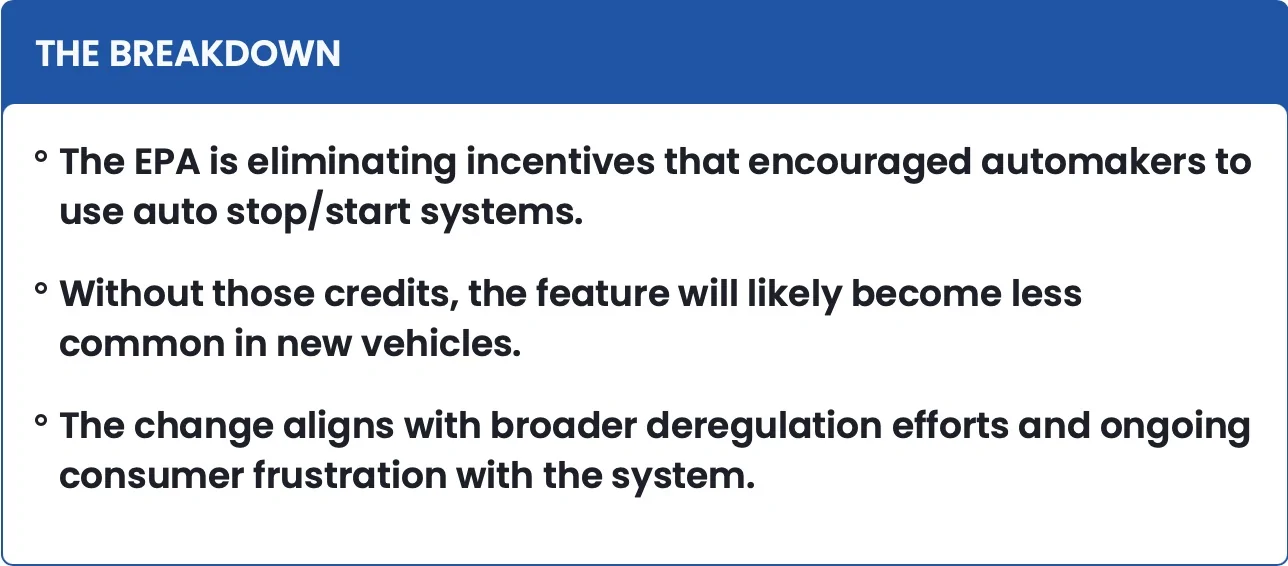
- Detroit-based brands like Ford and General Motors see this as a cost-saving opportunity, potentially reducing component complexity and warranty issues.
- Foreign automakers with smaller engine fleets—like BMW and Mazda—may need to recalibrate their EPA strategies, as many relied on start-stop to meet emissions targets.
- EV manufacturers, including Tesla and Rivian, are unaffected but welcome the shift as it aligns with their mission of cleaner, simpler drivetrains.
Whether you loved or loathed start-stop tech, its potential death may signal that the voice of the everyday driver is finally influencing federal policy.