
got3fords
Well-Known Member
...fix it until it is.If it ain’t broke…
Sponsored

...fix it until it is.If it ain’t broke…

Gasoline is a commodity, that is it is bought and sold between all brands. An example would be; crude is pumped out of the ground by Mobil, is sold to Shell, they transport it to a refinery owned by Texaco, they refined it and sell it to a distribution center owned by Citgo. Depending on how many distribution centers are in your geographical area all brands of gas is coming from the same tanks. The government dictates the minimum amount of detergent additives that must be in the gas. For the top tier brands they will dump in additional additives when the fill the tanker truck. There have been many articles both in favor and against paying for top tier gas. I for one have never made an effort to purchase top tier in my 55+ years of driving and have never had an issue. I for one believe it is more of a marketing thing than anything else.Don’t use cheap gas. Chevron (or a Techron additive) was recommended by a friend who is a retired Ford service manager.

That makes sense. I change mine every 30k, especially now because its less than $20Prolly ancient history… but one reason for his recommendation was seized and broken spark plugs when being changed at normal interval, which I believe was 90,000. Short blocks are expensive.

That’s what i’m thinking, I want to keep on a regular maintenance for this type of thing.Never hurts to keep things cleaned and maintained. If you’re already at that many miles and it’s never been done, I’d probably go ahead and do it just to prevent any issues down the line. I’ve heard/read that every 60k miles you should be cleaning injectors. I’d buy some cleaner to put in your gas tank and let it do its thing.
Yeah i’m curious whether it’d be better to just go to the ford dealership and have them do the injection cleaning service or whatever they call it. Not as thorough as walnut blasting but i don’t imagine the carbon buildup would be too significant. Hard to say though.The issue with direct injection engines like the one in the Ranger is there is no fuel being sprayed on the back side of the intake valves to keep the build up of carbon from forming. Putting a treatment in the gas tank will help keep the injectors clean but won't do anything for the intake valves.
In order to clean the intake valves you need to spray something into the intake while the engine is running or mechanically clean them with something like walnut blasting.
I have owned a Ford product with direct injection continuously since March of 2011. I would spray CRC Direct Injection Cleaner into the engine every 15k miles. Never had an issue. With the Ranger I am now at 43k miles and I have not used any top end cleaner and it is still running great. FWIW, a friend of mine had a Focus ST with the 2.0 Ecoboost engine which is direct injection. He ran it on 87 octane gas, changed the oil at 10k intervals and used conventional oil. It was still running strong at 120k miles when he traded it for a new truck.
There has been a lot of work developing oils that won't cause build up, better baffling in the PCB system to minimize oil vapor and clever tuning so valves get splashed with fuel when they are open. Not sure if it really is an issue anymore like it was in the early days of direct injection.
I’ll look into that, heard some good thinks about it.If its not running funny probably not needed. I get a big bottle of lucas once a year and do a few fill ups with it. It has lubrication in it too, typically do it in the winter when the gas is worse.
glad to see you spell your name the correct way!

The sprays cleaners dissolve the build up. A chunk coming loose and going through the turbo is just as likely to happen in everyday driving as is using the cleaners.Seems like I read not to use sprays to clean the intake valves on turbo engines if you haven't done it from the beginning frequently. If there are chunks knocked off they can go through the turbo an cause damage. Might be bad info but worth looking into.
Maybe get a cheap scope that attaches to your phone to look through a spark plug hole an see what's going on. I think 5K oil change intervals make a difference too but that's just me.
FWIW, back in 2012 when I purchased a Focus ST the only Ford authorized repair for carbon build on the intake valves was to replace the cylinder head. Not sure if Ford has changed or the dealer is offering the cleaning as a non warranty service.Yeah i’m curious whether it’d be better to just go to the ford dealership and have them do the injection cleaning service or whatever they call it. Not as thorough as walnut blasting but i don’t imagine the carbon buildup would be too significant. Hard to say though.



agree here big time. I figure one of the cheapest things I can do is pop into sport mode and hoon the truck for a few minutes once or twice a month. It’s cheap to do and funalso dont be afraid to stand on the skinny pedal every once in a while to keep the cats from carboning up.
I live in an area of Ohio that recently became the site of gas station wars. Cities/towns have begun placing moratoriums on new gas station construction (I’m being serious). As a result I have a lot of options that have the “top tier detergent” tag on the pumps and they cost the same due to competition. So I absolutely target these sites for refills. It’s another easy thing to do that often costs me nothing more than thinking about where to refuel.Don’t use cheap gas. Chevron (or a Techron additive) was recommended by a friend who is a retired Ford service manager.
I can see this being true. As I stated above, I have no idea how much my high tier detergent fuel is helping. If I was paying dramatically more for the fuel, I probably wouldn’t do it. For anyone worried about buildup on the valves, I think this is a great comment. It’s some info for each owner to weigh the merit of and then decide how they wanna proceed.Gasoline is a commodity, that is it is bought and sold between all brands. An example would be; crude is pumped out of the ground by Mobil, is sold to Shell, they transport it to a refinery owned by Texaco, they refined it and sell it to a distribution center owned by Citgo. Depending on how many distribution centers are in your geographical area all brands of gas is coming from the same tanks. The government dictates the minimum amount of detergent additives that must be in the gas. For the top tier brands they will dump in additional additives when the fill the tanker truck. There have been many articles both in favor and against paying for top tier gas. I for one have never made an effort to purchase top tier in my 55+ years of driving and have never had an issue. I for one believe it is more of a marketing thing than anything else.
You are much better off buying your gas at the local discount brand that is getting several deliveries a week than a small station of a name brand that only gets deliveries once a month
Additives in the gas will do nothing for keeping the backside of the intake valves clean because the fuel is not injected directly onto the valve backside like a multiport injection system does.boy this topic came up on a motorcycle forum I’m a member of and the debate over whether or not it was a waste of money got sassy quickly. I appreciate everyone’s discussion here because this thread is productive.
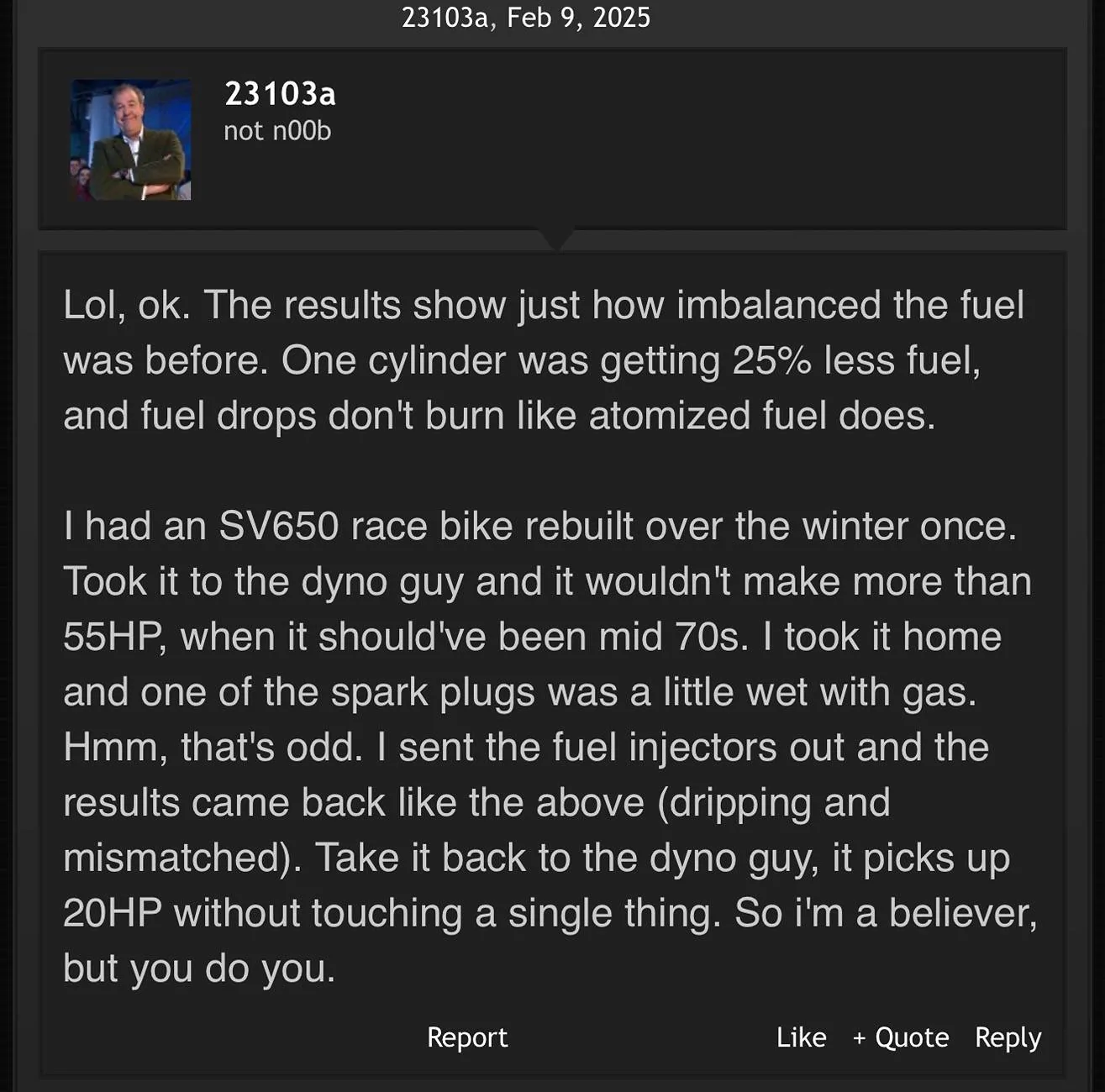
For what it’s worth, one guy did share dyno numbers before and after injector cleaning on a Suzuki SV650 race bike. It made a noticeable difference on torque and horsepower. It was a bike tho. Our trucks are so different in design so… really to tough to say.
Here’s a screenshot of the comment:

agree here big time. I figure one of the cheapest things I can do is pop into sport mode and hoon the truck for a few minutes once or twice a month. It’s cheap to do and fun
I live in an area of Ohio that recently became the site of gas station wars. Cities/towns have begun placing moratoriums on new gas station construction (I’m being serious). As a result I have a lot of options that have the “top tier detergent” tag on the pumps and they cost the same due to competition. So I absolutely target these sites for refills. It’s another easy thing to do that often costs me nothing more than thinking about where to refuel.
now whether or not the detergents truly help on valves? I dunno. I just do it anyway just in case.
I can see this being true. As I stated above, I have no idea how much my high tier detergent fuel is helping. If I was paying dramatically more for the fuel, I probably wouldn’t do it. For anyone worried about buildup on the valves, I think this is a great comment. It’s some info for each owner to weigh the merit of and then decide how they wanna proceed.
So my local ford dealership has a service for carbon buildup on these GDI engines and they said it’s specifically to help with the carbon buildup, not walnut blasting but it’s an intake cleaning service, they charge $290 for it, I feel like that’s with it, probably my best bet right?Due to having Direct Injection, a fuel injector cleaning by chemical will only clean the fuel system. To clean the Intake valve you need to do an intake service and your Dealer should have that service available
Very Helpful info, thanks for sharing that post from another thread too. Good point with using sport mode every so often, fun stuff and helpful.boy this topic came up on a motorcycle forum I’m a member of and the debate over whether or not it was a waste of money got sassy quickly. I appreciate everyone’s discussion here because this thread is productive.
For what it’s worth, one guy did share dyno numbers before and after injector cleaning on a Suzuki SV650 race bike. It made a noticeable difference on torque and horsepower. It was a bike tho. Our trucks are so different in design so… really to tough to say.
Here’s a screenshot of the comment:
agree here big time. I figure one of the cheapest things I can do is pop into sport mode and hoon the truck for a few minutes once or twice a month. It’s cheap to do and fun
I live in an area of Ohio that recently became the site of gas station wars. Cities/towns have begun placing moratoriums on new gas station construction (I’m being serious). As a result I have a lot of options that have the “top tier detergent” tag on the pumps and they cost the same due to competition. So I absolutely target these sites for refills. It’s another easy thing to do that often costs me nothing more than thinking about where to refuel.
now whether or not the detergents truly help on valves? I dunno. I just do it anyway just in case.
I can see this being true. As I stated above, I have no idea how much my high tier detergent fuel is helping. If I was paying dramatically more for the fuel, I probably wouldn’t do it. For anyone worried about buildup on the valves, I think this is a great comment. It’s some info for each owner to weigh the merit of and then decide how they wanna proceed.


