Sponsored

Truck Leveling for hitch setup.

BReeves61

Well-Known Member
First Name
Bobby
Joined
Sep 12, 2022
Threads
14
Messages
77
Reaction score
80
Location
North Carolina
Vehicle(s)
2022 Ford Ranger
Occupation
Retired
I use a Husky Centerline TS WDH to tow our 23 ft travel trailer. Hitch setup question...... The instructions say to make sure the truck and trailer are level after setup is complete. The unloaded truck is higher in the rear than the front by design, My question is should I be trying to achieve a level truck (allowing for some leaf spring compression or should I be trying to achieve the preloaded height in the rear? The unloaded front measurement is 36 inches at the fender well and rear is 39 inches or should it be 36 front, 36 rear?

Thanks!
Sponsored


dtech

Well-Known Member
Joined
May 10, 2020
Threads
37
Messages
3,135
Reaction score
7,574
Location
colorado
Vehicle(s)
Ranger Lariat FX4, chromed and forever damperless
I use a Husky Centerline TS WDH to tow our 23 ft travel trailer. Hitch setup question...... The instructions say to make sure the truck and trailer are level after setup is complete. The unloaded truck is higher in the rear than the front by design, My question is should I be trying to achieve a level truck (allowing for some leaf spring compression or should I be trying to achieve the preloaded height in the rear? The unloaded front measurement is 36 inches at the fender well and rear is 39 inches or should it be 36 front, 36 rear?

Thanks!
Sounds like similar instructions to the E2 Hitch I have, my truck still sits slightly higher in the back than the front, I tried a few different setups and found what towed best is when my trailer is not level but slopes down at the front by several inches.
 

notsolinear

Well-Known Member
Joined
Apr 1, 2023
Threads
3
Messages
77
Reaction score
95
Location
Illinois
Vehicle(s)
2021 Ford Ranger Lariat
My trailer dealership adjusted so that the change in compression at all four corners with trailer hitched was equal. So they preserved the factory rake. I have since been to CAT scales and confirmed that additional weight on each axle is pretty similar too.
 

EJH

Well-Known Member
First Name
Ed
Joined
Oct 7, 2020
Threads
17
Messages
932
Reaction score
1,832
Location
Oregon
Vehicle(s)
Subarus, 2021 Ranger
Occupation
Engineer
If you read Ford's instructions on WDHs and towing, they advise to recover 1/2 of the change in height with no trailer and a trailer w/o a WDH setup.
 

Grumpaw

Well-Known Member
First Name
Steve
Joined
Jul 1, 2021
Threads
84
Messages
5,860
Reaction score
29,196
Location
Fishersville, Va.
Vehicle(s)
Previous 2021 Ranger, Now 2019 Ford Expedition
Occupation
Navy Vet., Retired Police Sgt., Grumpy Old Senior Citizen
I use a Husky Centerline TS WDH to tow our 23 ft travel trailer. Hitch setup question...... The instructions say to make sure the truck and trailer are level after setup is complete. The unloaded truck is higher in the rear than the front by design, My question is should I be trying to achieve a level truck (allowing for some leaf spring compression or should I be trying to achieve the preloaded height in the rear? The unloaded front measurement is 36 inches at the fender well and rear is 39 inches or should it be 36 front, 36 rear?

Thanks!
Have you even tried to hitch your trailer up yet ? Pretty sure, if your hitch is set up properly, the added weight of the tongue weight will lower the rear of the Ranger.
There is a proper method of setting up a hitch in relation to the trailer coupler, and if you have followed it then pretty sure once you drop the trailer coupler onto the hitch, the rear of your truck will go down....
If you've not set it up yet....lots of video's and info on line....go to ETrailer web site....lots of info and videos on setting up a hitch properly.
From your description it sounds like your hitch head/ball may be to high, and need lowering.
But, everyone is trying to help but without a "hands on" it's hard to do via posts on a web site.


OP
OP

BReeves61

Well-Known Member
First Name
Bobby
Joined
Sep 12, 2022
Threads
14
Messages
77
Reaction score
80
Location
North Carolina
Vehicle(s)
2022 Ford Ranger
Occupation
Retired
My trailer dealership adjusted so that the change in compression at all four corners with trailer hitched was equal. So they preserved the factory rake. I have since been to CAT scales and confirmed that additional weight on each axle is pretty similar too.
Thanks! Do you find that you have to really raise the truck and tongue up very high to get the se
Have you even tried to hitch your trailer up yet ? Pretty sure, if your hitch is set up properly, the added weight of the tongue weight will lower the rear of the Ranger.
There is a proper method of setting up a hitch in relation to the trailer coupler, and if you have followed it then pretty sure once you drop the trailer coupler onto the hitch, the rear of your truck will go down....
If you've not set it up yet....lots of video's and info on line....go to ETrailer web site....lots of info and videos on setting up a hitch properly.
From your description it sounds like your hitch head/ball may be to high, and need lowering.
But, everyone is trying to help but without a "hands on" it's hard to do via posts on a web site.
Been towing with it for over a year. Simply asking questions since I'm not a hitch engineer.
 

Grumpaw

Well-Known Member
First Name
Steve
Joined
Jul 1, 2021
Threads
84
Messages
5,860
Reaction score
29,196
Location
Fishersville, Va.
Vehicle(s)
Previous 2021 Ranger, Now 2019 Ford Expedition
Occupation
Navy Vet., Retired Police Sgt., Grumpy Old Senior Citizen
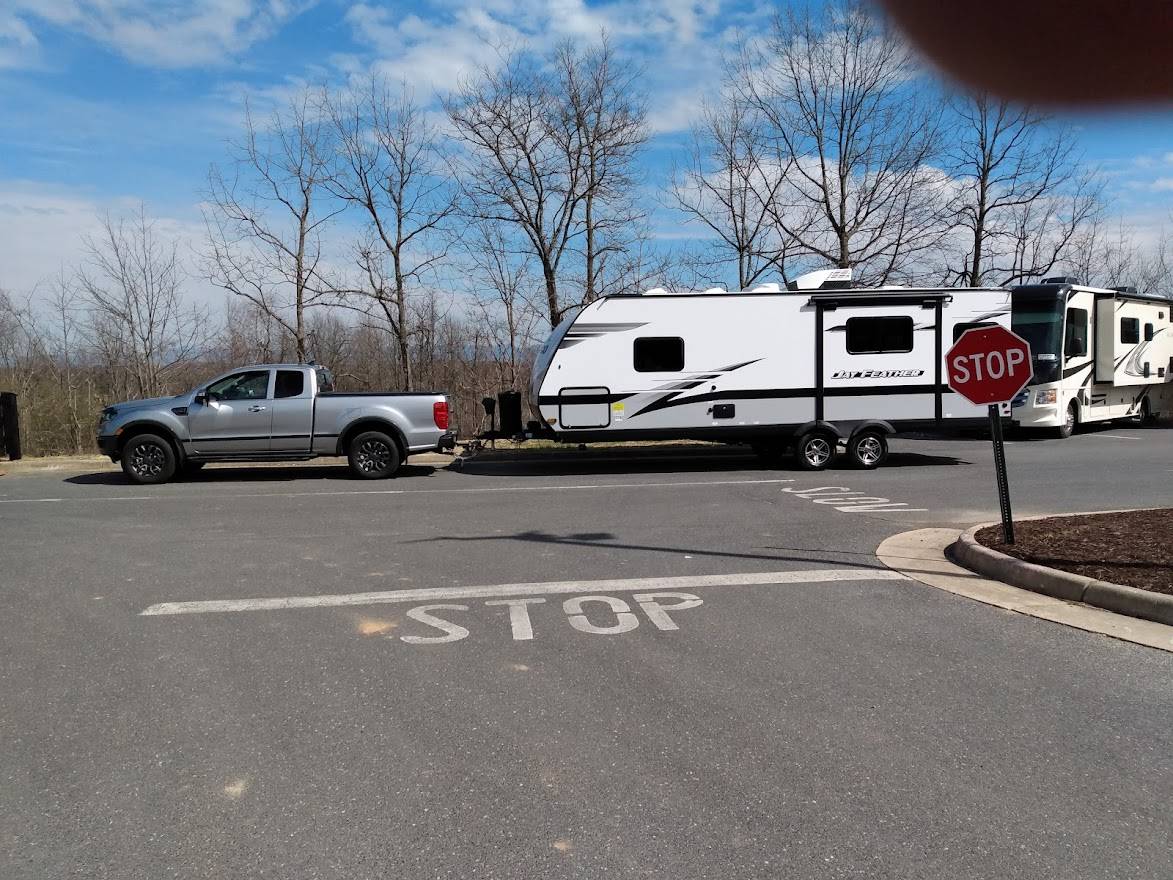
Truck should be close to level...a bit ass up is OK, and the front of the trailer should be a bit nose down.
This a pic of my 2 wheel drive with trailer hooked up....and unloaded the truck sits a good 3 inches ass high....
Trailer is just a bit nose down...

IMG_20220316_143343271.jpg
 

notsolinear

Well-Known Member
Joined
Apr 1, 2023
Threads
3
Messages
77
Reaction score
95
Location
Illinois
Vehicle(s)
2021 Ford Ranger Lariat
I have not used a tape measure to verify, but my installer claimed the front and rear axle squat was equal so rake angle is same. They also set it up so trailer sits very close to level, even though the truck itself is slightly tail-high.

I do have to raise the rear of the truck a considerable amount with the tongue jack to be able to install or remove the spring bars without any tension. I have the BlueOx TrackPro.
 

dtech

Well-Known Member
Joined
May 10, 2020
Threads
37
Messages
3,135
Reaction score
7,574
Location
colorado
Vehicle(s)
Ranger Lariat FX4, chromed and forever damperless
Have you even tried to hitch your trailer up yet ? .
From your description it sounds like your hitch head/ball may be to high, and need lowering.
But, everyone is trying to help but without a "hands on" it's hard to do via posts on a web site.

I tow a 23 ft, 4200lbs trailer - I'd agree with grumpaw about hitch ball height - if it's too high there can be too much tension on the spring bars. I'm using a 9 hole shank with the hitch ball assembly at hole 7 and found that having the trailer down at the front by several inches makes towing smoother.
Or in other words what the installer did may not be the ideal setup , the instructions in my E2 WDH mention having to make various adjustments - lots of differences from one trailer to another.
 
Last edited:

Jason B

Well-Known Member
First Name
Jason
Joined
May 19, 2021
Threads
9
Messages
3,009
Reaction score
8,319
Location
Louisiana
Vehicle(s)
2021 XL STX SE 4x2
Occupation
machinist
When they say truck and trailer should be level, I think they mean on level ground. If you add a level kit to the truck, then hitch a trailer, you will be nose up in what's called 'Carolina lean'. This will result in a banishment from this forum. :devil:
 

notsolinear

Well-Known Member
Joined
Apr 1, 2023
Threads
3
Messages
77
Reaction score
95
Location
Illinois
Vehicle(s)
2021 Ford Ranger Lariat
if it's too high there can be too much tension on the spring bars
Not familiar with others, but my TrackPro you can adjust the vertical position of the L brackets on the trailer frame that the spring bars rest on. If you adjust both the ball height and that bracket height you should be able to set the trailer tongue height while still choosing more or less spring tension.
 

Dgc333

Well-Known Member
First Name
Dave
Joined
Aug 24, 2021
Threads
17
Messages
1,742
Reaction score
4,112
Location
Massachusetts
Vehicle(s)
21 Ranger Lariat
Occupation
Engineer
The instructions for the Reese WDH I have states that you adjust the trailer level with the tongue jack then choose a shank with a drop/rise that will set the ball even with the coupling on the trailer. With the trailer attached to the tow vehicle use the link on the load bar chain that brings the trailer back to level. In my case 5 links of chain adds more load and the trailer sits 1/2 a bubble high and on 6 links of chain sits 1/2 a bubble low. I tow with 6 links. This works very well for me and I have not had any issues.

I have to give credit to this forum and Grumpaw in particular for the education on setting up a tow hitch.
 

Big Blue

Well-Known Member
First Name
Lee
Joined
May 5, 2020
Threads
16
Messages
3,927
Reaction score
9,352
Location
Wisconsin
Vehicle(s)
2019 Ford Ranger XLT FX4 Supercrew lighting blue
Occupation
Retired mechanical designer
Not familiar with others, but my TrackPro you can adjust the vertical position of the L brackets on the trailer frame that the spring bars rest on. If you adjust both the ball height and that bracket height you should be able to set the trailer tongue height while still choosing more or less spring tension.
On most conventional WDHs there are 4 main adjustments/factors that are involved in the setup. They all interact with each other. The first is bar stiffness. This is usually listed by tongue weight or total trailer weight. Too stiff or too soft bars are not good. The second is hitch hight. This should be set so the trailer when hitched up with the bars in place is close to level or slightly nose down, never nose high. The third depending on the hitch is the hight of the "L" brackets or the length of the chains loading the bars. This affects the amount of weight transfer of tongue weight to the front axle of the truck and to the trailer axle(s). The forth, and one many people miss or maybe the hitch doesn't have, is the angle of the hitch head mounted to the hitch bar. This is why when you hitch-up without the bars loaded the ends of the bars are low. This will fine tune the amount of weight transfered to the front axle of the tow vehicle. The adjustment for this is usually done with shims when attaching the hitch head to the bar

All of these adjustments interact with each other. But, none of then change the "tongue weight" of the trailer, just how it is distributed. what it does is effectively move the center of gravity of the tow vehicle forward back to where it normally should be.
 

dtech

Well-Known Member
Joined
May 10, 2020
Threads
37
Messages
3,135
Reaction score
7,574
Location
colorado
Vehicle(s)
Ranger Lariat FX4, chromed and forever damperless
On the E2 round bar WDH there is a bolt which one can add washers (shims) to adjust the angle of ball , the instructions suggest starting with 3 and adding more if necessary - I was using 6 in an attempt to get the ball lower but this didn't seem to tow right so bit the bullet and replaced the E2 6 hole drop shank with a 9 hole shank (Grumpaw had suggested this) , now I use 3 washers for the ball angle adjustment, the trailer sits a few inches lower at the front and I'm happier with the way it tows. I believe my round bars are for 600lbs tongue weight, the TT I have states the tongue weight @ 450 llbs.
 

Grumpaw

Well-Known Member
First Name
Steve
Joined
Jul 1, 2021
Threads
84
Messages
5,860
Reaction score
29,196
Location
Fishersville, Va.
Vehicle(s)
Previous 2021 Ranger, Now 2019 Ford Expedition
Occupation
Navy Vet., Retired Police Sgt., Grumpy Old Senior Citizen
On most conventional WDHs there are 4 main adjustments/factors that are involved in the setup. They all interact with each other. The first is bar stiffness. This is usually listed by tongue weight or total trailer weight. Too stiff or too soft bars are not good. The second is hitch hight. This should be set so the trailer when hitched up with the bars in place is close to level or slightly nose down, never nose high. The third depending on the hitch is the hight of the "L" brackets or the length of the chains loading the bars. This affects the amount of weight transfer of tongue weight to the front axle of the truck and to the trailer axle(s). The forth, and one many people miss or maybe the hitch doesn't have, is the angle of the hitch head mounted to the hitch bar. This is why when you hitch-up without the bars loaded the ends of the bars are low. This will fine tune the amount of weight transfered to the front axle of the tow vehicle. The adjustment for this is usually done with shims when attaching the hitch head to the bar

All of these adjustments interact with each other. But, none of then change the "tongue weight" of the trailer, just how it is distributed. what it does is effectively move the center of gravity of the tow vehicle forward back to where it normally should be.
You hit all the areas dead on. And that's why setting up a truck/hitch/trailer combo is different for EVERY application, and why it's almost impossible to answer generic questions on the site. To set up properly you must have a "hands on" approach....no matter how much info you give to us, no matter how much knowledge we may have, it's impossible to give correct answers, and why I always point people to specific sites that deal with their particular hitch.
Setting up hitch heads for use with underslung couplers is different from regular couplers and bars using chains are different from friction type bars.
Sponsored

 
Last edited:


Top