Sponsored

Ping when cold

airline tech

Well-Known Member
Joined
Aug 24, 2022
Threads
28
Messages
4,448
Reaction score
8,507
Location
Midwest - KS
Vehicle(s)
2022 Ranger Lariat-Super Crew, Cactus Gray
Occupation
Aircraft Tech
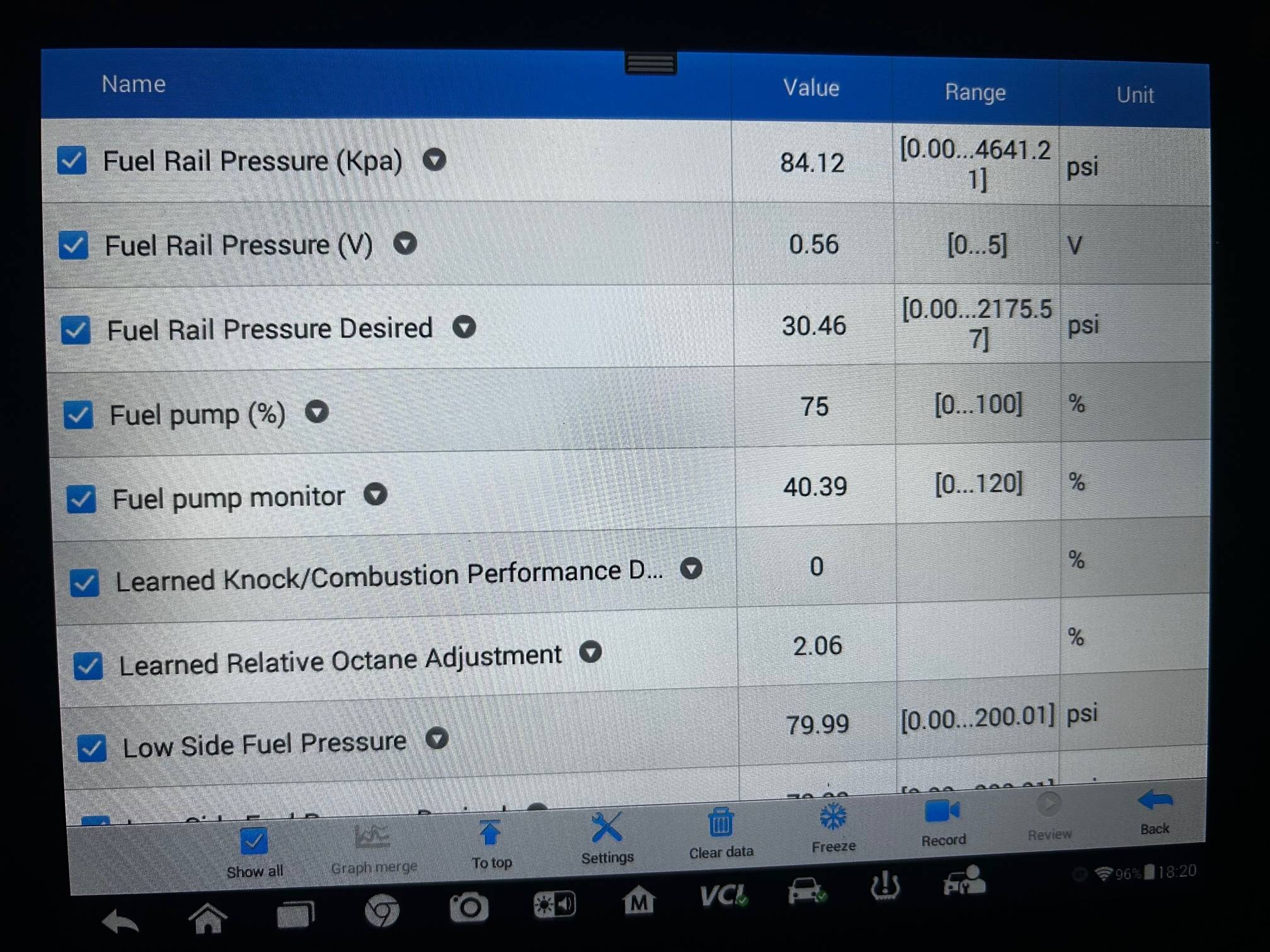
I used my Autel , got different parameters than your readings. i will use Forscan to get exact match readings.
I did have Knock Count of (1) on Cyl 3 all others (0)
Learned Relative Octane Adjustment = 2.06 - So check under (L) in PCM in Forscan for the PID

My KOEO - Fuel Rail Pressure = 1200 PSI at before (1st) start of the day
So when I get time, out of curiosity I will check with Forscan
Sponsored
 
OP
OP
seasprite

seasprite

Well-Known Member
Joined
Sep 1, 2022
Threads
25
Messages
468
Reaction score
1,111
Location
Missouri
Vehicle(s)
2022 Ranger XL STX
I used my Autel , got different parameters than your readings. i will use Forscan to get exact match readings.
I did have Knock Count of (1) on Cyl 3 all others (0)
Learned Relative Octane Adjustment = 2.06 - So check under (L) in PCM in Forscan for the PID

My KOEO - Fuel Rail Pressure = 1200 PSI at before (1st) start of the day
So when I get time, out of curiosity I will check with Forscan
Thats an interesting pressure reading after sitting all night especially when idle is around 220 psi?

I'll take a look in the PCM later on. I did find a pid lambda and I can't remember, but I thought it has something to do with the fuel, air mix?
 

airline tech

Well-Known Member
Joined
Aug 24, 2022
Threads
28
Messages
4,448
Reaction score
8,507
Location
Midwest - KS
Vehicle(s)
2022 Ranger Lariat-Super Crew, Cactus Gray
Occupation
Aircraft Tech
I tried my Autel again, here is what I show - KOEO - This is after 9 hours sitting

Fuel Press.jpg
 
Last edited:

airline tech

Well-Known Member
Joined
Aug 24, 2022
Threads
28
Messages
4,448
Reaction score
8,507
Location
Midwest - KS
Vehicle(s)
2022 Ranger Lariat-Super Crew, Cactus Gray
Occupation
Aircraft Tech
I am going to be honest and say I have never messed with tuning a car and am not certain exactly what the Learned Octane Adjustment is all about, I know it relates to the knock counters and adjusts timing based on those counters. So, in my quick research the numbers should be (0) or (-1) for a perfect setting. My Autel shows this as a (%) and cannot find a conversion chart to convert to numeric number of what the tuning pages call for.
So any tuners, please explain. I run 87 Octane - Stock No Tunes
 
OP
OP
seasprite

seasprite

Well-Known Member
Joined
Sep 1, 2022
Threads
25
Messages
468
Reaction score
1,111
Location
Missouri
Vehicle(s)
2022 Ranger XL STX
Well after looking at your data, the only real difference I'm seeing is prime pressure and as soon truck starts that is normal.

Still need to find the octane pid, will try today

Beginning to look like this isn't fuel issue, so need to think of other probable causes.
Maybe timing?
Can an EGR flow issue cause this issue? or evap?
airline tech can you think of any other systems to check? maybe turbo?


OP
OP
seasprite

seasprite

Well-Known Member
Joined
Sep 1, 2022
Threads
25
Messages
468
Reaction score
1,111
Location
Missouri
Vehicle(s)
2022 Ranger XL STX
Alright doing some research on LAMBDA and found some interesting info on it.


What is lambda?
In car diagnostics domain, air-fuel equivalence ratio is often regarded as lambda (Ī»). This is especially true in spoken language. Air-fuel equivalence ratio is the ratio of actual air-fuel ratio (AFR) to stoichiometry for a given mixture. In other words, lambda is the ratio between the amount of oxygen actually present in a combustion chamber versus the amount that should have been present to get perfect combustion.

  • In an ideal mixture, there’s exactly the amount of oxygen required to burn the amount of fuel present. Thus, lambda = 1.0.
  • In a lean mixture, there’s too much oxygen for the amount of fuel. Thus, lambda > 1.0.
  • In a rich mixture, there’s too little oxygen for the amount of fuel. Thus, lambda will be < 1.0.
In practice, the AFR devices measure the amount of residual oxygen or unburnt hydrocarbons in the exhaust gas. The engine monitors the lambda values in a feedback loop to adjust the air-fuel mixture.

OBD Auto Doctor uses the lambda values for the fuel consumption calculations. This is to get the most accurate estimation of fuel consumed.

So I'm going to load up the scanner and check some more pids today on my way to work
 
OP
OP
seasprite

seasprite

Well-Known Member
Joined
Sep 1, 2022
Threads
25
Messages
468
Reaction score
1,111
Location
Missouri
Vehicle(s)
2022 Ranger XL STX
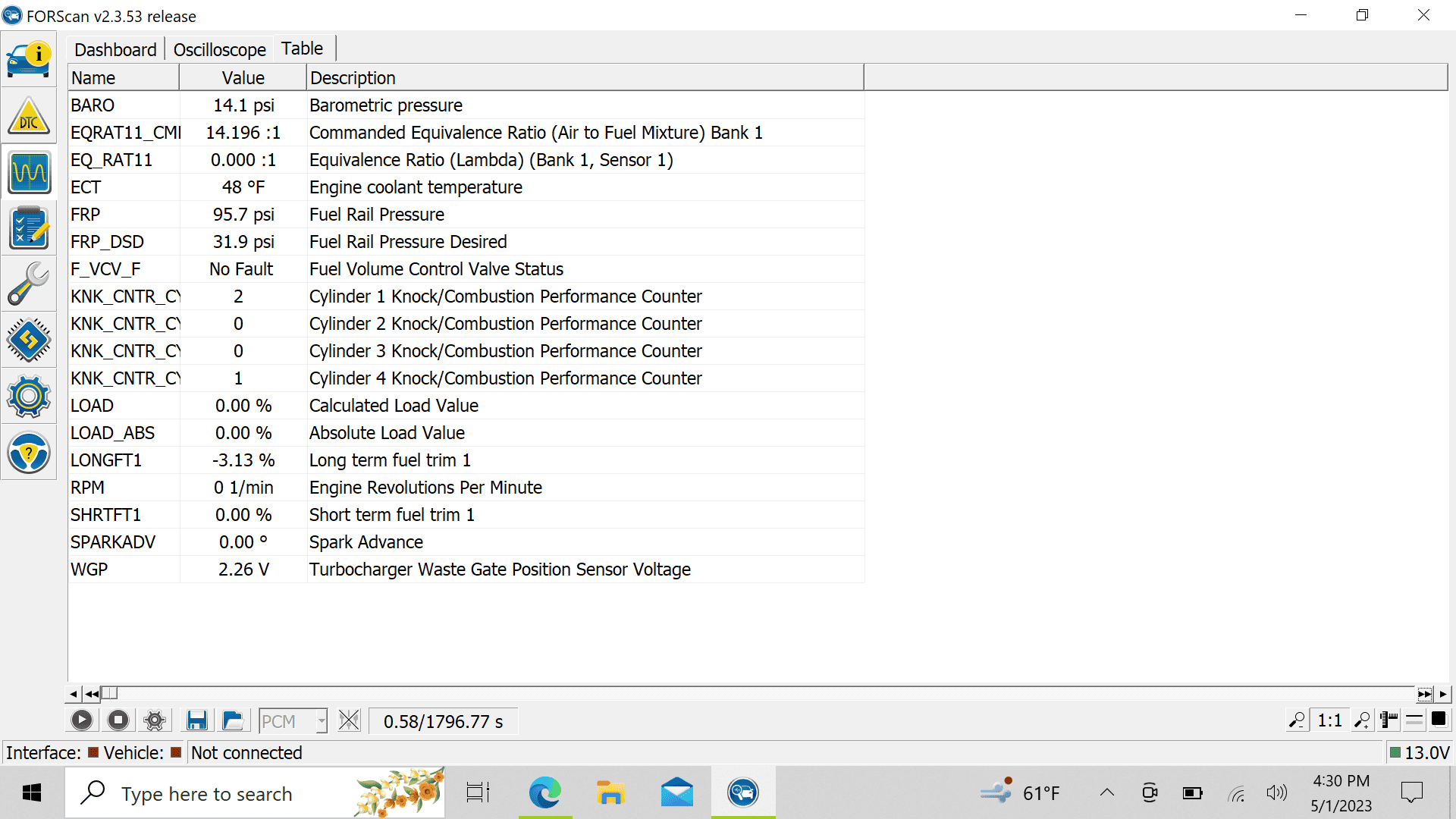
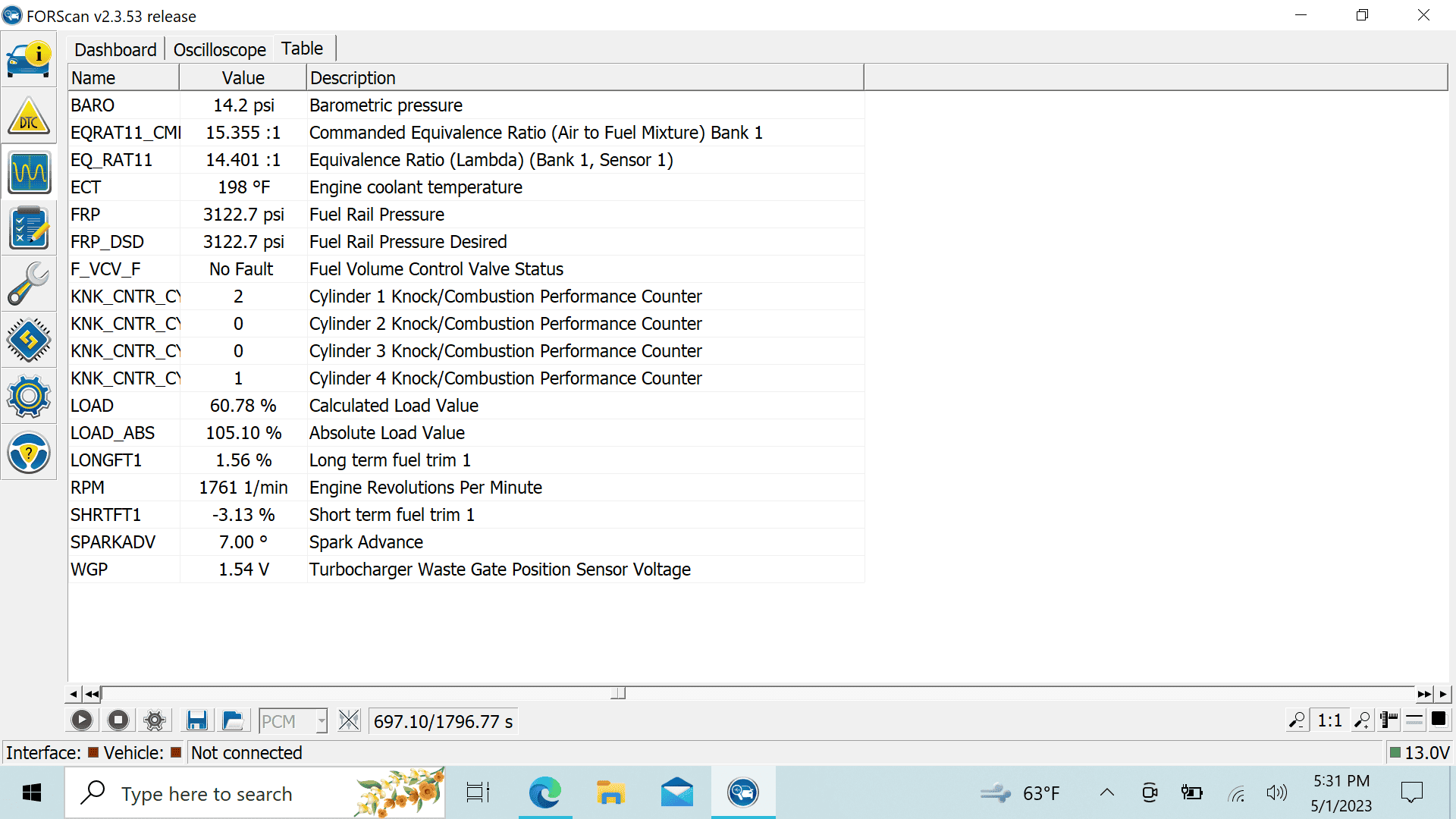
Collected some more data and made a discovery about the noisy fuel pump

KOEO cold soaked
Screenshot (16).png


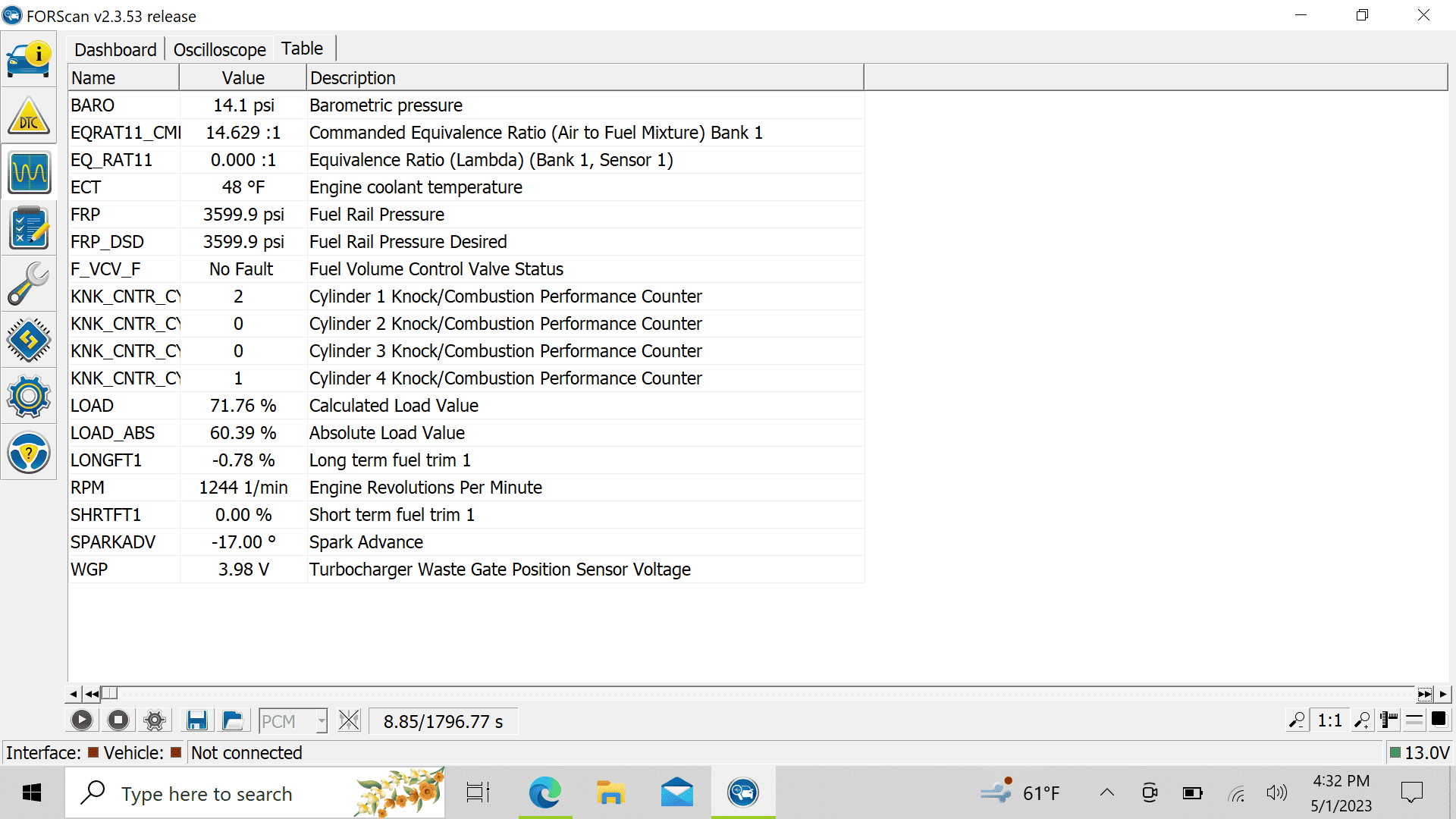
After I started the engine fuel pressure shot up to 3600 psi and stayed there for about minute and was louder than normal.

Screenshot (17).png


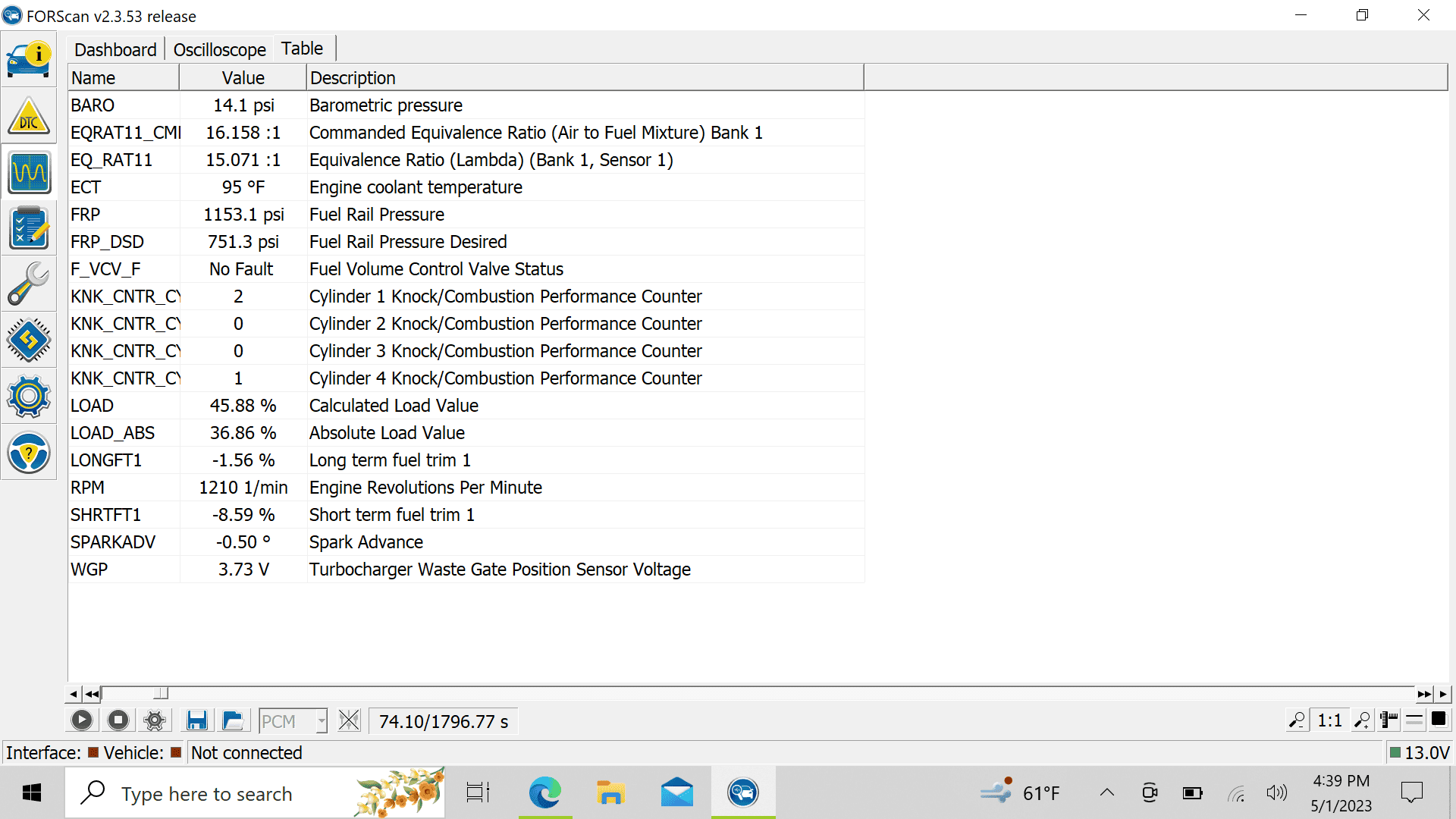
This when the HP fuel pump quieted down and you can see the fuel pressure dropping. Don't know what to think about the Lambda yet need to do more research before I can even take a wild guess on that.

Screenshot (18).png


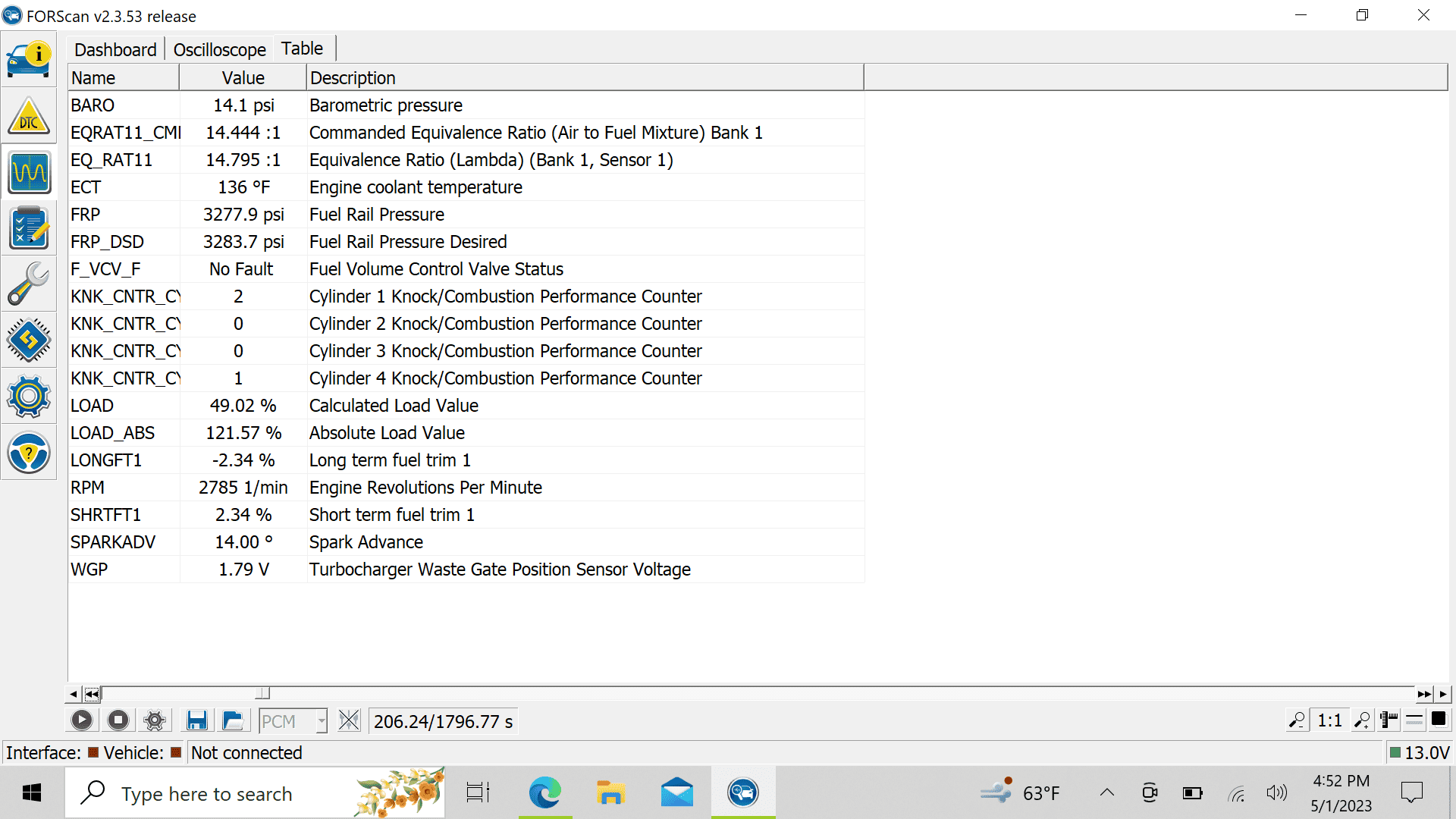
Around this time frame I heard the knock or ping but the counters never moved. Still no idea whats going on. Don't how to read the load values other than I was going up hill at the time. Don't know why the calculated and absolute is so different?

Screenshot (19).png


This next shot is me at cruse 65mph

Screenshot (20).png


Thinking about taking it in to the dealer and have them look at it, but I don't hear the excuse couldn't replicate or normal when it didn't make the sounds when I bought it.
 

airline tech

Well-Known Member
Joined
Aug 24, 2022
Threads
28
Messages
4,448
Reaction score
8,507
Location
Midwest - KS
Vehicle(s)
2022 Ranger Lariat-Super Crew, Cactus Gray
Occupation
Aircraft Tech
For the record here, I have a background in Automotive Maintenance but got out professionally in the early 90's, before Scan Tools became a norm for troubleshooting.
So, for me it's just evaluate my known problem and monitor scan data to see if anything stands out.
(For No Code) Diagnostics compare what I have vs what I should see (Specs), granted specs can vary based on temps etc. so there is always a variable.
With the PCM's now having pretty much Full control over Timing, it appears that in your case I do not see anything that stands out that is faulting, it is more based on fuel delivery and timing control and more importantly Learned Data.
You have a unique issue (only when cold) and the issue disappears, normally these issues relate to a vacuum leak and then seal themselves up when engine warms up, but these will push (+) fuel trim numbers. Your fuel trims look great.

If you only look at the Screen where the Knock Is Occurring.
FYI - The Knock Counters are only Learned Data and not Live Data
Now since you have no fault codes, I am leaning heavily on the PCM Learned Data and how it is handling Fuel Control and Spark

The only thing I see is the Spark Advance - 14.0 Deg (I am assuming here that in this screen shot it is (Spark Knocking)
When the Knock Sensors detect Knock, the PCM addresses this by Retarding the Spark
So, at this point the PCM has a Spark Advance of 14.0 Deg, the knock sensors are detecting a knock and the PCM then pulls Spark Advance back (Down) till the knock stops.
I'm sorry but there are so many variables that tie into this, here are a few more PIDs to look at:
As the next screen shot engine is warm to operating temp 198 deg and Spark Advance has been pulled back

Knock Sensors:
These will be cycling and jumping around but should hold around the spec numbers.
Knock_1 - Idle = 38 - 30 MPH = 53
Knock_2 - Idle = 46 - 30 MPH = 92

Variable Cam Timing: VCT

VCT_Exch_Act 1 - Idle (-0.13) 30 MPH (-0.19)
DIF1 ( 0.13 ) (0.13)

VCT_Int Act1 Idle (0.38) 30 MPH - (0.31)
DIF1 (-0.38) (-0.25)

These are all the controlling specs that would contribute to spark knock.
It boils down to how the PCM handles the Spark Advance and Retard.
You may try a different fuel (even) 87 Octane or even reset the KAM, just to see if the knock disappears.
If you go to the dealer, I am quite certain they will say try different fuel, but it is at least worth try just to see what they will do, but most likely if there is not any codes, they will send you away.
As they tend to operate (No Codes, No Problem)

Sorry, but nothing is jumping out and saying look at me, other than if the screen shot is actually when the Knock / Ping is occurring, will be the current Spark Advance of 14.0 Deg as a possible reason why you are getting the Knock/Ping

The only other thing that plays into this is the Load Values.
The Load Values are calculated from the MAPT sensor inputs to the PCM which is used in controlling Spark Advance, so for any (single) item to be giving misinformation. but not actually bad enough to fault (code-itself) would be the MAPT sensor.
 
Last edited:

Rp930

Well-Known Member
First Name
Rick
Joined
Nov 19, 2018
Threads
20
Messages
1,794
Reaction score
3,514
Location
Denver
Vehicle(s)
ā€˜19 Ford Ranger Lariat, ā€˜23 Macan,’21 Shelby GT500
Occupation
Retired
You may want to try a bottle of Techron Fuel System Cleaner on the off chance that combustion chamber deposits are causing it. I don’t think the dealer will get too excited about a light ping sometimes when itā€˜s cool out during warm up.
 
OP
OP
seasprite

seasprite

Well-Known Member
Joined
Sep 1, 2022
Threads
25
Messages
468
Reaction score
1,111
Location
Missouri
Vehicle(s)
2022 Ranger XL STX
For the record here, I have a background in Automotive Maintenance but got out professionally in the early 90's, before Scan Tools became a norm for troubleshooting.
So, for me it's just evaluate my known problem and monitor scan data to see if anything stands out.
(For No Code) Diagnostics compare what I have vs what I should see (Specs), granted specs can vary based on temps etc. so there is always a variable.
With the PCM's now having pretty much Full control over Timing, it appears that in your case I do not see anything that stands out that is faulting, it is more based on fuel delivery and timing control and more importantly Learned Data.
You have a unique issue (only when cold) and the issue disappears, normally these issues relate to a vacuum leak and then seal themselves up when engine warms up, but these will push (+) fuel trim numbers. Your fuel trims look great.

If you only look at the Screen where the Knock Is Occurring.
FYI - The Knock Counters are only Learned Data and not Live Data
Now since you have no fault codes, I am leaning heavily on the PCM Learned Data and how it is handling Fuel Control and Spark

The only thing I see is the Spark Advance - 14.0 Deg (I am assuming here that in this screen shot it is (Spark Knocking)
When the Knock Sensors detect Knock, the PCM addresses this by Retarding the Spark
So, at this point the PCM has a Spark Advance of 14.0 Deg, the knock sensors are detecting a knock and the PCM then pulls Spark Advance back (Down) till the knock stops.
I'm sorry but there are so many variables that tie into this, here are a few more PIDs to look at:
As the next screen shot engine is warm to operating temp 198 deg and Spark Advance has been pulled back

Knock Sensors:
These will be cycling and jumping around but should hold around the spec numbers.
Knock_1 - Idle = 38 - 30 MPH = 53
Knock_2 - Idle = 46 - 30 MPH = 92

Variable Cam Timing: VCT

VCT_Exch_Act 1 - Idle (-0.13) 30 MPH (-0.19)
DIF1 ( 0.13 ) (0.13)

VCT_Int Act1 Idle (0.38) 30 MPH - (0.31)
DIF1 (-0.38) (-0.25)

These are all the controlling specs that would contribute to spark knock.
It boils down to how the PCM handles the Spark Advance and Retard.
You may try a different fuel (even) 87 Octane or even reset the KAM, just to see if the knock disappears.
If you go to the dealer, I am quite certain they will say try different fuel, but it is at least worth try just to see what they will do, but most likely if there is not any codes, they will send you away.
As they tend to operate (No Codes, No Problem)

Sorry, but nothing is jumping out and saying look at me, other than if the screen shot is actually when the Knock / Ping is occurring, will be the current Spark Advance of 14.0 Deg as a possible reason why you are getting the Knock/Ping

The only other thing that plays into this is the Load Values.
The Load Values are calculated from the MAPT sensor inputs to the PCM which is used in controlling Spark Advance, so for any (single) item to be giving misinformation. but not actually bad enough to fault (code-itself) would be the MAPT sensor.
Yeah I'm not as qualified as you, just a shade tree that has worked on my own fords for past 30 years and usually hang on to them until they are ready for the salvage yard. My last was a 05 f150 with the 5.4 and managed to keep it running in good order for 245k. But the needle bearings on the roller followers and the entire timing system was due to be replaced and figured it was time to let it go instead dumping $4k in parts alone. Plus I like working on my own vehicles, there is nice satisfaction in doing the job right and not leaving any trace that you where even there. I like watching Pine Hollow Diagnostics and South Main Auto to see how advanced things have gone and to try to maintain some kind of know how. But in the end its about like staying at the Holiday in express ?

I tried looking for the octane pid and any other knock sensor pids and I'm not finding them in PCM with forscan. I'll see what I can find on the VCT pids and thought I had have the same thought as you on switching to 87 octane for couple of tanks to see this resets the fuel tables some.

Don't know about the KAM reset? I know the engine will have to relearn things like the idle which doesn't bother me on that. But injectors would probably have to some kind of relearn and on some vehicles you have to program the PCM with a part number on the injector it self. These DI engines are just a whole different beast to me and so much tech involved anymore.

Do you know if there is any special procedure for KAM relearn?

I do thank you for your time that you put into helping me on this :clap:

@Rp930 I plan on doing this, maybe it clean the injector tips and improve the spray pattern. Just don't know how much help it will be on these DI engines
 

RangerBill

Well-Known Member
First Name
Bob
Joined
Jun 8, 2022
Threads
3
Messages
1,601
Reaction score
2,125
Location
PA
Vehicle(s)
2019 Ford Ranger Lariat Super Crew FX4
Occupation
retired
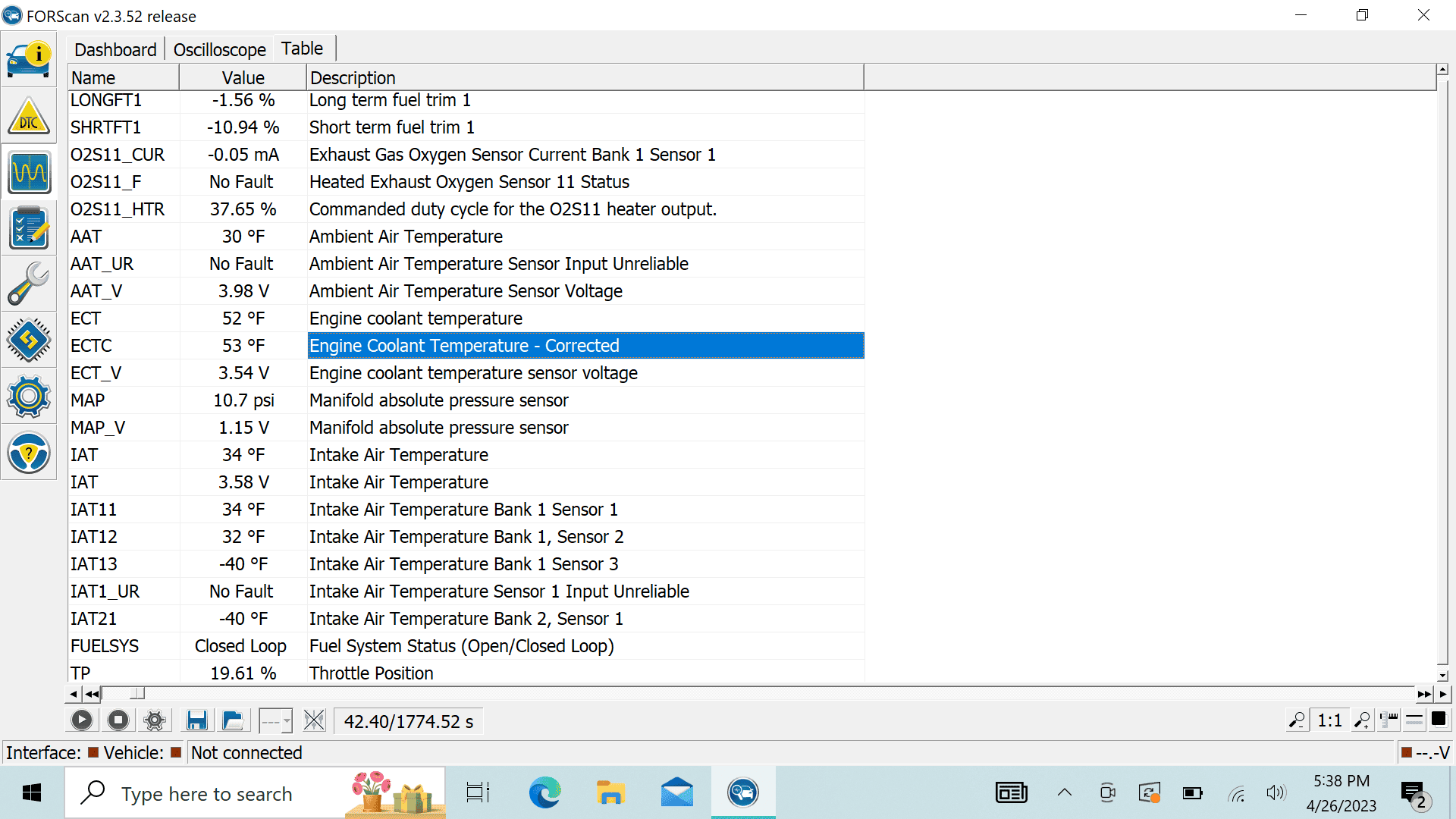
Been noticing a knocking only when the engine is cold under moderate acceleration 2.5k to 3 rpm. And no its not a lower end knock. I'm running 91 non ethanol gas. No codes and I have forscan so I can check some PIDs to see what is going on but don't know every PID I should check. I have checked some but don't have service data to see whats a normal range or substituted values until engine is warm?
I did check fuel trims and temp sensors.

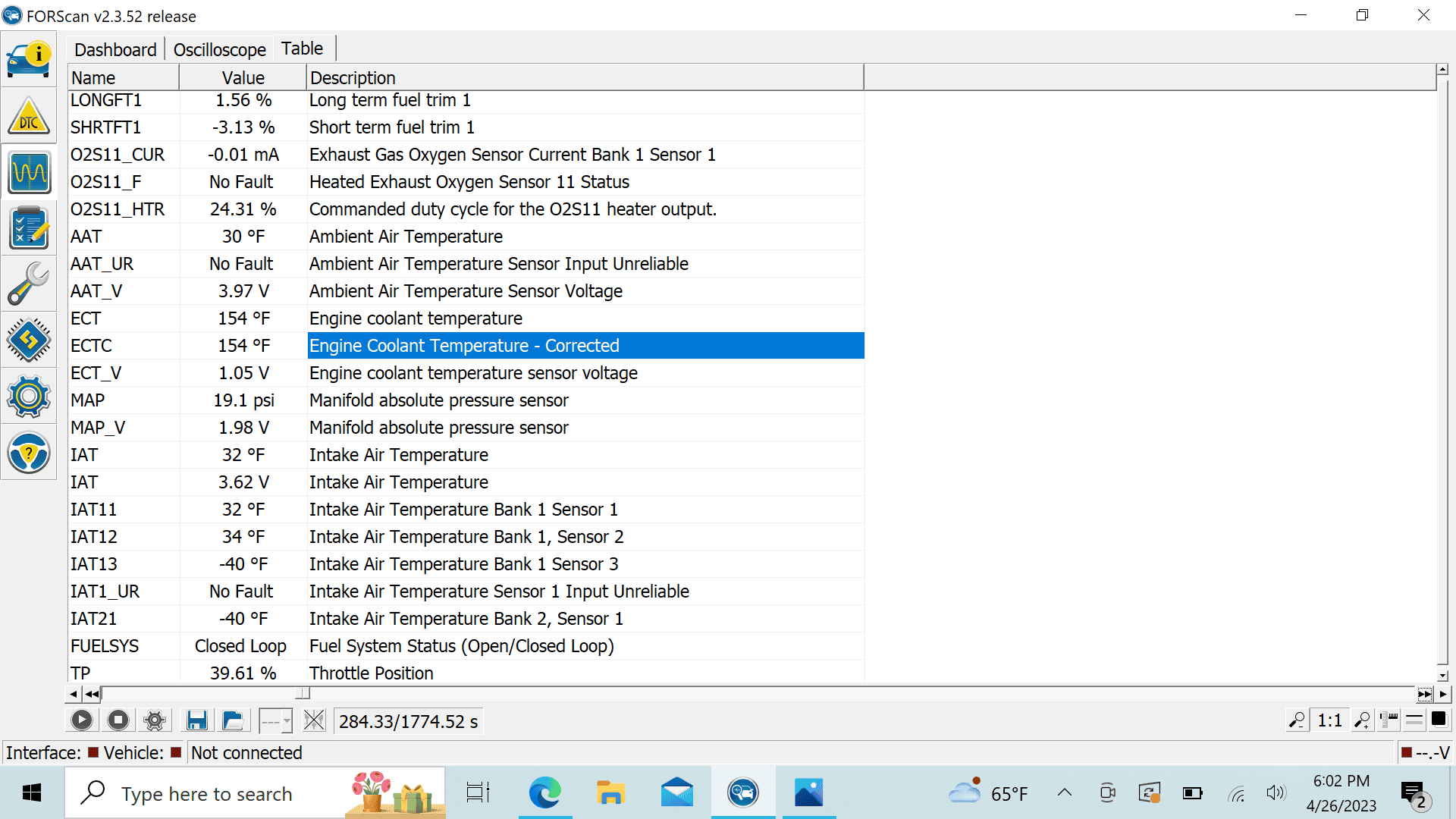
Here are a couple of screen shots one is at 42sec after start. The second one almost 5 min in.

Screenshot (2).png


Screenshot (3).png


The IAT13 and IAT21 I don't think they exist on this engine?

Any of you experience this and did you correct it and how?
See this article and see if it applies.
https://www.brakeandfrontend.com/lspi-low-speed-pre-ignition/
 

airline tech

Well-Known Member
Joined
Aug 24, 2022
Threads
28
Messages
4,448
Reaction score
8,507
Location
Midwest - KS
Vehicle(s)
2022 Ranger Lariat-Super Crew, Cactus Gray
Occupation
Aircraft Tech
since I touched on the subject, let's look at the MAP sensor Specs:
I noticed in one of your first posts that the MAP sensor PID was not reading at specs.

So, monitor these PIDS: when it is (Spark Knocking)
MAP - SPECs - KOEO 14.5 PSI - IDLE 4.93 PSI - 30 MPH 11.46 PSI 55 MPH 13.92 PSI
STFT
LTFT
LOAD - Specs - KOEO (0) - IDLE 27% - 30 MPH -35% - 55 MPH -33%
LOAD ABS

So, the MAP sensor input is only one of the inputs the PCM uses for Load Calculation, and if improper readings from the MAP might create your issue.
It's just shot in the dark here, but it would be a good PID to check.
I will hook up and see if my MAP Sensor and Load Values are different to yours, I cannot find a definitive number for Load Values on what is normal as they tend to vary depending on engine load itself.
 
OP
OP
seasprite

seasprite

Well-Known Member
Joined
Sep 1, 2022
Threads
25
Messages
468
Reaction score
1,111
Location
Missouri
Vehicle(s)
2022 Ranger XL STX
Last edited:
OP
OP
seasprite

seasprite

Well-Known Member
Joined
Sep 1, 2022
Threads
25
Messages
468
Reaction score
1,111
Location
Missouri
Vehicle(s)
2022 Ranger XL STX
since I touched on the subject, let's look at the MAP sensor Specs:
I noticed in one of your first posts that the MAP sensor PID was not reading at specs.

So, monitor these PIDS: when it is (Spark Knocking)
MAP - SPECs - KOEO 14.5 PSI - IDLE 4.93 PSI - 30 MPH 11.46 PSI 55 MPH 13.92 PSI
STFT
LTFT
LOAD - Specs - KOEO (0) - IDLE 27% - 30 MPH -35% - 55 MPH -33%
LOAD ABS

So, the MAP sensor input is only one of the inputs the PCM uses for Load Calculation, and if improper readings from the MAP might create your issue.
It's just shot in the dark here, but it would be a good PID to check.
I will hook up and see if my MAP Sensor and Load Values are different to yours, I cannot find a definitive number for Load Values on what is normal as they tend to vary depending on engine load itself.
We'll give it look and see. A little bit of frustration starting to set in since everything we check seems to be in spec. Trying to think of anything on mechanical side that might cause this, and the only thing that pops in my head is the heat range on the plugs. But if that was the case I think I would experiencing it more when at operating temps. Going to grab a bottle of fuel system cleaner tomorrow and see if cleaning the combustion chambers up some will help. I know you mentioned vacuum leak, but like you said the data doesn't show that as an issue.
 

Rp930

Well-Known Member
First Name
Rick
Joined
Nov 19, 2018
Threads
20
Messages
1,794
Reaction score
3,514
Location
Denver
Vehicle(s)
ā€˜19 Ford Ranger Lariat, ā€˜23 Macan,’21 Shelby GT500
Occupation
Retired
LSPI is pretty severe and more random than what you are describing. It happens more at low rpm high load, also not what you described. Don’t rule out programming to meet emissions that is on the edge. I’ve run Mobil 1 since new no issues.

I don’t think this is your issue but working as a Field Technical Rep on a high end brand I saw an engine with a layer of carbon over the piston that was substantial enough to cause pre detonation. The engineers said it was caused by poor fuel after getting fuel and oil samples. I never heard of or saw another one like it.
Sponsored


Top