Sponsored

P139C Code

RangerBill

Well-Known Member
First Name
Bob
Joined
Jun 8, 2022
Threads
3
Messages
1,867
Reaction score
2,631
Location
PA
Vehicle(s)
2019 Ford Ranger Lariat Super Crew FX4
Occupation
retired
I get the code off and on. While I was doing that previous test, the code light was off. I drove around for 15 minutes and the code came back on. I have to use my laptop with FORScan to monitor the data. I did notice while moving but without my foot on the gas, it was almost always around -0.80 psi.

DPFE_UR showed "no fault" even when the code light was on.

Also, it is running rough and "studdering".

Mark
Replace the DPFE sensor and see if that fixes it.
Sponsored


airline tech

Well-Known Member
Joined
Aug 24, 2022
Threads
28
Messages
4,679
Reaction score
8,972
Location
Midwest - KS
Vehicle(s)
2022 Ranger Lariat-Super Crew, Cactus Gray
Occupation
Aircraft Tech
yes - replace the sensor and then follow up with Live Data again to ensure readings come back to normal range if they do not - then the issue is within the EGR Tube Assembly or electrically (wiring) we can isolate that if the sensor does not bring it back to normal readings but since at KOEO the voltage is very near (new) normal - electrically it appears fine and the issue is withing the (pressure reading) capabilities
 
OP
OP

emesel

Well-Known Member
First Name
Mark
Joined
Mar 8, 2022
Threads
13
Messages
106
Reaction score
92
Location
New England
Vehicle(s)
2019 Ranger
Occupation
Engineer
I hope to receive and replace the sensor tomorrow. But, is there a way to check if the orifice is clear? What about blowing compressed air in high or low pressure port and checking other port for flow?
 

airline tech

Well-Known Member
Joined
Aug 24, 2022
Threads
28
Messages
4,679
Reaction score
8,972
Location
Midwest - KS
Vehicle(s)
2022 Ranger Lariat-Super Crew, Cactus Gray
Occupation
Aircraft Tech
I hope to receive and replace the sensor tomorrow. But, is there a way to check if the orifice is clear? What about blowing compressed air in high or low pressure port and checking other port for flow?
The high pressure side - only as to check the orifice the tube must be removed, the only thing that you can do is disconnect both hoses and then koeo and note did the readings change
 
OP
OP

emesel

Well-Known Member
First Name
Mark
Joined
Mar 8, 2022
Threads
13
Messages
106
Reaction score
92
Location
New England
Vehicle(s)
2019 Ranger
Occupation
Engineer
The high pressure side - only as to check the orifice the tube must be removed, the only thing that you can do is disconnect both hoses and then koeo and note did the readings change
I imagine it would have to be totally blocked for the readings to change when houses removed.


airline tech

Well-Known Member
Joined
Aug 24, 2022
Threads
28
Messages
4,679
Reaction score
8,972
Location
Midwest - KS
Vehicle(s)
2022 Ranger Lariat-Super Crew, Cactus Gray
Occupation
Aircraft Tech
My hunch is - it’s the sensor itself - the problem is that 99% of the members that have changed the sensor for Buck Surge did not have any PID data before they changed it - all of my data for T-Shoot is derived from expected readings from the very few (real failure) readings and my own Live Data (normal) drives , once you understand what is actually happening, you gain the understanding on how to monitor for the no code failures, and it’s all in the (Learned Zero) band and how much positive flow (accuracy) is left.
I will need to run Forscan and see if I can find the same PIDs as in the past it was not available, so this is actually some good news for others to post their PIDs as well - I imagine they are near the same readings as you have - the problem is the Buck / Surge appears before it codes P139C and the reason for that is it’s still in the Learned Zero Band , but when driving the positive flow is now not hitting it’s normal range voltage/ pressure- the PCM reacts by adding more EGR then the Buck Surge is felt although the sensor is still in a (PCM) believes the reading is normal until it pushes outside the band and becomes (untrustworthy) and sets the code - like you have
 
OP
OP

emesel

Well-Known Member
First Name
Mark
Joined
Mar 8, 2022
Threads
13
Messages
106
Reaction score
92
Location
New England
Vehicle(s)
2019 Ranger
Occupation
Engineer
Finally had time to replace the sensor, and all seems good; no bucking and I believe values read normal (see below).

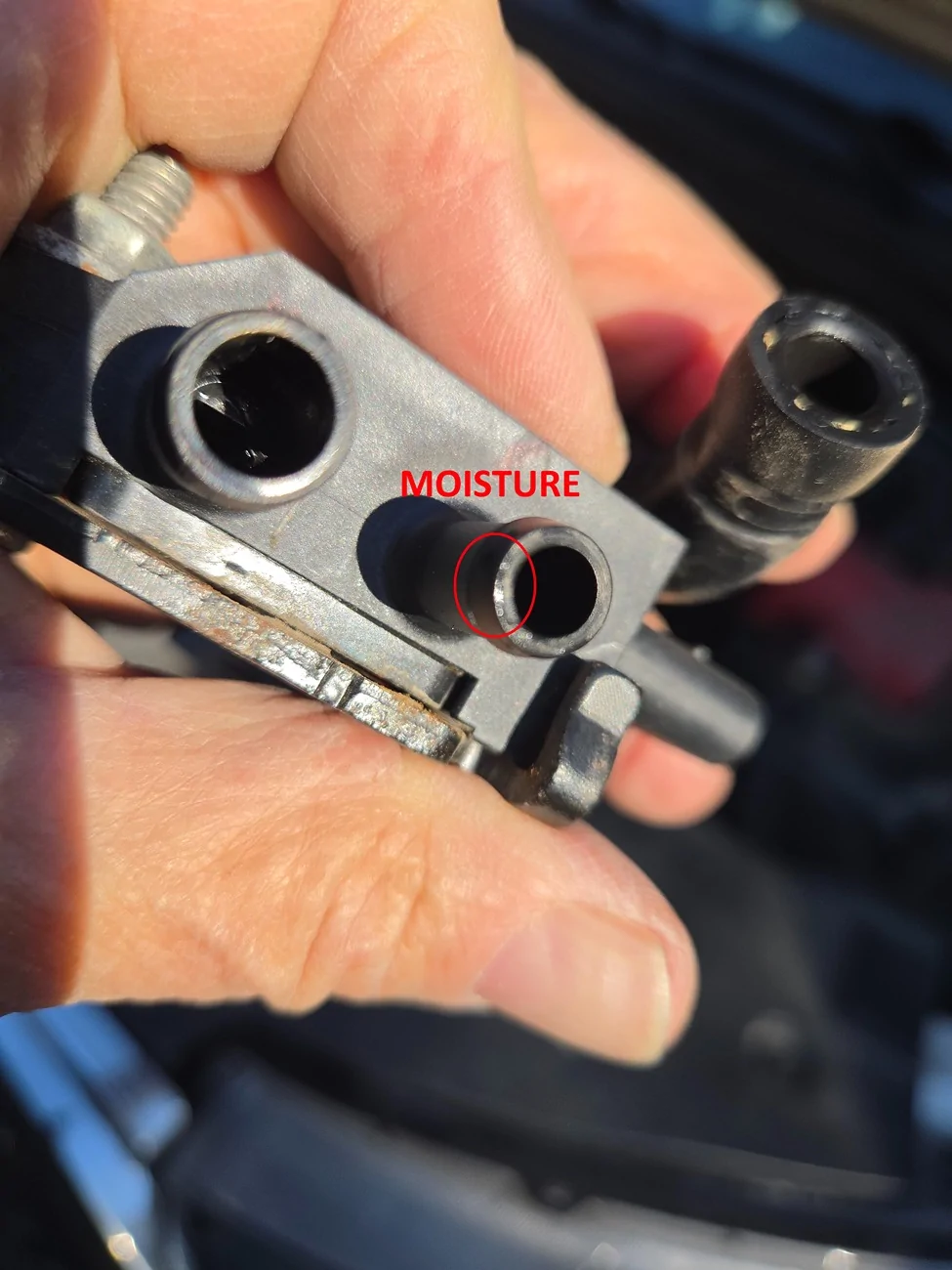
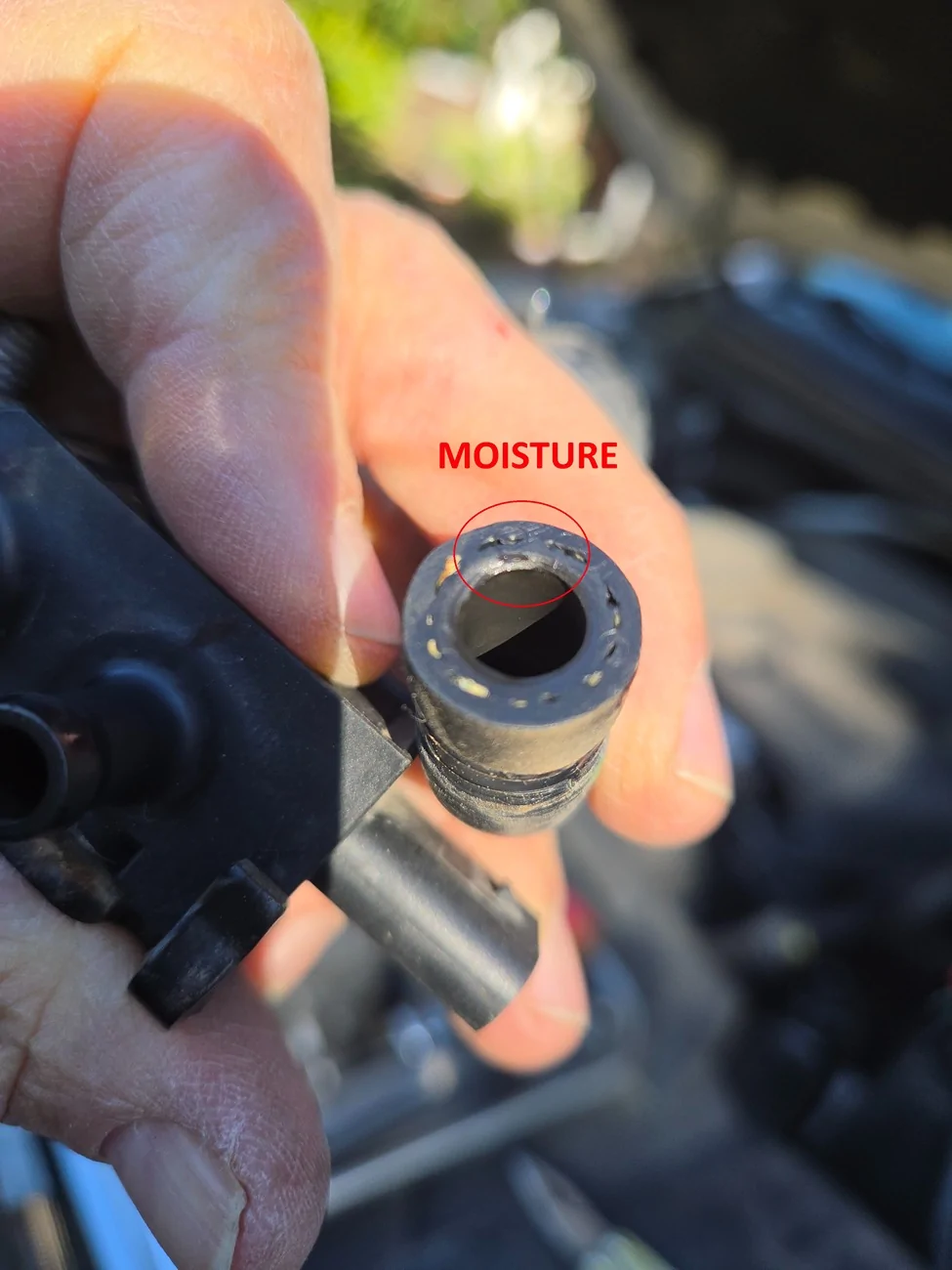
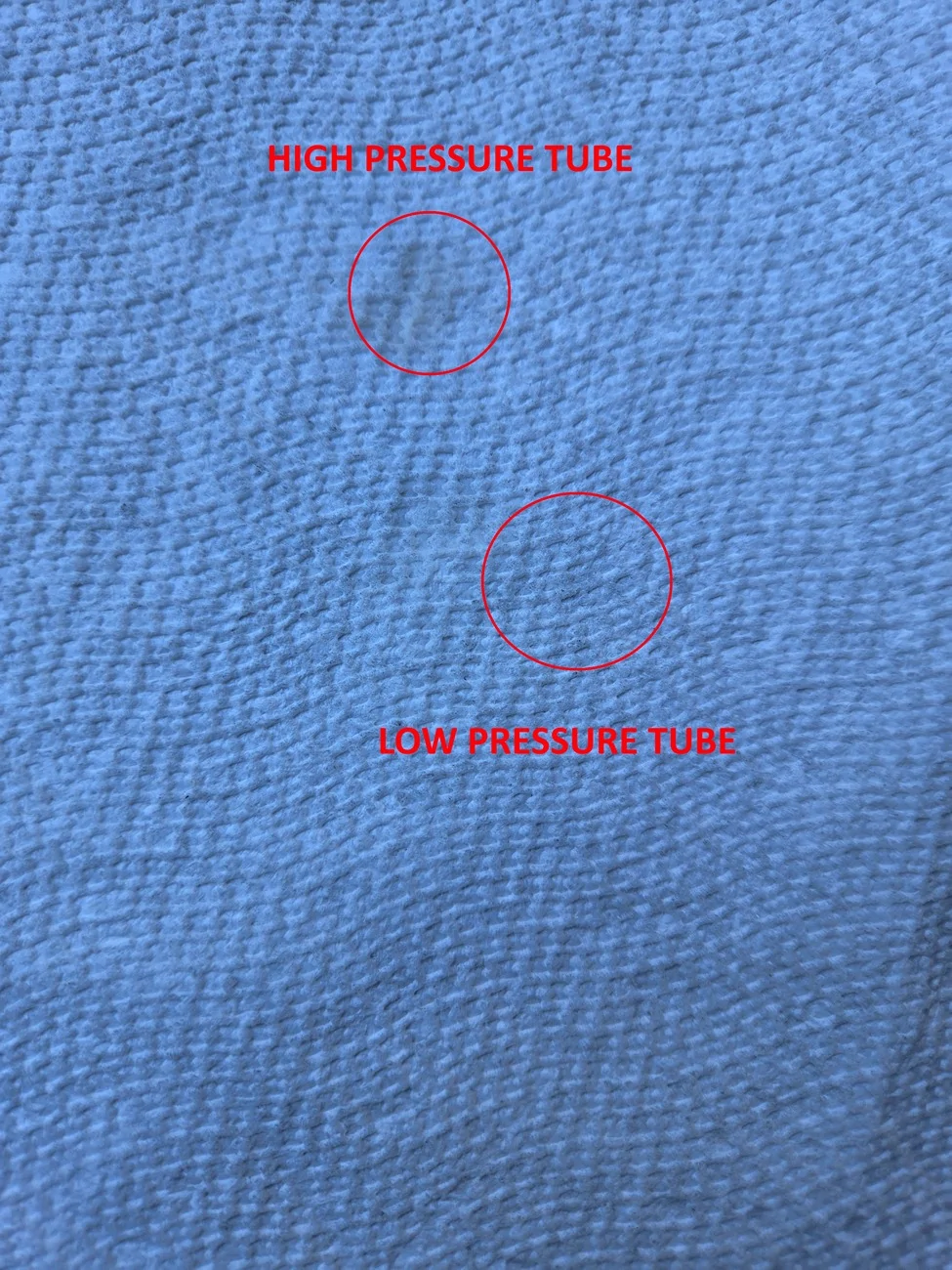
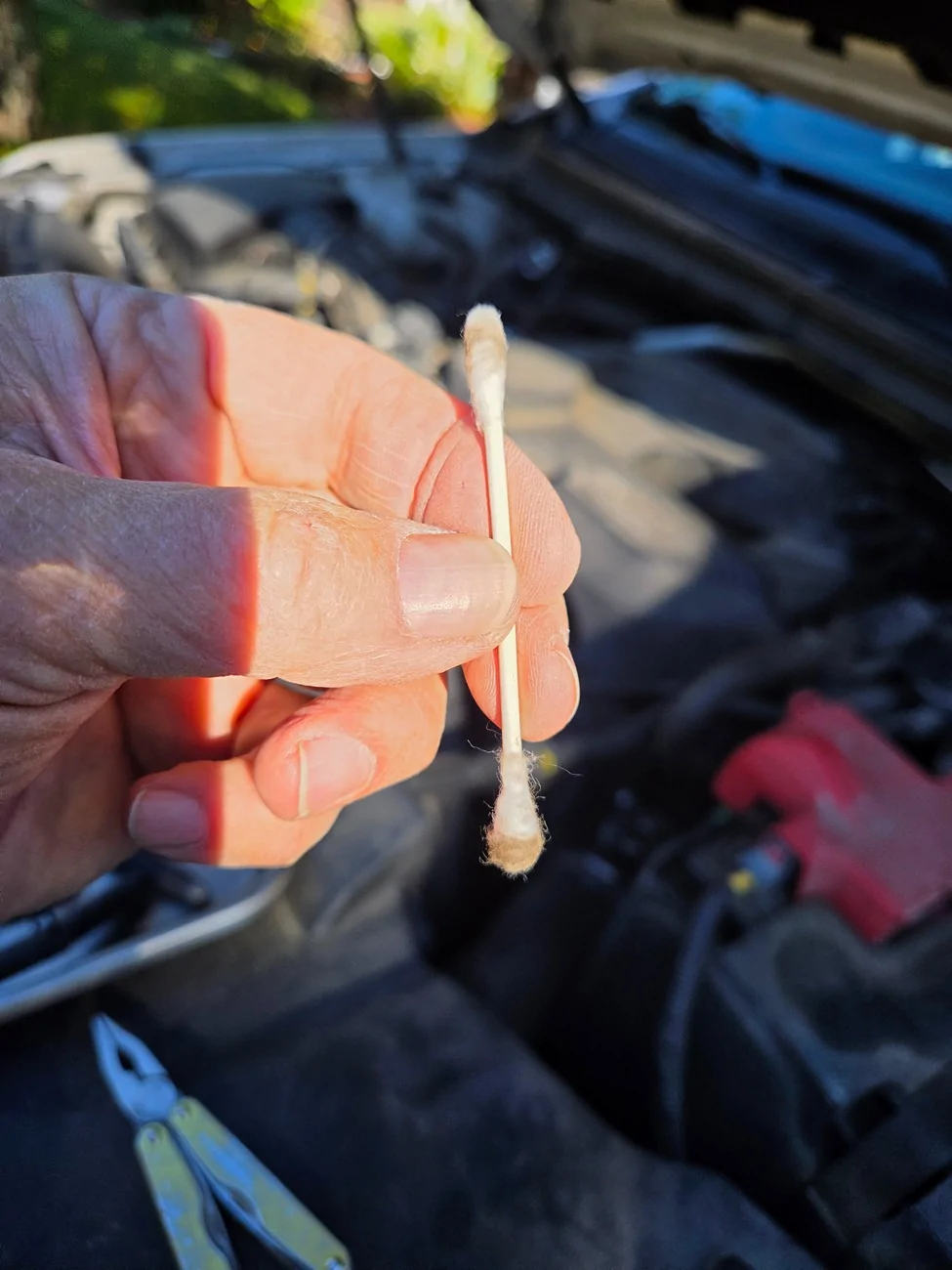
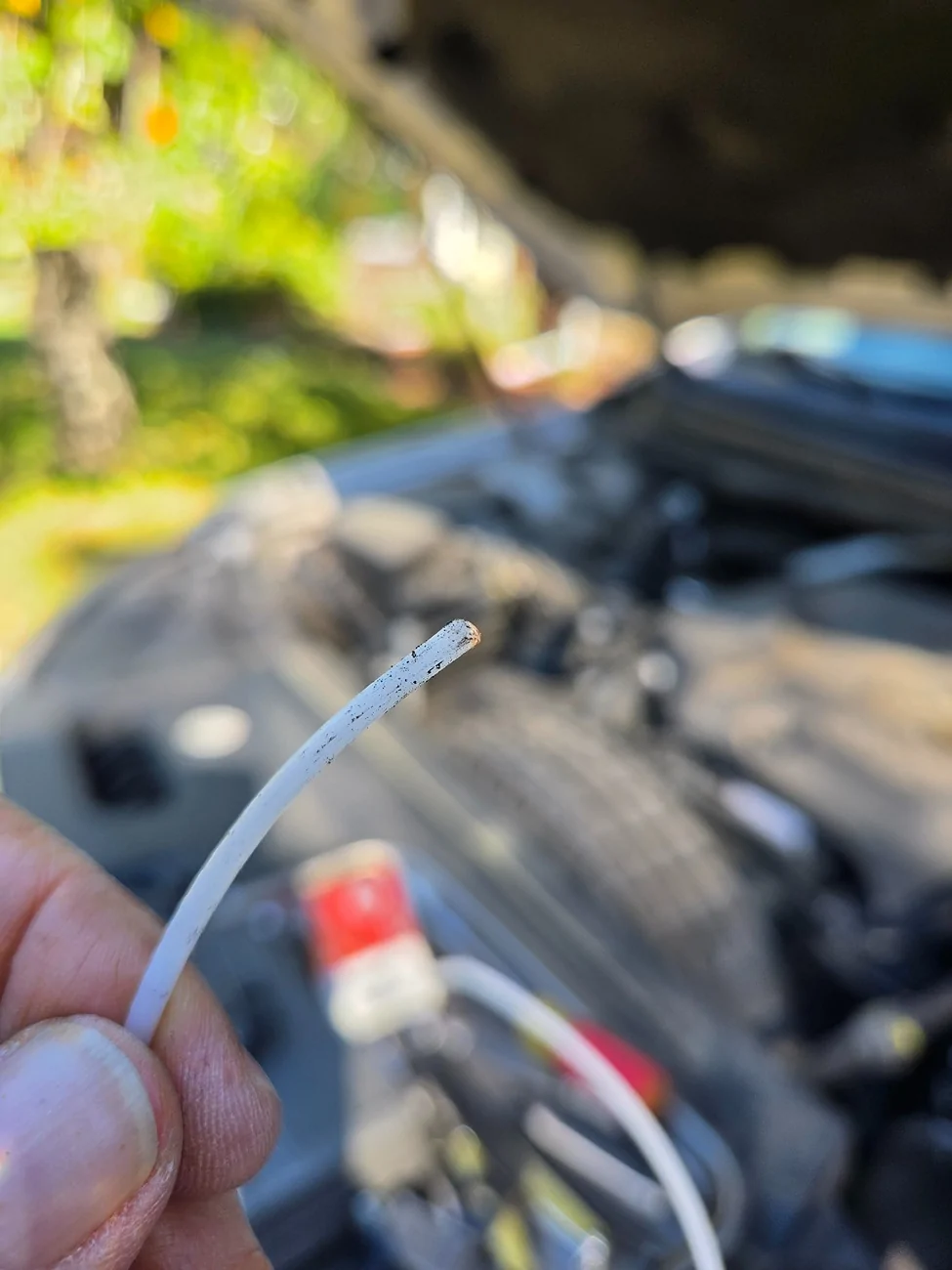
There was definitely some moisture in the high pressure tube and a bit in the low pressure tube. Prior to blowing the tubes out with air, I inserted a cotton swab and it came out damp, not dripping. I blew out the tubes onto a paper towel and, again, it was damp, not dripping. I then blew 30 pis air into the high pressure port. I also ran a short length of nylon trimmer string into both ports, and it came out with just a bit of black soot at the tip. Pics attached (sorry, pics are kind of lousy).

Data is below:

OLD SENSOR KOEO:

Tubes ON: 0.17 psi, 1.53 V

Tubes OFF: 0.12 psi, 1.53 V

NEW SENSOR:

KOEO:

Tubes OFF and ON the same values: -0.02 psi, 1.49 V

KOER:

At Idle Immediately after installation: 0.03 psi, 1.50 V

At Idle After 25 min. Drive: 0.01 psi, 1.50 V

While driving ~65-70 mph:

Delta P was -0.1 to 0.5 psi sometimes as low as -0.2 and up to 1.5 or 2.0

Voltage was 1 – 1.5 V sometimes up to 2 or even 3 briefly

Many thanks to Ranger Bill and Airline Tech for all the help and support. I’m interested in your thoughts on the data above.

BTW, I have the OBDLinkEX scanner and their OBDLink app, which is easier for me to use than FORScan. I purchased their Enhanced Network features which allowed me to monitor the EGR Sensor delta P and voltage while driving (easier than having to look at my laptop on the passenger seat).

Again, many thanks, Mark

sensor ports 9752.webp


moisture on tube 9753.webp


paper towel 9755.webp


cotton swab 9754.webp


soot on trimmer string 9756.webp
 

RangerBill

Well-Known Member
First Name
Bob
Joined
Jun 8, 2022
Threads
3
Messages
1,867
Reaction score
2,631
Location
PA
Vehicle(s)
2019 Ford Ranger Lariat Super Crew FX4
Occupation
retired
Finally had time to replace the sensor, and all seems good; no bucking and I believe values read normal (see below).

There was definitely some moisture in the high pressure tube and a bit in the low pressure tube. Prior to blowing the tubes out with air, I inserted a cotton swab and it came out damp, not dripping. I blew out the tubes onto a paper towel and, again, it was damp, not dripping. I then blew 30 pis air into the high pressure port. I also ran a short length of nylon trimmer string into both ports, and it came out with just a bit of black soot at the tip. Pics attached (sorry, pics are kind of lousy).

Data is below:

OLD SENSOR KOEO:

Tubes ON: 0.17 psi, 1.53 V

Tubes OFF: 0.12 psi, 1.53 V

NEW SENSOR:

KOEO:

Tubes OFF and ON the same values: -0.02 psi, 1.49 V

KOER:

At Idle Immediately after installation: 0.03 psi, 1.50 V

At Idle After 25 min. Drive: 0.01 psi, 1.50 V

While driving ~65-70 mph:

Delta P was -0.1 to 0.5 psi sometimes as low as -0.2 and up to 1.5 or 2.0

Voltage was 1 – 1.5 V sometimes up to 2 or even 3 briefly

Many thanks to Ranger Bill and Airline Tech for all the help and support. I’m interested in your thoughts on the data above.

BTW, I have the OBDLinkEX scanner and their OBDLink app, which is easier for me to use than FORScan. I purchased their Enhanced Network features which allowed me to monitor the EGR Sensor delta P and voltage while driving (easier than having to look at my laptop on the passenger seat).

Again, many thanks, Mark

sensor ports 9752.webp


moisture on tube 9753.webp


paper towel 9755.webp


cotton swab 9754.webp


soot on trimmer string 9756.webp
Looks good, there should be no EGR gasses flowing at idle and your old sensor was telling the PCM that you had flow when there shouldn't be any, thus causing the DTC code.
 
OP
OP

emesel

Well-Known Member
First Name
Mark
Joined
Mar 8, 2022
Threads
13
Messages
106
Reaction score
92
Location
New England
Vehicle(s)
2019 Ranger
Occupation
Engineer
Looks good, there should be no EGR gasses flowing at idle and your old sensor was telling the PCM that you had flow when there shouldn't be any, thus causing the DTC code.
Got it. Thanks again, Mark
 

Racket

Well-Known Member
First Name
John
Joined
Jan 21, 2020
Threads
23
Messages
2,263
Reaction score
3,589
Location
Here and There
Vehicle(s)
2019 Lariat Supercrew 2WD
Occupation
Transient
Seeing which port has moisture here is useful - I may experiment with some el cheapo disposable moisture trapper in line from harbor freight or something to see how much longer I can go between swapping DPFE sensors. It may be more tedious than beneficial but a thought to make me feel better.
 

airline tech

Well-Known Member
Joined
Aug 24, 2022
Threads
28
Messages
4,679
Reaction score
8,972
Location
Midwest - KS
Vehicle(s)
2022 Ranger Lariat-Super Crew, Cactus Gray
Occupation
Aircraft Tech
Seeing which port has moisture here is useful - I may experiment with some el cheapo disposable moisture trapper in line from harbor freight or something to see how much longer I can go between swapping DPFE sensors. It may be more tedious than beneficial but a thought to make me feel better.
It has been brought up and discussed before - Adding a moisture trap (Inline) but my dive into the system gives me the take away that (It will not work)


From my (Detailed Operation) I need to find time for a final draft


Modifications to the EGR Tube & Hoses (Prevent or Lower the Moisture Risk)


It has been discussed all over the web about adding a moisture trap or desiccant filter bowl to the hoses – and many posts stating yes it will work, but has anybody actually installed a working solution – I cannot find one, sure the web leads you to believe it can be done but it lacks the real evidence of a proven working solution.

Here is my thoughts on this, first we need to understand how a (Air Tool) moisture trap works and what is required for the moisture to separate – One key factor (required) and that is – Velocity if we reflect from what we learned from above – At the (Hi-Pressure) reference port we have a high pressure but a low velocity, this takes away the key requirement for the moisture trap function of operation.

Air Tool Style (Moisture Trap)

Air inside the trap is forced to change directions suddenly (spiral or sharp turns) the air can turn easily but the water droplets cannot, so they are flung outward towards the walls of the bowl and gravity fed down into the bottom of the bowl – all from the air movement (Velocity) flowing in one direction and in a constant flow.


The EGR Tube Assembly (Pressures)


  • Bidirectional Pressures (positive and negative)
  • High Pressure / Low Velocity (Avg 3-15psig)
  • Pulsed Exhaust Pressure
  • Condensation, not liquid flow
  • No steady flow direction
The moisture trap only works when there is a continuous flow and that flow is strong enough to move the liquid into the bowl – the DPFE hoses do not produce this requirement. So basically all the moisture trap will do is add volume to the pressure reference and may skew the sensor (bias) however still fall within the (Tolerance Bands)

The trap can provide (One Source) of collection and that is the gravity fed moisture that drains off of the DPFE sensor (Cooling Effect) Ref: DPFE Sensor Factor noted above. The reason this is a gravity feed down when (there) is no flow on the hoses, so the moisture has already reached the sensor and past the intended trap to contain it. The trap also will induce yet another (cold source) for condensation to occur – opposite of what you want to achieve.

Then you need to think about the added volume aspect of the equation, you would most likely need a trap on both hoses to equalize the DPFE (Zero Pressure Ref) in theory the sensor does have the +/- 0.30 Tolerance band, so this may not be an issue and one other item that you would need to address and that is the (Cold Start) frozen trap – this is going to alter the pressure reference and as well when it’s not frozen – where is the (full) bowl going to deliver the now pure moisture content – straight into the sensor you are trying to protect,

Desiccant Bowls

Desiccant requires a steady flow of air moving through the media (beads), the DPFE hoses have no steady flow and any vapor on the beads will saturate them almost immediately – so when they become fully saturated you end up with a dead volume bowl doing absolutely nothing as its intended function (drying) and also adding the same factors of skewing the pressure reference and then the same side effects of the moisture trap (once saturated) you are adding to the moisture problem you are trying to address.

Summary (Key - Take Away)

Because the upstream reference port sees high static pressure but very low velocity, there is no mechanism to move or separate moisture, making an inline moisture trap or desiccant filter ineffective and creates additional issues with the system


These are my thoughts on how a added (Moisture Trap) would function in the EGR System, feel free to experiment and play by trial and error.

1. It has not been proven (exactly) where the liquid moisture that ends up at the sensor (we visually see) (Main Source) - I feel its actually more at the plastic sensor housing being colder than the (EGR Tube) and gravity draining down into the hose

2. If not the sensor housing then its the (EGR Tube) itself (Temperature Variations) on the inside tube walls - EGR Flow (Tube Heats) - EGR Not Flowing (Tube Cools)

3. The flow in the EGR Tube after the EGR Cooler is already lowering the temp of the exhaust gas down to near the dew point
 

airline tech

Well-Known Member
Joined
Aug 24, 2022
Threads
28
Messages
4,679
Reaction score
8,972
Location
Midwest - KS
Vehicle(s)
2022 Ranger Lariat-Super Crew, Cactus Gray
Occupation
Aircraft Tech
Finally had time to replace the sensor, and all seems good; no bucking and I believe values read normal (see below).

There was definitely some moisture in the high pressure tube and a bit in the low pressure tube. Prior to blowing the tubes out with air, I inserted a cotton swab and it came out damp, not dripping. I blew out the tubes onto a paper towel and, again, it was damp, not dripping. I then blew 30 pis air into the high pressure port. I also ran a short length of nylon trimmer string into both ports, and it came out with just a bit of black soot at the tip. Pics attached (sorry, pics are kind of lousy).

Data is below:

OLD SENSOR KOEO:

Tubes ON: 0.17 psi, 1.53 V

Tubes OFF: 0.12 psi, 1.53 V

NEW SENSOR:

KOEO:

Tubes OFF and ON the same values: -0.02 psi, 1.49 V

KOER:

At Idle Immediately after installation: 0.03 psi, 1.50 V

At Idle After 25 min. Drive: 0.01 psi, 1.50 V

While driving ~65-70 mph:

Delta P was -0.1 to 0.5 psi sometimes as low as -0.2 and up to 1.5 or 2.0

Voltage was 1 – 1.5 V sometimes up to 2 or even 3 briefly

Many thanks to Ranger Bill and Airline Tech for all the help and support. I’m interested in your thoughts on the data above.

BTW, I have the OBDLinkEX scanner and their OBDLink app, which is easier for me to use than FORScan. I purchased their Enhanced Network features which allowed me to monitor the EGR Sensor delta P and voltage while driving (easier than having to look at my laptop on the passenger seat).

Again, many thanks, Mark

sensor ports 9752.webp


moisture on tube 9753.webp


paper towel 9755.webp


cotton swab 9754.webp


soot on trimmer string 9756.webp
Readings look much better
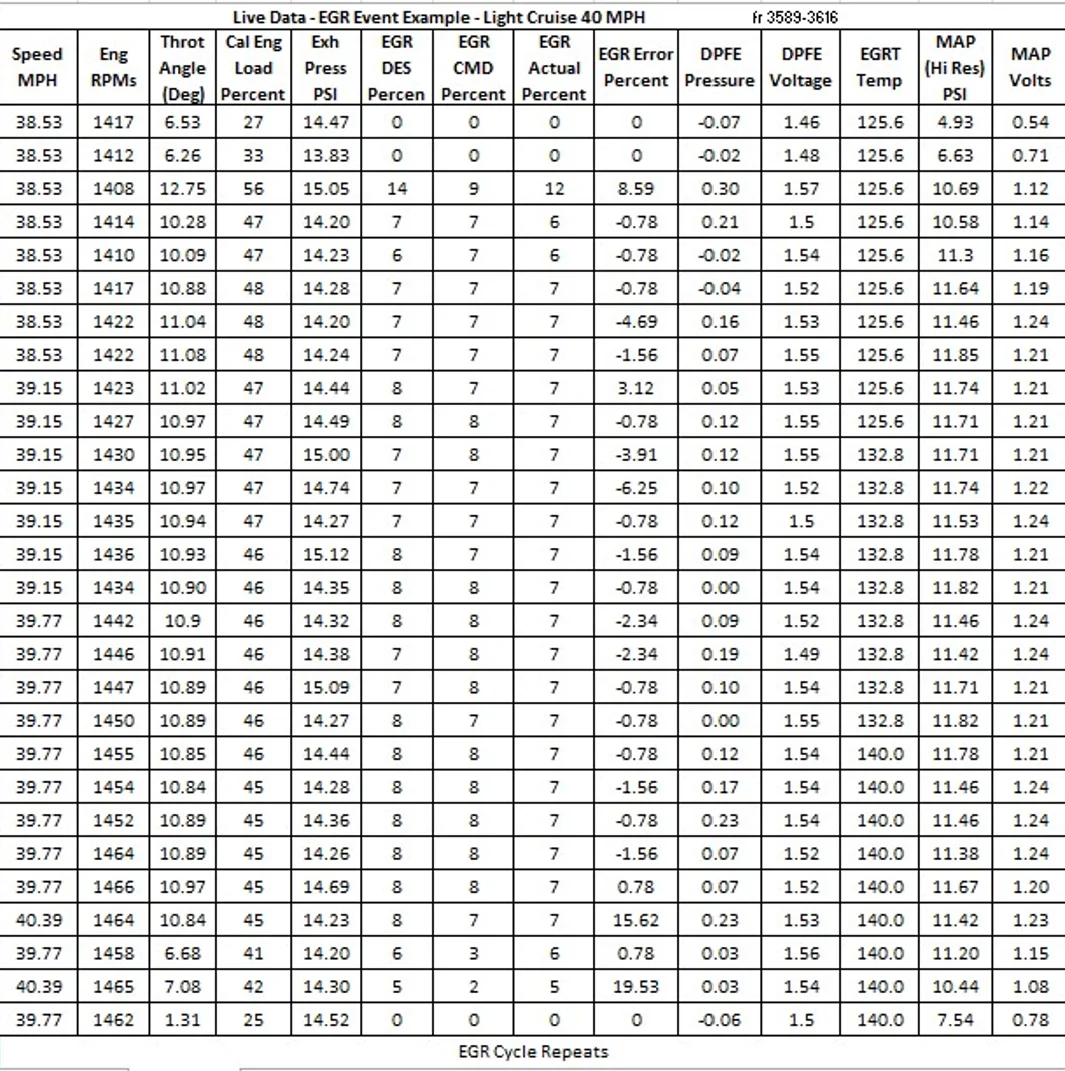
Here is my (Live Data) Drive 40 MPH Chart - showing a single (EGR Event) Closed - Open - Closed
This test drive (speed) is the most noted speed for Buck - Surge and this chart is a good reference for T-Shooting of what is normal

Note - each EGR Cycle is not long (about 30 seconds) or so


Live Data (Drive).webp
 
OP
OP

emesel

Well-Known Member
First Name
Mark
Joined
Mar 8, 2022
Threads
13
Messages
106
Reaction score
92
Location
New England
Vehicle(s)
2019 Ranger
Occupation
Engineer
Seeing which port has moisture here is useful - I may experiment with some el cheapo disposable moisture trapper in line from harbor freight or something to see how much longer I can go between swapping DPFE sensors. It may be more tedious than beneficial but a thought to make me feel better.
Well, I don't know how others are doing, but mine went at 110k ... I might not even be around in another 110k!
Kidding aside, it would be interesting to see how much moisture you can tap. There wasn't that much in mine.
Mark
 
OP
OP

emesel

Well-Known Member
First Name
Mark
Joined
Mar 8, 2022
Threads
13
Messages
106
Reaction score
92
Location
New England
Vehicle(s)
2019 Ranger
Occupation
Engineer
Readings look much better
Here is my (Live Data) Drive 40 MPH Chart - showing a single (EGR Event) Closed - Open - Closed
This test drive (speed) is the most noted speed for Buck - Surge and this chart is a good reference for T-Shooting of what is normal

Note - each EGR Cycle is not long (about 30 seconds) or so


Live Data (Drive).webp
This is interesting. I assume you grabbed this from FORScan. If so, can you explain how that is done?
Mark
 

airline tech

Well-Known Member
Joined
Aug 24, 2022
Threads
28
Messages
4,679
Reaction score
8,972
Location
Midwest - KS
Vehicle(s)
2022 Ranger Lariat-Super Crew, Cactus Gray
Occupation
Aircraft Tech
This is interesting. I assume you grabbed this from FORScan. If so, can you explain how that is done?
Mark
My Snap -On scanner, live data recording of a drive set to record only the PIDs I have listed in the chart, I then created a spreadsheet of my frame by frame video to capture and notate the detailed cycle.
Sponsored


Top