Sponsored

One Piece Driveshaft

D Fresh

Banned
Banned
First Name
Doug
Joined
Dec 10, 2020
Threads
20
Messages
6,272
Reaction score
13,570
Location
Colorado
Vehicle(s)
'20 Lariat FX4, '17 FiST, '16 CX-5, '95 YJ
Occupation
Milkman
I see both sides of the argument, and you at least understand the risks with a one piece, because the risks are there.
Others won't.
They will blindly buy into this shaft as the solution to the problem they may not have properly investigated and won't fully comprehend the other side of the equation.
Are you talking about dropping a front U joint and "vaulting?"


Wan't every RWD vehicle for 60+ years a single piece drive shaft?

I don't recall seeing a lot of safety hoops on those unless they were 11 second street tired track toys.
Sponsored
 

JohnnyO

Well-Known Member
First Name
Jon
Joined
Apr 8, 2021
Threads
23
Messages
1,969
Reaction score
6,143
Location
Pittsburgh, PA
Vehicle(s)
2020 Ranger STX 4x4
Occupation
Asst. Greenskeeper, Bushwood Country Club
Are you talking about dropping a front U joint and "vaulting?"


Wan't every RWD vehicle for 60+ years a single piece drive shaft?

I don't recall seeing a lot of safety hoops on those unless they were 11 second street tired track toys.
Yes but sometimes there was a crossmember that could catch it if it failed but that rarely happened. If it did it would be the U-joint and not the driveshaft itself.
 

Muddy Fenders

Banned
Banned
First Name
Judd
Joined
May 27, 2022
Threads
5
Messages
282
Reaction score
852
Location
Canada
Vehicle(s)
2019 Ranger
Occupation
Retired
That's one of many scenarios that can be covered by my blanket statement.
Vaulting though, is even more rare because that takes a lot of other planets to align. So its a no brainer that you wont see or find a lot of examples of that out there. But it has happened, and would still be considered a risk, albeit a low one.

1666809559920.webp
 

TJC

Well-Known Member
First Name
Tony
Joined
Aug 28, 2020
Threads
45
Messages
3,930
Reaction score
9,851
Location
North Carolina
Vehicle(s)
93 Miata, 05 Ranger 4x4, 20 Ranger 4x4, 23 CX-5
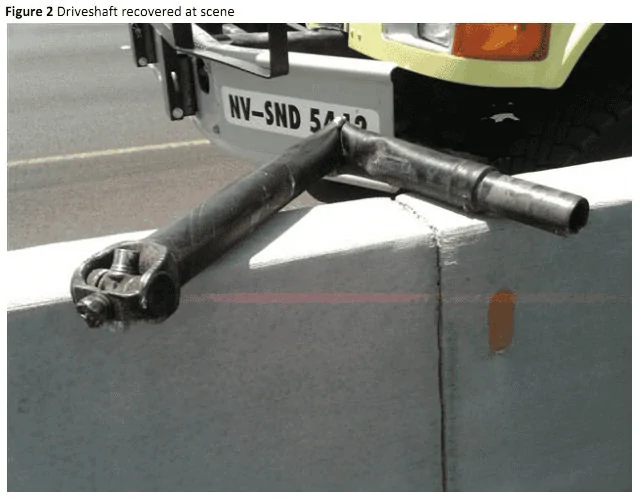
That driveshaft looks to be from a commercial truck. The u-joints are massive.

UPDATE:

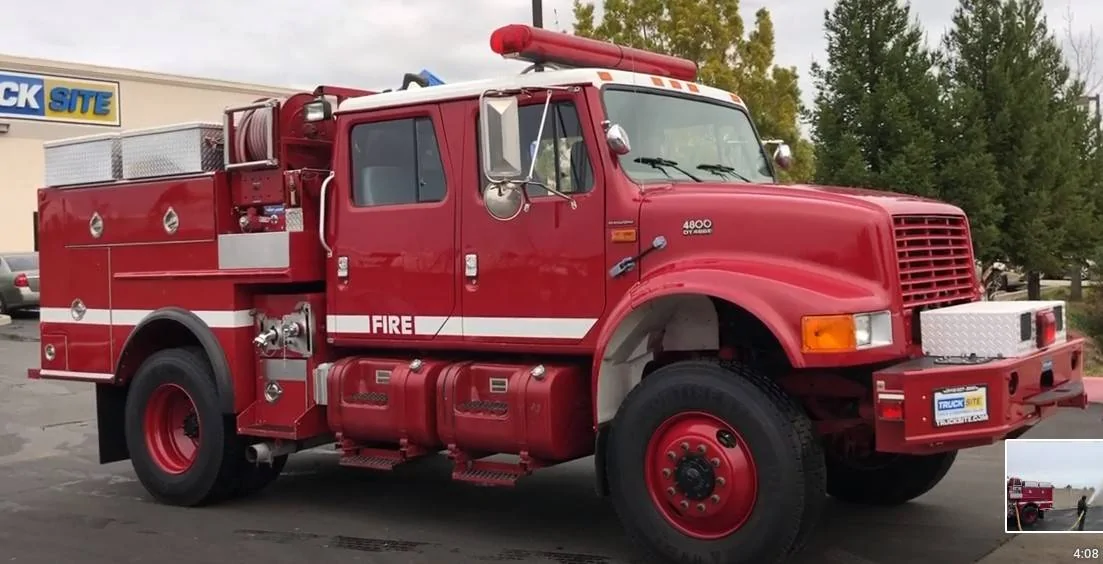
The driveshaft was from a commercial vehicle, a 2002 International 4800 4X4 firetruck similar to this. It was the 2 u-joint cardan joint equipped driveshaft that failed due to cardan joint failure.... from lack of grease - the part was not field serviceable. The issue was a known problem on this truck.

"The McCandless International Truck service manager and his lead technician stated that the centering ball and seat assembly had failed due to lack of grease.
They stated that the multiple cardan joint design on this style of drive shaft will allow for service of the u-joints but not the
centering ball and seat assembly in between the u-joints."


FT1.jpg

The story can be found here
Broken drive shaft on wildland engine scatters parts, damages four nearby vehicles

The official BLM accident report PDF is attached. It has some pretty interesting pictures.

Edited for clarity.
 

Attachments

Last edited:

D Fresh

Banned
Banned
First Name
Doug
Joined
Dec 10, 2020
Threads
20
Messages
6,272
Reaction score
13,570
Location
Colorado
Vehicle(s)
'20 Lariat FX4, '17 FiST, '16 CX-5, '95 YJ
Occupation
Milkman
That's one of many scenarios that can be covered by my blanket statement.
Vaulting though, is even more rare because that takes a lot of other planets to align. So its a no brainer that you wont see or find a lot of examples of that out there. But it has happened, and would still be considered a risk, albeit a low one.

1666809559920.png
Yes, I remember back in the 80's too.

There were mangled driveshafts littering the highways. A damn shame.

You don't think a broken U joint on a 2 piece shaft would result in some road debris too?


Muddy Fenders

Banned
Banned
First Name
Judd
Joined
May 27, 2022
Threads
5
Messages
282
Reaction score
852
Location
Canada
Vehicle(s)
2019 Ranger
Occupation
Retired
Yes, I remember back in the 80's too.

There were mangled driveshafts littering the highways. A damn shame.

You don't think a broken U joint on a 2 piece shaft would result in some road debris too?
Of course it could.
But what caused singles to blow a u joint most of the time? exceeding the speed limitation is my guess.
In our Rangers case though....maybe a wonky center bearing rubber will eventually be the cause of driveshafts failing.


I don't have a vibration issue on mine, but if there's a solution, such as the one the guys talking above that works, I have an option down the road should mine ever start going south.
 

NotBudule

Well-Known Member
Joined
Mar 6, 2022
Threads
43
Messages
2,984
Reaction score
11,852
Location
WV
Vehicle(s)
XLT
Just got home from work ,mostly uphill on the way TO work , mostly downhill on the way home , I think I feel a little something at certain speeds engine braking that I didn't before , maybe ... not sure , maybe need some flex after all , I'm going to split the difference and recheck...
 

D Fresh

Banned
Banned
First Name
Doug
Joined
Dec 10, 2020
Threads
20
Messages
6,272
Reaction score
13,570
Location
Colorado
Vehicle(s)
'20 Lariat FX4, '17 FiST, '16 CX-5, '95 YJ
Occupation
Milkman
Of course it could.
But what caused singles to blow a u joint most of the time? exceeding the speed limitation is my guess.
In our Rangers case though....maybe a wonky center bearing rubber will eventually be the cause of driveshafts failing.


I don't have a vibration issue on mine, but if there's a solution, such as the one the guys talking above that works, I have an option down the road should mine ever start going south.

I mean. That's a little absurd.

What caused them to fail? Generally lack of maintenance. You have to grease your U-joints periodically.

It's not like driveshaft algebra is new. It's been known for quite a while. There are literally hundreds if not thousands of shops nationwide building custom shafts for machines much more powerful than ours on a daily basis. Metelurgy may have changed but it's only made things easier.

If fear of a shop like Tom Wood's "doing the math wrong" is what makes you call this a "safety concern," that's completely unfounded.

But maybe choosing the safety side of the debate is just "you doing you."
 

TJC

Well-Known Member
First Name
Tony
Joined
Aug 28, 2020
Threads
45
Messages
3,930
Reaction score
9,851
Location
North Carolina
Vehicle(s)
93 Miata, 05 Ranger 4x4, 20 Ranger 4x4, 23 CX-5
I see both sides of the argument, and you at least understand the risks with a one piece, because the risks are there.
Others won't.
They will blindly buy into this shaft as the solution to the problem they may not have properly investigated and won't fully comprehend the other side of the equation.
There are many facets to this equation. There are actually more risks of points of failure with the 2 part driveshafts. More moving parts = more points of failure.
  • U-joints will fail on both driveshafts (but you have more points of failure (3 or 4 u-joints (or a constant velocity joint)) on a 2 piece shaft instead of only 2 on a single piece driveshaft
  • Carrier Bearings and Bushings fail on a 2 piece shaft (don't exist on a one piece shaft
  • 2 piece shafts are less efficient and more prone to vibration and excessive wear - you have two driveshafts to balance and insure they stay inline.
  • 2 piece driveshafts are less expensive to make than a quality 1 piece driveshaft. Phil pointed this out way back in this thread with this statement:

    "We had single piece shafts in the Econoline LWB...they were aluminum and 5.5" diameter...not packagable in Ranger... And with the aluminum dedicated the F150... likely there is a cost factor too...."
    Best,
    Phil
- T
 

TJC

Well-Known Member
First Name
Tony
Joined
Aug 28, 2020
Threads
45
Messages
3,930
Reaction score
9,851
Location
North Carolina
Vehicle(s)
93 Miata, 05 Ranger 4x4, 20 Ranger 4x4, 23 CX-5
But what caused singles to blow a u joint most of the time? exceeding the speed limitation is my guess.
Reductio ad absurdum

Sorry, but this is pure conjecture on your part. You have no factual basis to make such a statement.

Using your argument is akin to saying skid marks or stop signs cause accidents! Most accidents occur where there are skid marks and stop signs. Therefore stop signs and skid marks must cause the majority of accidents!

I have seen front wheel drive cars lose wheels - rolling down the road! Was the "short axle vibration" the cause of the bearing seizing up snapping the shaft? In other cases the ball joints gave it up. Must have been "axle shaft vibration" is my guess! NOT!

Please lets keep this discussion in the realm of reality.

No need for "fear porn".

Note that I am not discounting critical speed resonant vibration. Far from it.
- T
 

SigOris

Well-Known Member
First Name
John
Joined
May 18, 2022
Threads
47
Messages
1,242
Reaction score
4,088
Location
Greenwood Maine
Vehicle(s)
MY23 F150 CC Lariat PB & MY25 Mustang GT Convertible 60th #0807
Occupation
Retired DoD EE
Reductio ad absurdum

Sorry, but this is pure conjecture on your part. You have no factual basis to make such a statement.

Using your argument is akin to saying skid marks or stop signs cause accidents! Most accidents occur where there are skid marks and stop signs. Therefore stop signs and skid marks must cause the majority of accidents!

I have seen front wheel drive cars lose wheels - rolling down the road! Was the "short axle vibration" the cause of the bearing seizing up snapping the shaft? In other cases the ball joints gave it up. Must have been "axle shaft vibration" is my guess! NOT!

Please lets keep this discussion in the realm of reality.

No need for "fear porn".

Note that I am not discounting critical speed resonant vibration. Far from it.
- T
The times I’ve had skid marks were from a rear end accident ?
 

TJC

Well-Known Member
First Name
Tony
Joined
Aug 28, 2020
Threads
45
Messages
3,930
Reaction score
9,851
Location
North Carolina
Vehicle(s)
93 Miata, 05 Ranger 4x4, 20 Ranger 4x4, 23 CX-5
And one last data point. My 2005 Ford Ranger is scheduled for its 3rd recall for the same airbag! I no longer believe Ford gets it right the 1st time, or 2nd time... or..... seems to be the same unsafe debris issue.

-T
 

Shawn at Tom Wood's

Well-Known Member
First Name
Shawn
Joined
Sep 13, 2022
Threads
0
Messages
50
Reaction score
312
Location
Ogden, UT
Vehicle(s)
Vespa Scooter
Occupation
Drive shaft guy
I really should just walk away from this conversation at some point but here's some insight as to why shafts fail, as someone who has been a part of the industry for 23 years. Almost always the moving parts fail. When/if a tube fails it us usually because the tube got dented against a rock or something, or because way too much torque and load was applied to the shaft. Think clutch drops and drag racing, dropping a bunch of torque into the shaft all the sudden which causes shock loading or dramatic spikes in load. That and tube being low quality. Tube failures are rare though. Joint failures are by far the most common failure we see in shafts. Often, if something other than the joint does fail it is secondary to the joint failing and if the joint breaks/fails it is often secondary to the joint being worn. I even have a page all about this and a video that explains some of this https://4xshaft.com/blogs/faq/why-do-i-keep-wearing-out-and-or-breaking-u-joints.

When we're talking about a critical speed failure on a shaft, we are talking about the tube flexing under its own centrifugal force to the point of failure. This is in large part due to the fact that centrifugal forces of an imbalance increase quadratically, meaning the force increases 4X every time speed increases 2X. Think exponentially but not exactly. This means that when you get into those screaming fast speeds the forces of any imbalance or imperfections in the tube increase very dramatically. I plotted this on a graph, found about 6 minutes into the video on this page https://4xshaft.com/blogs/faq/diagnosing-drive-shaft-vibrations?_pos=1&_sid=d6ec76a03&_ss=r. The values are based on a 1 ounce imbalance on a 3" radius. I actually meant to use 3" diameter (1.5" radius) but the curve is the curve, regardless of the values. I can't remember if the force is in foot pounds or newtons either, but again, the curve is the curve. The curve, and the concept, demonstrates that yes if you spin things fast enough you can generate some real destructive forces. This depends on a ton of variables, as has been previously discussed though. What is important to remember is that speed alone does not create centrifugal force, speed X mass does. Speed multiplies force, force created by eccentric mass. If the mass is not eccentric there is no centrifugal force. So how straight, true, and balanced a rotating object is in the first place is the biggest contributing factor to how much potentially destructive force it can create at high speeds.

Almost always though, if there is a failure of a drive shaft, it is a result of a moving part wearing out. Wear takes the #1 spot on the podium, clear winner. #2, silver, goes to too much power + too much resistance. This causes parts to stress to the point of failure. In layman's terms you break a joint or twist a tube or break a yoke because it is not strong enough to handle the pure brute force you're putting on it. #3 is critical speed. But critical speed is so far behind the other two types of failures mentioned that it's not even deserving of being on the podium. Participation medal at best. Critical speed failures are what happen in drag cars when they go 150mph. Some quick google research tells me that a typical tire diameter and ring & pinion ratio for a drag car is 28.8" diameter tires and 4.56 gears. At 150 mph the shaft RPMs are 7,950. Factor in the fact that the shaft gets stressed and fatigued due to the enormously high stresses was subjected to getting up to 150mph or on the previous lap(s) and you have a recipe for eventual failure. Even then, it's not like every time someone runs a fast quarter mile they pole vault the finish line. I've mentioned it before but a Ford Ranger is not a drag car. If anyone thinks their truck is, please don't buy our drive shaft. Also, if you plan on driving 100+ on the interstate, please don't buy our drive shaft and please relinquish your drivers license to the nearest Highway Patrol Officer. If you are just driving like a regular person though, you'll be fine.
 
Last edited:

Muddy Fenders

Banned
Banned
First Name
Judd
Joined
May 27, 2022
Threads
5
Messages
282
Reaction score
852
Location
Canada
Vehicle(s)
2019 Ranger
Occupation
Retired
I mean. That's a little absurd.

What caused them to fail? Generally lack of maintenance. You have to grease your U-joints periodically.

It's not like driveshaft algebra is new. It's been known for quite a while. There are literally hundreds if not thousands of shops nationwide building custom shafts for machines much more powerful than ours on a daily basis. Metelurgy may have changed but it's only made things easier.

If fear of a shop like Tom Wood's "doing the math wrong" is what makes you call this a "safety concern," that's completely unfounded.

But maybe choosing the safety side of the debate is just "you doing you."
I was going to mention maintenance, but thought it wasn't a big enough concern. After all, every home mechanic on here is amazing by their own accord so it shouldn't be failing because they failed to grease a fitting.


Top