
Sponsored

Fan speed turning down on its own

Grandaccess

Well-Known Member
First Name
Robert
Joined
Jul 8, 2023
Threads
6
Messages
1,147
Reaction score
2,628
Location
Binghamton, N.Y
Vehicle(s)
2021 Ford Ranger XLT FX4
Occupation
Computer Consultant
Mine does this too, so does the wife’s ranger, and my f550 work truck. From what I’ve read, the truck turns the fan down when you’re on the phone to reduce background noise. If you turn the fan speed back up once you answer the phone it should turn up.
Yes it goes back up manually, but I would think it would do it once I hang up automatically?
Sponsored

 
OP
OP
GreyAreaRanger

GreyAreaRanger

Well-Known Member
Joined
Jul 25, 2023
Threads
11
Messages
272
Reaction score
440
Location
Houston
Vehicle(s)
2019 Ford Ranger XLT
Occupation
Surgical Nurse
Is it kicking out of max on time out? I know when I had my escape it kept kicking off recirc so I checked into it and it had a timer programmed in to kick it off and let fresh air in so people don't pass out for lack of oxygen in the passenger compartment. Just something you can look into in the owners manual.
I’m not sure. I have manual controls, no auto anything. Today it did it once at a stop light when stopped. I didn’t see any loose connections Saturday when I went looking.
 

airline tech

Well-Known Member
Joined
Aug 24, 2022
Threads
28
Messages
4,571
Reaction score
8,718
Location
Midwest - KS
Vehicle(s)
2022 Ranger Lariat-Super Crew, Cactus Gray
Occupation
Aircraft Tech
Keep in mind that even the manual - climate system is still partially (Automatic) controlled by the FCIM.
Being that it appears that this thread has 2 scenarios- during and after calls - it’s normal operation to lower the fan speed , however it should resume the speed - after the call ends , if not then Sync is not releasing the handshake of the call - and still sees it as a active call.

If this is happening at a stoplight etc - then either ASS is triggering the drop or the FCIM is seeing a voltage drop , weak battery or low SOC and it’s lowering the fan speed to save battery (voltage) - so the question is what is the SOC and Battery Voltage- at the time of the event?
This will help isolate- battery voltage / charge issues vs actual blower module power issues
If bumps are triggering the fan speed to change- then there is a bad connection somewhere- creating a high resistance, this high resistance is what is causing the fan speed to drop at stops, you need to also note that the factory set SOC target will cause at idle charging to run strictly off battery and maintain about 12.2 volts, factor in a high resistance in the blower circuit and you may end up with say 10 volts on the blower- it cannot run full speed with that voltage
 

Motorpsychology

Well-Known Member
First Name
Chris
Joined
Nov 13, 2019
Threads
21
Messages
3,341
Reaction score
11,726
Location
Prescott, WI
Vehicle(s)
2021 Ranger STX SuperCab 4X4 Carbonized grey; 2025 Mazda CX-90 Platinum Quartz
Occupation
Vagabond
For the speed control issue, a remote possibility is that the brake switch is being tapped just slightly enough to disengage it, or maybe there's corrosion on or in the switch, where a slight bump will make internal contact in the switch and cut the cruise.

Maybe you could have someone follow you as you drive over this section with the cruise on and notice if the brake lights flicker
 

airline tech

Well-Known Member
Joined
Aug 24, 2022
Threads
28
Messages
4,571
Reaction score
8,718
Location
Midwest - KS
Vehicle(s)
2022 Ranger Lariat-Super Crew, Cactus Gray
Occupation
Aircraft Tech
I have checked the diagrams for any obvious standouts for a tie in to both that would ONLY affect these 2 functions - nothing stands out (YET) - so unless there are other symptoms - (anything) that flickers or noted inop - I do expect its pushing out a code that may help pinpoint it down and its most likely a Lost (Com) type code.

Plus - if you have the ability to - Live Data Monitor - all the modules have a - Module Supply Voltage or Similar PID - these can be monitored to see if the voltage is actually dropping - this would be beneficial data if you are using a plug in volt meter in the power point and it maintains above 12.2 volts at idle.
If we only focus on the - Blower Motor (Issue)
Then we have - Always Hot (Relay) - so main battery feed to the BJB and related cables and then the control side via the FCIM


OP
OP
GreyAreaRanger

GreyAreaRanger

Well-Known Member
Joined
Jul 25, 2023
Threads
11
Messages
272
Reaction score
440
Location
Houston
Vehicle(s)
2019 Ford Ranger XLT
Occupation
Surgical Nurse
Sorry for being absent of late, I had a hernia repair surgery last Tuesday and haven’t really been driving much since.

I’ve been paying attention to fan speed changes and it definitely only happens when I spin it to max ac because it’s 100+ degrees here. When it does reduce the fan speed, it reduces it to where it was prior to the max ac setting. Would it still turn it off automatically even though I have no auto controls on this thing? If that’s the case, I want to be placed in a room with the f****** m**** engineer dropout who decided that was a good idea and make sure that the only thing they’re allowed to design are waste disposal bags I bring with me when I take the dogs out for a walk as that is clearly all they can safely design.

I am so over all the stupid things the so called engineers ford hires think is the best way to do something and the overall cheapness of the build quality despite the expensive replacement parts. Rant over.
 

Superspirit

Well-Known Member
First Name
Joe
Joined
Jun 18, 2022
Threads
12
Messages
920
Reaction score
1,874
Location
earth
Vehicle(s)
22 ranger
I have to ask, is it actually turning the blower speed down or opening the recirculation door changing the sound and making you think the blower changed. The logic used to open the recirculation door is there to let fresh air in so Ford doesn't get sued when the occupants run out of oxygen and crash because of it. I do not care for this safety feature as my vehicle only has 1 or 2 passengers and we don't come close to consuming all the oxygen in the passenger compartment. But that is the logic behind it.
 
OP
OP
GreyAreaRanger

GreyAreaRanger

Well-Known Member
Joined
Jul 25, 2023
Threads
11
Messages
272
Reaction score
440
Location
Houston
Vehicle(s)
2019 Ford Ranger XLT
Occupation
Surgical Nurse
I have to ask, is it actually turning the blower speed down or opening the recirculation door changing the sound and making you think the blower changed. The logic used to open the recirculation door is there to let fresh air in so Ford doesn't get sued when the occupants run out of oxygen and crash because of it. I do not care for this safety feature as my vehicle only has 1 or 2 passengers and we don't come close to consuming all the oxygen in the passenger compartment. But that is the logic behind it.
Blower speed is turning down. The recirc turning off I’ve only seen happen in the winter time and is another annoyance I have against ford as vehicles have had continuous recirculating air on for decades without issue for them to make this stuff up now.
 

airline tech

Well-Known Member
Joined
Aug 24, 2022
Threads
28
Messages
4,571
Reaction score
8,718
Location
Midwest - KS
Vehicle(s)
2022 Ranger Lariat-Super Crew, Cactus Gray
Occupation
Aircraft Tech
From the manual - this is the operation of Max AC - even with manual controls


MAX A/C

When MAX A/C is selected:

  • the air inlet door closes, preventing outside air and allowing only recirculated air.
  • the recirculated air indicator is illuminated (recirculated air forced on).
  • the air distribution doors operate simultaneously to direct airflow to the instrument panel registers.
  • the temperature door moves to the full cool position. The air temperature is adjustable.
  • the A/C button is illuminated.
  • the A/C compressor operates if the outside temperature is above approximately 32.0°F (°C).
  • the blower motor is commanded to the highest speed, but can be manually adjusted if desired.

Air Inlet Door (Operation)


The FCIM adjusts the air inlet door depending on the humidity measured by the in-vehicle temperature and humidity sensor. If the vehicle cabin becomes too humid and recirculated air is selected, the FCIM adjusts the air inlet door to allow more fresh air. When the humidity level drops, it adjusts back to partial recirculated air. The FCIM also adjusts the system based on in-vehicle temperature. The in-vehicle temperature portion of the in-vehicle temperature and humidity sensor supplies information to the FCIM indicating the in car temperature. The FCIM adjusts the system based on the in car temperature.


In-Vehicle Temperature And Humidity Sensor

The in-vehicle temperature and humidity sensor contains a thermistor and a sensing element which separately measures the in-vehicle air temperature and the humidity, then sends those readings to the FCIM . The in-vehicle temperature and humidity sensor has an electric fan within the sensor that draws in-vehicle air across the two sensing elements. The FCIM may adjust the air inlet door based on the in-vehicle temperature and humidity sensor information to maintain the desired humidity of the passenger cabin air.


Now, nowhere I can find that the (Air Inlet- Temp Humidity) control side can override the (Max AC) request and open the air inlet door - thus tripping off the max ac request.

Side Note - When you select the (Recirculation) button - the system has a 5-Minute timer and will open the door - this is the safety feature (mentioned above)

With the symptoms of - Hitting bumps and max ac - affecting the blower speed , I am thinking that there is a bad connection somewhere.
So either the control side is glitching and not fully engaging (max ac) or the blower motor itself cannot produce (max speed) and the limitation is being picked up (internally) by the FCIM and its control logic

I think that if you were to get a high end scan tool on it and view the PIDs in the FCIM module may reveal - what is happening behind the scenes - switch positions, current modes and actuator positions and the sensor readings.

So, I am curious -
1. What is the (air inlet door) doing - when Max AC is selected?
2. When you manually control the blower speed and go to max setting, will it stay and hold that speed?
3. While at max speed , palm bump the blower motor and the FCIM panel -and note does it reduce speed and also slightly shake the blower motor - connector

We have the following that may be affecting this

1. Actual battery - Voltage and SOC Reading - may be limiting the high fan speed
2. Bad connection at the BJB C1035A - Blower Module (Power) from the relay (high resistance)
3. Bad ground - Connection at the Blower Module (high resistance)

1. Bad connection - FCIM connector - (PWM) control wire feeding the Blower Module
Note: This is where the FCIM control logic adjusts the blower speed and it varies the ground applied (timing) for the blower motor - so at MAX AC - the ground should be applied (constant)

The FCIM controls blower speed by commanding a PWM duty cycle; the blower motor control module uses that command to vary the amount of time the blower motor is connected to ground.

I would get a meter and check

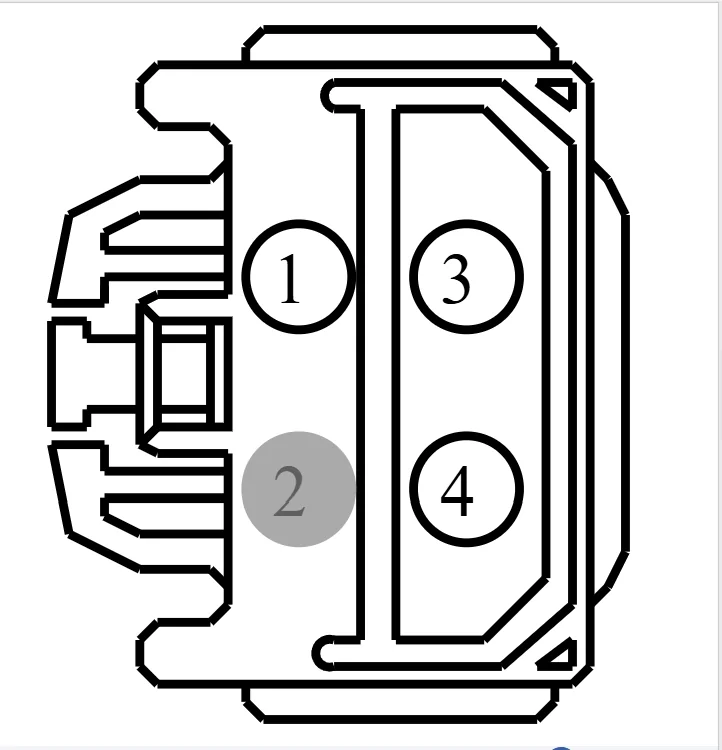
C297 - Blower Module Connector

Pin 2 - Relay Power (In)
Pin 3 - PWM (FCIM Variable Control)
Pin 4 - Module Ground

Engine Running - AC (On)
Measure Battery Voltage (at the battery)
Measure (Pin 2 to Pin 4) and (Pin 2 to a good body ground)
Should closely match battery voltage
Cycle through fan speeds - the voltage should remain constant


Now move to the control side

Measure Pin3 to Pin 4 and Pin 3 to a good body ground
I cannot find a Ford spec on the readings here, so we will need to get a basis reading,
cycle through fan speeds and note readings at each level , the most important is the (High) and then select (Max Ac) - does the Max Ac match the reading you had on the manual adjusted (High)

The Ford (PIDs) list the blower speed in (steps) - so the voltage readings from pin 3, are referencing the (step) PID.

This may help isolate - is it a blower power / ground issue vs a FCIM controlled step down issue

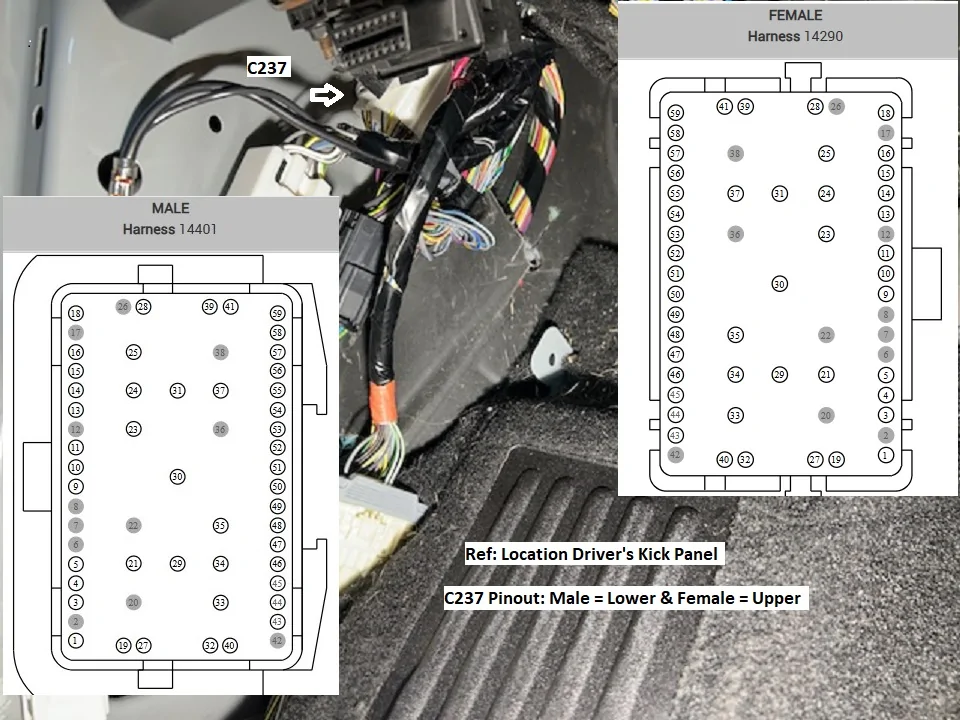
The only connectors (accessible) without pulling the FCIM out - are the blower module and this inline connector C237

C297 - Blower Module Connector

1787496770236-fw.webp


C237

C237 Detailed.webp
 

Motorpsychology

Well-Known Member
First Name
Chris
Joined
Nov 13, 2019
Threads
21
Messages
3,341
Reaction score
11,726
Location
Prescott, WI
Vehicle(s)
2021 Ranger STX SuperCab 4X4 Carbonized grey; 2025 Mazda CX-90 Platinum Quartz
Occupation
Vagabond
From the manual - this is the operation of Max AC - even with manual controls


MAX A/C

When MAX A/C is selected:

  • the air inlet door closes, preventing outside air and allowing only recirculated air.
  • the recirculated air indicator is illuminated (recirculated air forced on).
  • the air distribution doors operate simultaneously to direct airflow to the instrument panel registers.
  • the temperature door moves to the full cool position. The air temperature is adjustable.
  • the A/C button is illuminated.
  • the A/C compressor operates if the outside temperature is above approximately 32.0°F (°C).
  • the blower motor is commanded to the highest speed, but can be manually adjusted if desired.

Air Inlet Door (Operation)


The FCIM adjusts the air inlet door depending on the humidity measured by the in-vehicle temperature and humidity sensor. If the vehicle cabin becomes too humid and recirculated air is selected, the FCIM adjusts the air inlet door to allow more fresh air. When the humidity level drops, it adjusts back to partial recirculated air. The FCIM also adjusts the system based on in-vehicle temperature. The in-vehicle temperature portion of the in-vehicle temperature and humidity sensor supplies information to the FCIM indicating the in car temperature. The FCIM adjusts the system based on the in car temperature.


In-Vehicle Temperature And Humidity Sensor

The in-vehicle temperature and humidity sensor contains a thermistor and a sensing element which separately measures the in-vehicle air temperature and the humidity, then sends those readings to the FCIM . The in-vehicle temperature and humidity sensor has an electric fan within the sensor that draws in-vehicle air across the two sensing elements. The FCIM may adjust the air inlet door based on the in-vehicle temperature and humidity sensor information to maintain the desired humidity of the passenger cabin air.


Now, nowhere I can find that the (Air Inlet- Temp Humidity) control side can override the (Max AC) request and open the air inlet door - thus tripping off the max ac request.

Side Note - When you select the (Recirculation) button - the system has a 5-Minute timer and will open the door - this is the safety feature (mentioned above)

With the symptoms of - Hitting bumps and max ac - affecting the blower speed , I am thinking that there is a bad connection somewhere.
So either the control side is glitching and not fully engaging (max ac) or the blower motor itself cannot produce (max speed) and the limitation is being picked up (internally) by the FCIM and its control logic

I think that if you were to get a high end scan tool on it and view the PIDs in the FCIM module may reveal - what is happening behind the scenes - switch positions, current modes and actuator positions and the sensor readings.

So, I am curious -
1. What is the (air inlet door) doing - when Max AC is selected?
2. When you manually control the blower speed and go to max setting, will it stay and hold that speed?
3. While at max speed , palm bump the blower motor and the FCIM panel -and note does it reduce speed and also slightly shake the blower motor - connector

We have the following that may be affecting this

1. Actual battery - Voltage and SOC Reading - may be limiting the high fan speed
2. Bad connection at the BJB C1035A - Blower Module (Power) from the relay (high resistance)
3. Bad ground - Connection at the Blower Module (high resistance)

1. Bad connection - FCIM connector - (PWM) control wire feeding the Blower Module
Note: This is where the FCIM control logic adjusts the blower speed and it varies the ground applied (timing) for the blower motor - so at MAX AC - the ground should be applied (constant)

The FCIM controls blower speed by commanding a PWM duty cycle; the blower motor control module uses that command to vary the amount of time the blower motor is connected to ground.

I would get a meter and check

C297 - Blower Module Connector

Pin 2 - Relay Power (In)
Pin 3 - PWM (FCIM Variable Control)
Pin 4 - Module Ground

Engine Running - AC (On)
Measure Battery Voltage (at the battery)
Measure (Pin 2 to Pin 4) and (Pin 2 to a good body ground)
Should closely match battery voltage
Cycle through fan speeds - the voltage should remain constant


Now move to the control side

Measure Pin3 to Pin 4 and Pin 3 to a good body ground
I cannot find a Ford spec on the readings here, so we will need to get a basis reading,
cycle through fan speeds and note readings at each level , the most important is the (High) and then select (Max Ac) - does the Max Ac match the reading you had on the manual adjusted (High)

The Ford (PIDs) list the blower speed in (steps) - so the voltage readings from pin 3, are referencing the (step) PID.

This may help isolate - is it a blower power / ground issue vs a FCIM controlled step down issue

The only connectors (accessible) without pulling the FCIM out - are the blower module and this inline connector C237

C297 - Blower Module Connector

1787496770236-fw.webp


C237

C237 Detailed.webp
I am in awe.
shocked in awe GIF by bartek ujma.gif
 
OP
OP
GreyAreaRanger

GreyAreaRanger

Well-Known Member
Joined
Jul 25, 2023
Threads
11
Messages
272
Reaction score
440
Location
Houston
Vehicle(s)
2019 Ford Ranger XLT
Occupation
Surgical Nurse
From the manual - this is the operation of Max AC - even with manual controls


MAX A/C

When MAX A/C is selected:

  • the air inlet door closes, preventing outside air and allowing only recirculated air.
  • the recirculated air indicator is illuminated (recirculated air forced on).
  • the air distribution doors operate simultaneously to direct airflow to the instrument panel registers.
  • the temperature door moves to the full cool position. The air temperature is adjustable.
  • the A/C button is illuminated.
  • the A/C compressor operates if the outside temperature is above approximately 32.0°F (°C).
  • the blower motor is commanded to the highest speed, but can be manually adjusted if desired.

Air Inlet Door (Operation)


The FCIM adjusts the air inlet door depending on the humidity measured by the in-vehicle temperature and humidity sensor. If the vehicle cabin becomes too humid and recirculated air is selected, the FCIM adjusts the air inlet door to allow more fresh air. When the humidity level drops, it adjusts back to partial recirculated air. The FCIM also adjusts the system based on in-vehicle temperature. The in-vehicle temperature portion of the in-vehicle temperature and humidity sensor supplies information to the FCIM indicating the in car temperature. The FCIM adjusts the system based on the in car temperature.


In-Vehicle Temperature And Humidity Sensor

The in-vehicle temperature and humidity sensor contains a thermistor and a sensing element which separately measures the in-vehicle air temperature and the humidity, then sends those readings to the FCIM . The in-vehicle temperature and humidity sensor has an electric fan within the sensor that draws in-vehicle air across the two sensing elements. The FCIM may adjust the air inlet door based on the in-vehicle temperature and humidity sensor information to maintain the desired humidity of the passenger cabin air.


Now, nowhere I can find that the (Air Inlet- Temp Humidity) control side can override the (Max AC) request and open the air inlet door - thus tripping off the max ac request.

Side Note - When you select the (Recirculation) button - the system has a 5-Minute timer and will open the door - this is the safety feature (mentioned above)

With the symptoms of - Hitting bumps and max ac - affecting the blower speed , I am thinking that there is a bad connection somewhere.
So either the control side is glitching and not fully engaging (max ac) or the blower motor itself cannot produce (max speed) and the limitation is being picked up (internally) by the FCIM and its control logic

I think that if you were to get a high end scan tool on it and view the PIDs in the FCIM module may reveal - what is happening behind the scenes - switch positions, current modes and actuator positions and the sensor readings.

So, I am curious -
1. What is the (air inlet door) doing - when Max AC is selected?
2. When you manually control the blower speed and go to max setting, will it stay and hold that speed?
3. While at max speed , palm bump the blower motor and the FCIM panel -and note does it reduce speed and also slightly shake the blower motor - connector

We have the following that may be affecting this

1. Actual battery - Voltage and SOC Reading - may be limiting the high fan speed
2. Bad connection at the BJB C1035A - Blower Module (Power) from the relay (high resistance)
3. Bad ground - Connection at the Blower Module (high resistance)

1. Bad connection - FCIM connector - (PWM) control wire feeding the Blower Module
Note: This is where the FCIM control logic adjusts the blower speed and it varies the ground applied (timing) for the blower motor - so at MAX AC - the ground should be applied (constant)

The FCIM controls blower speed by commanding a PWM duty cycle; the blower motor control module uses that command to vary the amount of time the blower motor is connected to ground.

I would get a meter and check

C297 - Blower Module Connector

Pin 2 - Relay Power (In)
Pin 3 - PWM (FCIM Variable Control)
Pin 4 - Module Ground

Engine Running - AC (On)
Measure Battery Voltage (at the battery)
Measure (Pin 2 to Pin 4) and (Pin 2 to a good body ground)
Should closely match battery voltage
Cycle through fan speeds - the voltage should remain constant


Now move to the control side

Measure Pin3 to Pin 4 and Pin 3 to a good body ground
I cannot find a Ford spec on the readings here, so we will need to get a basis reading,
cycle through fan speeds and note readings at each level , the most important is the (High) and then select (Max Ac) - does the Max Ac match the reading you had on the manual adjusted (High)

The Ford (PIDs) list the blower speed in (steps) - so the voltage readings from pin 3, are referencing the (step) PID.

This may help isolate - is it a blower power / ground issue vs a FCIM controlled step down issue

The only connectors (accessible) without pulling the FCIM out - are the blower module and this inline connector C237

C297 - Blower Module Connector

1787496770236-fw.webp


C237

C237 Detailed.webp
Would these conditions still apply when it happens at a stoplight? The last couple of times on my way to work, I caught some of the red lights, and while waiting, the fan speed turned itself down. I have the stop/start disabled through forscan so its not that
 

RangerBill

Well-Known Member
First Name
Bob
Joined
Jun 8, 2022
Threads
3
Messages
1,763
Reaction score
2,377
Location
PA
Vehicle(s)
2019 Ford Ranger Lariat Super Crew FX4
Occupation
retired
Would these conditions still apply when it happens at a stoplight? The last couple of times on my way to work, I caught some of the red lights, and while waiting, the fan speed turned itself down. I have the stop/start disabled through forscan so its not that
Since you have Forscan, scan for any DTCs.
 

airline tech

Well-Known Member
Joined
Aug 24, 2022
Threads
28
Messages
4,571
Reaction score
8,718
Location
Midwest - KS
Vehicle(s)
2022 Ranger Lariat-Super Crew, Cactus Gray
Occupation
Aircraft Tech
If you changed BCM 726-48-02 to disable the BMS vs a connector disconnect.
What this does is take away (one factor) logic for the ASS system to enable, the climate system is another factor - a high demand - Heat or AC is another factor that should prevent ASS to engage even with it fully active and Max AC is one of the factors that will prevent - ASS to enable and changing the blower speed when (active) would force a engine restart.
The blower speed (lowering) should not be part of ASS, I do not have ASS (deleted from factory) so I cannot perform any real tests on system operation.

With the (2) symptoms alone.
1. Lowers at stoplights
2. Lowers when hitting bumps

Points me in the direction of a - High Resistance - issue in the blower power circuit or a battery voltage supply issue - bad connection anywhere between the battery and (High Current - Box) and back up to the BJB

Somethings you may want to try
Monitor battery voltage - Plug in Meter at the power point - note what the voltage is - driving and at idle (stoplights) and what the reading is - when the fan speed lowers

Reenable - the BMS and note if that makes a difference

When you are noting the blower speed drop, add another high current load and see if anything is noted - such as Power Windows (Up Speed) or Wipers (Fast) - are they slower than normal?


Get a meter and measure the voltage at the blower module (at idle) and increasing the RPM , it should follow what you read directly at the battery by a small margin.
I forgot to note - that when measuring at the connector - (Back Probe) the connector and leave it connected.

For me it sounds like the issue is on the blower supply over the control side and I think this should be coding something on that blower circuit.
Sponsored


Top