Sponsored

Audio System "Enhanced" Engine Sound and your Subwoofer

Racket

Well-Known Member
First Name
John
Joined
Jan 21, 2020
Threads
22
Messages
2,203
Reaction score
3,402
Location
Here and There
Vehicle(s)
2019 Lariat Supercrew 2WD
Occupation
Transient
I'll echo Zaph's musings, although I wonder if Ford pipes in faux noise into the 'work truck' XL? It would be interesting to know if impedance is tricking the system into not introducing 'enhanced engine noise' when using an active line out converter but since I don't comprehend how it works to begin with I can't speculate. I've seen a 10 inch Rockford Fosgate sub with a 3.5 inch depth and while that's intriguing I can't get past the whole artificial noise issue.
Sponsored
 

armoredpig

Well-Known Member
First Name
Joseph
Joined
Mar 7, 2020
Threads
26
Messages
375
Reaction score
1,167
Location
VA
Vehicle(s)
2019 Ford Ranger STX
Occupation
Nurse
I'll echo Zaph's musings, although I wonder if Ford pipes in faux noise into the 'work truck' XL? It would be interesting to know if impedance is tricking the system into not introducing 'enhanced engine noise' when using an active line out converter but since I don't comprehend how it works to begin with I can't speculate. I've seen a 10 inch Rockford Fosgate sub with a 3.5 inch depth and while that's intriguing I can't get past the whole artificial noise issue.
I'm pretty sure they are on the XL too. I remember thinking how good the engine sounded when I got on the throttle, then after the install the engine sounded anemic and the chimes were routed to the instrument panel. Coincidence? I think not! Tricky ford..
 

fusseli

Well-Known Member
Joined
Aug 11, 2019
Threads
23
Messages
624
Reaction score
966
Location
Colorado
Vehicle(s)
2019 Lariat FX4 White Platinum Tri-Coat
Occupation
EE
Vehicle Showcase
1
I'm pretty sure they are on the XL too. I remember thinking how good the engine sounded when I got on the throttle, then after the install the engine sounded anemic and the chimes were routed to the instrument panel. Coincidence? I think not! Tricky ford..
If anything i kinda miss the sound! It's definitely a lot more boring without it. Not anemic or anything, there's just nothing resembling an engine note let alone a respectable performance sound like the ranger turbo deserves!
 

Racket

Well-Known Member
First Name
John
Joined
Jan 21, 2020
Threads
22
Messages
2,203
Reaction score
3,402
Location
Here and There
Vehicle(s)
2019 Lariat Supercrew 2WD
Occupation
Transient
Please ignore my somewhat off topic rant above (that I deleted)
For my ride, I'm angling to refine it more. Soundproofing in the doors is on my list - I understand why Ford made the sheetmetal so thin (weight savings and gas mileage) but I feel it adds to both the noise and frankly frail impression of the truck.
I really admire some of the innovative ideas here and I'll slowly be moving in that direction. I want everything to look factory as possible.
I re-read this thread and saw a reference to modding the DSP to drop out the enhanced sound, and browsing an F 150 forum found some pin-out diagrams for those radios. Is there diagrams to identify those connections for the Ranger radio/Sync/DSP?
 

justspeed7

Active Member
First Name
Justin
Joined
Feb 10, 2019
Threads
7
Messages
30
Reaction score
28
Location
Florida
Vehicle(s)
2019 Ford Ranger Lariat
Hey guys never really go on here anymore just letting you know I dealt with this when I first got my truck only solution is to add the Zev interface to eliminate the ANC, I even had someone try to write code to eliminate it via forscan and they couldn’t get it figured out. The Zev unit replaced the factory amplifier eliminating the noise feedback. I have a 13 TW5 and no problems and all Focal component speakers and I am going to be adding two more 8 inch TW3s here soon.


Racket

Well-Known Member
First Name
John
Joined
Jan 21, 2020
Threads
22
Messages
2,203
Reaction score
3,402
Location
Here and There
Vehicle(s)
2019 Lariat Supercrew 2WD
Occupation
Transient
Hey guys never really go on here anymore just letting you know I dealt with this when I first got my truck only solution is to add the Zev interface to eliminate the ANC, I even had someone try to write code to eliminate it via forscan and they couldn’t get it figured out. The Zev unit replaced the factory amplifier eliminating the noise feedback. I have a 13 TW5 and no problems and all Focal component speakers and I am going to be adding two more 8 inch TW3s here soon.
Yeah, my audio upgrades are really on hold apart from maybe soundproofing until disabling the fake motor sound is available without massive expense. I'm not changing the factory receiver. If I read correctly try in the non-B&O trucks the factory amp is under the center console. From reading the F150 forums and Explorer forums, it appears (or used to) that there is/was some specific connection to the factory Sony amp that handled the sound. Not sure that could be disabled via FORSCAN but it would be somewhere in the Sync system. There was some mention in other forums about using FORSCAN to alter the line-out .levels on the Sony system for cleaner inputs to amps. Previously the dealer could turn it off and someone here (could be a LARP) claimed they did it (?). Nice to have one inside voice from Ford (retired) Phil S. but I'd sure like an official Ford rep like some of the other forums here.

This really is a sticking point for me.
 
Last edited:

BuffleAus

Member
First Name
Troy
Joined
Dec 6, 2020
Threads
0
Messages
7
Reaction score
6
Location
Australia
Vehicle(s)
MY20.75 Wildtrak
Occupation
Consultant
Yes. Power would have to be pulled on the amp to get rid of it.


If it doesn't exist, there's no getting rid of real engine/exhaust noise obviously. Also, things may be different with the B&O system, I don't know. I have the 301A package with the 8" screen and no sub in back. Just a note: I'm ready to eat my foot if there is no enhanced engine sound and that is true engine exhaust sound. :D

@CCRanger thanks for the post. Sheesh, if a dealer could disable the fake engine noise for us, that would put an end to this discussion real fast wouldn't it. I think I'll ask. Forscan Experts: sound off if it's a possibility. My brother has one to mess with his Explorer, I'm going to ask him about it.

At 18:25 of that 2nd video, it's not clear if that pink noise is right off the amplifier feed or if it's from a mic in the cabin. It's also not clear what the line deviation is on those RTA's he's using, 3db, 6, 10 or whatever. If they are amplifier feeds, I'm blown away by how non-flat they are, unless this vehicle is purposely compensated for speaker deficiencies in the preamp. The majority of amps I've tested in my life have close to straight line response. On the other hand, if it's mic'd cabin response, that's pretty damn impressive. I would expect wild swings in the response curve. The other issue: He says he's using pink noise. I think he means white noise. Pink noise would not look like that on the RTA.
I’m late to this thread, but thought it’d be worth me adding information to this thread for the benefit of others coming across it.

My Ranger - a MY20.75 Wildtrak 2.0 biturbo diesel in Australia - doesn’t seem to have engine sound audio augmentation, so I can’t comment on that. What I can comment on is factory EQ. My car has the 8” Sync 3 head unit and had 6.5” dual-cone drivers front and rear (it’s a dual-cab/four door) and tweeters in the front crossed first order with a cap directly behind the tweeter and driven in parallel to the midwoofer.

The system now is comprised of a MiniDSP 2x8, an Alpine X-A90V amp driving SB Acoustics Satori 5” midwoofers (8 ohm) and SB14ST-C000-4 tweeters in factory locations in the front doors and a Peerless 830452 10” XLS subwoofer under the rear seat and an older Alpine PDX4.100 bridged driving SB Acoustics 6” NAC midwoofers in factory locations in the rear doors. Covers freqs in front passenger config are 3900 Hz, 145 Hz, and 74 Hz, all time-aligned.

After tuning for nice frequency response driving the MiniDSP directly with pink periodic noise, when driven by the head unit the response was all over the place. I then set everything up to measure the response coming from the head unit using white noise, but at this point my laptop died. For a crude measurement I used a tone generator via USB (iPhone using Studio Six audio tools tone generator) into the head unit and a Fluke true RMS multimeter on the HU outputs. The RTA variation observed in that video may well be the HU output.

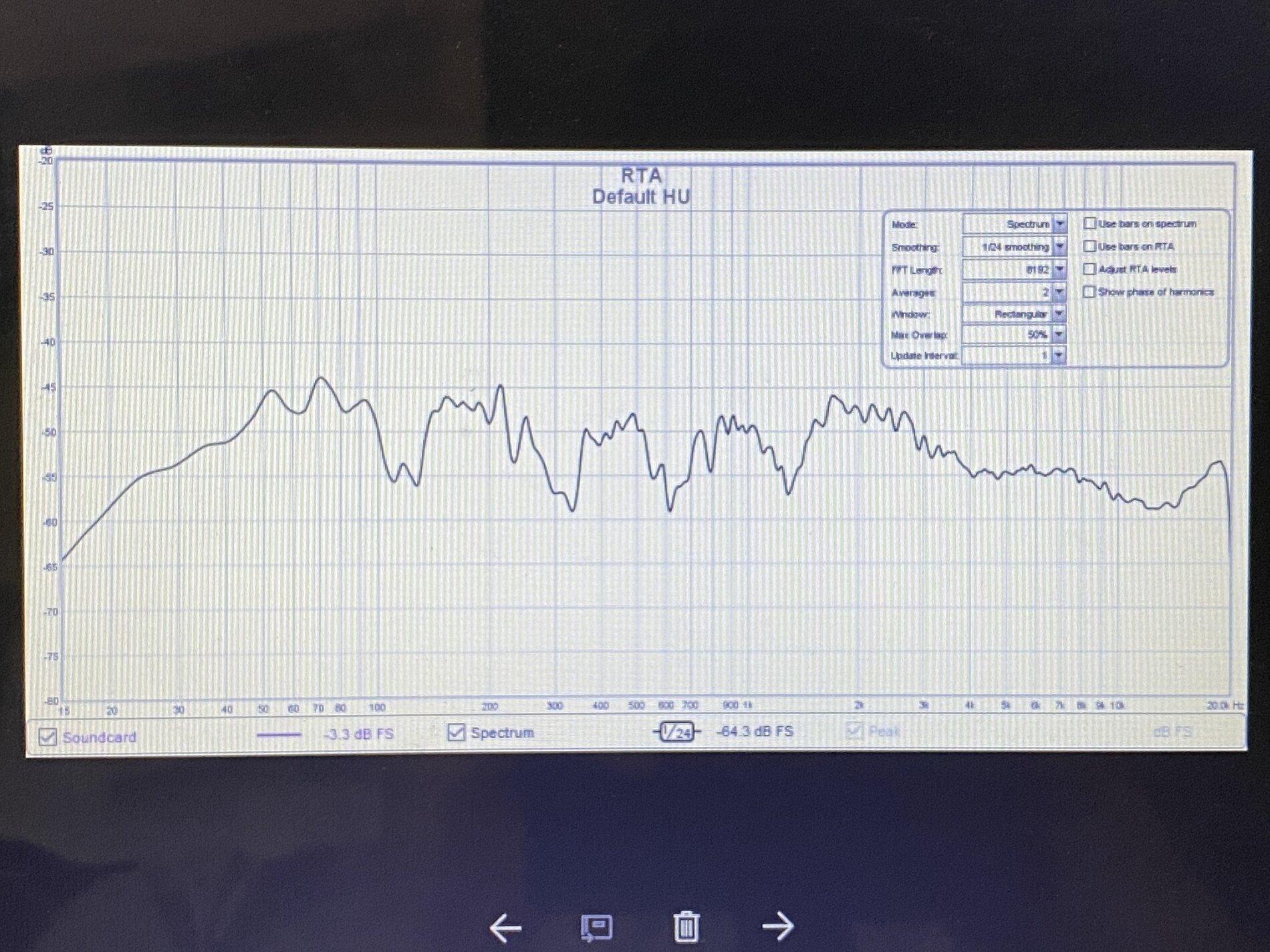
Bass is heavily rolled off from around 40 Hz down. My measurements showed high-Q cuts of around 8.5 dB at 100 Hz, 9.4 dB at 280 Hz, 6.9 dB at 630 Hz, 7.2 dB at 1270 Hz, 8 dB at 4000 Hz, and a steady roll-off from around 6000 Hz up. Note that these are, of course, quite rough figures given the measurement method. I’m also currently using speaker level outputs (front) from the HU into the 8V balanced MiniDSP inputs without load resistors, so the HF roll-off may be partially attributable to any output filter in the HU. It does appear, though, that quite a lot of factory EQ is being applied.

I am now awaiting delivery of an OBDlink adapter so I can attempt to disable the factory EQ using Forscan, as well as switch to using line level outputs. I’ll also make some proper measurements both with factory EQ applied and disabled.
 
OP
OP
Zaph

Zaph

Well-Known Member
Joined
Nov 28, 2019
Threads
11
Messages
772
Reaction score
2,126
Location
Wisconsin
Vehicle(s)
2019 Ranger, A whole garage full of motorcycles
Occupation
Engineer
Bass is heavily rolled off from around 40 Hz down. My measurements showed high-Q cuts of around 8.5 dB at 100 Hz, 9.4 dB at 280 Hz, 6.9 dB at 630 Hz, 7.2 dB at 1270 Hz, 8 dB at 4000 Hz, and a steady roll-off from around 6000 Hz up. Note that these are, of course, quite rough figures given the measurement method. I’m also currently using speaker level outputs (front) from the HU into the 8V balanced MiniDSP inputs without load resistors, so the HF roll-off may be partially attributable to any output filter in the HU. It does appear, though, that quite a lot of factory EQ is being applied.
Interesting. Nice selection of drivers btw.

That seems pretty excessive and I think something is up with your measurement method given given where the cuts are showing up. If a car system were to have some factory EQ, I would generally expect no more that 2 filters: one a 3rd or 4th order subsonic filter, and maybe a mild cabin node damping filter. But highly unlikely to have high Q dips anywhere else.

I don't think I have any answers for you but could it be possible the digital based amp is not playing well with your measurement method. Even though my home amplifiers are all digital Tripath amp based these days, I have to keep a traditional A-B class amp around for measurements to work right.

How about this. Bypass the DSP and outboard amp for now and go back to stock, load up a white noise track and do a near field RTA measurement. I bet you don't see you dips, except for the minor dip/peak combo based on the wavelength reflection from behind the door, and you can calculate where that is based on the frequency wavelength and the distance.
 

BuffleAus

Member
First Name
Troy
Joined
Dec 6, 2020
Threads
0
Messages
7
Reaction score
6
Location
Australia
Vehicle(s)
MY20.75 Wildtrak
Occupation
Consultant
Interesting. Nice selection of drivers btw.

That seems pretty excessive and I think something is up with your measurement method given given where the cuts are showing up. If a car system were to have some factory EQ, I would generally expect no more that 2 filters: one a 3rd or 4th order subsonic filter, and maybe a mild cabin node damping filter. But highly unlikely to have high Q dips anywhere else.

I don't think I have any answers for you but could it be possible the digital based amp is not playing well with your measurement method. Even though my home amplifiers are all digital Tripath amp based these days, I have to keep a traditional A-B class amp around for measurements to work right.

How about this. Bypass the DSP and outboard amp for now and go back to stock, load up a white noise track and do a near field RTA measurement. I bet you don't see you dips, except for the minor dip/peak combo based on the wavelength reflection from behind the door, and you can calculate where that is based on the frequency wavelength and the distance.
I have a huge selection of drivers on my shelves. In a previous life I was an amplifier and speaker designer, and am aware and appreciative of your own work in this regard. I’d prefer to be using the Satori ring radiator tweeters that I have on hand or even SB65s as mids in 3-way fronts, but that would defeat one of my goals of keeping everything hidden.

I think you’re probably right that it’s either measurement method (it was a very crude method) or something funky happening with the unloaded digital amp chip in the HU (measurements were taken from a set-flat MiniDSP output) or filter. I can’t imagine that it was input signal or DAC related, but can’t entirely rule that out either.

There are a couple of reasons that I didn’t immediately dismiss the measurements. The first is that flexible DSP ICs are cheap as chips now (pun intended) and the second is that the lower cuts are where I might expect modal issues. That said, my presumption was that I’d see steep bass roll-off, a gradual high frequency roll-off, and maybe some mild boost around about 4000 Hz or so to fill between the stock midwoofer off-axis response and the first-order crossed stock tweeter, the latter of which is cheaply made with tiny xmax and probably high Fs, meaning it’d be crossed quite high (I didn’t bother looking at the cap value before scrapping them).

This weekend I’ll see if I can get some time using my proper measurement equipment. I’ll use my software to do some white noise measurements and sweeps and then also some oscilloscope observations with sine waves.

Varying between direct inputs to the MiniDSP and going through the HU I can hear obvious EQ on the latter, but as you say it seems unlikely that they’d apply such high Q corrections. I do know there is EQ applied, though, as I know where the option codes are for the various stored EQs including flat/disabled.
 
Last edited:

geophb

Well-Known Member
Joined
Aug 3, 2020
Threads
4
Messages
530
Reaction score
750
Location
Wisconsin
Vehicle(s)
2019 Ranger
Occupation
Mechanical Engineer

BuffleAus

Member
First Name
Troy
Joined
Dec 6, 2020
Threads
0
Messages
7
Reaction score
6
Location
Australia
Vehicle(s)
MY20.75 Wildtrak
Occupation
Consultant
Interesting. Nice selection of drivers btw.

That seems pretty excessive and I think something is up with your measurement method given given where the cuts are showing up. If a car system were to have some factory EQ, I would generally expect no more that 2 filters: one a 3rd or 4th order subsonic filter, and maybe a mild cabin node damping filter. But highly unlikely to have high Q dips anywhere else.

I don't think I have any answers for you but could it be possible the digital based amp is not playing well with your measurement method. Even though my home amplifiers are all digital Tripath amp based these days, I have to keep a traditional A-B class amp around for measurements to work right.

How about this. Bypass the DSP and outboard amp for now and go back to stock, load up a white noise track and do a near field RTA measurement. I bet you don't see you dips, except for the minor dip/peak combo based on the wavelength reflection from behind the door, and you can calculate where that is based on the frequency wavelength and the distance.
I had a short amount of time available today, so did some measurements using REW. The source was white noise, originally using a Six Studios generator app and then an AAC file to confirm. This was via an iPhone connected to the Ford Sync 3 8” head unit with the tone adjustments set to neutral. As before, the head unit is connected to the MiniDSP via the front outputs into the balanced inputs (8V). Two channels were set to fully flat on the MiniDSP, with these connected to the analog inputs of the laptop and the laptop sound card pre-calibrated using an in-out loop.

There was quite a lot of noise, some of which was present in the bass (~30 dB below the signal level) with an amplitude inversely proportional to frequency, and some of which I didn’t investigate due to it not being relevant to the purpose and this not being my proper measuring equipment, which I don’t currently have access to. The EQ was consistently visible within the noise and confirms my prior observations. There are a combination of low Q boosts and high Q cuts. Excuse the photos of the screen captures, but this laptop is air-gapped.

Until I receive my OBD cable I’ve gotten things quite flat by routing the analog inputs to the digital SPDIF output and looping this back to the SPDIF input, giving me 15 PEQs per channel to correct the inputs globally. Mic sweeps and listening tests confirm a reasonably flat outcome similar to inputting directly to the MiniDSP, further indicating that the measurements of the HU are reflective of actual EQ being applied. I can only hope that after disabling EQ and changing to line out using Forscan it’s actually flat...

DA9E2F0D-48FD-4B31-BF8F-487546D52BFB.jpeg
 
Last edited:
OP
OP
Zaph

Zaph

Well-Known Member
Joined
Nov 28, 2019
Threads
11
Messages
772
Reaction score
2,126
Location
Wisconsin
Vehicle(s)
2019 Ranger, A whole garage full of motorcycles
Occupation
Engineer
@BuffleAus From your notes it looks like you don't have resistor loads installed on the speaker outputs of the factory amp before the feed to the minidsp. This may be causing some strange behavior with the digital factory amp.

I still recommend pulling the minidsp and aftermarket amps and testing without it. I would use white noise recorded onto a USB flash drive, near field in the midbass to see if those dips are there.
 

BuffleAus

Member
First Name
Troy
Joined
Dec 6, 2020
Threads
0
Messages
7
Reaction score
6
Location
Australia
Vehicle(s)
MY20.75 Wildtrak
Occupation
Consultant
@BuffleAus From your notes it looks like you don't have resistor loads installed on the speaker outputs of the factory amp before the feed to the minidsp. This may be causing some strange behavior with the digital factory amp.

I still recommend pulling the minidsp and aftermarket amps and testing without it. I would use white noise recorded onto a USB flash drive, near field in the midbass to see if those dips are there.
I should have mentioned, I measured both with and without 4 ohm dummy load resistors on the head unit outputs. No difference other than the bump around 20 kHz, leading me to assume the output chip in the HU is class D.. Due to the way I’ve installed the wiring and amps, bypassing them isn’t a trivial task, whereas accessing the rear of the MiniDSP is relatively easy.
 

BuffleAus

Member
First Name
Troy
Joined
Dec 6, 2020
Threads
0
Messages
7
Reaction score
6
Location
Australia
Vehicle(s)
MY20.75 Wildtrak
Occupation
Consultant
My OBD2 cable finally arrived today. I set the HU outputs to line level and disabled EQ. I can confirm that the output from the HU now has a flat frequency response.

Having thought more about it, it makes sense that the factory DSP would be quite complex, especially in reducing positive cabin modes. This would be a requirement to effectively implementing ANC. Even with ANC being somewhat self-correcting by being inherently a feedback loop, this would require a reasonably flat low-frequency cabin response to start with. Implementing ANC also requires the HU to contain a capable DSP. Of course, the new system is accurately calibrated for all drivers and summed (global) response within the MiniDSP.
 

mlarma

Well-Known Member
First Name
Mark
Joined
Nov 18, 2020
Threads
12
Messages
217
Reaction score
471
Location
North Carolina
Vehicle(s)
2020 Ranger XLT 4x2
Occupation
Computers/Networks
Hi everyone,

This is my first post here on this forum, I live and work in Thailand and have a 2020 Raptor with basic audio system, 4 channels, 6 speakers and no amp.
I am currently purchasing everything for a full audio upgrade, retaining the factory head unit with sync 3, my Raptor has ANC and the enhanced engine sounds.

I recently installed a temporary JBL underseat sub box with a Audio Control LC2i and took the signal from the rear speakers, straight away I had a unbearable droning from the sub and had to turn it off, I assumed it was feedback from the ANC but it also increased and decreased in volume with the throttle which made me think it was also linked somehow with the enhanced engine sound thingy.

Have spent the last few weeks scouring the net, watching 5 Star Car Stereo youtube videos of F150 builds and taking to local car audio shops, most of which has not helped.

All of the local audio shops I talked to had no knowledge of this engine sound, but I did find one shop who knew how to remove ANC, they were very reluctant to help me but today we managed to convince them to help, result, no more ANC and the drone from the sub is gone, the engine sound is still there but doesn't seem to be interfering with the audio anymore.

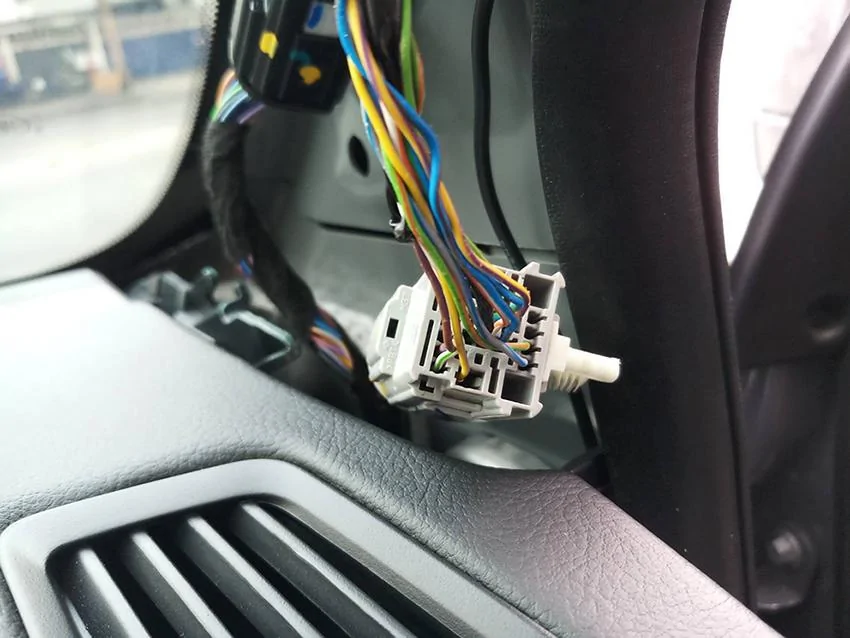
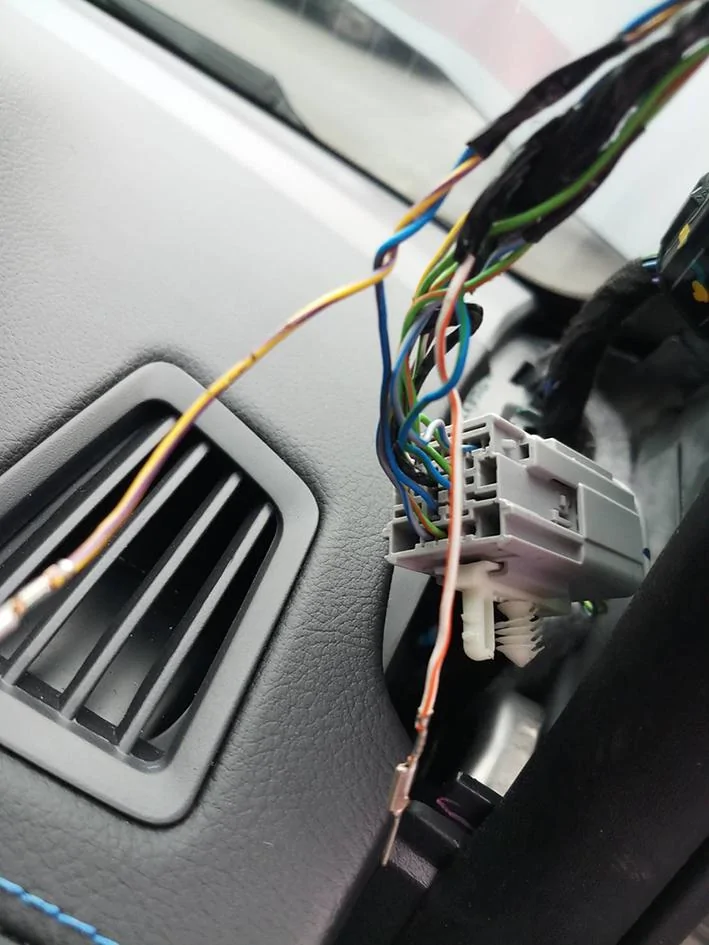
They disconnected 2 wires from the white connector in the RHS A pillar, my Raptor has 3 small round microphones in the roof liner in addition to the phone microphone, guess they are the ANC microphones and what they disconnected today, BTW these things are glued into the liner, so left them intact.

Parts for my new audio upgrade almost together, importing everything from Europe and the US, way too expensive to buy here.

I will post details here when I start the build, setup is Audio Control D-4.800 DSP amp, front and rear Dynaudio Esotec components, passive rear, active fronts, Audio Control LC-1.800 amp for JL Audio 13TW5v2-4 subwoofer in custom shallow box behind the rear seat.

I made a rough sub box for a test last weekend, very rough but wanted to get as close to the 0.8ft3 volume as possible make sure I could close the seat, the JL sub is less than 2.5" deep and the box is around 0.7ft3 at the moment.
Here's a photo of the connector and the wires to remove, white with orange stripe and yellow with purple stripe.
Still keen to find a way to delete those engine sounds although it's now bearable.

ANC1.jpg


ANC2.jpg
Those Dynaudio Esotec drivers...wow, haven't heard that model line in a while (I researched drivers in the 1990s when I built a set of bookshelf monitors for a friend). Those are very very very nice and not cheap. I am curious how that build went as I've been hesitant to consider that level of audio in a vehicle due to the raised noise floor (it's a vehicle after all) and the resonance from the enclosures (door panels). I am less than happy with the detail on the high end so was going to start there...but do let me know how this went!
Sponsored


Top