
Sponsored

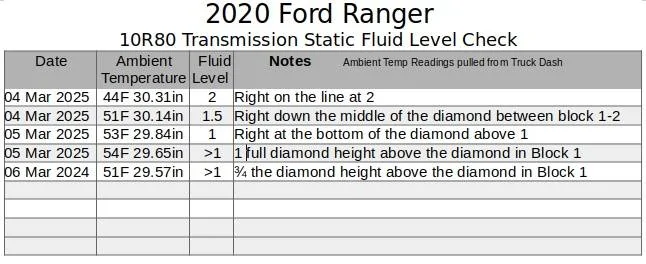
An interesting test regarding transmission fluid level readings measured at different ambient temps

Kemo Sabe

Well-Known Member
First Name
Kemo
Joined
Dec 22, 2019
Threads
1
Messages
316
Reaction score
525
Location
Upstate SC
Vehicle(s)
2019 Ranger
So this morning I began taking ambient temps from inside the truck by simply turning the ignition on and recording the temp from inside the cab, them checking then checking the transmission fluid level. Here are my first two entries. The truck has not been started or moved. A 6F change in ambient temperature moved the fluid level up 1/2 a block on the dip stick. A bigger jump than I anticipated.

It reached a high of 66F today, but my garage remains colder longer. I'll keep updating this chart at spring progresses to quantify how ambient temps affect fluid level measurements.

Trans fluid Measurements .jpg


It would be interesting if others could confirm my findings.
How did you make your dipstick that accessible??
Thanks.
Sponsored


got3fords

Well-Known Member
First Name
James
Joined
Apr 12, 2021
Threads
131
Messages
5,334
Reaction score
13,875
Location
22973
Vehicle(s)
2026 Marsh Gray Ranger Raptor, 1995 Harley XLH1200
Occupation
Mom Joke Professional
How did you make your dipstick that accessible??
Thanks.
Ah! The Mike's Build Shop after market dip stick perhaps? AKA the Fitzstick. Search it here, numerous posts.
 
OP
OP

TJC

Well-Known Member
First Name
Tony
Joined
Aug 28, 2020
Threads
45
Messages
3,956
Reaction score
9,940
Location
North Carolina
Vehicle(s)
93 Miata, 05 Ranger 4x4, 20 Ranger 4x4, 23 CX-5
MBS Dipstick! "The FitzStick" A must have if you do your own maintenance.

I'm holding off new measurements until the temps heat up a bit. Level is currently stable. Will update the chart in the first post when temp push up to 80F later this week. I won't start or drive the truck until this measurement test is complete.
 
Last edited:
OP
OP

TJC

Well-Known Member
First Name
Tony
Joined
Aug 28, 2020
Threads
45
Messages
3,956
Reaction score
9,940
Location
North Carolina
Vehicle(s)
93 Miata, 05 Ranger 4x4, 20 Ranger 4x4, 23 CX-5
Well, I installed my PPE Deep pan last week I took a few more readings. I used my xTools D8 diagnostic tablet to monitor the transmission fluid temps in real time. I power braked the engine / drive train to push fluid temps to 215F and checked my levels.

I successfully achieved the perfect fill on the FitzStick... on the diamond block dead center between 4-5.

Details on Power Brake
From a warm engine idle it didn't take long for temps to reach 215F! Just pull the emergency brake, plant your left foot on the brake pedal, and raise the engine to 2000 RPMs. The transmission temps start to climb pretty quickly. Go off throttle 5F-10F degrees before the 215F target as the temps will continue to climb for a short while.

Cold Static Fill Fluid Check
I let the truck sit overnight and checked the fluid level static, engine off 12 hours after shutting it down. Fluid level was between the 1-2 marks. I do not trust this measurement as the longer I let the truck sit while draining the fluid before changing the pan, the more fluid I got out.
5qts initially, waited over night, got another 1 qt, waited the next night, got another 1qt, and the next day before lifting the truck and pulling the pan I got just over 0.5qt.

When I pulled the Ford pan, there was already more fluid in it, and removing the filter even more fluid. So basically the longer the truck sits the more fluid drains into the pan resulting in higher the cold static readings. I have seen my fluid level well above the scale on the FitzStick when I have not driven the truck for a week.

Cold Engine Start - 24 hours since driven
I started the truck and quickly shifted through the gears in 5 second intervals as Ford recommends, then checked the fluid level. The fluid just showed in the dipstick, maybe 1/8", Still on the bended area of the tip of the dipstick.

I suspect that many are overfilling their transmissions due to checking the fluid while it is cold.

Final Note
I initially followed Ford instructions when filling the PPE Deep pan.

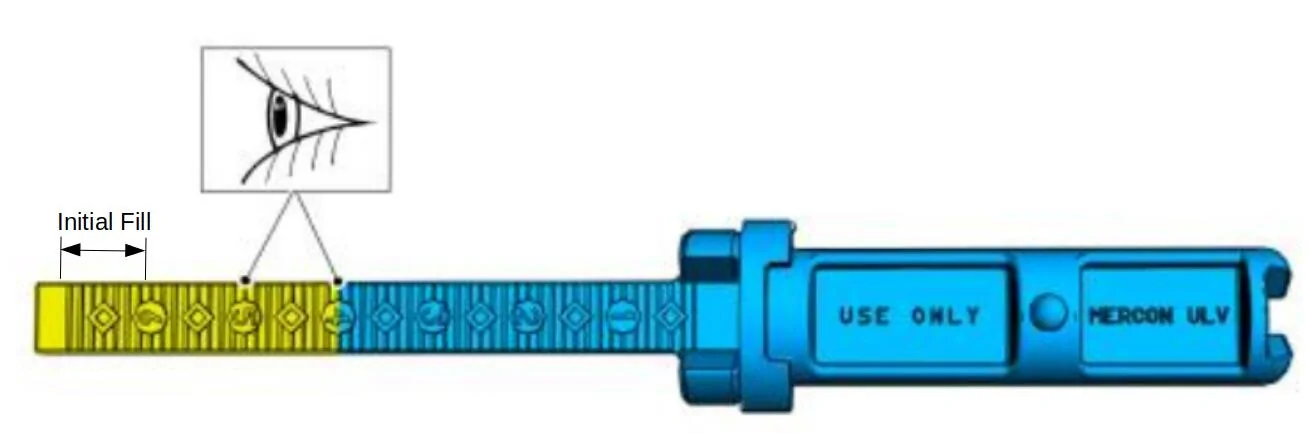
"The initial fill enables the engine to be started. Filling the transmission to between 6 and the low crosshatch mark allows the vehicle to be driven." Ford's initial fill calls for 5qts.

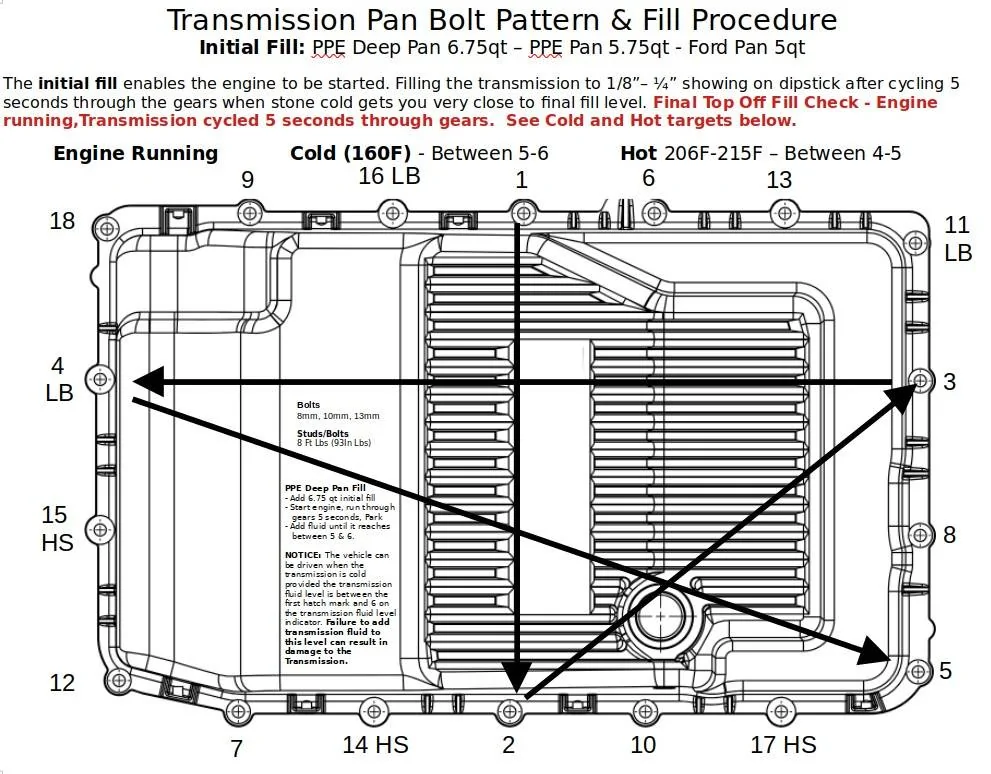
For those of us using different pans, here are the initial fill amounts.

Initial Fill:
  • PPE Deep Pan 6.75qt​
  • PPE Pan 5.75qt​
  • Ford Pan 5qt​
Ford then states to "fill between the cross hatch and the 6 to allow the truck to be driven." This is not the final fill. I followed this instruction, filling it to the 6, shifting for 5 seconds through range, checking the fluid level until I reached the 6, then drove the truck 10 miles to warm it up, and came home. I set up my xTools D8, noticed the transmission temp was at 195F. I proceeded to power brake the engine, raising the temps to 215F, and checked my fluid level. It was above the diamond between 3 and 4! I pulled out 12 oz of fluid and checked it again. This time the fluid check came back right on target on the diamond between 4 and 5.

Drove the truck again, and checked the temps with my D8, they were at 180F. Fluid level still at the diamond between 4 and 5 when I raised the temps to 215F for a final check.

1746121342411-5v.jpg


Lessons Learned
  • Make your initial fill based upon the pan you have installed
  • Start engine cold but do not drive, shift through the gears at 5 sec intervals and fill to the lowest hatch mark on the stick, (or do not shift the gears and fill to 6)
  • Power Brake the engine until you reach 215F, check fluid, add/remove as necessary.
Note: No where could I find if I should have shifted the gears prior to the second fill (when adding fluid to the 6 mark). Not shifting would have possibly kept me from overfilling the transmission (that 12 oz).

I did notice that raising temps from 205F to 215F raised the fluid level by ~1 segment.

I''l take the time over the next few days to validate fluid levels at 10F degree increments now that I have my fluid level properly set.
 
Last edited:
OP
OP

TJC

Well-Known Member
First Name
Tony
Joined
Aug 28, 2020
Threads
45
Messages
3,956
Reaction score
9,940
Location
North Carolina
Vehicle(s)
93 Miata, 05 Ranger 4x4, 20 Ranger 4x4, 23 CX-5
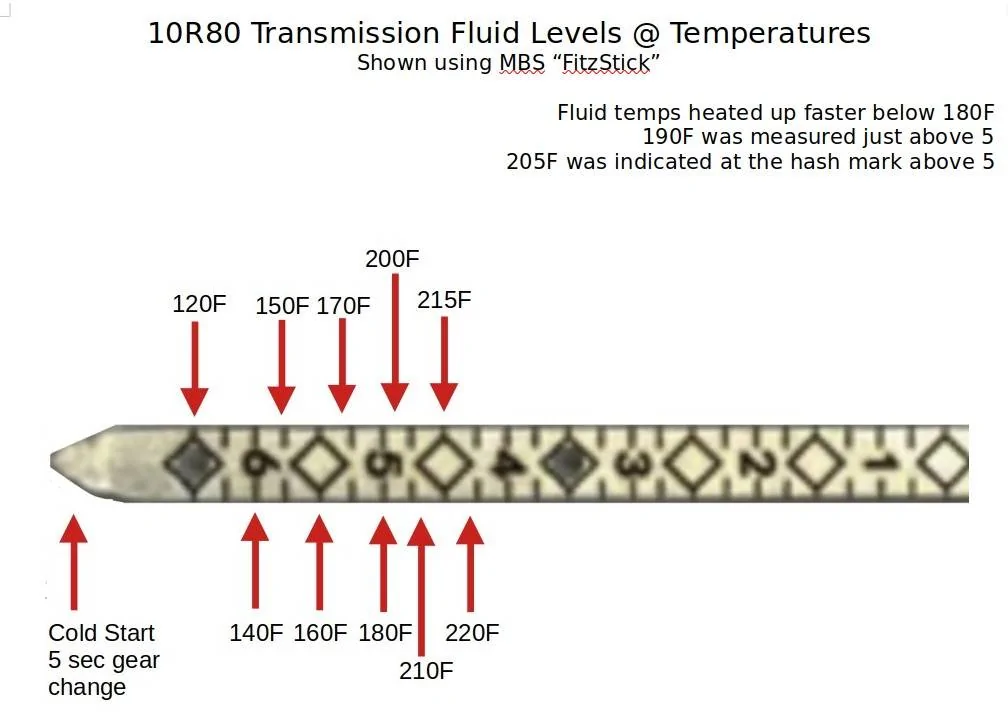
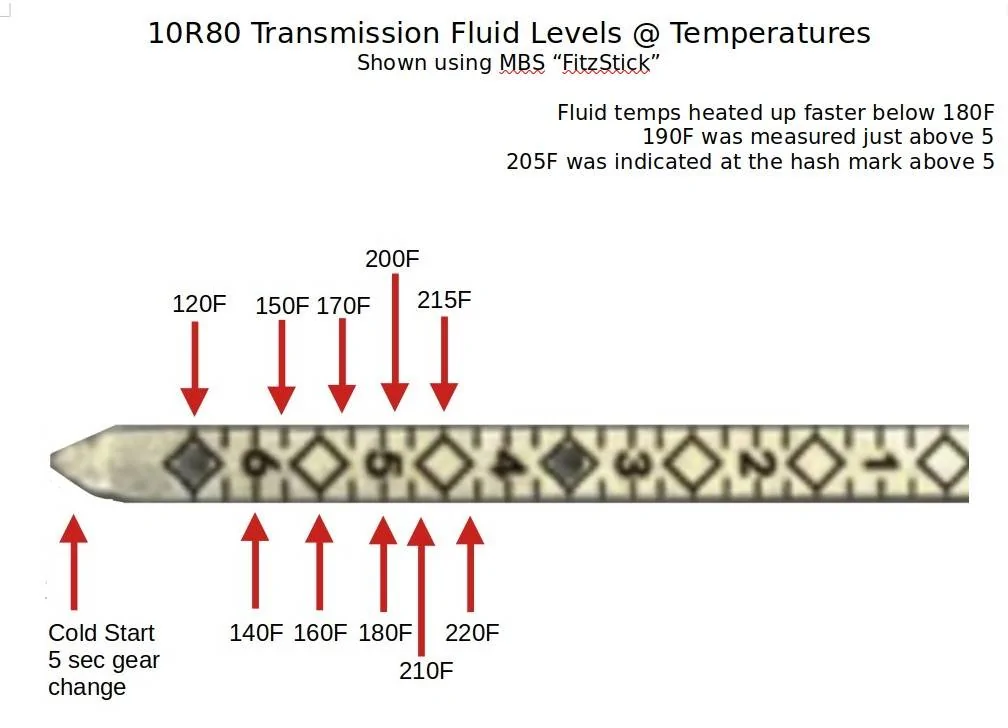
I just completed measuring the Transmission fluid levels from cold start to 220F. I am confident that my fluid level is spot on. I have measured it 3 times now at 215F and it is dead on the Diamond between 4 and 5.

A few interesting observations.
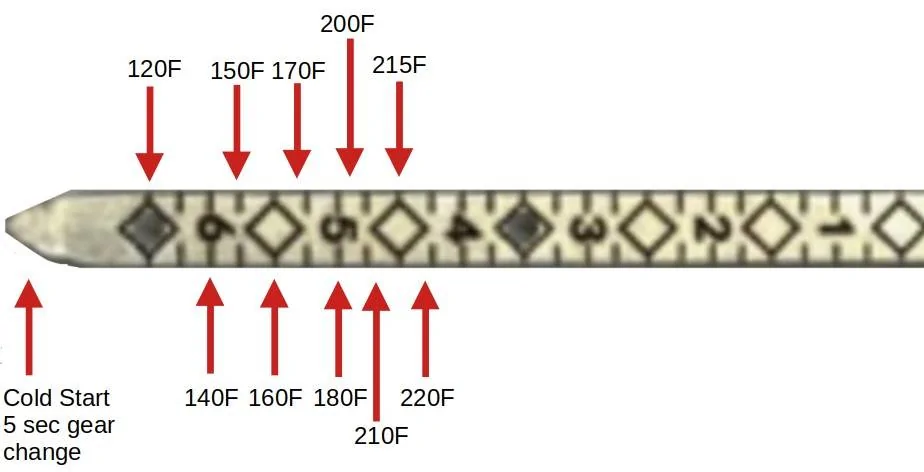
I let the transmission warm the fluid at idle up to 180F. On the way up I measured "Cold Start" by shifting through the gears at 5 second intervals ending in Park, then taking my measurement. I began measuring on the way up at 120F, 140F, 150F, 160F, 170F, and 180F. I only looked at the numbered side of the dip stick. The back side of the stick seemed to read slightly higher, possibly due to less resistance due to less printing... or splash, or residual oil in tube, maybe angle of the stick. I can't explain it and really don't need to. But I stayed with reading from the numbers side for consistency.

The temp increase rate had dropped pretty low from 170F-180F, so I "Power Brake the engine" to load the transmission and heat the fluid faster, I held it until I bumped past 210F and went back to idle. The fluid temps peaked at 223F. I measured at 220F, 215F, 210F, 205F, 200F, and 190F on the way down.

The Results
Note the dipstick used is the excellent MBS FitzStick. The numbers correlate perfectly with the Ford mini dipstick. But I would advise you not to attempt the check the fluid level using the Ford dipstick, You are at serious risk of receiving burns from the catalytic converter.

Transmission Levels at temperature ( F).jpg


Observations
If you start your engine cold and wait until your water temperature reads normal, your transmission will be ~140F - 160F range. If you fill to the 150F level, you should end up well within the 4-5 range at 215F. I believe this is the rule of thumb that FordTechMakuloco is using. The Ranger 10R80 target range is 4-5, not 5-6 like the F150 that he is servicing. I do not believe his transmission fluid is ambient "cold". It is colder than the 215F, but it is not 80F.

I'll do a quick time check to see how much time I need to wait to get the trannie fluid level to the 150F-160F window.

Then all anyone needs to do is do the initial fill, then start the truck and top off to the correct temp level when the allotted time is reached. 160F would be the diamond between 5 and 6.
 
Last edited:


got3fords

Well-Known Member
First Name
James
Joined
Apr 12, 2021
Threads
131
Messages
5,334
Reaction score
13,875
Location
22973
Vehicle(s)
2026 Marsh Gray Ranger Raptor, 1995 Harley XLH1200
Occupation
Mom Joke Professional
I just completed measuring the Transmission fluid levels from cold start to 220F. I am confident that my fluid level is spot on. I have measured it 3 times now at 215F and it is dead on the Diamond between 4 and 5.

A few interesting observations.
I let the transmission warm the fluid at idle up to 180F. On the way up I measured "Cold Start" by shifting through the gears at 5 second intervals ending in Park, then taking my measurement. I began measuring on the way up at 120F, 140F, 150F, 160F, 170F, and 180F. I only looked at the numbered side of the dip stick. The back side of the stick seemed to read slightly higher, possibly due to less resistance due to less printing... or splash, or residual oil in tube, maybe angle of the stick. I can't explain it and really don't need to. But I stayed with reading from the numbers side for consistency.

The temp increase rate had dropped pretty low from 170F-180F, so I "Power Brake the engine" to load the transmission and heat the fluid faster, I held it until I bumped past 210F and went back to idle. The fluid temps peaked at 223F. I measured at 220F, 215F, 210F, 205F, 200F, and 190F on the way down.

The Results
Note the dipstick used is the excellent MBS FitzStick. The numbers correlate perfectly with the Ford mini dipstick. But I would advise you not to attempt the check the fluid level using the Ford dipstick, You are at serious risk of receiving burns from the catalytic converter.

Transmission Levels at temperature ( F).jpg


Observations
If you start your engine cold and wait until your water temperature reads normal, your transmission will be ~140F - 160F range. If you fill to the 150F level, you should end up well within the 4-5 range at 215F. I believe this is the rule of thumb that FordTechMakuloco is using. The Ranger 10R80 target range is 4-5, not 5-6 like the F150 that he is servicing. I do not believe his transmission fluid is ambient "cold". It is colder than the 215F, but it is not 80F.

I'll do a quick time check to see how much time I need to wait to get the trannie fluid level to the 150F-160F window.

Then all anyone needs to do is do the initial fill, then start the truck and top off to the correct temp level when the allotted time is reached. 160F would be the diamond between 5 and 6.
Fantastic information. Thanks!
 
OP
OP

TJC

Well-Known Member
First Name
Tony
Joined
Aug 28, 2020
Threads
45
Messages
3,956
Reaction score
9,940
Location
North Carolina
Vehicle(s)
93 Miata, 05 Ranger 4x4, 20 Ranger 4x4, 23 CX-5
Thank You! I don't know why I didn't do this sooner. I am going to time startup to 160F to make it even easier to get the level correct. No need to power brake to get temps to 215F.

When the time expires, simply fill to 160 target - the diamond between 5 and 6.
Your done!
 
Last edited:
OP
OP

TJC

Well-Known Member
First Name
Tony
Joined
Aug 28, 2020
Threads
45
Messages
3,956
Reaction score
9,940
Location
North Carolina
Vehicle(s)
93 Miata, 05 Ranger 4x4, 20 Ranger 4x4, 23 CX-5
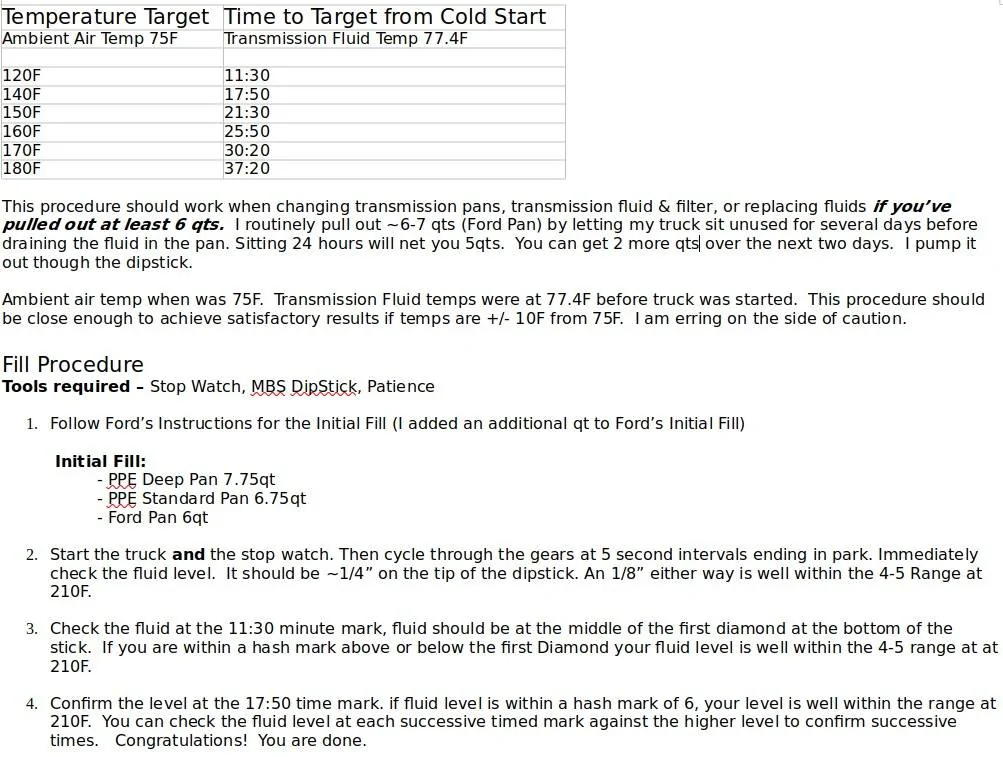
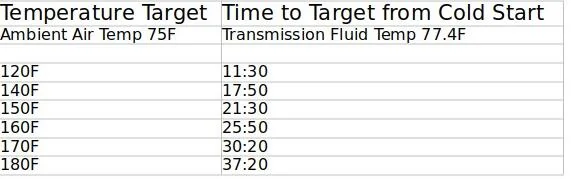
OK I have completed the time / fluid level correlation exercise and have created a chart with time marks at each level I marked on the dipstick a few days ago. This should enable all of us to easily obtain the correct transmission fluid level without having to check the fluid level at 210F.

I intentionally chose the target fluid level and temperature level to be dead center of both spectrums. 210F is dead center of between 205F-215F. And the Diamond is dead center between the 4 and 5 levels on the dipstick. I even drilled a hole in the middle of the diamond in my dipstick to enable me to see the optimal fluid level more easily. I do not encourage others to do the same as the steel is hard, and small bits tend to wander even with the assistance of a dimple from a punch.

There are assumptions and requirements that must be considered.

- Ambient Fluid and Air temps when the tested +/- 10F should be fine
- Transmission mechanical condition
- Truck must be on level ground
- Must have an MBS FitzStick installed

Here is what I came up with. I know this process works for me. It would be great if others could validate my findings.

Using the Fluid Level at Temperatures Chart follow the directions in Picture 2. Picture 3 gives a bolt pattern tightening procedure when installing a transmission pan. The PPE pan in the picture is looking into the pan.

The attached PDF file has this data in it for download and printing out.

Hope this helps folks a little bit.

10R80 1.webp

10R80 2.webp


10R80 3.webp
 

Attachments

got3fords

Well-Known Member
First Name
James
Joined
Apr 12, 2021
Threads
131
Messages
5,334
Reaction score
13,875
Location
22973
Vehicle(s)
2026 Marsh Gray Ranger Raptor, 1995 Harley XLH1200
Occupation
Mom Joke Professional
OK I have completed the time / fluid level correlation exercise and have created a chart with time marks at each level I marked on the dipstick a few days ago. This should enable all of us to easily obtain the correct transmission fluid level without having to check the fluid level at 210F.

I intentionally chose the target fluid level and temperature level to be dead center of both spectrums. 210F is dead center of between 205F-215F. And the Diamond is dead center between the 4 and 5 levels on the dipstick. I even drilled a hole in the middle of the diamond in my dipstick to enable me to see the optimal fluid level more easily. I do not encourage others to do the same as the steel is hard, and small bits tend to wander even with the assistance of a dimple from a punch.

There are assumptions and requirements that must be considered.

- Ambient Fluid and Air temps when the tested +/- 10F should be fine
- Transmission mechanical condition
- Truck must be on level ground
- Must have an MBS FitzStick installed

Here is what I came up with. I know this process works for me. It would be great if others could validate my findings.

Using the Fluid Level at Temperatures Chart follow the directions in Picture 2. Picture 3 gives a bolt pattern tightening procedure when installing a transmission pan. The PPE pan in the picture is looking into the pan.

The attached PDF file has this data in it for download and printing out.

Hope this helps folks a little bit.

10R80 1.jpg

10R80 2.jpg


10R80 3.jpg
What awesome information. I may have missed it, but are you basing all the timed measurements when the ambient temp is 75, +/- 10? Or are you assuming the owner is measuring the oil temp somehow?
 
OP
OP

TJC

Well-Known Member
First Name
Tony
Joined
Aug 28, 2020
Threads
45
Messages
3,956
Reaction score
9,940
Location
North Carolina
Vehicle(s)
93 Miata, 05 Ranger 4x4, 20 Ranger 4x4, 23 CX-5
What awesome information. I may have missed it, but are you basing all the timed measurements when the ambient temp is 75, +/- 10? Or are you assuming the owner is measuring the oil temp somehow?
Yes, on 75F ambient air temps only, but the truck must be cold saturated and level. Overnight first thing in the morning or in a garage. I am making an educated guess that 10F+/- degrees will keep you in the safe window.

I will validate this as temps rise here locally. All next week we are in the mid 70's. I only need to run up to 180F on an 85F day to test the theory. Even if I am incorrect about the 10F degree difference, I can track the time for my truck to reach the target temps on an 85F day, and build a table with a columns of different ambient temps with adjusted times. This will be a sample of 1, but can be easily validated with those who can accurately measure fluid temps in real time (dynamically).

I measured the fluid temps in real time with my xTools D8 diagnostic tablet. The fluid temp before starting the truck was at 77.4F.

I had previously took the temps to 210F and set my fluid to center of the acceptable range, the diamond between 4 and 5 on the MBS FitzStick.

Once I had the fluid dead on accurate, The next day with a cold truck I monitored the temps rise and recorded the readings on the dipstick at various temps. From Ambient (Cold Start running through the gears at 5 sec intervals - the first reading on the dipstick.) then pulling the dipstick and recording the level. I then continued to record each of the following the dipstick levels at 120F, 140F, 150F, 160F, 170F, 180F, 200F, 210F, 215F, and 220F.

ALL OF THEM CORRELATE TO THE PROPER FLUID LEVEL, JUST AT DIFFERENT FLUID TEMPERATURES.

Finally, the following day (starting with a cold engine) I completed the 3rd step, recording the time required to reach each temperature threshold I documented the previous day on the dipstick. It was 75F when I ran this test and documented the times for my truck to reach the target temps.

Theoretically, a person could simply start his engine, and at the time I gave, fill to the location on the dipstick, and be done. They could continue to the next checkpoint on the dipstick to validate the first fill attempt as accurate.

I will be the first to admit that I am using heuristics (rule of thumb) to correlate the fluid level via time, but if your temps start close to the temps I started at, you should be right on target, and even if your are off a tad, I targeted the center of the acceptable range window. Being off a hash mark one way or the other keeps you well within the acceptable range.

With that stated, each truck may be slightly different, transmission wear, modifications, etc., all enter into the equation.

Others, please validate my work! If your area temps are at or near 75F, you can test my results. Truck should be in the shade or garage and stone cold when checking the levels and not yet started that day or night.

If you have a real time data feed that tracks transmission temps, you can accomplish this in one pass. Simply start the truck cold, start your stop watch and track the time required to reach each temp threshold, then check you dipstick level, write down the time required to hit the threshold, and fluid level, then continue to the next temp threshold. Repeat to 180F, then power brake your engine to reach 210F. Document the dipstick fluid level and note exactly where it is in relation to mine (the diamond between 5 and 6).

The complete test took me about 45 minutes, under 38 minutes to go from cold to 180F, then another 5 minutes or so to reach 210F by power braking the truck. I actually checked the dipstick at 220F, 215F, 210F, 200F and 190F on the way down as the transmission cooled.

-----------------

For different ambient temperatures, we will need others to measure the rate of rise. I can do it over the summer as temps rise to the mid to high 90's here. I can do 80F, 85F, 90F, and 95F, and over winter do 70F, 65F, 60F, and 55F. Not going to check it colder weather than that. If I start to see a pattern, I can extrapolate as well.

Any help will be appreciated.

Note the difference, and monitor / document fluid levels on the dipstick at each temperature level that I recorded as the temperatures rise. They should be the same distance off at each level as the first measurement.

Not sure if I explained this adequately. Feel free to ask questions or point out possible errors.

T
 
Last edited:

jdamtb918

Well-Known Member
First Name
Jon
Joined
Mar 11, 2025
Threads
1
Messages
55
Reaction score
102
Location
Tulsa
Vehicle(s)
2021 Ranger Tremor
Occupation
HVAC Tech
So do we know where the reading should be 1st thing in the morning before starting the truck yet? Or can you even get an accurate reading if the truck has not been started yet? I just installed the MBS stick yesterday and afterwards drove the truck around and did my best to warm up tranny, My first reading was closer to the 6 mark which from the help of this forum that would indicate low. I put in a 1/2 QT Merc ULV and drove some more. the next check it was between 4 & 5. I plan to take some more readings today. Any advice on how much ULV to add when trying dial in fluid level? Is 1/2qt to aggressive if im trying to bump up 1 hash mark on the Fitzstick? Truck is a late 21' Tremor with almost 54k. Thank you a 100000x over for approaching this in the manner you are doing here. So freakin helpful!
 

Fitzmotor

Gold Sponsor
First Name
Mike
Joined
May 6, 2021
Threads
24
Messages
1,389
Reaction score
5,838
Location
Saugus
Vehicle(s)
2021 Ranger Tremor, 75 crewcab F350, 65 Mustang
Occupation
Retired from Honda Racing.
Yes, 1/2 quart will move it a lot, if you are still low I would add 8-10 ounces to bring it into the range.

It's the old "add until full" advise.

As for the cold full, I have not tried to get a exact number, I think that checking and setting the final level is best done hot.

The cold level check idea came from having to check it hot under the truck with the stock dipstick.

Hey, you could add in some Lubeguard to bring it up a little!
 
OP
OP

TJC

Well-Known Member
First Name
Tony
Joined
Aug 28, 2020
Threads
45
Messages
3,956
Reaction score
9,940
Location
North Carolina
Vehicle(s)
93 Miata, 05 Ranger 4x4, 20 Ranger 4x4, 23 CX-5
So do we know where the reading should be 1st thing in the morning before starting the truck yet? Or can you even get an accurate reading if the truck has not been started yet? I just installed the MBS stick yesterday and afterwards drove the truck around and did my best to warm up tranny, My first reading was closer to the 6 mark which from the help of this forum that would indicate low. I put in a 1/2 QT Merc ULV and drove some more. the next check it was between 4 & 5. I plan to take some more readings today. Any advice on how much ULV to add when trying dial in fluid level? Is 1/2qt to aggressive if im trying to bump up 1 hash mark on the Fitzstick? Truck is a late 21' Tremor with almost 54k. Thank you a 100000x over for approaching this in the manner you are doing here. So freakin helpful!
Don't rush to add fluid!

If you start your truck cold (sitting at least over night and level) and let it idle for 37.5 minutes to 50 minutes, your fluid level should be in the 180F-200F range. That range is very narrow on the dipstick. From 5 to 1/2 way to the first hash mark above 5. This will get you to the diamond between 4 and 5 at 215F. A perfect fill. I have found this procedure to be repeatable on my truck, but I will test it again tomorrow AM.

OR

When I drive my truck normally (not like I stole it) my fluid temps are generally between 180F and 200F, but it takes at least a 30 minute drive to get it there. I'm talking about <=55 mph. Park level and take your measurement.

OR

Use your diagnostic tool to read the fluid temps
(ForScan may do it as well, but I've never tried it) Then look at the Fitzstick image below and fill to the appropriate temp level.

If you are skeptical, you can validate by simply power braking your engine with transmission in Drive until your trans fluid temp reaches 215F. Be warned that it is very easy to overshoot the 215F target, but temps will start top drop relatively quickly.

1747083478920-sf.jpg


10R80 1.jpg


I do not believe that you can get an accurate reading of the fluid level static unless you let the truck sit for at least 3-4 days at a minimum unstarted. I let my trick sit for 3 days and I kept seeing the fluid level rise. After 3 days I stopped looking... I do know that fluid levels continues to rise in the pan for at least that long, and maybe even longer.

That said I do believe you can get an accurate enough reading (defined as within a hash mark either side of the diamond that is dead center in the 4-5 block) by starting the truck on a level flat surface, immediately run through the gears at 5 second intervals ending back in park, then immediately checking the fluid. It should be just showing on the dipstick, no more than 1/4" This was with the fluid temperature at 77.4F

I am presently attempting to check the fluid levels at 10F ambient air and fluid temperature increments.

I'm shooting for 55F - 95F ambient air measurement. I already have fluid temps from 120F-220F. and the time it takesd to get to those temps starting at 77F fluid temps.

I'm building a block matrix chart with air and fluid temps, and time milestones to achieve 121F-220F, with a diagram of the Fitzstick with the fluid level.

This presently is all theoretical, I know what I have presented so far works correctly on my truck. I haven't proven anything yet, except on my truck.

Right now the problem is I keep my truck garaged and the ambient air temps don't drop a great deal in the attched garage, so I ll be moving my ranger to a uninsultatged work garage and let it sit several days anc check the temps. I'll end up repeating this test muliple times to get the colder temps. The warmer temps are easier. I'll simply monitor the fluid temps (if they prove to correlate at all with the air temps) start the times frfom 85F, 95F, etc.

I'll most likely move the trruck into the work garage this evening, and measure air and fluid temps beforfe starting the truck. If the static fluid temp is close to the air temp, this gets much easier, if not I'll need to plot delta differences between the two.

All this said, I am hopeful.

Edited for clarity
 
Last edited:

HeatXfer

Well-Known Member
First Name
Chris
Joined
Jan 15, 2024
Threads
6
Messages
279
Reaction score
689
Location
Nor Cal
Vehicle(s)
2019 Ford Ranger XLT SuperCrew
Occupation
Retired Pipefitter & commercial HVACR Tech
I haven't found any specific information regarding ULV thermal expansion, but this was gleaned from Bobistheoilguy

"Coefficient of thermal expansion for oils and transmission fluids is around 0.0007 per degree C (0.07%/C). So, if you've got 12 liters in the pan, it will expand 0.0084 L per degree C. Since there's increased volume, and the surface area of the fluid does not change appreciably, the fluid goes higher on the dipstick.

Volume = Area x Height. So, Height = Volume/Area. Therefore, height on the dipstick is proportional to volume change.

Summer time temperature change might be ambient air temperature 68F (20C), at start up, to around 180F(82C) at operating temperature. Or, around 62C.

Therefore, during the summertime, the fluid could be expected to expand 0.0007 x 62C = 0.0434 (4.3%)."


Although this does not specifically include ULV, it'll probably be pretty close.
 

RedlandRanger

Moderator
First Name
Rob
Joined
Nov 14, 2018
Threads
42
Messages
5,115
Reaction score
11,116
Location
Oregon
Vehicle(s)
2019 Ford Ranger Lariat FX4, 1973 Mercury Capri
Vehicle Showcase
1
I just wanted to say thank you to Tony for this great info. I took the dive today and installed the PPE pan which obviously necessitated some fluid changing. I spent probably an hour getting the fluid level in the correct range - I only got the trans up to 185 but I'm sitting just over 5 on the fitzstick, so I should be good to go.

When I pulled the fluid, it looked a bit darker than I remember it being last time, but there was nothing on the magnet in the pan and no evidence of any clutch material. I didn't have quite as good of success with the electric pump as some of you have had, but it was helpful - I couldn't get all the fluid out of the pan before dropping it, but I did get some which made it a lot mess messy. I also used it to pull out some fluid since I overfilled it a bit. I also put in lubeguard platinum (last time I just used regular lubeguard, not the platinum).

After driving it a bit, it felt improved, but it could just be my imagination. Time will tell if I feel any more strange shifts.

Now that I have a drain plug, future fluid changes should be a lot simpler. I have enough fluid for another swap. I will probably do it in 5-10,000 miles I'm thinking - that will be fluid swap #3.
Sponsored


Top