
Sponsored

Randy2400h
Well-Known Member
I got 24.8 MPG driving between 70-75mph going up in elevation (3300ft - 6800ft MSL) during my 3hr drive home from the dealership. That includes a couple 100mph passes around traffic on a 2-lane highway!
Give it time.
Give it time.
LightningBlue
Well-Known Member
- First Name
- Ryan
- Joined
- Feb 12, 2019
- Threads
- 13
- Messages
- 279
- Reaction score
- 385
- Location
- Rancho Cucamonga, Ca
- Vehicle(s)
- 2019 Lightning Blue XLT FX4/ 2023 Subaru Forester
- Vehicle Showcase
- 1
I wonder if this has anything to do with the TSB for Rough idle. Depending on the parameters involved with the PCM I'd guess it could majorly effect fuel consumption.
Jason L
Well-Known Member
- First Name
- Jason
- Joined
- Jan 28, 2019
- Threads
- 6
- Messages
- 111
- Reaction score
- 71
- Location
- Mount Pleasant, SC
- Vehicle(s)
- 2019 Ranger XLT 302A
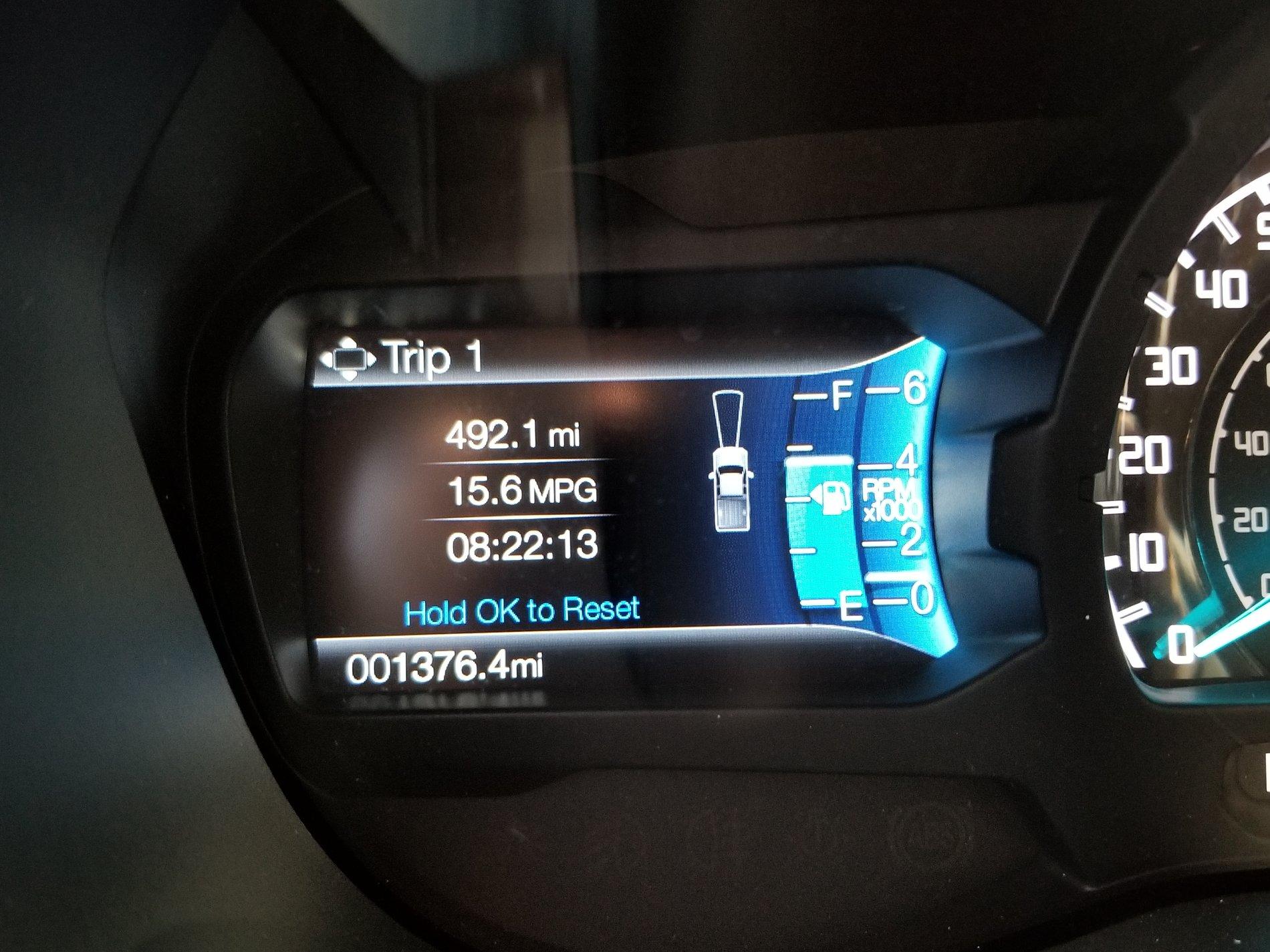
So I took my first road trip today. Maintained posted speed limits pretty much 70mph. As you can see..the ACTUAL mpg is nowhere NEAR the advertised! So far my only gripe with the truck..j/s

Did you check your tire pressure? Most of us seem to have overinflated tires from factory.

Andy
Well-Known Member
I’d take it in and get the tsb flashed with the updates fuel tables. What temperatures did you drive in during that trip?So I took my first road trip today. Maintained posted speed limits pretty much 70mph. As you can see..the ACTUAL mpg is nowhere NEAR the advertised! So far my only gripe with the truck..j/s

ToothRanger
Well-Known Member
- First Name
- Kyle
- Joined
- Feb 14, 2019
- Threads
- 5
- Messages
- 118
- Reaction score
- 181
- Location
- South Texas
- Vehicle(s)
- 2019 Ranger Lariat FX4
- Occupation
- D.D.S.
- Vehicle Showcase
- 1
Also, reset your trip odometer and try again. 492 miles on a single tank? Not with that MPG.
Your average MPG is being shown which includes all 492 miles of that current trip. You should really be calculating your MPG at the time of fill-up, and resetting your trip odometer after that so you also reset your average MPG. I have found my actual calculations are often a couple MPG lower than the car's computed avg MPG.
Moreover, auto start/stop is included with our vehicles for a reason. Anytime you're idling at a light you're wasting gas and getting crappy MPG. Not saying this was your scenario, but offering as a reason some might be getting crappy numbers.
Your average MPG is being shown which includes all 492 miles of that current trip. You should really be calculating your MPG at the time of fill-up, and resetting your trip odometer after that so you also reset your average MPG. I have found my actual calculations are often a couple MPG lower than the car's computed avg MPG.
Moreover, auto start/stop is included with our vehicles for a reason. Anytime you're idling at a light you're wasting gas and getting crappy MPG. Not saying this was your scenario, but offering as a reason some might be getting crappy numbers.
Last edited:
RangerKody
Well-Known Member
- First Name
- Kody
- Joined
- Feb 12, 2019
- Threads
- 5
- Messages
- 122
- Reaction score
- 110
- Location
- Orlando, FL
- Vehicle(s)
- 2019 Ford Ranger
- Vehicle Showcase
- 1
How would you know if you needed the updates?I’d take it in and get the tsb flashed with the updates fuel tables. What temperatures did you drive in during that trip?
Andy
Well-Known Member
If the truck was built before 2/11.How would you know if you needed the updates?
RangerKody
Well-Known Member
- First Name
- Kody
- Joined
- Feb 12, 2019
- Threads
- 5
- Messages
- 122
- Reaction score
- 110
- Location
- Orlando, FL
- Vehicle(s)
- 2019 Ford Ranger
- Vehicle Showcase
- 1
I guess since I bought it on 2/11 I qualify. HahaIf the truck was built before 2/11.
t4thfavor
Well-Known Member
My truck was born on 1/9, and it is getting great mileage. Overinflated tires would make the mileage better anyways. I'm thinking you may not have driven a turbocharged vehicle before. Even small stabs at the throttle, "cost" a ton in your mileage as the truck dumps lots of fuel in anticipation of boost. If those throttle events are short, that's a lot of extra fuel you're not actually burning, but still using. I still may go and get the PCM update, but currently I've not noticed any problems with the idle, even in the frozen north.
VAMike
Well-Known Member
Not necessarily: if it's causing the tires to bounce off bumps in the road and making the truck vibrate more, that takes energy and will reduce fuel economy. If more pressure were always better, you could just throw out the tires and run directly on the rims--they're stiffer than even overinflated tires--but unless you're running on a perfectly smooth surface (like a steel rail) that turns out to actually not work well.Overinflated tires would make the mileage better anyways.
t4thfavor
Well-Known Member
Been "concerned" with fuel mileage for a long time, I can tell you from 100's of thousands of miles of driving that harder tires always net extra economy. Solid tires would be best, but you'd need new kidneys after every drive.Not necessarily: if it's causing the tires to bounce off bumps in the road and making the truck vibrate more, that takes energy and will reduce fuel economy. If more pressure were always better, you could just throw out the tires and run directly on the rims--they're stiffer than even overinflated tires--but unless you're running on a perfectly smooth surface (like a steel rail) that turns out to actually not work well.
VAMike
Well-Known Member
No, they really would't be. Consider the case of a small rock on the road. Does it take more energy to squish a rubber tire over the rock, or to lift the entire vehicle over the rock on the solid wheel? There's a crossover point where the reduction in rolling resistance is outweighed by other losses. If it was just a matter of passenger comfort, and you could get dramatic fuel economy improvements with no downsides by running on solid wheels, you'd see automakers making them along with some kind of air bed suspension to decouple the passengers from the wheels. If you've never hit the crossover point, it just means your rated max pressure is low enough to keep you from reaching it. You've also apparently not hit the point where you start having issues keeping the car on the road because the tires are too stiff to make good contact, had pieces start breaking off the car from hitting a bump, etc.Been "concerned" with fuel mileage for a long time, I can tell you from 100's of thousands of miles of driving that harder tires always net extra economy. Solid tires would be best, but you'd need new kidneys after every drive.
t4thfavor
Well-Known Member
Agreed, I'm just stating it would take a crapload more pressure than the roughly 40PSI in those tires to start having to "lift" the vehicle over a rock, plus the suspension squishes up as well. my last Ranger would get 17MPG with the 35PSI and 20 with 40PSI in the tires. It's why you are seeing rock hard tires called "Low Rolling Resistance" on cars like the prius and the volt/bolt as well. The LRR tires are hard, and don't give nearly as much, similar to being over inflated.
uthunter
Well-Known Member
I'm only get 15.9 mpg on mine (4x4 FX4). I really don't think its my driving style.. my wife calls me "The Coaster" because I coast up to every stop light 
Do we have reason to believe the TSB for rough idle could be negatively affecting mileage (mine was built 12/19/18) or is that just a guess? Also, I keep hearing that they run rich for the first 1,000 miles (I'm at 480 miles) but is that factual or just a guess too? I haven't been able to find anything via Google searches on either of them.
Thanks for your help!
Do we have reason to believe the TSB for rough idle could be negatively affecting mileage (mine was built 12/19/18) or is that just a guess? Also, I keep hearing that they run rich for the first 1,000 miles (I'm at 480 miles) but is that factual or just a guess too? I haven't been able to find anything via Google searches on either of them.
Thanks for your help!
Sponsored


