Sponsored

Vibrations coming from under foot rest? Help

RangerFD

Well-Known Member
First Name
J
Joined
Jun 14, 2020
Threads
8
Messages
48
Reaction score
41
Location
Northern VA, United States
Vehicle(s)
2019 Ford Ranger
Occupation
Firefighter
Hey can someone help me out. When you get in your Ranger and drive around and your left foot rests on the foot rest, can you feel vibrations coming from underneath that area when the truck is in motion? I don’t know if this is normal or something is off. Thanks!
Sponsored
 

Tracy Bowman

Well-Known Member
First Name
Tracy
Joined
Apr 11, 2019
Threads
25
Messages
5,524
Reaction score
28,717
Location
Alabama
Vehicle(s)
2013 Hyundai Accent, 2001 Ford F-150, 2019 Ford Ranger FX4 Saber Lariat
Hey can someone help me out. When you get in your Ranger and drive around and your left foot rests on the foot rest, can you feel vibrations coming from underneath that area when the truck is in motion? I don’t know if this is normal or something is off. Thanks!
So far, 21,000 miles in, have not noticed anything.
 

Ace Holliday

Well-Known Member
First Name
Scott K
Joined
Apr 19, 2020
Threads
5
Messages
405
Reaction score
890
Location
South Kalifornikstan
Vehicle(s)
2019 Ranger XLT Super Crew
Occupation
Aerospace Machinist/CNC Programmer - Retired
Hey can someone help me out. When you get in your Ranger and drive around and your left foot rests on the foot rest, can you feel vibrations coming from underneath that area when the truck is in motion? I don’t know if this is normal or something is off. Thanks!
A bit more info would help. Does it happen all of the time? At certain speeds? Aftermarket wheels/tires?
 
OP
OP
RangerFD

RangerFD

Well-Known Member
First Name
J
Joined
Jun 14, 2020
Threads
8
Messages
48
Reaction score
41
Location
Northern VA, United States
Vehicle(s)
2019 Ford Ranger
Occupation
Firefighter
A bit more info would help. Does it happen all of the time? At certain speeds? Aftermarket wheels/tires?
It’s kinda random to be honest, no certain speed. (I know this doesn’t help) it’s almost like I can feel the tire on the road on the foot rest. I have stock tires, just a leveling kit installed.
 

P. A. Schilke

Well-Known Member
First Name
Phil
Joined
Apr 3, 2019
Threads
149
Messages
7,083
Reaction score
37,187
Location
GV Arizona
Vehicle(s)
2019 Ranger FX4 Lariat 4x4, 2020 Lincoln Nautilus, 2005 Alfa Motorhome
Occupation
Engineer Retired
Vehicle Showcase
1
It’s kinda random to be honest, no certain speed. (I know this doesn’t help) it’s almost like I can feel the tire on the road on the foot rest. I have stock tires, just a leveling kit installed.
Hi J,

When it is as you describe as coming and going and not a certain speed, It indicates a variable phasing issue which is most related to a tire out of balance. To some extent it would help if you could describe the frequency of the occurance. Today's techs in the dealership have the instrumentation to help identify these type of concerns by determining the frequency of the vibration. I might use an analogy of a twin prop plane where the rpm were out of phase by a few rpm. You get smooth that transitions to a slight vibration that increases in frequency and then transitions to smooth. Sometimes it is sound where you get something like this. ....rr.....rr....rrr....rrr..rrrr.rrrr..rrr...rr....rr...r...... We call this a beating moan in NVH terms. Pilot can kick one throttle just a tad to put one engine in phase.

Okay...a back story.... This was a 1978 Econoline E350 with 460 cid engine. Drive at any speed and you would get this above beating moan condition. Why? we had dual Thermactor air pumps on the engine to meet emissions. Each air pump had the same diameter pulley ratio and each air pump had three veins pumping air...so if both pumps had veins at 12 O'clock, 4 O'Clock and 8 O'Clock all was well. However, due to belt slippage and manufacturing tolerances on pulley diameter, one pump would get out of phase and you got this beating moan. It took me bit of time to figure out what was causing this issue, so recorded the sound and determined the frequency using an Fast Fourier Transform analyzer. Then by plotting an alignment diagram I discovered that the two pumps overlayed each other on the diagram except when out of phase. So I had the answer to the cause...but what was the fix? Well....the rule of thumb is separating the rpm of the two pumps by 10%...however...this required tooling up a new pulley but more importantly this modification had to pass EPA and California Emissions, which needed to be tested and data submitted to the government agencies. We had to machine a special set of reduced diameter pulleys for testing. All in all it took about 5 months to green light this change, but the good news was the 1978 customer from Job #1 on had the "fix" in place. I have to say this was quite a difficult nut to crack when faced with this issue, but we got it done to the benefit of the customer.

Okay...no jokes about beating moans...it is a auto industry NVH term....

Best,
Phil Schilke
Ranger Vehicle Engineering
Ford Motor Co. Retired


OP
OP
RangerFD

RangerFD

Well-Known Member
First Name
J
Joined
Jun 14, 2020
Threads
8
Messages
48
Reaction score
41
Location
Northern VA, United States
Vehicle(s)
2019 Ford Ranger
Occupation
Firefighter
You kn
Hi J,

When it is as you describe as coming and going and not a certain speed, It indicates a variable phasing issue which is most related to a tire out of balance. To some extent it would help if you could describe the frequency of the occurance. Today's techs in the dealership have the instrumentation to help identify these type of concerns by determining the frequency of the vibration. I might use an analogy of a twin prop plane where the rpm were out of phase by a few rpm. You get smooth that transitions to a slight vibration that increases in frequency and then transitions to smooth. Sometimes it is sound where you get something like this. ....rr.....rr....rrr....rrr..rrrr.rrrr..rrr...rr....rr...r...... We call this a beating moan in NVH terms. Pilot can kick one throttle just a tad to put one engine in phase.

Okay...a back story.... This was a 1978 Econoline E350 with 460 cid engine. Drive at any speed and you would get this above beating moan condition. Why? we had dual Thermactor air pumps on the engine to meet emissions. Each air pump had the same diameter pulley ratio and each air pump had three veins pumping air...so if both pumps had veins at 12 O'clock, 4 O'Clock and 8 O'Clock all was well. However, due to belt slippage and manufacturing tolerances on pulley diameter, one pump would get out of phase and you got this beating moan. It took me bit of time to figure out what was causing this issue, so recorded the sound and determined the frequency using an Fast Fourier Transform analyzer. Then by plotting an alignment diagram I discovered that the two pumps overlayed each other on the diagram except when out of phase. So I had the answer to the cause...but what was the fix? Well....the rule of thumb is separating the rpm of the two pumps by 10%...however...this required tooling up a new pulley but more importantly this modification had to pass EPA and California Emissions, which needed to be tested and data submitted to the government agencies. We had to machine a special set of reduced diameter pulleys for testing. All in all it took about 5 months to green light this change, but the good news was the 1978 customer from Job #1 on had the "fix" in place. I have to say this was quite a difficult nut to crack when faced with this issue, but we got it done to the benefit of the customer.

Okay...no jokes about beating moans...it is a auto industry NVH term....

Best,
Phil Schilke
Ranger Vehicle Engineering
Ford Motor Co. Retired
You know, not that you mention it, I did get a tire rotation very recently like under 200miles ago recently. Could that just be it? When I say vibration it’s nothing I can hear. It almost just feels like someone is very lightly tapping the underpart of my foot
 
OP
OP
RangerFD

RangerFD

Well-Known Member
First Name
J
Joined
Jun 14, 2020
Threads
8
Messages
48
Reaction score
41
Location
Northern VA, United States
Vehicle(s)
2019 Ford Ranger
Occupation
Firefighter
if you're tires are not uniformly worn, then you could get what Phil describes. especially after a tire rotation.
I was thinking road noise from the pavement surface, but then your tapping reference throws that way off on the frequency.

if it's tap tap tap....I'm thinking ifs not from your tire rotation. warped rotor maybe? big stone stuck in the treads?

I guess to rule that out, does the tap get faster when you go faster? slower when you slow down?
Yes it does when I get faster but it still isn’t a constant thing it comes and goes. I especially notice it when I’m coasting after accelerating.
 

jss81258

Well-Known Member
First Name
James
Joined
Jul 5, 2020
Threads
1
Messages
169
Reaction score
253
Location
Texas
Vehicle(s)
2020 Ford Ranger Lariat 4x4, 2004 Chevrolet Corvette Z06
Occupation
Fixed equipment inspector
Hi J,

When it is as you describe as coming and going and not a certain speed, It indicates a variable phasing issue which is most related to a tire out of balance. To some extent it would help if you could describe the frequency of the occurance. Today's techs in the dealership have the instrumentation to help identify these type of concerns by determining the frequency of the vibration. I might use an analogy of a twin prop plane where the rpm were out of phase by a few rpm. You get smooth that transitions to a slight vibration that increases in frequency and then transitions to smooth. Sometimes it is sound where you get something like this. ....rr.....rr....rrr....rrr..rrrr.rrrr..rrr...rr....rr...r...... We call this a beating moan in NVH terms. Pilot can kick one throttle just a tad to put one engine in phase.

Okay...a back story.... This was a 1978 Econoline E350 with 460 cid engine. Drive at any speed and you would get this above beating moan condition. Why? we had dual Thermactor air pumps on the engine to meet emissions. Each air pump had the same diameter pulley ratio and each air pump had three veins pumping air...so if both pumps had veins at 12 O'clock, 4 O'Clock and 8 O'Clock all was well. However, due to belt slippage and manufacturing tolerances on pulley diameter, one pump would get out of phase and you got this beating moan. It took me bit of time to figure out what was causing this issue, so recorded the sound and determined the frequency using an Fast Fourier Transform analyzer. Then by plotting an alignment diagram I discovered that the two pumps overlayed each other on the diagram except when out of phase. So I had the answer to the cause...but what was the fix? Well....the rule of thumb is separating the rpm of the two pumps by 10%...however...this required tooling up a new pulley but more importantly this modification had to pass EPA and California Emissions, which needed to be tested and data submitted to the government agencies. We had to machine a special set of reduced diameter pulleys for testing. All in all it took about 5 months to green light this change, but the good news was the 1978 customer from Job #1 on had the "fix" in place. I have to say this was quite a difficult nut to crack when faced with this issue, but we got it done to the benefit of the customer.

Okay...no jokes about beating moans...it is a auto industry NVH term....

Best,
Phil Schilke
Ranger Vehicle Engineering
Ford Motor Co. Retired
Hey Phil,

In another life, I worked with rotating equipment in a chemical plant, and did vibration analysis.

First, I'll say that I have no idea what a "bleating moan" is.

With imbalance, I suspect the two would become in phase when you feel the vibration. So, with the case of tires, we may balance them where each tire by itself is balanced acceptably. But, they might be just good enough. So we drive down the road and as long as they are out of phase on the same axle, we are all fat, dumb and happy. Then we drive through a curve, and the imbalance becomes in phase. Now, both tires are acting on the suspension, springs, frame etc at the same time. Even though they are on opposite sides, we are effectively doubling the energy. And, this can have other effects since we can get into resonance and harmonics.

Then we go through another curve, the tires become out of phase, and the felt vibration goes away.

If I thought tire imbalance was causing the problem, I would probably start by swapping a rear tire to the front to change the match up. I would be trying to get a change, either better or worse. This would confirm that the tire imbalance/phase is the problem, and then I might have the tires rebalanced.

Anyway, food for thought.
 

wanted33

Well-Known Member
First Name
Jim
Joined
Nov 18, 2018
Threads
12
Messages
2,191
Reaction score
7,227
Location
Down south in Dixie
Vehicle(s)
Mustang GT, Jeep Wrangler
Occupation
Old used up LEO
Yes it does when I get faster but it still isn’t a constant thing it comes and goes. I especially notice it when I’m coasting after accelerating.
A rock in the treads, or a nail/screw head you picked up on the road can make a varying clicking/tapping sound. The AT tires on my Jeep can pick up a boulder in those treads, and I get that all the time. It's an easy check to see if that's the problem. If that's not it I would take her to the dealer, or a local tire shop to check the balance on that tire.

Oh, and also. Like Ranger Pride said it could just be a little uneven wear showing up after you rotated the tires if the vibration wasn't there before the rotation. All things being equal before, the rotation could point to the change in tire positions being the culprit. Good luck, I hope it's nothing serious.
 
OP
OP
RangerFD

RangerFD

Well-Known Member
First Name
J
Joined
Jun 14, 2020
Threads
8
Messages
48
Reaction score
41
Location
Northern VA, United States
Vehicle(s)
2019 Ford Ranger
Occupation
Firefighter
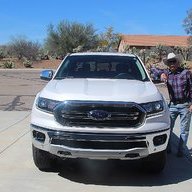
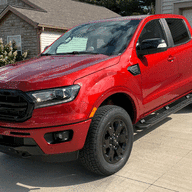
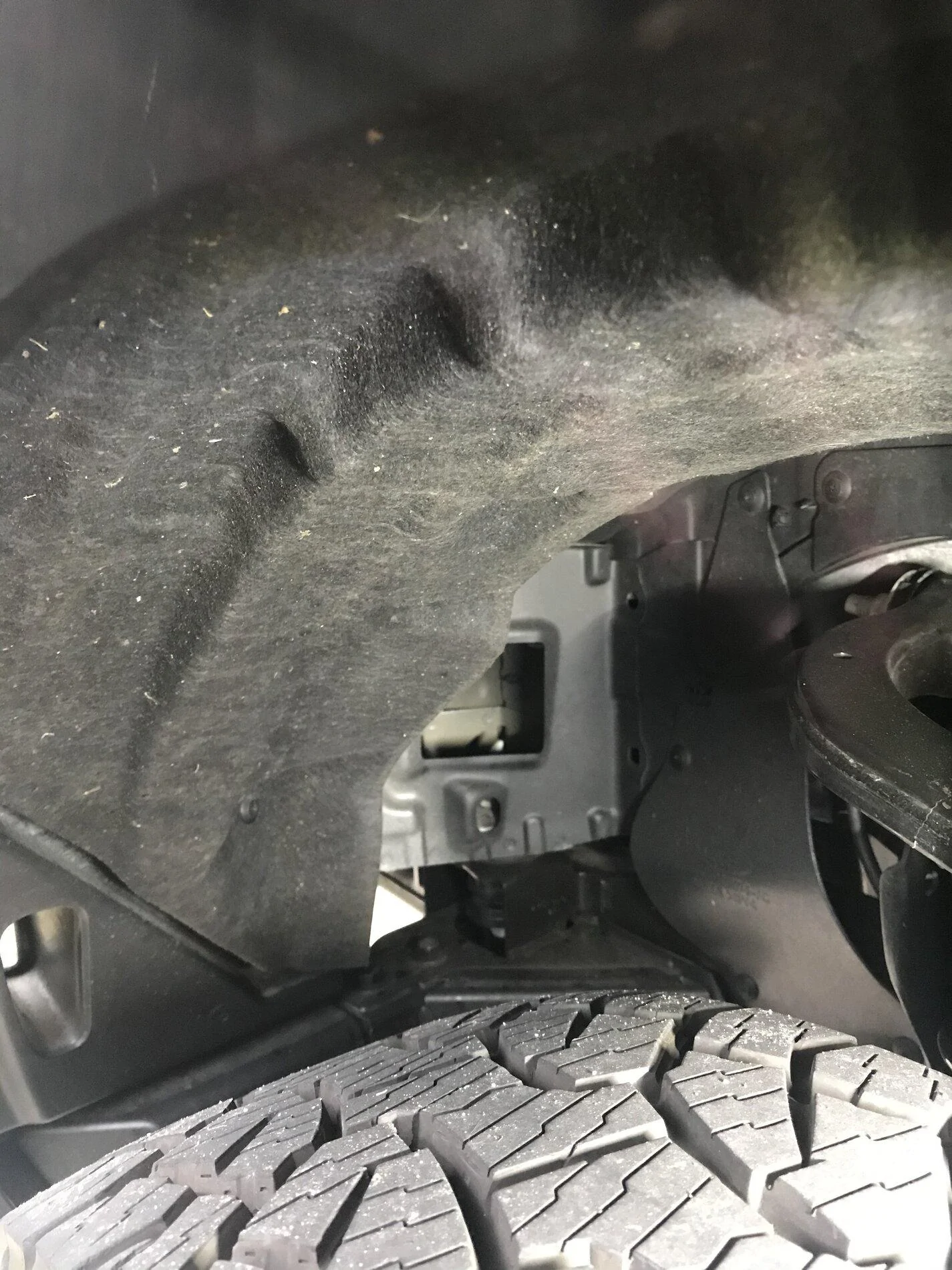
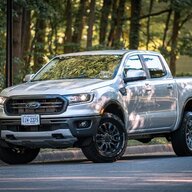
Can someone send me a picture of what the bottom left of there truck looks like? Towards the front above the tire.
F054728E-16E1-42F5-B247-8F5DB918F339.webp
Sponsored


Top