Sponsored

P139C Code

emesel

Well-Known Member
First Name
Mark
Joined
Mar 8, 2022
Threads
13
Messages
97
Reaction score
89
Location
New England
Vehicle(s)
2019 Ranger
Occupation
Engineer
I'm getting a P139C code with rough engine at low speeds. When I looked it up it says cracked hose or failed valve. Should I just assume it's the valve and replace it? Is it important to get OEM, or is something from Autozone ok (I usually buy OEM for things like brakes, etc)? Is it ok to drive in the meantime?
Thanks, Mark
Sponsored


RangerBill

Well-Known Member
First Name
Bob
Joined
Jun 8, 2022
Threads
3
Messages
1,848
Reaction score
2,588
Location
PA
Vehicle(s)
2019 Ford Ranger Lariat Super Crew FX4
Occupation
retired
I'm getting a P139C code with rough engine at low speeds. When I looked it up it says cracked hose or failed valve. Should I just assume it's the valve and replace it? Is it important to get OEM, or is something from Autozone ok (I usually buy OEM for things like brakes, etc)? Is it ok to drive in the meantime?
Thanks, Mark
From the shop manual:

P139C - EGR Sensor C Downstream Hose Off Or Plugged

Description:
At idle, the exhaust gas recirculation (EGR) monitor commands the EGR valve closed and checks the differential pressure across the EGR tube orifice which should be zero to indicate the hoses are connected and not restricted. This DTC sets when the differential pressure indicated by the sensor exceeds a maximum threshold or falls below a minimum threshold. Possible Causes:
  • The downstream hose is disconnected
  • The downstream hose is restricted
  • Restricted or damaged EGR tube
Diagnostic Aids: Look for signs of water or icing in the hose. Verify the hose connection and routing. Check the differential pressure feedback EGR sensor for correct mounting and function.

Check for the proper connection of the hoses to the EGR DPFE sensor. It could be a bad EGR DFPE sensor. It is about $20 at RockAuto.
The Standard Motor Products is the OEM manufacturer.
https://www.rockauto.com/en/catalog...sion,egr+pressure+feedback+(dpfe)+sensor,5088

Here is a thread on the replacement procedure:
https://www.ranger5g.com/forum/thre...mbly-replacement-write-up-lb5z-9j433-b.29247/
 
Last edited:
OP
OP

emesel

Well-Known Member
First Name
Mark
Joined
Mar 8, 2022
Threads
13
Messages
97
Reaction score
89
Location
New England
Vehicle(s)
2019 Ranger
Occupation
Engineer
Thanks RangerBill!
I just bought from Rock Auto; I don't know why I frequently forget about them.
An FYI, I checked a discounted online OEM Ford source: it was $132 discounted from around $200, which included bracket, hoses and clamps, but, still really expensive.
Thanks again, Mark
 

airline tech

Well-Known Member
Joined
Aug 24, 2022
Threads
28
Messages
4,663
Reaction score
8,939
Location
Midwest - KS
Vehicle(s)
2022 Ranger Lariat-Super Crew, Cactus Gray
Occupation
Aircraft Tech
From my (Detailed System Ops)

P139C - EGR Sensor C (DPFE) downstream hose off or plugged (Low > High)

During idle operation with EGR commanded closed, the PCM expects the pressure at the upstream (HI) and downstream (LO) reference ports of the DPFE sensor to equalize, resulting in a differential pressure near the learned KOEO baseline. The PCM continuously evaluates the DPFE signal for rationality and monitors for excessive negative differential pressure. If the DPFE signal remains below the calibrated lower limit of (−0.58 psi) for approximately 50 seconds, indicating a sustained pressure imbalance or sensor signal outside the physically plausible operating range, the PCM identifies the signal as invalid and sets DTC P139C.

P139C sets when the PCM detects the DPFE sensor signal remains below (−0.58 psi) for approximately 50 seconds during idle conditions with EGR commanded closed, indicating an implausibly low differential pressure and a fault in the DPFE sensor or pressure reference system.

Ref the (-0.58 psi) note this is well after the buck surge zone of (-0.35 to -0.45 psi) so this highlights why the buck surge issues are experienced before the P139C code sets.

P139C sets when

Using Learned Zero – Voltage & Pressure as Ref Values

So if using Learned Zero Ref of 1.48 volts = a voltage reading of about 0.96 to 1.07 volts will trigger the code

Trigger Time Duration = 50 Seconds

Trigger Pressure / Voltage – (-0.58 psi) / 0.41 to 0.52 volts

The monitor is a continuous monitor and monitors at Idle only, no EGR flow.

The monitor is a (Negative Imbalance - Monitor) - Low Pressure > High Pressure

P139C –Possible Causes

  • DPFE Sensor – internal bias failure (moisture)
  • DPFE Sensor – internal diaphragm damage
  • DPFE Sensor – electrical fault
  • High Pressure Hose / Port – restriction – blockage
  • Low Pressure Hose – leaking

Learned Zero Ref - Should be reading near (-0.06 psi and 1.48 volts).
It can bias out of tolerance and no issues, but when it nears (-0.30) its on the outer limits of reliable readings.

You will most likely find moisture in the (High Pressure) Hose, this creates a (Pressure Ref) imbalance and also over time it destroys the sensor membrane and it causes it to bias the DPFE electrically.
So if you have a scanner capable of reading the DPFE (Pressure and/or Voltage) PIDs
Compare - KOEO and KOER - Key On - Engine Off / Running
I suspect its not reading in a normal range.
 

RangerBill

Well-Known Member
First Name
Bob
Joined
Jun 8, 2022
Threads
3
Messages
1,848
Reaction score
2,588
Location
PA
Vehicle(s)
2019 Ford Ranger Lariat Super Crew FX4
Occupation
retired
Thanks RangerBill!
I just bought from Rock Auto; I don't know why I frequently forget about them.
An FYI, I checked a discounted online OEM Ford source: it was $132 discounted from around $200, which included bracket, hoses and clamps, but, still really expensive.
Thanks again, Mark
After the hoses are disconnected from the DPFE sensor, use low pressure air to blow out moisture from the hoses. You will need 2 hose clamps to use the replacement sensor, as the Standard Motor Products unit doesn't come with the hoses or bracket. You can reuse the bracket and hoses.


airline tech

Well-Known Member
Joined
Aug 24, 2022
Threads
28
Messages
4,663
Reaction score
8,939
Location
Midwest - KS
Vehicle(s)
2022 Ranger Lariat-Super Crew, Cactus Gray
Occupation
Aircraft Tech
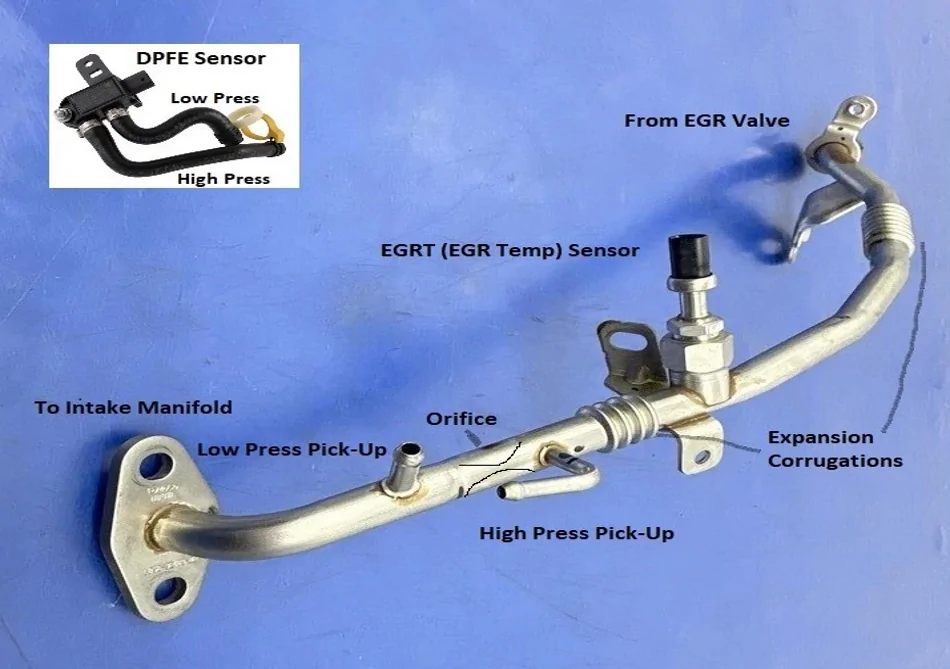
If you have (Air) in addition to the hoses - blow through the (Hi-Pressure) Pick Up - tube or use a piece of (safety wire) to ensure the tube is not blocked.
Moisture accumulates at this port and pushes into the hose and up to the sensor.

The (Orifice) creates a restriction point and the natural (moisture-vapor) can pass through the orifice as a vapor mist but once that vapor is condensed into a liquid it cannot pass through the restriction as easily and becomes trapped at that point –(On the upstream side of the orifice)


The (Upstream) reference port has (Hi-Pressure) but low velocity exhaust pressure when the EGR is flowing and the low velocity pressure is the reason why the moisture will (stall) at this point – the velocity of the flow is not fast enough to push the liquid moisture through the orifice restriction (in a liquid state) – some of the liquid vapor may be able to pass through but not easily and this is why the orifice become a (moisture trap)

Now add in - Soot (if present) in the tube mixing with the liquid moisture, presents a possibility of partially blocking the (Hi Pressure) port with a paste but as of now, I think only a few have had to replace the tube assembly and have not seen hard evidence that the system actually accumulates the soot in the tube.
Liquid Moisture have been proven, and it accumulates from a few factors acting on the exposed tube assembly
The exhaust temp - after the EGR Cooler (Dew Point), Engine Bay Temp and EGR Events (Duration) all factor in on the temp of the inner tube walls as the EGR Valve (Opens and Closes)
Then another factor is the (Temp of the Rubber Hose and the plastic housing of the DPFE)
The Rubber (Thermal Lag) and the Thermal Prosperities of the plastic housing - temperature variance can produce (Liquid Moisture)

1791613748906-id.webp
 
OP
OP

emesel

Well-Known Member
First Name
Mark
Joined
Mar 8, 2022
Threads
13
Messages
97
Reaction score
89
Location
New England
Vehicle(s)
2019 Ranger
Occupation
Engineer
From my (Detailed System Ops)

P139C - EGR Sensor C (DPFE) downstream hose off or plugged (Low > High)

During idle operation with EGR commanded closed, the PCM expects the pressure at the upstream (HI) and downstream (LO) reference ports of the DPFE sensor to equalize, resulting in a differential pressure near the learned KOEO baseline. The PCM continuously evaluates the DPFE signal for rationality and monitors for excessive negative differential pressure. If the DPFE signal remains below the calibrated lower limit of (−0.58 psi) for approximately 50 seconds, indicating a sustained pressure imbalance or sensor signal outside the physically plausible operating range, the PCM identifies the signal as invalid and sets DTC P139C.

P139C sets when the PCM detects the DPFE sensor signal remains below (−0.58 psi) for approximately 50 seconds during idle conditions with EGR commanded closed, indicating an implausibly low differential pressure and a fault in the DPFE sensor or pressure reference system.

Ref the (-0.58 psi) note this is well after the buck surge zone of (-0.35 to -0.45 psi) so this highlights why the buck surge issues are experienced before the P139C code sets.

P139C sets when

Using Learned Zero – Voltage & Pressure as Ref Values

So if using Learned Zero Ref of 1.48 volts = a voltage reading of about 0.96 to 1.07 volts will trigger the code

Trigger Time Duration = 50 Seconds

Trigger Pressure / Voltage – (-0.58 psi) / 0.41 to 0.52 volts

The monitor is a continuous monitor and monitors at Idle only, no EGR flow.

The monitor is a (Negative Imbalance - Monitor) - Low Pressure > High Pressure

P139C –Possible Causes

  • DPFE Sensor – internal bias failure (moisture)
  • DPFE Sensor – internal diaphragm damage
  • DPFE Sensor – electrical fault
  • High Pressure Hose / Port – restriction – blockage
  • Low Pressure Hose – leaking

Learned Zero Ref - Should be reading near (-0.06 psi and 1.48 volts).
It can bias out of tolerance and no issues, but when it nears (-0.30) its on the outer limits of reliable readings.

You will most likely find moisture in the (High Pressure) Hose, this creates a (Pressure Ref) imbalance and also over time it destroys the sensor membrane and it causes it to bias the DPFE electrically.
So if you have a scanner capable of reading the DPFE (Pressure and/or Voltage) PIDs
Compare - KOEO and KOER - Key On - Engine Off / Running
I suspect its not reading in a normal range.
Thanks, I'll check my scanner, but most of what you posted is over my head. Mark
 
OP
OP

emesel

Well-Known Member
First Name
Mark
Joined
Mar 8, 2022
Threads
13
Messages
97
Reaction score
89
Location
New England
Vehicle(s)
2019 Ranger
Occupation
Engineer
After the hoses are disconnected from the DPFE sensor, use low pressure air to blow out moisture from the hoses. You will need 2 hose clamps to use the replacement sensor, as the Standard Motor Products unit doesn't come with the hoses or bracket. You can reuse the bracket and hoses.
Thanks, I'll make sure to do this. It looks like a pretty easy replacement (after you get the spring clamps off).
Mark
 
OP
OP

emesel

Well-Known Member
First Name
Mark
Joined
Mar 8, 2022
Threads
13
Messages
97
Reaction score
89
Location
New England
Vehicle(s)
2019 Ranger
Occupation
Engineer
If you have (Air) in addition to the hoses - blow through the (Hi-Pressure) Pick Up - tube or use a piece of (safety wire) to ensure the tube is not blocked.
Moisture accumulates at this port and pushes into the hose and up to the sensor.

The (Orifice) creates a restriction point and the natural (moisture-vapor) can pass through the orifice as a vapor mist but once that vapor is condensed into a liquid it cannot pass through the restriction as easily and becomes trapped at that point –(On the upstream side of the orifice)


The (Upstream) reference port has (Hi-Pressure) but low velocity exhaust pressure when the EGR is flowing and the low velocity pressure is the reason why the moisture will (stall) at this point – the velocity of the flow is not fast enough to push the liquid moisture through the orifice restriction (in a liquid state) – some of the liquid vapor may be able to pass through but not easily and this is why the orifice become a (moisture trap)

Now add in - Soot (if present) in the tube mixing with the liquid moisture, presents a possibility of partially blocking the (Hi Pressure) port with a paste but as of now, I think only a few have had to replace the tube assembly and have not seen hard evidence that the system actually accumulates the soot in the tube.
Liquid Moisture have been proven, and it accumulates from a few factors acting on the exposed tube assembly
The exhaust temp - after the EGR Cooler (Dew Point), Engine Bay Temp and EGR Events (Duration) all factor in on the temp of the inner tube walls as the EGR Valve (Opens and Closes)
Then another factor is the (Temp of the Rubber Hose and the plastic housing of the DPFE)
The Rubber (Thermal Lag) and the Thermal Prosperities of the plastic housing - temperature variance can produce (Liquid Moisture)

1791613748906-id.webp
This all makes sense to me and is helpful. I was thinking I could use some string trimmer line to poke through the tube attachment points, but it seems there's no way to ensure the orifice is clear, correct?
Mark
Sponsored


Top