Sponsored

Low oil pressure warning

RangerBill

Well-Known Member
First Name
Bob
Joined
Jun 8, 2022
Threads
3
Messages
1,601
Reaction score
2,122
Location
PA
Vehicle(s)
2019 Ford Ranger Lariat Super Crew FX4
Occupation
retired
The most important clue here is the "control circuit" key word. If there was only a low reading from the oil pressure sensor, you would see the "Oil Pressure low" DTC. But the PCM is telling you that in addition to a low sensor reading, the 12V excitation (the control circuit) to the sensor is also out of limits (low), so it sets this DTC and not the "Oil Pressure Low" DTC.

Most sensors have several DTCs like this for any given sensor. They give a "sanity check" on a low reading. Other sanity checks exist, like the accelerator position sensor actually has two sensors in the same housing, and they have to match within a certain ratio limit, or this will set a DTC.

Very helpful for troubleshooting, as you can see.
(And as @Ranger Bill has so cleverly demonstrated.)
??️‍♂
Thank you.

While this is true for sensors, the F12 fuse is feeding power to control solenoids, not sensors, according to the shop wiring diagram. His DTC codes are all for control solenoids.
Sponsored

 
Last edited:

OP
OP

Shammy

Member
First Name
Doug
Joined
Jul 14, 2022
Threads
1
Messages
14
Reaction score
35
Location
Apex, NC USA
Vehicle(s)
2021 Ranger Tremor
Occupation
Investor, race car builder/driver
While this is true for sensors, the F12 fuse is feeding control solenoids, not sensors, according to the shop wiring diagram. His DTC codes are all for control solenoids.
Is that true for oil pressure? Is there a solenoid in the oil delivery system and what is its purpose? The fuse description says "oil pump" which I assumed was oil pressure sensor, because pls god the oil pump is mechanical and not electrically actuated, right?

I see the turbo bypass, cabin coolant, etc. solenoids on that circuit.
 

FunInTheSun

Well-Known Member
First Name
Dave
Joined
Jun 6, 2021
Threads
2
Messages
550
Reaction score
1,619
Location
South Florida
Vehicle(s)
2021 Ranger XL 4x4, STX, in Velocity Blue
Occupation
Engineer (Semi-Retired)
Vehicle Showcase
1
Thank you.

While this is true for sensors, the F12 fuse is feeding power to control solenoids, not sensors, according to the shop wiring diagram. His DTC codes are all for control solenoids.
You are correct. I didn't get to look up the exact meaning of the DTCs he listed, as I read the rest of the thread, and you had already done all the detective work. Brilliant job! This kind of help is one of the things that makes forums worth attending to.
 

RangerBill

Well-Known Member
First Name
Bob
Joined
Jun 8, 2022
Threads
3
Messages
1,601
Reaction score
2,122
Location
PA
Vehicle(s)
2019 Ford Ranger Lariat Super Crew FX4
Occupation
retired
Is that true for oil pressure? Is there a solenoid in the oil delivery system and what is its purpose? The fuse description says "oil pump" which I assumed was oil pressure sensor, because pls god the oil pump is mechanical and not electrically actuated, right?

I see the turbo bypass, cabin coolant, etc. solenoids on that circuit.
The electrical diagram shows a solenoid to control oil pressure, so the PCM does regulate oil pressure using a mechanical oil pump. (electrically actuated bypass valve?)
 

FunInTheSun

Well-Known Member
First Name
Dave
Joined
Jun 6, 2021
Threads
2
Messages
550
Reaction score
1,619
Location
South Florida
Vehicle(s)
2021 Ranger XL 4x4, STX, in Velocity Blue
Occupation
Engineer (Semi-Retired)
Vehicle Showcase
1
Is that true for oil pressure? Is there a solenoid in the oil delivery system and what is its purpose? The fuse description says "oil pump" which I assumed was oil pressure sensor, because pls god the oil pump is mechanical and not electrically actuated, right?

I see the turbo bypass, cabin coolant, etc. solenoids on that circuit.
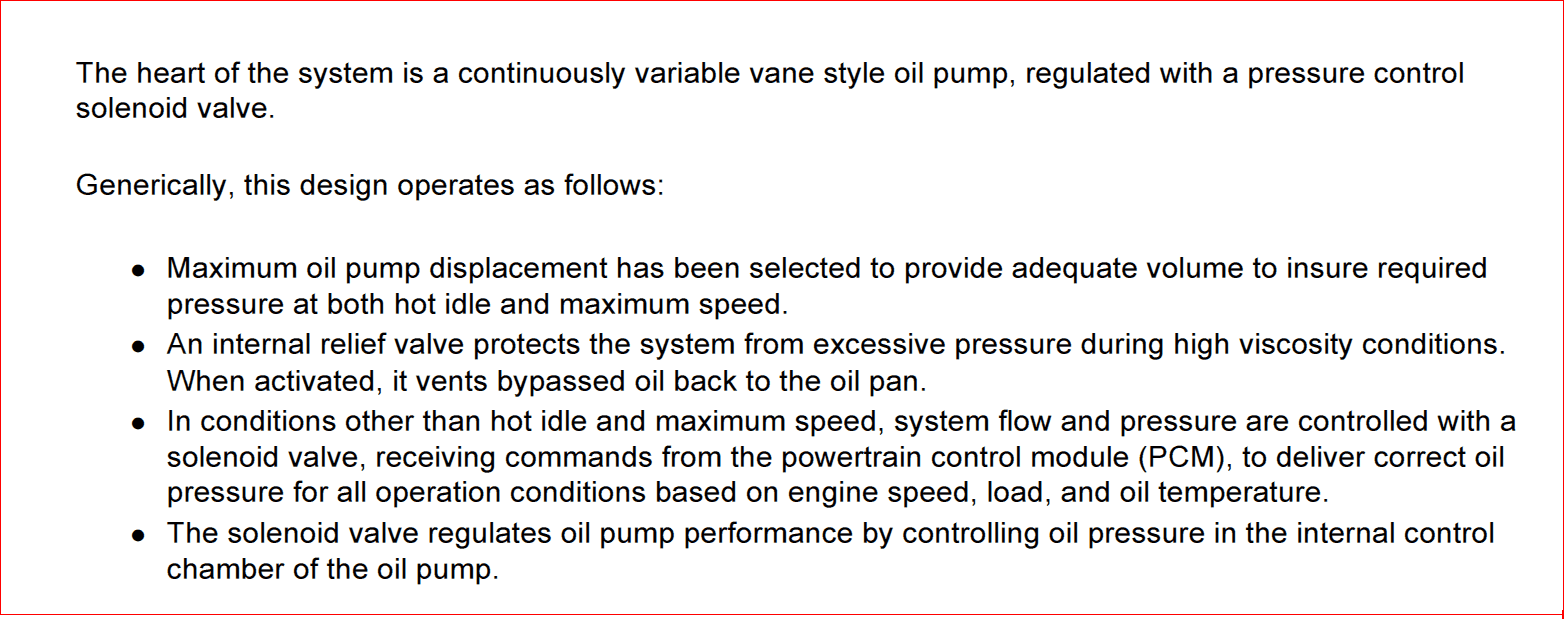
You guessed correctly. There is an engine-driven variable displacement oil pump and an oil pressure control solenoid. (From the Service Manual) ???

1673279139375.png


I believe the solenoid action reduces pressure when energized. So if the control circuit fails, the pump is at maximum displacement, and the mechanical pressure relief valve limits pressure to a safe value.


OP
OP

Shammy

Member
First Name
Doug
Joined
Jul 14, 2022
Threads
1
Messages
14
Reaction score
35
Location
Apex, NC USA
Vehicle(s)
2021 Ranger Tremor
Occupation
Investor, race car builder/driver
The electrical diagram shows a solenoid to control oil pressure, so the PCM does regulate oil pressure using a mechanical oil pump. (electrically actuated bypass valve?)
Maybe to reduce oil pressure for fuel economy?
You guessed correctly. There is an engine-driven variable displacement oil pump and an oil pressure control solenoid. (From the Service Manual) ???

1673279139375.png


I believe the solenoid action reduces pressure when energized. So if the control circuit fails, the pump is at maximum displacement, and the mechanical pressure relief valve limits pressure to a safe value.
Great info, thank you!
 

FunInTheSun

Well-Known Member
First Name
Dave
Joined
Jun 6, 2021
Threads
2
Messages
550
Reaction score
1,619
Location
South Florida
Vehicle(s)
2021 Ranger XL 4x4, STX, in Velocity Blue
Occupation
Engineer (Semi-Retired)
Vehicle Showcase
1
Maybe to reduce oil pressure for fuel economy?


Great info, thank you!
Positive displacement pumps deliver a specific volume of fluid on each revolution. slow speed, slow flow, high speed, high flow. Pressure is set by the system resistance. This is why whenever you use a positive displacement pump, there has to be a pressure relief (bypass) valve to limit system pressure. Otherwise a blockage will cause pressure to rise until something breaks.

Old school oiling systems (typically) size the fixed displacement pump to deliver sufficient oil volume at low speed without any bypassing, and the bypass valve sets the system pressure as the pump rpm rises. The bypass valve is usually sized (for safety) to accommodate the full output volume of the pump at max rpm. Oil pressure is set by the bypass valve spring rate and system resistance. Excessive oil delivered is shunted back to the pan.

With variable delivery systems, you can match requirements more closely, and as you correctly guessed, it is probably done to lower the parasitic drag of pumping oil that is just going to get bypassed back to the sump. Takes energy to turn a pump against resistance, so minimizing this makes a difference. So you have a small pump at low speed, and a larger pump at high speed, and it's just the right size everywhere in between. The magic of electronic controls.

Costs a little more to build and maintain a system with more sophisticated controls, but with EPA efficiency standards ever-rising, it is worth doing it to avoid ruinous fines if you fail to meet CAFE standards.
 

Jason B

Well-Known Member
First Name
Jason
Joined
May 19, 2021
Threads
9
Messages
3,009
Reaction score
8,320
Location
Louisiana
Vehicle(s)
2021 XL STX SE 4x2
Occupation
machinist
The 2.3 also uses oil pressure for the Ti-VCT:

" Variable Camshaft Timing (VCT) is an automobile variable valve timing technology developed by Ford. It allows for more optimum engine performance, reduced emissions, and increased fuel efficiency compared to engines with fixed camshafts. It uses electronically controlled hydraulic valves that direct high pressure engine oil into the camshaft phaser cavity. These oil control solenoids are bolted into the cylinder heads towards the front of the engine near the camshaft phasers. The powertrain control module (PCM) transmits a signal to the solenoids to move a valve spool that regulates the flow of oil to the phaser cavity. The phaser cavity changes the valve timing by rotating the camshaft slightly from its initial orientation, which results in the camshaft timing being advanced or retarded. The PCM adjusts the camshaft timing depending on factors such as engine load and RPM. "
 

got3fords

Well-Known Member
First Name
James
Joined
Apr 12, 2021
Threads
131
Messages
5,319
Reaction score
13,805
Location
22973
Vehicle(s)
2026 Marsh Gray Ranger Raptor, 1995 Harley XLH1200
Occupation
Mom Joke Professional
Received a low oil pressure warning on start up. Scanner revealed 5 codes:
- P06DB - engine oil pressure control circuit low
- P0034 - turbo bypass valve A control circuit low
- P06A0 - variable A/C compressor control circuit
- P2602 - coolant pump A control circuit low
- P2682 - engine coolant bypass valve A control circuit low

Gave her an oil change (some comments that oil nearing end of life could cause oil pressure issue on this engine), no joy. I also don't see any way to see actual oil pressure from PCM. I have a nice Autel MX808 scanner, the Ford app has no live data (that I can find anyway).

My first move would normally be swapping in a new oil pressure sensor but, only 12K on the truck and that's a lot of codes to all be secondary. Appreciate any experience, advice the community has on this.
With that fuse blown, was the truck still drivable?
 
OP
OP

Shammy

Member
First Name
Doug
Joined
Jul 14, 2022
Threads
1
Messages
14
Reaction score
35
Location
Apex, NC USA
Vehicle(s)
2021 Ranger Tremor
Occupation
Investor, race car builder/driver
The 2.3 also uses oil pressure for the Ti-VCT:

" Variable Camshaft Timing (VCT) is an automobile variable valve timing technology developed by Ford. It allows for more optimum engine performance, reduced emissions, and increased fuel efficiency compared to engines with fixed camshafts. It uses electronically controlled hydraulic valves that direct high pressure engine oil into the camshaft phaser cavity. These oil control solenoids are bolted into the cylinder heads towards the front of the engine near the camshaft phasers. The powertrain control module (PCM) transmits a signal to the solenoids to move a valve spool that regulates the flow of oil to the phaser cavity. The phaser cavity changes the valve timing by rotating the camshaft slightly from its initial orientation, which results in the camshaft timing being advanced or retarded. The PCM adjusts the camshaft timing depending on factors such as engine load and RPM. "
Yes, VCT uses oil pressure to operate (sorta like engine vacuum operated things). They are not an oil pressure management system afaik.
 
OP
OP

Shammy

Member
First Name
Doug
Joined
Jul 14, 2022
Threads
1
Messages
14
Reaction score
35
Location
Apex, NC USA
Vehicle(s)
2021 Ranger Tremor
Occupation
Investor, race car builder/driver
Fuse, you nailed it Bob. Thank you!!
UPDATE: No reoccurrence after replacing fuse. Early I know and yes, I’m jinxing myself by saying this. I’m now wondering if this is a current inrush issue where too many of the solenoids fired simultaneously on startup. Idk, just a theory.
 

RangerBill

Well-Known Member
First Name
Bob
Joined
Jun 8, 2022
Threads
3
Messages
1,601
Reaction score
2,122
Location
PA
Vehicle(s)
2019 Ford Ranger Lariat Super Crew FX4
Occupation
retired
UPDATE: No reoccurrence after replacing fuse. Early I know and yes, I’m jinxing myself by saying this. I’m now wondering if this is a current inrush issue where too many of the solenoids fired simultaneously on startup. Idk, just a theory.
That is good news. Although rare, fuses can be defective. I have even come across an intermittent fuse.
 

FunInTheSun

Well-Known Member
First Name
Dave
Joined
Jun 6, 2021
Threads
2
Messages
550
Reaction score
1,619
Location
South Florida
Vehicle(s)
2021 Ranger XL 4x4, STX, in Velocity Blue
Occupation
Engineer (Semi-Retired)
Vehicle Showcase
1
UPDATE: No reoccurrence after replacing fuse. Early I know and yes, I’m jinxing myself by saying this. I’m now wondering if this is a current inrush issue where too many of the solenoids fired simultaneously on startup. Idk, just a theory.
Although not likely in this case, contact resistance can case fuse failure. This is another slightly off-topic story from an old guy, so feel free to ignore this post.

I've only seen this in high-current fuses with big electrical loads (100 HP+ electrical motor), but it was pretty dramatic for me. Normal contact resistance for these big fuses and contacts is less than 0.001 ohms or so. This is not even measurable without specialized equipment, but if the fuse clips get corroded, and the resistance goes up to even 0.1 ohm (still not easily measurable with a typical multimeter), then the power dissipated at the contact point can be as high as (125 Amps squared times 0.1 ohms = ) 1,563 Watts. ???

This results in a rapid temperature rise, and the fuse literally cooks open just from the heat generated at the contacts. This amount of heat melted part of the fuse block and the spring clip lost its springiness, and the fuse literally disconnected from the block. The (easily measurable) voltage drop across this contact would be only 12.5 Volts at 125 Amps, so not enough to trip out any motor controls, etc.

But in a system where the source voltage is only 12 volts or so, even a tiny amount of resistance at the contacts in a high current circuit can drop nearly all the source voltage at the contact point, instead of at the starter motor, for instance. At 300 Amps, a contact resistance of 0.002 ohms will drop 6 volts, so if you only have 12 to start with, that only leaves 6 volts at the starter motor...

The practical takeaway from this is keep all contact surfaces smooth, clean and shiny. Especially in a high current circuit, like the lines to the starter and alternator. But even in a 15 Amp circuit, a resistance of 0.3 ohms will dissipate almost 70 watts, and produce a voltage drop of 4.5 Volts.

Blade fuse contacts are typically self-cleaning. When you stick the fuse in, the housing contact scrapes a shiny spot in the fuse blade, exposing brand new un-oxidized metal at the point of contact, so this is usually not too much of an issue, but it's worth paying attention to when installing a new fuse.

If you're still here, thanks for listening. You may continue doomscrolling ...
 
OP
OP

Shammy

Member
First Name
Doug
Joined
Jul 14, 2022
Threads
1
Messages
14
Reaction score
35
Location
Apex, NC USA
Vehicle(s)
2021 Ranger Tremor
Occupation
Investor, race car builder/driver
That is good news. Although rare, fuses can be defective. I have even come across an intermittent fuse.
Although not likely in this case, contact resistance can case fuse failure. This is another slightly off-topic story from an old guy, so feel free to ignore this post.

I've only seen this in high-current fuses with big electrical loads (100 HP+ electrical motor), but it was pretty dramatic for me. Normal contact resistance for these big fuses and contacts is less than 0.001 ohms or so. This is not even measurable without specialized equipment, but if the fuse clips get corroded, and the resistance goes up to even 0.1 ohm (still not easily measurable with a typical multimeter), then the power dissipated at the contact point can be as high as (125 Amps squared times 0.1 ohms = ) 1,563 Watts. ???

This results in a rapid temperature rise, and the fuse literally cooks open just from the heat generated at the contacts. This amount of heat melted part of the fuse block and the spring clip lost its springiness, and the fuse literally disconnected from the block. The (easily measurable) voltage drop across this contact would be only 12.5 Volts at 125 Amps, so not enough to trip out any motor controls, etc.

But in a system where the source voltage is only 12 volts or so, even a tiny amount of resistance at the contacts in a high current circuit can drop nearly all the source voltage at the contact point, instead of at the starter motor, for instance. At 300 Amps, a contact resistance of 0.002 ohms will drop 6 volts, so if you only have 12 to start with, that only leaves 6 volts at the starter motor...

The practical takeaway from this is keep all contact surfaces smooth, clean and shiny. Especially in a high current circuit, like the lines to the starter and alternator. But even in a 15 Amp circuit, a resistance of 0.3 ohms will dissipate almost 70 watts, and produce a voltage drop of 4.5 Volts.

Blade fuse contacts are typically self-cleaning. When you stick the fuse in, the housing contact scrapes a shiny spot in the fuse blade, exposing brand new un-oxidized metal at the point of contact, so this is usually not too much of an issue, but it's worth paying attention to when installing a new fuse.

If you're still here, thanks for listening. You may continue doomscrolling ...
I expect you're correct Dave, not likely. I thought about finding the amp ratings on all the solenoids on that circuit and add them up. There are a bunch. Not sure that data exists outside of having the parts in your hand. I assume that these parts are rated by actuation current, not energized current but not 100% sure about that either. Anyway, I'm totally in wondering over a beer zone here, which is not all bad.

Again, thanks to all for your help. End of thread unless the problem resurfaces.
Sponsored


Top