
Sponsored

Fan speed turning down on its own

airline tech

Well-Known Member
Joined
Aug 24, 2022
Threads
28
Messages
4,651
Reaction score
8,910
Location
Midwest - KS
Vehicle(s)
2022 Ranger Lariat-Super Crew, Cactus Gray
Occupation
Aircraft Tech
Plus:

In any other mode - other than Max AC - can you get the fan speed to operate at (Full Speed) and it maintain that speed (amp draw) - we know that you see it in Max AC and state it drops back to the speed prior to you selecting (Max AC) which tells me you are not a full speed -when selecting.

Is the blower motor (quiet) or do you hear any kind of noise - out of normal
Sponsored

 
OP
OP
GreyAreaRanger

GreyAreaRanger

Well-Known Member
Joined
Jul 25, 2023
Threads
11
Messages
288
Reaction score
479
Location
Houston
Vehicle(s)
2019 Ford Ranger XLT
Occupation
Surgical Nurse
Since you have Forscan, scan for any DTCs.
Just scanned today, and no DTCs at this time
You may have a fan control switch that is intermittently making contact when you go over bumps. You could try tapping on the dash area near the fan speed controls and see if it changes the speed. It may also show up as a DTC code if the switch is acting up.
I know how I must look smacking (slight exaggeration) the dash while going down the road, but so far it does not appear to make any changes while driving and tapping the dash.
Out of curiosity, does the AC compressor stay engaged?
As far as I can tell. Air still blows cold, just reduces fan speed.
Plus:

In any other mode - other than Max AC - can you get the fan speed to operate at (Full Speed) and it maintain that speed (amp draw) - we know that you see it in Max AC and state it drops back to the speed prior to you selecting (Max AC) which tells me you are not a full speed -when selecting.

Is the blower motor (quiet) or do you hear any kind of noise - out of normal
No abnormal noises that I can hear, but I have been wearing hearing aids since I was 6 years old. It will go to full speed when I turn on Max AC, and I will leave it there for my entire drive, as it is over 100 degrees here, but it will randomly reduce the fan speed to the setting prior to Max AC being selected. Another interesting note: if Max AC is already on when I start the truck, it will not reduce the fan speed. Discovered this the other night when driving across Houston at 3 in the afternoon and again yesterday.
 

TJC

Well-Known Member
First Name
Tony
Joined
Aug 28, 2020
Threads
47
Messages
4,141
Reaction score
10,578
Location
North Carolina
Vehicle(s)
93 Miata, 05 Ranger 4x4, 20 Ranger 4x4, 23 CX-5
Just scanned today, and no DTCs at this time

I know how I must look smacking (slight exaggeration) the dash while going down the road, but so far it does not appear to make any changes while driving and tapping the dash.

As far as I can tell. Air still blows cold, just reduces fan speed.

No abnormal noises that I can hear, but I have been wearing hearing aids since I was 6 years old. It will go to full speed when I turn on Max AC, and I will leave it there for my entire drive, as it is over 100 degrees here, but it will randomly reduce the fan speed to the setting prior to Max AC being selected. Another interesting note: if Max AC is already on when I start the truck, it will not reduce the fan speed. Discovered this the other night when driving across Houston at 3 in the afternoon and again yesterday.
I'm beginning to think it is normal behavior, Programming... I leave my AC on Max all the time and it never changes. I think I've seen my truck behave in a similar way when not on Max. It may reach the target temp and then stabilize it kicking the fan on/off when needed to maintain temp targets.
 
OP
OP
GreyAreaRanger

GreyAreaRanger

Well-Known Member
Joined
Jul 25, 2023
Threads
11
Messages
288
Reaction score
479
Location
Houston
Vehicle(s)
2019 Ford Ranger XLT
Occupation
Surgical Nurse
I'm beginning to think it is normal behavior, Programming... I leave my AC on Max all the time and it never changes. I think I've seen my truck behave in a similar way when not on Max. It may reach the target temp and then stabilize it kicking the fan on/off when needed to maintain temp targets.
Even with manual controls? My xlt has the base ac options and 4" radio screen. I did see a comment from Airline Tech in another post that suggests that I need to check my freon levels in my ride as my output temps are usually 75 degrees or so when its 90+ degrees outside
 

TJC

Well-Known Member
First Name
Tony
Joined
Aug 28, 2020
Threads
47
Messages
4,141
Reaction score
10,578
Location
North Carolina
Vehicle(s)
93 Miata, 05 Ranger 4x4, 20 Ranger 4x4, 23 CX-5
Even with manual controls? My xlt has the base ac options and 4" radio screen. I did see a comment from Airline Tech in another post that suggests that I need to check my freon levels in my ride as my output temps are usually 75 degrees or so when its 90+ degrees outside
I have no idea how the 4" screen version with "manual controls" work. I'm putting on my engineering cap now and making an unverified statement (and assumption that may very well be incorrect).

Ford, being as frugal as they are, wouldn't change the underlying hardware and behavior of the system, they would simply choose set points for each manual control of the AC. They would use the identical logic of the AC system and controls, just give you a knob to set them rather then a touch screen with a fancy feedback. Overall, functional behavior would be the same.

The temperature of the air could be caused by at least 3 different variables, outside air mixing incorrectly, dirty condenser/radiator, or low charge. Normal output air temps in MAX measured 2"-3" inside the opening should be much colder than 75F.

if you're testing on a typical hot day:
  • 90–95°F ambient: I'd expect roughly 45–55°F from the center vent after the system stabilizes.
  • 95–100°F+: roughly 48–58°F can still be perfectly reasonable.
  • 60°F+ vent temperature in ~95°F weather is on the edge, and it is time to start investigating.
  • 65–70°F+ is a strong indication that something isn't right.
I don't know how you measured the temp, but if you used an IR thermometer, you may be measuring the vent ductwork temps instead of the actual air temp. I use a digital thermometer with a temperature probe (a thermocouple) placed 2" into the vent that does not touch the ducts.

You can still use an IR thermometer if you can test another known working Ranger and use the results as a baseline. Or simply use the IR thermometer knowing that it may be reading high, and clean the condenser/radiator and see of the temps drop any at all.

Without getting too complicated, vent temperature + low/high refrigerant pressures + ambient temperature + humidity + condenser airflow, all enter into the equation. Usually low refrigerant levels will lead to the compressor cycling much more often.

I test my AC this way:
  1. Test in the shade if possible. Don't test immediately after the truck has been sitting in the sun.
  2. Start the engine and let it reach normal operating temperature.
  3. Close all windows and doors.
  4. Set the climate control to (these Ford settings) :
    • MAX A/C
    • Temperature LO
    • Recirculation ON
    • Air directed through the center dash vents
    • Blower on high
  5. Put a thermometer probe 2" - 3" directly into the center dash vent, and don't let the probe touch the plastic.
  6. Let the A/C run for at least 5–10 minutes. I actually drive my truck at a constant speed, say 45mph or better for 10 minutes first, because airflow through the condenser while driving gives me a more accurate test.
  7. Record:
    • Outside temperature
    • Vent temperature
    • Relative humidity
    • Engine coolant temperature, if you have a scan tool
  8. Take readings every minute and watch where the vent temperature stabilizes.
If you still come back >= to 60F I'd begin by looking at the condenser and radiator to insure you've got adequate air flow. And don't use a power washer to clean it, too high water pressure will bend the fins and make matters worse. If you find mud or debris, blow it out back the way it came in, and be patient if the mud has hardened, it takes time for running water to soften caked on mud. Resist the urge to remove the mud rapidly.

Once you know the condenser and radiator are clean, retest the AC air temp using the exact process. You want definable repeatable testing, which will reward you with accurate results.

If you do not have a thermometer (or digital VOM meter with the function), with a probe, you can use an inexpensive thermometer like this to do the job. it's ~$8.50. Or these 3 smaller thermometers for almost the same price - $8.99. I prefer the smaller size.

One more useful tidbit... If your A/C is:

Cold while driving and warmer at idle. It is suggestive of an airflow problem, such as a dirty condenser, cooling fan issue, or condenser airflow restriction.

If it's warm both at idle and while driving, then refrigerant charge, compressor operation, expansion valve, blend door, etc. become more likely to be the culprit.

Hope some of this helps.
 
Last edited:


OP
OP
GreyAreaRanger

GreyAreaRanger

Well-Known Member
Joined
Jul 25, 2023
Threads
11
Messages
288
Reaction score
479
Location
Houston
Vehicle(s)
2019 Ford Ranger XLT
Occupation
Surgical Nurse
I have no idea how the 4" screen version with "manual controls" work. I'm putting on my engineering cap now and making an unverified statement (and assumption that may very well be incorrect).

Ford, being as frugal as they are, wouldn't change the underlying hardware and behavior of the system, they would simply choose set points for each manual control of the AC. They would use the identical logic of the AC system and controls, just give you a knob to set them rather then a touch screen with a fancy feedback. Overall, functional behavior would be the same.

The temperature of the air could be caused by at least 3 different variables, outside air mixing incorrectly, dirty condenser/radiator, or low charge. Normal output air temps in MAX measured 2"-3" inside the opening should be much colder than 75F.

if you're testing on a typical hot day:
  • 90–95°F ambient: I'd expect roughly 45–55°F from the center vent after the system stabilizes.
  • 95–100°F+: roughly 48–58°F can still be perfectly reasonable.
  • 60°F+ vent temperature in ~95°F weather is on the edge, and it is time to start investigating.
  • 65–70°F+ is a strong indication that something isn't right.
I don't know how you measured the temp, but if you used an IR thermometer, you may be measuring the vent ductwork temps instead of the actual air temp. I use a digital thermometer with a temperature probe (a thermocouple) placed 2" into the vent that does not touch the ducts.

You can still use an IR thermometer if you can test another known working Ranger and use the results as a baseline. Or simply use the IR thermometer knowing that it may be reading high, and clean the condenser/radiator and see of the temps drop any at all.

Without getting too complicated, vent temperature + low/high refrigerant pressures + ambient temperature + humidity + condenser airflow, all enter into the equation. Usually low refrigerant levels will lead to the compressor cycling much more often.

I test my AC this way:
  1. Test in the shade if possible. Don't test immediately after the truck has been sitting in the sun.
  2. Start the engine and let it reach normal operating temperature.
  3. Close all windows and doors.
  4. Set the climate control to (these Ford settings) :
    • MAX A/C
    • Temperature LO
    • Recirculation ON
    • Air directed through the center dash vents
    • Blower on high
  5. Put a thermometer probe 2" - 3" directly into the center dash vent, and don't let the probe touch the plastic.
  6. Let the A/C run for at least 5–10 minutes. I actually drive my truck at a constant speed, say 45mph or better for 10 minutes first, because airflow through the condenser while driving gives me a more accurate test.
  7. Record:
    • Outside temperature
    • Vent temperature
    • Relative humidity
    • Engine coolant temperature, if you have a scan tool
  8. Take readings every minute and watch where the vent temperature stabilizes.
If you still come back >= to 60F I'd begin by looking at the condenser and radiator to insure you've got adequate air flow. And don't use a power washer to clean it, too high water pressure will bend the fins and make matters worse. If you find mud or debris, blow it out back the way it came in, and be patient if the mud has hardened, it takes time for running water to soften caked on mud. Resist the urge to remove the mud rapidly.

Once you know the condenser and radiator are clean, retest the AC air temp using the exact process. You want definable repeatable testing, which will reward you with accurate results.

If you do not have a thermometer (or digital VOM meter with the function), with a probe, you can use an inexpensive thermometer like this to do the job. it's ~$8.50. Or these 3 smaller thermometers for almost the same price - $8.99. I prefer the smaller size.

One more useful tidbit... If your A/C is:

Cold while driving and warmer at idle. It is suggestive of an airflow problem, such as a dirty condenser, cooling fan issue, or condenser airflow restriction.

If it's warm both at idle and while driving, then refrigerant charge, compressor operation, expansion valve, blend door, etc. become more likely to be the culprit.

Hope some of this helps.
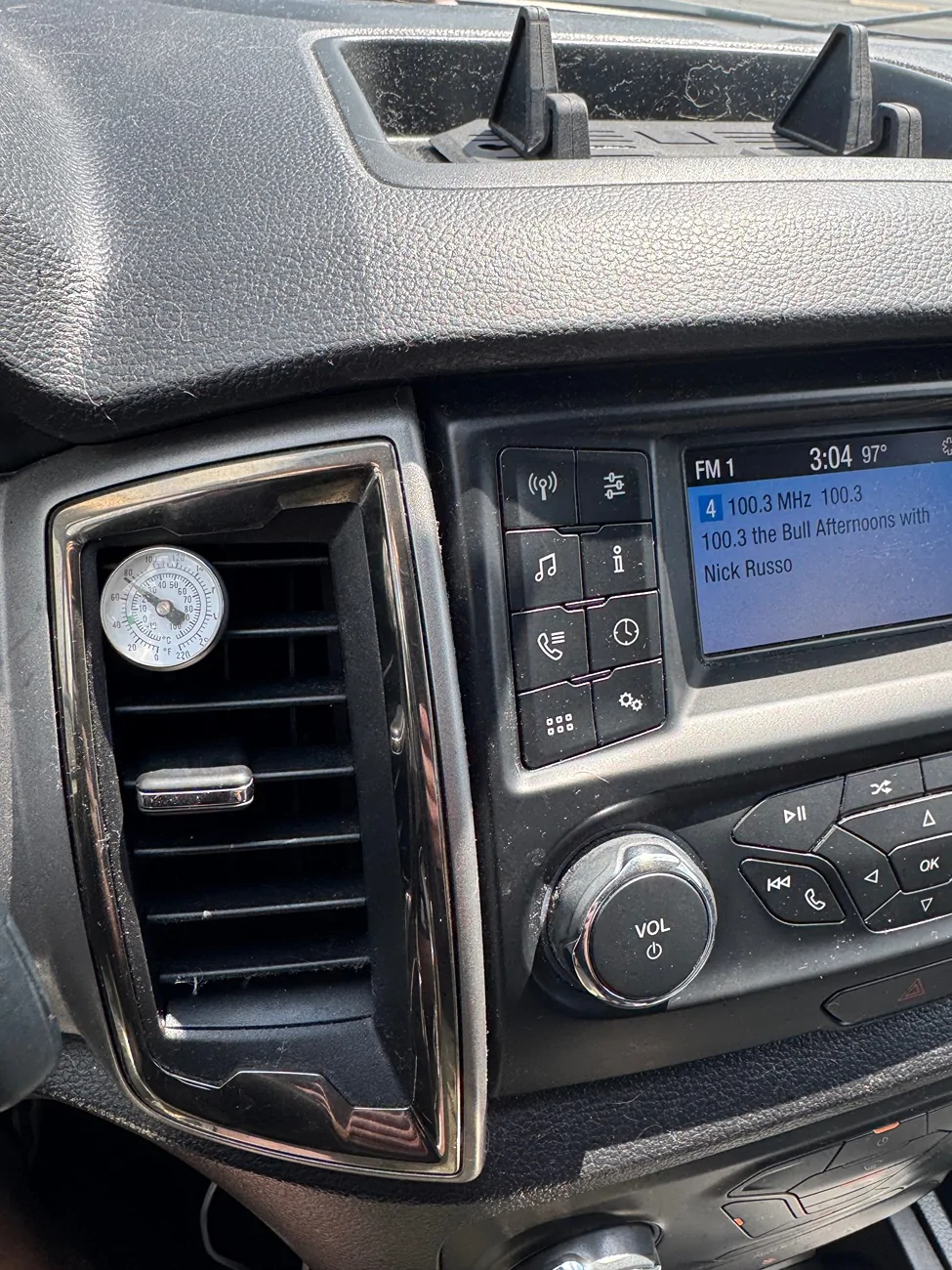
This is the temp at idle when it’s 97°F out and thermometer is showing almost 80. Why test it in the shade? That’s the only part that makes no sense to me
IMG_1807.webp

Edit to add: This is the thermometer that I use
 
Last edited:

airline tech

Well-Known Member
Joined
Aug 24, 2022
Threads
28
Messages
4,651
Reaction score
8,910
Location
Midwest - KS
Vehicle(s)
2022 Ranger Lariat-Super Crew, Cactus Gray
Occupation
Aircraft Tech
This is the temp at idle when it’s 97°F out and thermometer is showing almost 80. Why test it in the shade? That’s the only part that makes no sense to me
IMG_1807.webp

Edit to add: This is the thermometer that I use
Because the (Test) parameters (pressures) etc are set with a controlled environment of - Ambient Temps + Humidity (Ranges) - Direct sunlight can skew the results
but for that reading - its either slightly low on freon or the condenser is clogged with debris, this still does not explain the blower speed drop on its own

Would be curious what the AC Press PID is reading
 
OP
OP
GreyAreaRanger

GreyAreaRanger

Well-Known Member
Joined
Jul 25, 2023
Threads
11
Messages
288
Reaction score
479
Location
Houston
Vehicle(s)
2019 Ford Ranger XLT
Occupation
Surgical Nurse
Because the (Test) parameters (pressures) etc are set with a controlled environment of - Ambient Temps + Humidity (Ranges) - Direct sunlight can skew the results
but for that reading - its either slightly low on freon or the condenser is clogged with debris, this still does not explain the blower speed drop on its own

Would be curious what the AC Press PID is reading
Gotcha, and as for the PID reading, I seem to be the most inept person for trying to access that information. I have a Bluetooth OBD reader that can read that data, but I'm not sure how to select and view the right one. Due to the leak in the line, I do have an appointment set for Monday and have included my observations about the fan speed, since I still have coverage under my extended warranty for now.
Sponsored


Top