
woodworker
Well-Known Member
Are you on LHD7.?Thank You
Sponsored

Are you on LHD7.?
LHD7 ?Are you on LHD7.?
You answered my question.LHD7 ?


antifreeze in the container.
The neg test - has me scratching my head as well,Airline Tech,
FWIW, I think that you are correct in your analysis.
Question for the owner... Has the truck ever suffered from being overheated prior to this issue?
From the video, I can see air being pushed out into the overflow tank (I am assuming the overflow tank is part of the closed coolant system, not vented). That generally means head gasket blown (warped heads) or cracked heads/block.
Loose hoses would typically be expelling fluid when under pressure, unless they are on a negative low pressure point. And offhand, I can't think of an instance where that would occur.
Are there any other secondary functions tied into the cooling system that could allow air into the system if they were compromised? Perhaps lines to/from transmission cooler (if a secondary coolant thermostat is involved), or EGR Exhaust types of cooler on the truck? (I'm throwing darts here...)
The lack of combustion gases in the coolant is a real head scratcher.
Whatever and wherever the leak is, the pressure must be greater than the cooling system pressure to enter the cooling system. Otherwise, you'd be seeing coolant external to the engine. And all we are seeing is pressure building in the coolant system, and the changes in coolant temps indicating air being collected/trapped in the system.
My old v8 GM diesel loved to blow head gaskets, and I'd see serious bubbling in the overflow tank, but those were large gasket failures between the combustion chamber and the coolant jackets adjacent to the cylinders. The first symptoms were temporary coolant temp spikes, which as things progressed, turned into serious steady overheating, and serious boiling of the coolant in the overflow tank (which was vented and would puke on the ground).
I became very proficient at changing heads/gaskets on that car.
It is a real possibility.The more I think about this:
Previous (CO2) Test Fail
It's not a violent (Press) burp
Exhaust Pressure in the (EGR Cooler) closely matches (Cooling Sys Pressures) w/o Turbo and slightly elevated with Turbo-Boost
Brings me to the conclusion - it's not the Pistons it's the EGR Cooler - and would explain why it appears as a slow leak or pressure offset.
Makes more logical sense than the Piston Pressure as it's a much greater pressure and would provide the (More Notable - aggressive violent Burps)
Is it viscous clutch fan or electric? Once warm the fan should cycle off/on as the engine heats up. If it is not cycling, the viscous clutch may have failed.A friend told me that maybe the fan isn't cooling enough.
The fan is constantly running at idle, I tried to stop it while the engine was cold and I managed to do it without much resistance. I also did the same thing when the temperature was close to operating temperature and the same thing, I stopped the fan, I don't know if that should be possible.
By the way, when I did the Co2 test, the fluid at idle was still, but when I stepped on the gas, the pressure pulled it in and not out.
Elektric or ?Is it viscous clutch fan or electric? Once warm the fan should cycle off/on as the engine heats up. If it is not cycling, the viscous clutch may have failed.
When first starting our USA Rangers, the fan clutch cycles on and our truck sounds like a multi-ton diesel truck for a few seconds as the rush of air is quite loud, even in the cab with the windows up.
Your friend may very well be correct!
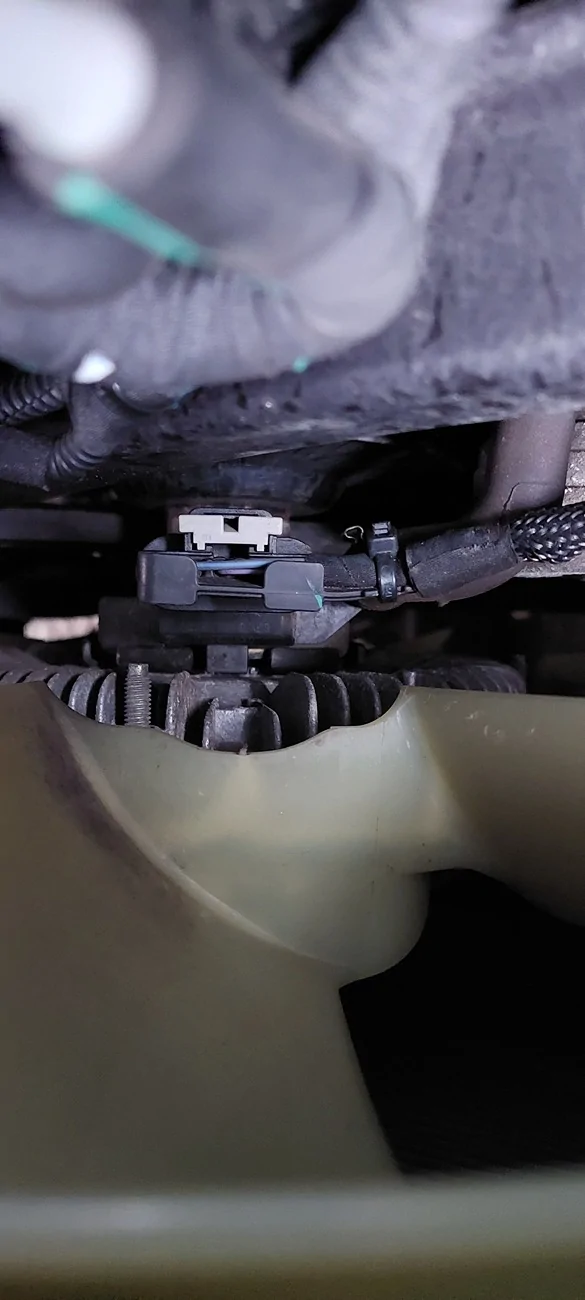
Its electro viscous - its not a true electric fan, its pulse width modulated (PWM) controlled by the PCM Its still a clutch fan style - only instead of a thermal spring it has the PCM controlling the speed via a VREF circuit -I do not think this is your issue.Elektric or ?


