beetlespin
Well-Known Member
Just hitch up a boat or load up the bed.
It is a truck and not a car
It is a truck and not a car
Sponsored

I feel your pain here, my crew cab 1/2 ton was a plush ride... and I do miss those big couch cushion seats. But I think Ford has been on the mark for the past 4 years or so as far as making a cockpit for real drivers. The seats may not be as comfortable but they hug you, the contoured steering wheel feels great and you can see absolutely everything around you. But I may have some extra cushion put in the seats when I have them reupholsteredNone are as comfortable as the full size Chevy 1/2 ton I just sold. Getting use to and comfortable in my new Ranger and shorter cloth seats.


I've been driving 4x4 mid sized trucks since 1997. What I've found is that light truck tires need to be rotated every 4,000 miles to minimize cupping and severe wear patterns. That's why I've always changed oil at 8,000 miles too.I’ve noticed/ been yelled at by our tire shop that 10k is too long of an interval for tire rotation with truck/all terrain/mud tires. They have told me 5k is good and as a general rule, the more space between tread blocks, the shorter the interval. Regardless of how you drive you will get cupping and at a certain point it’s hard for the tire to recover. Find out if they rebalanced when rotated, with bigger tires with more tread, uneven wear can happen quickly and unbalance even a brand new tire. If they didn’t, rebalancing the tires may help.

Hi John,I've been driving 4x4 mid sized trucks since 1997. What I've found is that light truck tires need to be rotated every 4,000 miles to minimize cupping and severe wear patterns. That's why I've always changed oil at 8,000 miles too.
As for the tire air pressure, follow what is specified on the drivers side door jamb. That's the ideal pressure for your specific truck / tire combination. SuperCab vs SuperCrew, 16" vs 17" vs 18", FX4 vs std 4x4... they all will have different pressures specified.
The dealers do a horrible job of ensuring that the tire pressures are correct. When we picked up our SuperCab Ranger last Saturday (9-14-19), it had 50 psi in the 265/65R17 Hankook tires. Door sticker specifies 38 psi.
I learned from experience that anything more, or less, than what's on the door sticker will lead to premature tire wear. That being said, if I'm towing or hauling a load, I will up the air pressure accordingly, based on the weight on the truck.
I'm considering throwing a couple 80 lb sandbags in the bed, back behind the rear wheel wells near the tailgate... I'm betting that will help the ride immensely. When we were searching for our Ranger a local dealer let us drive a SuperCrew FX4 Ranger for 2 days. They ride much better than our SuperCab.
Hope that helps!
John
PS: The monoleaf rear springs, IMO, are a bad design. If multi leafs were used and designed correctly the truck would ride like a Buick when empty, and get progressively stiffer as the load increases.
Single leaf = cheaper to manufacture.Hi John,
Yep...multileaf springs have coulomb damping...aka friction damping...monoleaf are much lighter though...
best,
Phil Schilke
Ranger Vehicle Engineering
Ford Motor Co. Retired
Hi Dar,Single leaf = cheaper to manufacture.
Well.. of course you are right, but for a street truck I'd gladly trade 40 more lbs of leaf springs to have a much better ride quality. But I fully acknowledge that it's a truck.. and it rides like one. The folks at Ford could have done better though.Hi John,
Yep...multileaf springs have coulomb damping...aka friction damping...monoleaf are much lighter though...
best,
Phil Schilke
Ranger Vehicle Engineering
Ford Motor Co. Retired

The Ranger owners manual says the tires should be rotated such that:I was told the same thing about rotating the tires every 5k. I've adhered to that for 10 years now and was wondering if I should have the Ranger rotated every 5k. I will probably stay with that recommended 5k.
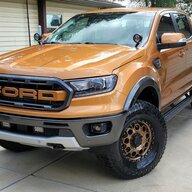
Lariat FX4: There's been lots of talk about the ride being bouncy... especially on the FX4. I never seemed to feel that. When I picked up my truck (August 26), I noticed the tire pressure was set to 40 lbs for all 4 wheels. I loved the ride and have had no complaints so I left it alone.
Last night, I decided to air them down to 32 lbs...just to see if there was a difference in ride quality. There definitely is!
The better, softer ride helped me understand the "bouncy" feeling others have talked about. I would describe it as a "Hard" ride rather then bouncy. I definitely noticed the tires when they were at 40 lbs...they seemed to feel every little road imperfection.
I'll test the air pressure/ride quality again when I get my A.R.E. topper. I may have to play with the air pressure a little with the permanent added weight in the rear.
Interesting, I didn't notice that. I can see where the rotation will cause problems with tire wear. Think I'll stay with the 5k rotation.The Ranger owners manual says the tires should be rotated such that:
If you wait until 10K to rotate tires that means the tires originally on the rear axle will not rotate in the opposite direction until 20K miles. That will likely cause problems for those two tires.
- the rear tires move forward (without crossing) to the front axle
- the front tires cross as they move to the rear axle
This makes a lot of sense. I still feel like the rear is "bouncy", especially rebound on dips at high speed. Still a lot of inquiries on ride quality and a lot has been made of the "short wheelbase." Sure, its shorter, but not a ton. Isn't this monoleaf setup the single biggest difference to what we all have been riding around on for years? If its not a cost thing whats the reason for the mono spring....weight savings for mpg or payload numbers??On the Saleen Rangers we raced, the main reason for a monoleaf was weight redution. Monoleaf makes the shock have to work harder with no spring damping...
Hi,This makes a lot of sense. I still feel like the rear is "bouncy", especially rebound on dips at high speed. Still a lot of inquiries on ride quality and a lot has been made of the "short wheelbase." Sure, its shorter, but not a ton. Isn't this monoleaf setup the single biggest difference to what we all have been riding around on for years? If its not a cost thing whats the reason for the mono spring....weight savings for mpg or payload numbers??
A lot of people have tried rear shocks with limited success. Has anyone changed the rear springs? Any aftermarket solutions or advice?


