Sponsored

Uneven Steering Force

canyonslicker

Well-Known Member
First Name
Andy
Joined
Jun 13, 2021
Threads
43
Messages
1,437
Reaction score
5,294
Location
California
Vehicle(s)
2021 Ranger Lariat
Occupation
65 YO Juvenile Delinquent
Maybe a full 4 wheel alignment including thrust angle alignment.

It’s just a thought.
Sponsored


airline tech

Well-Known Member
Joined
Aug 24, 2022
Threads
28
Messages
4,470
Reaction score
8,545
Location
Midwest - KS
Vehicle(s)
2022 Ranger Lariat-Super Crew, Cactus Gray
Occupation
Aircraft Tech
Ok, I read the OP complaint again, so this has been since new.
Turning right requires more effort than turning left, when turning right the steering wheel center return is noted as being faster than the left.
I am thinking that since you get a normal feel (equal) when stationary and it is only noted while in motion.
It is related to the EPAS, more specifically the torque sensor input that is integrated within the PSCM / Gear assembly.
If this is not coding, then it will take a deep look into what is actually happening and can be viewed with a high-end scanner and monitor PID's while driving.
There are quite a few modules that tie into the EPAS, as vehicle speed increases the steering feel changes.
The most difficult part of this, is it is only on one side, not both.

Now mechanical parts other than Ball Joint, Outer Tie Rod etc .
I would focus on parts that function differently while driving.

The Main Ones are:
The CV-Half shaft, sticking / binding. while rotating and in a turn.

The Inner Tie Rod, more specifically the Bellows, stiffer on the R/Side, causing greater resistance (when collapsing)

Sorry, but there are way too many variables, so just some random thoughts on possibilities.
 

Ounal

New Member
First Name
Oguz
Joined
Jan 28, 2024
Threads
0
Messages
1
Reaction score
0
Location
Istanbul
Vehicle(s)
Ranger Wildtrak
Occupation
Lawyer
Hi there;
I bought a brand new ranger at 2021. From the first day i have trouble with steering.
the steering wheel is straight, car drives straight, no pulling everything seems ok. But it is hard to steer right than left.
When idling stationery the wheel force is even both sides.
the problem begins when riding.
I tried at car park lots, i tried at completely flat surfaces but steering wheel is always stiff to right turns.
I went to dealer they check the alignment and they said alignment is ok
i didn't trust them went to another mechanic and they said the same "the alignment is ok"

i am searching this nearly for three years and couldn't find anything wrong at car and couldn't find any solution either.
i read all the forum titles about steering but couldn't find anything

Please help !
Hi Akcar, I have the exact same issue with my 2022 Wildtrak and I am also from Turkey.

I noticed it a month ago. Turning right is a bit stiff than turning left. Also the steering wheel centers itself faster after a right turn. But sometimes it becomes the opposite, left centers faster than right, especilly if the road a bit banked to right side.

I asked a fellow owner but he told me that he did not notice, probably because us being meticulous.

This bothers me a lot because I am an obsessive person.

If this is not normal than it is due to a problem from steering system, which will be impossible to persuade the dealer to replace.

So I will probably sell the truck and will buy something else.
 
OP
OP

akcar

Member
First Name
umut
Joined
Jul 11, 2023
Threads
1
Messages
10
Reaction score
9
Location
turkey
Vehicle(s)
'20 Ranger
Hi Akcar, I have the exact same issue with my 2022 Wildtrak and I am also from Turkey.

I noticed it a month ago. Turning right is a bit stiff than turning left. Also the steering wheel centers itself faster after a right turn. But sometimes it becomes the opposite, left centers faster than right, especilly if the road a bit banked to right side.

I asked a fellow owner but he told me that he did not notice, probably because us being meticulous.

This bothers me a lot because I am an obsessive person.

If this is not normal than it is due to a problem from steering system, which will be impossible to persuade the dealer to replace.

So I will probably sell the truck and will buy something else.
Same here with the obsession.

You said you asked other owners but no one can feel that. By the way i took the truck to dealer and other independent services several times nobody seamed to feel the problem. it is minor but enough to make me crazy.

just one owner felt it but he didn't care less because he said "i felt it but i bought it to sell so i don't care"

if you ever come to Ankara please feel free to call me. you may test my truck and vice versa. may be we can find a solution if we get together.

don't sell the truck i have tried all the trucks before buying. ford is the best in our market.
mitsubishi l200 is to harsh about comfort
nissan says they use springs but it is also uncomfortable especially back seats
amarok uses awd system instead of 4wd and its offroad performance is limited
 
Last edited:

Cmar

Well-Known Member
First Name
Cam
Joined
Feb 10, 2020
Threads
20
Messages
1,875
Reaction score
5,185
Location
Australia
Vehicle(s)
Ford Ranger PX
Occupation
Medical Scientist
Check that the rack is actually properly centered when in the straight ahead position. If installed incorrectly it will think you are turning when you are not.


airline tech

Well-Known Member
Joined
Aug 24, 2022
Threads
28
Messages
4,470
Reaction score
8,545
Location
Midwest - KS
Vehicle(s)
2022 Ranger Lariat-Super Crew, Cactus Gray
Occupation
Aircraft Tech
This ties into a post above about current draw, while the steering gear is in motion.
You will need a scanner capable of Live Data to view the PID -- MOD_SUP_V (VOLT) PID.

There are many factors here, so if it is not in the Alignment then it is speed related and tied to the ABS (Speed Input) being fed to the PSCM which controls the EPAS Gear


BK9 : CHECK FOR INTERMITTENT PSCM WIRING HARNESS POWER AND GROUND CIRCUIT OPERATION
  • Ignition ON, engine running.
  • Make sure the front wheels are on the ground and the vehicle is not being supported by other means.
—Make sure the front tires are clean and dry.
—Make sure the ground under the front tires is clean and dry.
  • Take the following measurement while turning the steering wheel back and forth, lock to lock, continuously at 1 revolution per second.
  • Measure the voltage between:
(+)
12 Volt Vehicle Battery
(-)
12 Volt Vehicle Battery
Positive terminalNegative terminal
  • Record the measured battery voltage.
  • View the following PID while turning the steering wheel back and forth, lock to lock, continuously at 1 revolution per second.
  • Access the PSCM and monitor the MOD_SUP_V (VOLT) PID.
  • Compare the measured battery voltage with the PID display.
NOTE: If the scan tool cannot display the PID reading due to no communication with the PSCM, select the No Result / Action.
  • Do the measured battery voltage and the PID display differ by more than 1.5 volts?
YesNo
INSTALL a new PSCM wiring harness.
Go to BK10
The system is operating correctly at this time. The concern may have been caused by a loose or corroded PSCM electrical connector or a wiring harness in-line electrical connector and was repaired during this procedure.


To better understand and visualize what is happening.
Here is a operational description.

.

EPAS System

The PSCM controls the functions of the EPAS system and communicates with other modules over the HS-CAN2 and through the GWM .

To activate, the EPAS system requires battery voltage at the hot at all times PSCM input, battery voltage at the PSCM ignition-run input. The PSCM must also be able to communicate with other modules over the HS-CAN2 and must receive the power pack status message from the PCM .

The main input for calculating the level of EPAS assist is the steering torque sensor signal (internal to the PSCM ). Vehicle speed is also taken into consideration in order to achieve the vehicle speed dependent steering assist characteristic.

The EPAS gear uses a reversible motor to apply the steering assist by moving the rack inside the steering gear The motor is connected to the rack of the steering gear by a toothed belt and pulley-bearing assembly.

The PSCM continually monitors and adjusts steering efforts based on the steering torque sensor signal, motor position and HS-CAN2 inputs to enhance the feel of the steering system. As vehicle speed increases, the amount of assist decreases to improve and enhance road feel at the steering wheel. As vehicle speed decreases, the amount of assist increases to ease vehicle maneuvering. Compensation is made to reduce the effect of pull or drift experienced when driving on roads with a high degree of camber. Compensation is also made for the impact of wheel imbalance on steering feel, up to a predetermined threshold.

The steering torque sensor senses the torque at the steering wheel. It is integrated into the PSCM and works by measuring the relative rotation between an input and output shaft which are connected by a torsion bar. The steering torque sensor sends out 2 PWM signals which allows a channel-to-channel cross-check and an accurate correction of the neutral point.

The PSCM is self-monitoring and is capable of setting and storing Diagnostic Trouble Codes (DTCs). Depending on the DTC set, the PSCM may enter a failure mode. In addition, the PSCM may send a request to the IPC to display a message in the message center, alerting the driver of a potential EPAS concern. The warning message is sent over the HS-CAN2 to the GWM which relays the message to the IPC over the HS-CAN3.

Failure Modes

When a DTC is present in the PSCM, the EPAS enters 1 of 2 modes of operation.

Reduced Steering Assist Mode - The EPAS enters a reduced steering assist mode to protect the internal components of the EPAS when a non-critical safety concern is detected by the PSCM , concerns such as low battery voltage, high battery voltage or over-temperature are considered non-critical safety concerns. This reduced steering assist mode gives the steering operation a heavier than normal feel.

Manual Steering Mode - The EPAS enters a manual steering mode (no electrical steering assistance is provided) when a concern considered to be a critical safety concern is detected. In manual steering mode, the vehicle has mechanical steering only which gives the steering operation a heavy feel.

Pull Drift Compensation (PDC)

The Pull Drift Compensation (PDC) feature adjusts power assist offset by reducing the steering wheel effort (input torque) required to keep the vehicle traveling straight. The Pull Drift Compensation (PDC) feature is automatically enabled at vehicle speeds above 40 km/h (25 mph) with sensors indicating the vehicle is traveling straight. Pull Drift Compensation (PDC) is designed to compensate for variations in road crown.

The system detects input torque to the wheel by the driver to slowly ramp in a steering assist offset to neutralize, in most situations and within limits, steering efforts for the duration of time those driving conditions exist. Full compensation requires up to 45 seconds. Changing lanes on a multilane road and the expected change in road crown would trigger a change in torque input and a compensation adjustment and is a normal operation of the Pull Drift Compensation (PDC) feature. The feature updates automatically and continuously, however, since it is based on input torque, the feature only works with hands on the steering wheel while driving in a straight line. The system does not compensate when turning or during slight curves on highways. The system does not compensate if driver input torque, steering wheel angle or vehicle yaw rate is too large. For the system to compensate, the driver must have both hands on the steering wheel.


EPAS Gear

The EPAS gear is an assembly consisting of a PSCM, a motor, and a steering torque sensor, all of which are serviced as an assembly.

  • The steering torque sensor is mounted near the input shaft of the EPAS gear and is used by the PSCM to determine how much force is being used to turn the steering wheel.
  • The EPAS gear has one inner tie rod located and one outer tie rod at each end of the gear assembly and is available separately for service.
  • The EPAS gear has one bellows boot located at each side of the EPAS gear assembly. Each boot is held in place with 2 boot camps. The boots and clamps are available for service.
PSCM

The PSCM is the ECU for the EPAS system. The module monitors all sensor inputs and HS-CAN2 messages relating to the EPAS system and directly controls the output of the EPAS motor.


I would have to hook up my scanner, but I believe that there is PID's to view the Steering Wheel Angle and Torque Sensor Data as well.

So, by the information given, I am going with an issue in the EPAS gear or how it is reacting to speed input.
 

airline tech

Well-Known Member
Joined
Aug 24, 2022
Threads
28
Messages
4,470
Reaction score
8,545
Location
Midwest - KS
Vehicle(s)
2022 Ranger Lariat-Super Crew, Cactus Gray
Occupation
Aircraft Tech
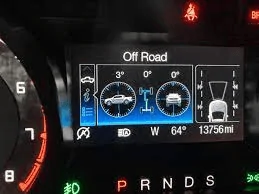
One other screen that may help you for monitoring, if you do not have this you can enable this screen with Forscan

Note: In the Center of the Screen - is steering angle input
you may possibly be able to see any noted difference between turning left / right
Do they match or does turning right glitch on the indication?

1706750736632.webp
 

airline tech

Well-Known Member
Joined
Aug 24, 2022
Threads
28
Messages
4,470
Reaction score
8,545
Location
Midwest - KS
Vehicle(s)
2022 Ranger Lariat-Super Crew, Cactus Gray
Occupation
Aircraft Tech
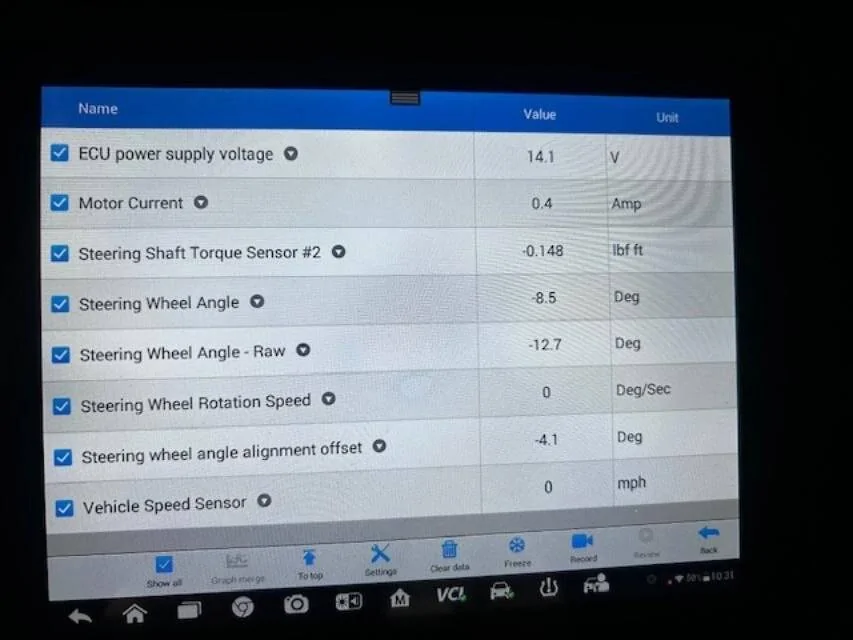
While I had my Scanner Out today
I pulled these PID's from the PSCM - Power Steering Control Module - Live Data

These PID's would most likely show a (Red Flag) and possible failure issue.
Between Turning Left or Right
Mainly Motor Current and the Steering Shaft Torque Sensor and then ECU Power Supply Voltage

Just look for any abnormal differences between Left / Right hand turns

PSCM PID's.webp
 

Johnson Araya Arce

New Member
First Name
Johnson27
Joined
Jul 11, 2025
Threads
1
Messages
2
Reaction score
0
Location
Costa Rica
Vehicle(s)
Raptor 2022
Occupation
Technical Support
Yes they feel the stiffness but said "it is ok, alignment is ok so don't worry about that"
They didn't investigate further because for them it is normal in electric steering.

i'm in turkey, the mechanics aren't that educated.

i can't place a spring scale because it is noticeable when riding but for me it is 1.3ish times stiff when turning right. the weird thing is when stationary it is even. Also when driving at low speeds (5-10km/h) the steering wheel centers it self faster within right turns.
Hello
Meaby you can help me, I am looking a nox sensor for Ford Raptor 2022 2.0, I found one in Turkey, do you know if the website is secure: www.fordoner.com, do you Know meaby the place or ear something about it
Thank you
Sponsored


Top