
Shawn at Tom Wood's
Well-Known Member
I've said this to a few people, that I can physically deflect the rubber bearing mount radially by hand. I'm no wimp but it doesn't require much of my strength and I'm a 170lb person, not a 4,000 truck. If I can easily deflect the rubber, of course the truck will be able to. A stiffer bearing mount would keep the bearing from moving so dramatically from side to side but a stiffer mount might also have less of a dampening effect on the forces causing the bearing to move in the first place. I think this is a bit of a "Chicken or the Egg" question. Is the soft mount causing too much deflection thereby causing the shudder? Or is the shudder inherent to the drive shaft thereby causing the deflection in the bearing? I honestly don't know. Maybe it is both, maybe it creates a feedback loop of sorts.I have noticed on my truck the cooler the outside temperature, the milder the shudder. The center bearing support material inside the aluminum frame is very soft. I can pull on it and deflect the driveshaft with very little effort. I don't have another vehicle with a two piece driveshaft to compare it to but I do remember my 1994 Ranger 2wd supercab center bearing was much stiffer material.
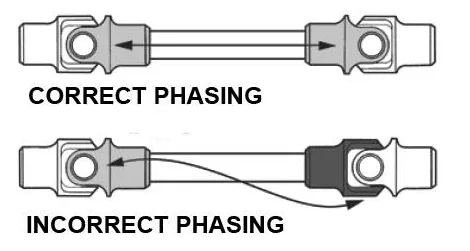
Regarding the previous conversation about phasing. All these Ranger shafts seem to be out of phase. Here's why: I don't know for sure. I think I know but admittedly I have to presume the intention behind a decision I wasn't a part of and Ford or Dana didn't tell us about. My theory though, which I'm pretty confident is correct, is that the peculiar phasing is there to interrupt one oscillation/shudder/vibration with another. Like they are intentionally adding a vibration to shaft to interrupt the frequency of another, thus reducing the perceived intensity of the issue.
Sponsored