Sponsored

Looking for wisdom on the rating system and actual durability (I might be a dummy)

Desert ride

Member
First Name
Pedro
Joined
Jan 18, 2020
Threads
2
Messages
10
Reaction score
8
Location
Tucson AZ
Vehicle(s)
Ranger XLT FX4
Long time viewer and consumer of knowledge, but fresh to post.

I know another tire thread is not what is desired, but some stuff does not make sense to me, or I need an explanation like I am 5 (maybe add some crayon pictures in there) from people that have a lot more tire wisdom than I do.


What I understand:

  • Tire width – 255, 265, etc.
  • Sidewall height and its relation to width (65, 70….)
  • Speed rating – pretty straight forward.
  • Rating – P and LT should define the amount of plies used (or equivalent of) and the pressure it can handle to hold the allowed weight.
  • Weight rating – amount of weight the tire can handle (pressure dependent).


Where things get messier for me is on weight load vs pressure vs durability.


In reading through the infinite number of threads in this forum, one can conclude the following:

P Rated tires have less “plies”, therefore are more road focused, have softer sidewalls, handle less pressure, and less weight.

Pulled from Tirerack.com

1777941712244-i5.webp


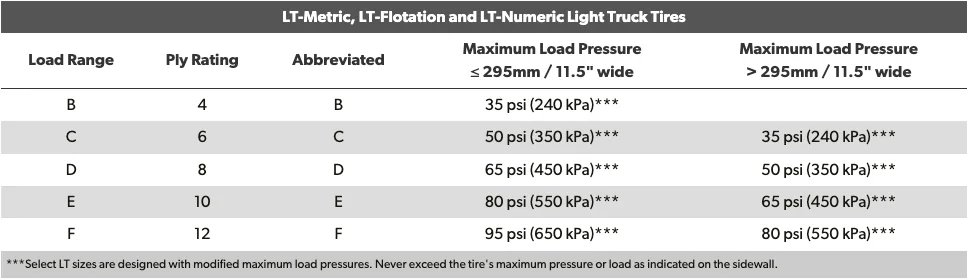
LT rated tires have more “plies”, therefore can handle more weight and more pressure.
1777941589500-uk.webp


Knowing the above and understanding that a C rated tires are 50 psi typically rated 113 to 116 (roughly 2400 to 2700 pounds), conventional wisdom deduces that the 6 ply tires make the sidewall stiffer and allow for the pressure and weight rating.

E rated tires have a clear distinction from the rest of the pack.

The part that loses me is how some XL tires are rated to the same 50PSI and always on the upper weight rating 115, 116 (2600 to 2700 pounds), with SL tires on the same 50PSI and lower weight rating.


With the above information, my question being; what is the everyday usage difference between a XL and a C rated tire?

  • Less plies on the XL, but are they better plies as they have to handle the same pressure and weight with less?
  • Are they less durable because of the lack of the 6 Ply rating? in which case the question above still stands and are they actually less durable?
  • If pressure + weight rating = durability, then wouldn’t Xl be just as tough as C loads?


If terrain matters, I am in the AZ desert where everything wants to hurt you or kill you.


What am I missing?
Is it just the different materials for the Plies, amounts of it, and deeper treads?


Example tires


Falken

WildPeak A/T4W – 265/70 R17 SL 115T – 51psi 2679lbs

WildPeak A/T4W – 275/70 R17 C 114S – 50psi 2600lbs

WildPeak A/T4W – 285/70 R17 C 116R – 50psi 2600lbs


Mickey Thompson

Baja Boss A/T 265/70 R17 XL 116T – 50psi 2756lbs


Nitto

Nitto Terra Grappler G3 265/70 R17 XL 116T – 50psi 2756lbs

Nitto Terra Grappler G3 265/70 R17 C 112S – 50psi 2470lbs


Sorry for the roundabout way of saying I’m a tire dummy, but some wisdom would be greatly appreciated. Especially before I make the mistake of installing 50+ pound anchors on the truck.
Sponsored
 

ScarzRanger21(2.0)

Well-Known Member
First Name
Eric
Joined
Dec 9, 2025
Threads
9
Messages
203
Reaction score
700
Location
Auberry, CA
Vehicle(s)
2021 Ranger 4x4, 2019 Ranger Fx4
Occupation
Electrician
Selecting tires for you truck really depends on what you’re doing with it and what type of ride you want. My wife and I both have rangers and I put the same tires on both of our trucks, Falken Wildpeak AT4. Where I switched things up is putting E load range on mine and hers are C or D (I’d have to check because I don’t remember for sure).

The difference in ride quality is noticeable, her truck handles more responsively than mine when unloaded. I can’t give you exact numbers but my tires are definitely heavier and my truck isn’t as snappy with acceleration. Mine rides stiffer because of the difference in the sidewall. On the flip side, mine handles better when the truck is loaded up or when towing. Her tires feel “mushy” compared to mine when I’ve towed the boat or travel trailer with her truck.

My reasoning for putting different rated tires on our trucks is because if we do any type of offroading or towing, it’s usually in my truck. I wanted tires that were beefier, more durable, and more puncture resistant. My truck also has an extra couple hundred lbs of gear compared to hers. Rack and toolboxes in the bed, winch on the front, recovery gear, gas cans, roof rack, etc…

E rated tires are overkill for a ranger but I like the peace of mind knowing that I’m not likely to get a flat when I’m 10 miles up a trail in the mountains heading to a camping or fishing spot. Been there, done that…

Hopefully that’s enough of a pros/cons list to help you make a decision.
 

Mighty Little Blue

Well-Known Member
First Name
Jeff
Joined
Jul 11, 2021
Threads
17
Messages
364
Reaction score
1,217
Location
Wisconsin Rapids, WI / Philippines
Vehicle(s)
2021 Velocity Blue Supercab FX4
Occupation
Printer/Retired
Vehicle Showcase
1
Selecting tires for you truck really depends on what you’re doing with it and what type of ride you want. My wife and I both have rangers and I put the same tires on both of our trucks, Falken Wildpeak AT4. Where I switched things up is putting E load range on mine and hers are C or D (I’d have to check because I don’t remember for sure).

The difference in ride quality is noticeable, her truck handles more responsively than mine when unloaded. I can’t give you exact numbers but my tires are definitely heavier and my truck isn’t as snappy with acceleration. Mine rides stiffer because of the difference in the sidewall. On the flip side, mine handles better when the truck is loaded up or when towing. Her tires feel “mushy” compared to mine when I’ve towed the boat or travel trailer with her truck.

My reasoning for putting different rated tires on our trucks is because if we do any type of offroading or towing, it’s usually in my truck. I wanted tires that were beefier, more durable, and more puncture resistant. My truck also has an extra couple hundred lbs of gear compared to hers. Rack and toolboxes in the bed, winch on the front, recovery gear, gas cans, roof rack, etc…

E rated tires are overkill for a ranger but I like the peace of mind knowing that I’m not likely to get a flat when I’m 10 miles up a trail in the mountains heading to a camping or fishing spot. Been there, done that…

Hopefully that’s enough of a pros/cons list to help you make a decision.
Good Answer
Especially the first sentence.
 
OP
OP

Desert ride

Member
First Name
Pedro
Joined
Jan 18, 2020
Threads
2
Messages
10
Reaction score
8
Location
Tucson AZ
Vehicle(s)
Ranger XLT FX4
Selecting tires for you truck really depends on what you’re doing with it and what type of ride you want. My wife and I both have rangers and I put the same tires on both of our trucks, Falken Wildpeak AT4. Where I switched things up is putting E load range on mine and hers are C or D (I’d have to check because I don’t remember for sure).

The difference in ride quality is noticeable, her truck handles more responsively than mine when unloaded. I can’t give you exact numbers but my tires are definitely heavier and my truck isn’t as snappy with acceleration. Mine rides stiffer because of the difference in the sidewall. On the flip side, mine handles better when the truck is loaded up or when towing. Her tires feel “mushy” compared to mine when I’ve towed the boat or travel trailer with her truck.

My reasoning for putting different rated tires on our trucks is because if we do any type of offroading or towing, it’s usually in my truck. I wanted tires that were beefier, more durable, and more puncture resistant. My truck also has an extra couple hundred lbs of gear compared to hers. Rack and toolboxes in the bed, winch on the front, recovery gear, gas cans, roof rack, etc…

E rated tires are overkill for a ranger but I like the peace of mind knowing that I’m not likely to get a flat when I’m 10 miles up a trail in the mountains heading to a camping or fishing spot. Been there, done that…

Hopefully that’s enough of a pros/cons list to help you make a decision.
Thank you for that response. The Wildpeak is one of the tires I am considering, in the 275 flavor C rated to be more exact, though the 58lbs/tire might be rough.
The E rated tires are clear cut for me, they handle 80PSI and a 3200+ pounds of weight. That might be beyond my use case, other than the times I tow the camper, trailer, or AZ rocks being sharp. Even then, I don't have racks, winches, etc.

I was looking to stay on the C range, or 50PSI 2600 to 2700 pounds, and here is where the I got stuck. Which led me to wonder what the actual difference between an XL and C tire is as they are rated about the same.
I would imagine the XL would have to be built as strong if they have similar pressure and weight rating, sometimes a higher rating on the XL. Is it just a difference in build? Is the C actually more durable or does it come down to different compounds/technology.

Buying an E tire is fairly straight forward, pick your brand, size, purpose and go with it.
The other ratings you have to compromise, so understanding the differences on the nitty gritty details would help with the compromise.
I over analyze things a lot in the pursuit of not spending money twice or regretting purchases for 5 years.
 

ScarzRanger21(2.0)

Well-Known Member
First Name
Eric
Joined
Dec 9, 2025
Threads
9
Messages
203
Reaction score
700
Location
Auberry, CA
Vehicle(s)
2021 Ranger 4x4, 2019 Ranger Fx4
Occupation
Electrician
The difference between C and XL tires are sidewall stiffness and rubber compound. They’re both designed for trucks and SUV’s carrying heavier cargo but one is a more robust and durable tire. XL tires are designed for a smoother ride, C tires are more focused on heavy loads/towing and durability. They’re both roughly equal when it comes to towing and load capacity, the difference is in how they feel under load.

If you’re towing frequently, keep a lot of weight in the bed, or doing any kind of offroading I would go with C. If you’re only towing occasionally and the bed is usually kept empty, XL will give you a smoother ride and save a bit on MPG because they’re made with a softer rubber compound with softer more flexible sidewalls. They’re both a good choice for the ranger and you can’t go wrong with either. Like I said in the original response, it really depends how you're using your truck and what kind of ride you’re looking to achieve.

I’ve had XL tires before on my F150 and didn’t like them. They wore out super fast and I ended up replacing them after 2 years because the tread was worn. They had better grip because of the softer rubber but wore out faster.

Class aside, the Wildpeaks have been the best performing tires I’ve ever put on a vehicle. I’ve had all sorts of tires over the years. BF Goodrich, Goodyear, Yokohama, Nitto, etc… The Wildpeaks outperform all of them in my opinion.


OP
OP

Desert ride

Member
First Name
Pedro
Joined
Jan 18, 2020
Threads
2
Messages
10
Reaction score
8
Location
Tucson AZ
Vehicle(s)
Ranger XLT FX4
The difference between C and XL tires are sidewall stiffness and rubber compound. They’re both designed for trucks and SUV’s carrying heavier cargo but one is a more robust and durable tire. XL tires are designed for a smoother ride, C tires are more focused on heavy loads/towing and durability. They’re both roughly equal when it comes to towing and load capacity, the difference is in how they feel under load.

If you’re towing frequently, keep a lot of weight in the bed, or doing any kind of offroading I would go with C. If you’re only towing occasionally and the bed is usually kept empty, XL will give you a smoother ride and save a bit on MPG because they’re made with a softer rubber compound with softer more flexible sidewalls. They’re both a good choice for the ranger and you can’t go wrong with either. Like I said in the original response, it really depends how you're using your truck and what kind of ride you’re looking to achieve.

I’ve had XL tires before on my F150 and didn’t like them. They wore out super fast and I ended up replacing them after 2 years because the tread was worn. They had better grip because of the softer rubber but wore out faster.

Class aside, the Wildpeaks have been the best performing tires I’ve ever put on a vehicle. I’ve had all sorts of tires over the years. BF Goodrich, Goodyear, Yokohama, Nitto, etc… The Wildpeaks outperform all of them in my opinion.
Thank you!


That answered my question really well, and I get that layout and materials change the ride of the tire to achieve the desired focus of the tire.

Definitely willing to have a bit stiffer ride for more durability and better towing.
The Wilddpeaks are at the top of the list and I am glad to get more positive reviews on them. They seem popular and must have a reason behind it.
The only other tire that had peeked my interest was the new Pirelli XTM A/T, but they only make those in E, which might be a bit too stiff for my needs.

Thank you again,
 

ScarzRanger21(2.0)

Well-Known Member
First Name
Eric
Joined
Dec 9, 2025
Threads
9
Messages
203
Reaction score
700
Location
Auberry, CA
Vehicle(s)
2021 Ranger 4x4, 2019 Ranger Fx4
Occupation
Electrician
One more thing I would take into consideration when choosing tires is what type of roads you drive mostly. I noticed my last set of tires were wearing unevenly, the inside and outside shoulders were getting eaten up. Because of the winding mountain roads and chewed up asphalt where I live, my tires were taking a beating.

Switching to a stiffer sidewall made a significant difference in prolonging the tread life. My truck doesn’t ride quite as smooth but I’ll take that over burning through tires every 2 years.
 
OP
OP

Desert ride

Member
First Name
Pedro
Joined
Jan 18, 2020
Threads
2
Messages
10
Reaction score
8
Location
Tucson AZ
Vehicle(s)
Ranger XLT FX4
One more thing I would take into consideration when choosing tires is what type of roads you drive mostly. I noticed my last set of tires were wearing unevenly, the inside and outside shoulders were getting eaten up. Because of the winding mountain roads and chewed up asphalt where I live, my tires were taking a beating.

Switching to a stiffer sidewall made a significant difference in prolonging the tread life. My truck doesn’t ride quite as smooth but I’ll take that over burning through tires every 2 years.
I'll likely be going the stiffer route due to driving habits and getting off the beaten path, roads around here are rough as well.
I too am not looking forward to replacing tires every 2 years.

Thank you!
Sponsored


Top