
onobeka
Well-Known Member
- Thread starter
- #1
I am posting this to help others that may be in the same situation as I was.
It's story telling … sorry to waste your time if you do no care for such a story.
Today I swapped my summer wheels to winter and I thought it's a good time to do an inspection of the brakes. I do this every year once or twice when I swap the wheels. I removed the caliper and tried to remove the rotor. It did move freely, easily so it was not stuck on the hub. Yet I could not remove it. My first fear was bent lugs, as I've overtightened them once. My worst fear was to have to cut the bent lugs. Since I am approaching my mid 40s, I tend to take my time, so I've verified all lugs with a square angle tool. Everything seemed fine yet I could not measure the squareness to the brake disk flange all around the lugs. I hammered gently the flange and around, gently the rotor with a rubber mallet to see how far it would move - I still had the bent lugs idea in my mind. I could not get it beyond half of the lug length off. However the rotor was not touching the threads. Every mm I've moved out the rotor, I've moved it back to check the damage on the thread, trying to identify the bent lug.
I've finally resorted to a crowbar. I've placed it between the rear of the rotor and the knuckle, where the caliper is bolted. I've rotated the rotor and gently pried it out. The whole thing took about 10 mins and possibly 40-50 pry out iterations. When the rotor was about to get off the lugs (still had the bent lug idea in my head) it "magically" moved freely - I was relieved.
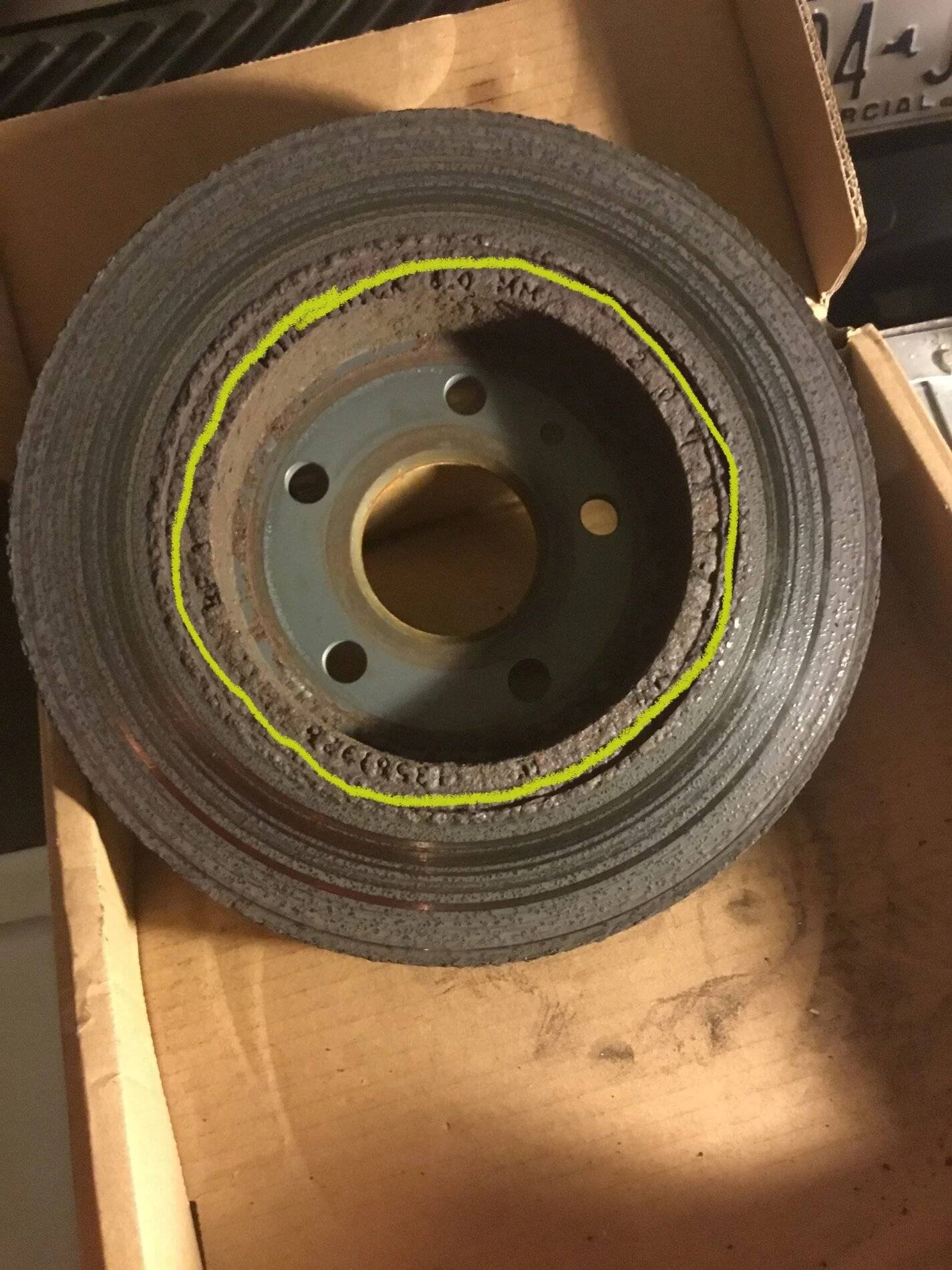
The culprit was a huge "lip" (quite wide) of rust on the inside of the rotor flange and cylinder, after the depth of the hub. Sorry for the dodgy explanation. The hub does sit flush on the rotor flange yet it does not touch the rotor cylindrical part. Behind the area where the hub overlaps, rust is in its element. It was about 1mm thick all around the cylinder. My truck is 3y old, 25000km.
What is my take on this: if you do low mileage like I do, it would be good to take the rotors off once in a while and wire brush the inside cylinder. It seems there is a minimal difference between the hub diameter and the rotor. As the inner side of rotors is always more damaged than the outside, due to moisture, the inside of the rotor "drum" is even worse prone to rust.
It's story telling … sorry to waste your time if you do no care for such a story.
Today I swapped my summer wheels to winter and I thought it's a good time to do an inspection of the brakes. I do this every year once or twice when I swap the wheels. I removed the caliper and tried to remove the rotor. It did move freely, easily so it was not stuck on the hub. Yet I could not remove it. My first fear was bent lugs, as I've overtightened them once. My worst fear was to have to cut the bent lugs. Since I am approaching my mid 40s, I tend to take my time, so I've verified all lugs with a square angle tool. Everything seemed fine yet I could not measure the squareness to the brake disk flange all around the lugs. I hammered gently the flange and around, gently the rotor with a rubber mallet to see how far it would move - I still had the bent lugs idea in my mind. I could not get it beyond half of the lug length off. However the rotor was not touching the threads. Every mm I've moved out the rotor, I've moved it back to check the damage on the thread, trying to identify the bent lug.
I've finally resorted to a crowbar. I've placed it between the rear of the rotor and the knuckle, where the caliper is bolted. I've rotated the rotor and gently pried it out. The whole thing took about 10 mins and possibly 40-50 pry out iterations. When the rotor was about to get off the lugs (still had the bent lug idea in my head) it "magically" moved freely - I was relieved.
The culprit was a huge "lip" (quite wide) of rust on the inside of the rotor flange and cylinder, after the depth of the hub. Sorry for the dodgy explanation. The hub does sit flush on the rotor flange yet it does not touch the rotor cylindrical part. Behind the area where the hub overlaps, rust is in its element. It was about 1mm thick all around the cylinder. My truck is 3y old, 25000km.
What is my take on this: if you do low mileage like I do, it would be good to take the rotors off once in a while and wire brush the inside cylinder. It seems there is a minimal difference between the hub diameter and the rotor. As the inner side of rotors is always more damaged than the outside, due to moisture, the inside of the rotor "drum" is even worse prone to rust.
Sponsored